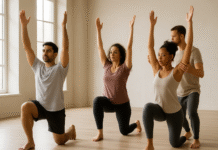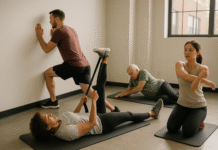

















If your back tightens at your desk, your hips feel glued after long drives, or your shoulders creep toward your ears when you train, a simple fix can make a big difference: a short, consistent mobility session. This 10 minute daily stretching routine is designed to improve posture and everyday performance by restoring range of motion in the areas that get stiffest—neck, chest, thoracic spine, hips, hamstrings, calves, and ankles—while teaching you how to breathe and “set” your posture afterward. You’ll learn exactly what to do, how long to hold each position, how to scale up or down, and how to track your progress over four weeks.
Medical disclaimer: The following is educational only and not a substitute for personal medical advice. If you have pain, recent injury, surgery, osteoporosis, neurological symptoms (numbness/tingling), or any condition affecting your joints, speak with a qualified clinician before starting or modifying a program.
Key takeaways
- Consistency beats intensity. Ten focused minutes most days outperforms long, occasional stretch sessions for posture and mobility results.
- Sequence matters. Brief dynamic prep first, then targeted stretches held at a comfortable intensity, finishing with a simple posture “set.”
- Dose counts. Aim for about 60 seconds per muscle group each session (for example, 2–4 holds of 15–30 seconds).
- Warm before you load. Use dynamic movements before workouts; save longer static holds for after exercise or separate sessions.
- Posture changes best with both mobility and strength. Stretching helps range of motion; pair it with light strengthening to see visible posture improvements.
- Measure it. Use quick at-home checks (like knee-to-wall ankle test or shoulder-to-wall reach) to track objective progress.
How this 10-minute routine works (and why)
This routine is built on three principles:
- Move, then lengthen. Start with one minute of dynamic motions to drive blood flow and joint lubrication.
- Target the usual culprits for “modern posture.” Tight pecs, stiff thoracic spine, short hip flexors, sticky calves/ankles, and tense posterior hips and hamstrings can all restrict comfortable upright alignment and movement quality.
- Use proven dosing. For most adults, static holds of 10–30 seconds performed 2–4 times per position accumulate roughly 60 seconds per area. Older adults may benefit from holds toward the 30–60 second range. Work to a sensation of gentle tension—never pain.
For training days, keep pre-workout holds brief and emphasize dynamic moves; longer static holds can be saved for the cool-down or a separate session. If your goal is posture and daily comfort, the timing within the day is less critical than doing the routine consistently.
Quick-start warm-up (about 60–90 seconds)
No equipment, just stand tall and breathe through your nose:
- March + arm swings (30 seconds). March in place, swing arms front/back, keep ribs down.
- Cat-camel or spinal wave (20–30 seconds). Gently flex/extend the spine, small range.
- Leg swings (20–30 seconds). Front/back, then side/side, light and controlled.
Now you’re ready for the focused work.
The 10-minute daily sequence at a glance
Use a timer. Move briskly between positions. The times listed are suggestions; choose the hold length that lets you accumulate ~60 seconds per area.
- Chin tucks & neck side glide — 60 seconds
- Doorway chest stretch — 60 seconds per side
- Thoracic “open book” rotation — 60 seconds per side
- Half-kneeling hip flexor stretch — 60 seconds per side
- Seated or supine hamstring stretch — 60 seconds per side
- Figure-4 glute/piriformis stretch — 60 seconds per side
- Calf wall stretch (gastrocnemius/soleus) — 60 seconds per side
- Ankle knee-to-wall mobilization — 60 seconds per side
- Lat/side body reach (child’s pose variation or wall lat stretch) — 60 seconds
- Posture set & breath — 30–45 seconds
That’s about 10 minutes. On busy days, prioritize hips, chest, and ankles (items 2, 4, 8).
1) Chin tucks & neck side glide
What it is & benefits: A gentle cervical reset that reduces forward-head tension, improves awareness of head-on-neck position, and can ease desk-related discomfort. This isn’t a deep stretch; it’s a precise mobility drill.
Requirements: None. A wall or chair back helps with feedback.
Step-by-step:
- Chin tuck (retraction): Stand tall. Without looking up/down, glide your head straight back, making a subtle “double chin.” Hold 2–3 seconds; release. Repeat 6–10 reps.
- Side glide: Keep your nose facing forward and gently slide your head right (ear over shoulder without tilting), then left. Small range, 6–10 total reps.
- Finish with length: Tilt right ear toward right shoulder until a gentle stretch appears on the left side of the neck. Hold 10–20 seconds; switch.
Beginner modifications & progressions:
- Easier: Do it lying on your back; the surface guides neutral alignment.
- Progress: Add a light towel traction: hold a towel at the base of the skull and gently upwardly bias during the chin tuck (very light).
Frequency/duration/metrics: 60 seconds total. Track perceived neck tension before/after (0–10 scale).
Safety & common mistakes: Don’t jam the chin down; avoid sharp pain or dizziness. Keep the motion a glide, not a shrug or tilt.
Mini-plan example:
• 8 chin tucks (2–3 seconds each) → • 20 seconds side glide (slow) → • 20 seconds ear-to-shoulder stretch.
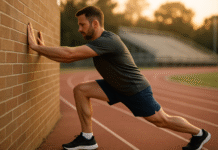
2) Doorway chest stretch
What it is & benefits: Opens the front of the shoulders and chest, countering rounded posture and long sitting. Comfortable length in the pectoral region supports more efficient scapular mechanics during pressing and overhead tasks.
Requirements: A doorway or upright. No cost alternatives: a corner wall or squat rack post.
Step-by-step:
- Stand in a doorway; place forearm on the frame, elbow just below shoulder height.
- Step the same-side foot forward and gently shift weight until you feel a stretch across the chest/front of the shoulder.
- Keep ribs down; don’t arch. Hold 15–30 seconds; switch sides.
Beginner modifications & progressions:
- Easier: Lower the elbow to reduce intensity.
- Progress: Move elbow slightly higher; rotate your body a hair farther; or stretch one arm at a time then both arms in a corner corner-stretch.
Frequency/duration/metrics: Accumulate ~60 seconds per side. Track how far you can step through while maintaining neutral ribcage.
Safety & common mistakes: No tingling into the arm or hand. Ease off immediately if you feel nerve symptoms. Avoid flaring ribs or jutting head forward.
Mini-plan example:
• 2 × 20–30 seconds each side → • 10 scapular retractions (pinch shoulder blades gently, 1–2 seconds, no shrug).
3) Thoracic “open book” rotation
What it is & benefits: Restores upper-back rotation and extension, which reduces overuse of the low back and neck and improves shoulder motion for pressing and reaching.
Requirements: A yoga mat or carpet. Optional pillow between knees.
Step-by-step:
- Lie on your side, hips and knees bent to 90°, arms straight in front (palms together).
- Keep knees stacked; rotate your top arm out and back, opening your chest like a book.
- Follow your hand with your eyes. Pause at end range for 2–3 deep breaths; return. Repeat 6–8 reps, then switch sides.
Beginner modifications & progressions:
- Easier: Place a cushion between knees to keep hips from rolling.
- Progress: Hold the end position 10–20 seconds, or elevate the top knee on a foam roller for more hip lock.
Frequency/duration/metrics: ~60 seconds per side. Subjectively rate thoracic stiffness before/after.
Safety & common mistakes: Don’t yank into end range; keep knees stacked to bias the thoracic spine rather than the low back.
Mini-plan example:
• 6 slow reps with 3-second holds → • 1 long 20-second hold each side.
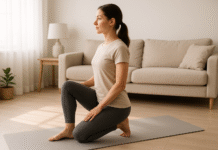
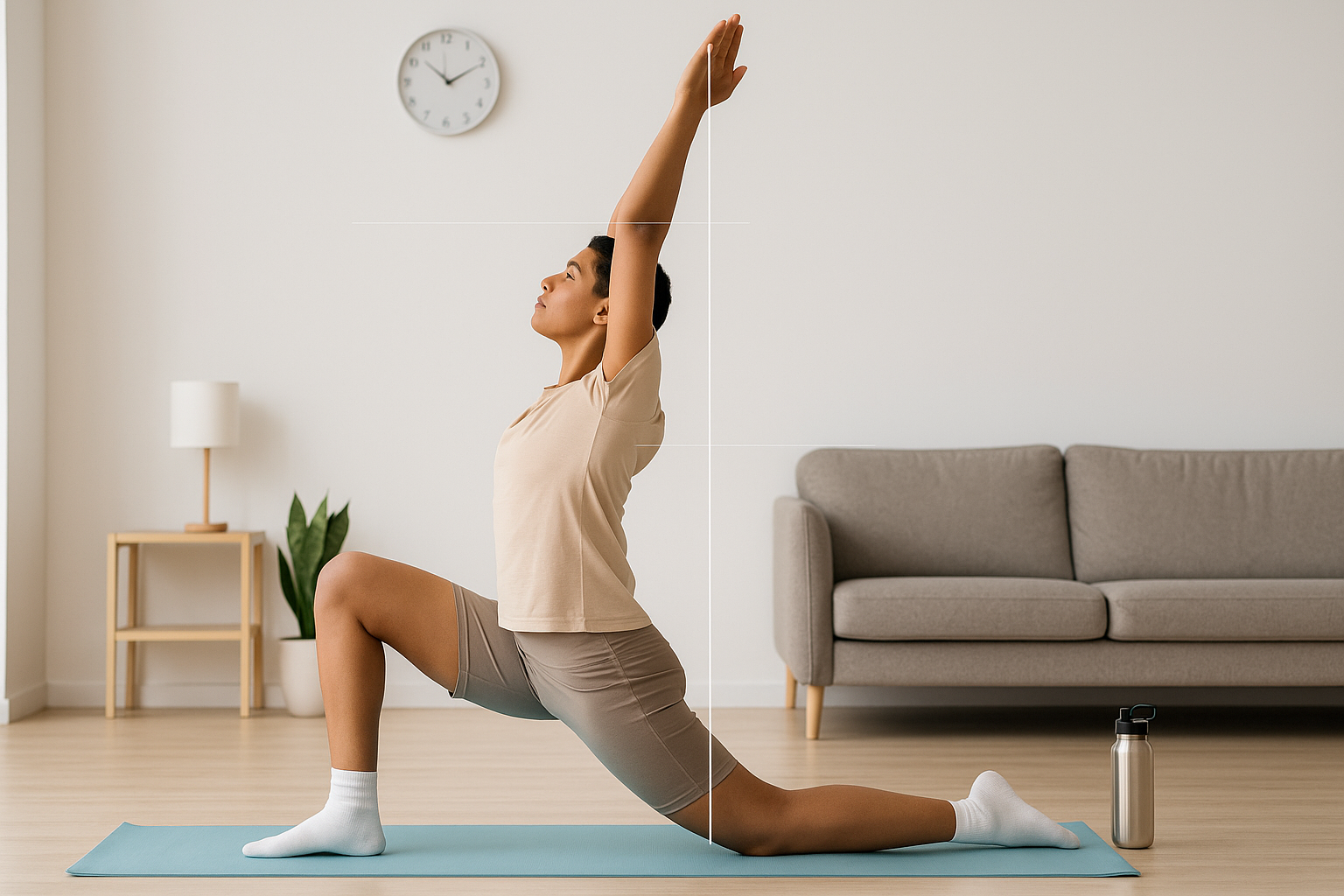
4) Half-kneeling hip flexor stretch
What it is & benefits: Lengthens the front of the hip (psoas/iliacus/rectus femoris), tight from prolonged sitting. Restoring hip extension helps reduce anterior pelvic tilt and takes pressure off the lumbar spine when you stand, walk, and run.
Requirements: A pad or folded towel for the knee.
Step-by-step:
- Assume a half-kneeling lunge: front knee over toes, back knee under hip.
- Tuck the pelvis slightly (think “zipper to ribs”) and squeeze the glute of the back leg.
- Shift weight forward a few centimeters while maintaining the tuck. Gentle stretch in the front of the hip; hold 15–30 seconds.
- Optional: reach the arm on the kneeling-knee side overhead and side-bend away for a fascial line stretch.
Beginner modifications & progressions:
- Easier: Keep torso upright and reduce the shift.
- Progress: Elevate the back foot on a step or grab it behind you to bias rectus femoris (quad/hip flexor).
Frequency/duration/metrics: ~60 seconds per side. Track how upright you feel afterward and the ease of standing/walking.
Safety & common mistakes: Don’t hyperextend the low back or chase range by arching; the glute squeeze and posterior pelvic tilt are key.
Mini-plan example:
• 2 × 20–30 seconds per side → • 5 glute squeezes (2 seconds) in the end position.
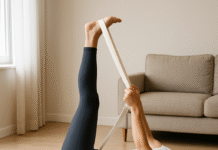
5) Seated or supine hamstring stretch
What it is & benefits: Improves back-of-thigh flexibility, easing pulling sensations during bending and reducing compensations in the low back.
Requirements: A strap, belt, or towel if supine; a sturdy chair if seated.
Step-by-step (supine strap variation):
- Lie on your back; loop a strap around the forefoot.
- Keep the opposite leg straight (or bent if you feel tension in your back).
- Gently extend the knee and draw the leg toward you until you feel a stretch behind the thigh. Hold 15–30 seconds; switch.
Beginner modifications & progressions:
- Easier: Bend the opposite knee; use a softer angle.
- Progress: Add ankle pumps (point/flex) at end range to bias neural and fascial tissues—only if there’s no tingling.
Frequency/duration/metrics: ~60 seconds per side. Optional fingertip-to-toe distance measure in a seated long-sit reach, keeping spine neutral.
Safety & common mistakes: Don’t round hard through the spine in seated versions; hinge from the hips. Back off if you feel nerve-like symptoms (pins/needles).
Mini-plan example:
• 2 × 20–30 seconds per side → • 5 ankle pumps at end range (gentle).
6) Figure-4 glute/piriformis stretch
What it is & benefits: Targets the deep posterior hip. Often brings instant relief to “sitting hips,” supports comfortable squats and lunges, and balances hip rotation.
Requirements: Mat or chair.
Step-by-step (lying variation):
- Lie on your back, knees bent. Cross right ankle over left knee (figure-4).
- Thread hands behind the left thigh and gently pull the leg toward your chest until you feel a stretch in the right posterior hip. Hold 15–30 seconds; switch.
Beginner modifications & progressions:
- Easier: Do a seated figure-4 on a chair; hinge forward a few centimeters.
- Progress: Gently press the crossed knee away with your hand to increase external rotation; or do a pigeon-style version on the floor if comfortable.
Frequency/duration/metrics: ~60 seconds per side. Note how deep you can sit without pinching after this stretch.
Safety & common mistakes: Keep shins parallel to avoid twisting the knee; never force your knee into painful ranges.
Mini-plan example:
• 2 × 20–30 seconds per side → • 5 gentle knee presses (1 second) in the end position.
7) Calf wall stretch (gastrocnemius/soleus combo)
What it is & benefits: Restores ankle dorsiflexion and softens Achilles/calf tension, aiding gait, squats, and running mechanics.
Requirements: Wall, wedge, or step.
Step-by-step:
- Straight-knee version (gastrocnemius): Facing a wall, step the right foot back, heel down, knee straight. Lean forward until you feel a stretch; hold 15–30 seconds.
- Bent-knee version (soleus): Keep heel down; slightly bend the back knee while leaning forward; hold 15–30 seconds. Switch sides.
Beginner modifications & progressions:
- Easier: Reduce step length; use a gentle incline against a book or rolled towel.
- Progress: Use a slant board for a stronger bias; hold toward the longer end of your recommended window.
Frequency/duration/metrics: Accumulate ~60 seconds per side (split between straight and bent knee). Track heel staying down more easily in squats or while walking uphill.
Safety & common mistakes: Don’t let the back heel lift; avoid bouncing.
Mini-plan example:
• 30 seconds straight-knee → • 30 seconds bent-knee (each side).
8) Ankle knee-to-wall mobilization
What it is & benefits: A dynamic measure-and-move drill for ankle dorsiflexion. It not only improves mobility but also gives you an objective number to track.
Requirements: A wall and a ruler/tape measure.
Step-by-step:
- Place your big toe a few centimeters from the wall.
- Keeping the heel down and knee tracking over the middle of the foot, drive the knee toward the wall until it touches.
- If it touches easily, slide the foot slightly back and retest. Find the max distance where the heel stays down and the knee just touches. Do 8–12 controlled reps per side, spending a second at end range.
Beginner modifications & progressions:
- Easier: Start closer to the wall and build gradually.
- Progress: Elevate the forefoot on a thin plate or book to increase angle, but keep it pain-free.
Frequency/duration/metrics: ~60 seconds per side. Record the toe-to-wall distance in centimeters as your ankle ROM KPI.
Safety & common mistakes: Knee should track over the second/third toe, not collapse inward; keep the heel glued to the ground.
Mini-plan example:
• 10 reps each side (1–2 seconds end-range) → • Retest distance, jot down the best number.
9) Lat/side body reach (child’s pose with reach or wall lat stretch)
What it is & benefits: Targets the big side body line—the lats, thoracolumbar fascia, and obliques—that can limit overhead reach and stiffen the mid-back.
Requirements: Mat or wall.
Step-by-step (child’s pose reach):
- Kneel and sit back toward your heels, hands forward.
- Walk both hands to the right 10–20 cm and sink the left ribs slightly toward the floor for a side body stretch; hold 15–30 seconds.
- Walk hands to the left; repeat.
Beginner modifications & progressions:
- Easier: Do a wall lat stretch—hands on the wall at shoulder height, step back and hinge, then bias to one side.
- Progress: Add a gentle exhale-hold (2 seconds) at end range to deepen the stretch without forcing it.
Frequency/duration/metrics: ~60 seconds total. Note any improvement reaching overhead or pressing a bar/weight.
Safety & common mistakes: Keep shoulders down away from ears; avoid pinching at the front of the shoulder.
Mini-plan example:
• 2 × 20–30 seconds per side (alternating).
10) Posture set & breath (30–45 seconds)
What it is & benefits: A quick neuromuscular “save” to help you leave the session tall and relaxed. Think of it as hitting Save after editing your document.
Requirements: A wall.
Step-by-step (wall tall):
- Stand with back to the wall: heels 5–10 cm away, buttocks, mid-back, and the back of the head lightly touching.
- Gently tuck chin, lengthen through the crown, ribs down.
- Inhale quietly through your nose for 4 counts; exhale for 6 counts, feeling your lower ribs move inward. 4–6 slow breaths.
Beginner modifications & progressions: Do it seated if standing is uncomfortable. Progress by stepping slightly farther from the wall while maintaining alignment.
Frequency/duration/metrics: 30–45 seconds. Subjective posture score (0–10) and “lightness” of shoulders after.
Safety & common mistakes: Don’t jam your low back flat; maintain a natural, slight curve.
Mini-plan example:
• 4 slow breaths → • Step away from the wall and maintain alignment for 10 seconds.
Troubleshooting & common pitfalls
- “I don’t feel the stretch in the right place.” Adjust small things first: rib position, pelvic tuck, and where your knee or elbow sits. In the hip flexor stretch, a good glute squeeze plus a slight posterior pelvic tilt often produces the targeted sensation instantly.
- “My foot tingles during the hamstring stretch.” That’s neural tension—back off and avoid ankle pumps. Keep the knee slightly bent and stretch the muscle, not the nerve.
- “I’m pressed for time.” Hit items 2, 4, and 8 (chest, hip flexors, ankles). That 4–5 minute “express” alone helps most desk-bound bodies.
- “Stretching before my lifts makes me feel weaker.” Keep pre-lift static holds brief (<30–60 seconds) and emphasize dynamic prep. Save longer static holds for cool-downs or off-day mobility.
- “My posture still looks rounded in photos.” Stretching improves range; visible posture changes typically require light strengthening (e.g., rows, face pulls, Y-T-W raises, reverse lunges) in addition to mobility.
- “My low back feels pinchy in child’s pose.” Elevate your hips on a pillow and reduce range; focus on side-to-side reach rather than deep flexion.
How to measure progress (simple at-home tests)
- Ankle knee-to-wall distance. Mark the farthest spot from the wall where your knee touches with the heel down. Record the distance in centimeters per side. Retest weekly. Even a 1–2 cm gain is meaningful.
- Overhead reach clearance. Stand with your back to a wall, low ribs gently down. Raise straight arms overhead; note whether your thumbs comfortably touch the wall without your ribs flaring. Track the feel and any change in clearance weekly.
- Seated hamstring reach (neutral spine). Sit tall on a bench, one leg extended. Hinge forward from the hips (don’t round) and measure fingertip-to-toe distance. Record left/right.
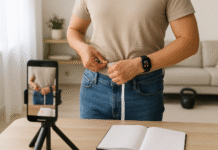
- Photo posture check. Take front/side photos in the same light once every two weeks. You’re looking for head position and shoulder carriage to feel more effortless—not perfection.
- Subjective markers. Jot down a quick daily note (2–3 words): “hips freer,” “shoulders light,” “ankles 8/10.” If the notes trend positive and your objective numbers creep up, the routine is working.
A simple 4-week starter plan (10 minutes per day)
Week 1 — Learn the shapes (7 days):
- Do the full sequence once daily. Use short holds (10–20 seconds) but aim to hit each area.
- KPI: Write down knee-to-wall distances and one subjective note after each session.
Week 2 — Accumulate time (5–7 days):
- Increase holds to 20–30 seconds where comfortable. Keep total around 10 minutes by moving smoothly.
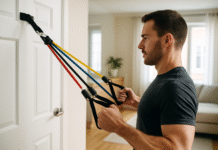
- Add 1 light set of band pull-aparts or face pulls (10–12 reps) on three days to complement chest/upper-back balance.
Week 3 — Add breath & control (5–6 days):
- Keep holds steady and integrate 2–3 slow nasal breaths at end range in each position.
- After chest and hip flexor stretches, perform 5–8 reps of a simple strength “pair” (e.g., bodyweight row or band row; reverse lunge). This blends mobility with the light strength work that helps posture “stick.”
Week 4 — Consolidate gains (5–6 days):
- Maintain holds you tolerate well (some may reach 30–45 seconds).
- Re-test all KPIs mid-week and at week’s end. If ankle ROM or overhead reach hasn’t changed, shift time toward the limiting areas in the next cycle.
Optional: On training days, keep pre-workout holds brief, do your dynamic warm-up, and return to longer static holds afterward or on off days.
Safety notes, caveats, and common mistakes to avoid
- Intensity: Stretch to mild tension, not pain. Tingling, numbness, or sharp pain means stop and adjust.
- Timing: Longer static holds immediately before maximal power/strength efforts can transiently reduce performance; keep pre-work static stretching short and emphasize dynamic warm-ups.
- Expectations: Stretching improves range of motion and movement comfort. Visible posture changes usually require adding light strengthening for the mid-back and hips along with this routine.
- Breathing: Don’t hold your breath. Slow nasal inhales and relaxed, long exhales help muscles let go without forcing range.
- Progress: More hold time isn’t inherently better. Accumulate around 60 seconds total per area and let consistency do the work.
FAQs
1) Is 10 minutes really enough to improve posture and performance?
Yes—provided you do it most days and target the right areas. Range of motion improves with consistent, moderate dosing. Pairing mobility with a bit of strengthening amplifies posture changes over time.
2) Should I stretch before or after a workout?
Before training, keep static holds brief and favor dynamic movements. After training (or in a separate session), longer static holds are appropriate to work on mobility without interfering with performance.
3) How long should I hold each stretch?
For most adults, 10–30 seconds per hold, repeated 2–4 times, is a solid starting point (about 60 seconds total per area). Older adults may benefit from holds closer to 30–60 seconds if comfortable.
4) Can stretching alone fix rounded shoulders or forward head?
Stretching helps open tight tissues, but visible posture changes usually require strengthening under-active muscles (mid-back, deep neck flexors, glutes). Use both for best results.
5) What if I only have five minutes?
Do the warm-up and prioritize chest, hip flexors, and ankles. You can rotate through the remaining items on alternate days.
6) Will stretching prevent soreness or injuries?
Stretching reliably improves flexibility. Its effect on post-exercise soreness is inconsistent. As part of a well-rounded plan—including strength, sleep, and load management—mobility may support comfort and movement quality.
7) I sit all day. How often should I do this routine?
Daily is ideal. Even two short “micro-sessions” (morning and mid-afternoon) can feel better than one longer block. Take posture-breaking “movement snacks” every 45–60 minutes when possible.
8) How hard should a stretch feel?
Aim for a 5–6/10 on a personal tension scale—noticeable but comfortable. If you can’t breathe slowly, it’s too intense.
9) Can I over-stretch?
Yes. If joints feel unstable or achy afterward, reduce range and volume. People with hypermobility should emphasize gentle mobility and prioritize strength.
10) How soon will I notice changes?
Many feel lighter immediately; objective changes in range can appear within days to weeks. Track your KPIs weekly and adjust which areas get the most time.
A quick example “micro-plan” for busy days (5 minutes)
- March + arm swings — 30 seconds
- Doorway chest stretch — 2 × 20 seconds per side
- Half-kneeling hip flexor — 2 × 20 seconds per side
- Knee-to-wall ankles — 8 reps per side
- Posture set & breath — 30 seconds
When you have your full 10 minutes, run the complete sequence.
Conclusion
You don’t need an hour of yoga or a physical therapy degree to stand taller and move better. Ten purposeful minutes most days—done in the right order, at the right intensity, with a few simple metrics—can unwind desk stiffness, smooth your lifts, and make everyday movement feel easier. Start tonight, check one metric next week, and let consistency do the heavy lifting.
Copy-ready CTA: Save this routine, set a 10-minute timer, and do your first session today.
References
- Current Concepts in Muscle Stretching for Exercise and Rehabilitation, National Library of Medicine (PMC), 2012. https://pmc.ncbi.nlm.nih.gov/articles/PMC3273886/
- Stretching and Flexibility Guidelines Update, American College of Sports Medicine (ACSM), 2021. https://www.acsm.org/blog-detail/acsm-certified-blog/2021/03/18/stretching-and-flexibility-guidelines-update
- Ask the Doctor: Stretching Before Exercise, Harvard Health Publishing, 2015. https://www.health.harvard.edu/staying-healthy/ask-the-doctor-stretching-before-exercise
- Effect of Acute Static Stretch on Maximal Muscle Performance (Kay & Blazevich), PubMed, 2012. https://pubmed.ncbi.nlm.nih.gov/21659901/
- Acute Effects of Muscle Stretching on Physical Performance, Range of Motion, and Injury Incidence in Healthy Active Individuals (Behm et al.), PubMed, 2016. https://pubmed.ncbi.nlm.nih.gov/26642915/
- A Review of the Acute Effects of Static and Dynamic Stretching on Performance (Behm & Chaouachi), PubMed, 2011. https://pubmed.ncbi.nlm.nih.gov/21373870/
- How to Stretch After Exercising, NHS, accessed 2025. https://www.nhs.uk/live-well/exercise/how-to-stretch-after-exercising/
- Flexibility Exercises, NHS, accessed 2025. https://www.nhs.uk/live-well/exercise/flexibility-exercises/
- Take Time to Stretch, Harvard Health Publishing, 2025. https://www.health.harvard.edu/exercise-and-fitness/take-time-to-stretch
- Reliability of Three Measures of Ankle Dorsiflexion Range of Motion (Konor et al.), National Library of Medicine (PMC), 2012. https://pmc.ncbi.nlm.nih.gov/articles/PMC3362988/
- Reliability and Minimal Detectable Change of the Weight-Bearing Lunge Test (Powden et al.), ScienceDirect (abstract), 2015. https://www.sciencedirect.com/science/article/abs/pii/S1356689X15000065
- Effects of Stretching or Strengthening Exercise on Spinal and Pelvic Posture: Systematic Review and Meta-Analysis (Warneke et al.), National Library of Medicine (PMC), 2024. https://pmc.ncbi.nlm.nih.gov/articles/PMC11150224/
- The Effect of Various Therapeutic Exercises on Forward Head, Rounded Shoulders, and Kyphosis: Meta-analysis (Sepehri et al.), BMC Musculoskeletal Disorders, 2024. https://bmcmusculoskeletdisord.biomedcentral.com/articles/10.1186/s12891-024-07224-4
- The Combined Effect of Lower Trapezius Strengthening and Pectoralis Minor Stretching on Rounded Shoulder Posture (Hasan et al.), National Library of Medicine (PMC), 2023. https://pmc.ncbi.nlm.nih.gov/articles/PMC9956189/
- Stretching: Focus on Flexibility, Mayo Clinic, accessed 2025. https://www.mayoclinic.org/healthy-lifestyle/fitness/in-depth/stretching/art-20047931