























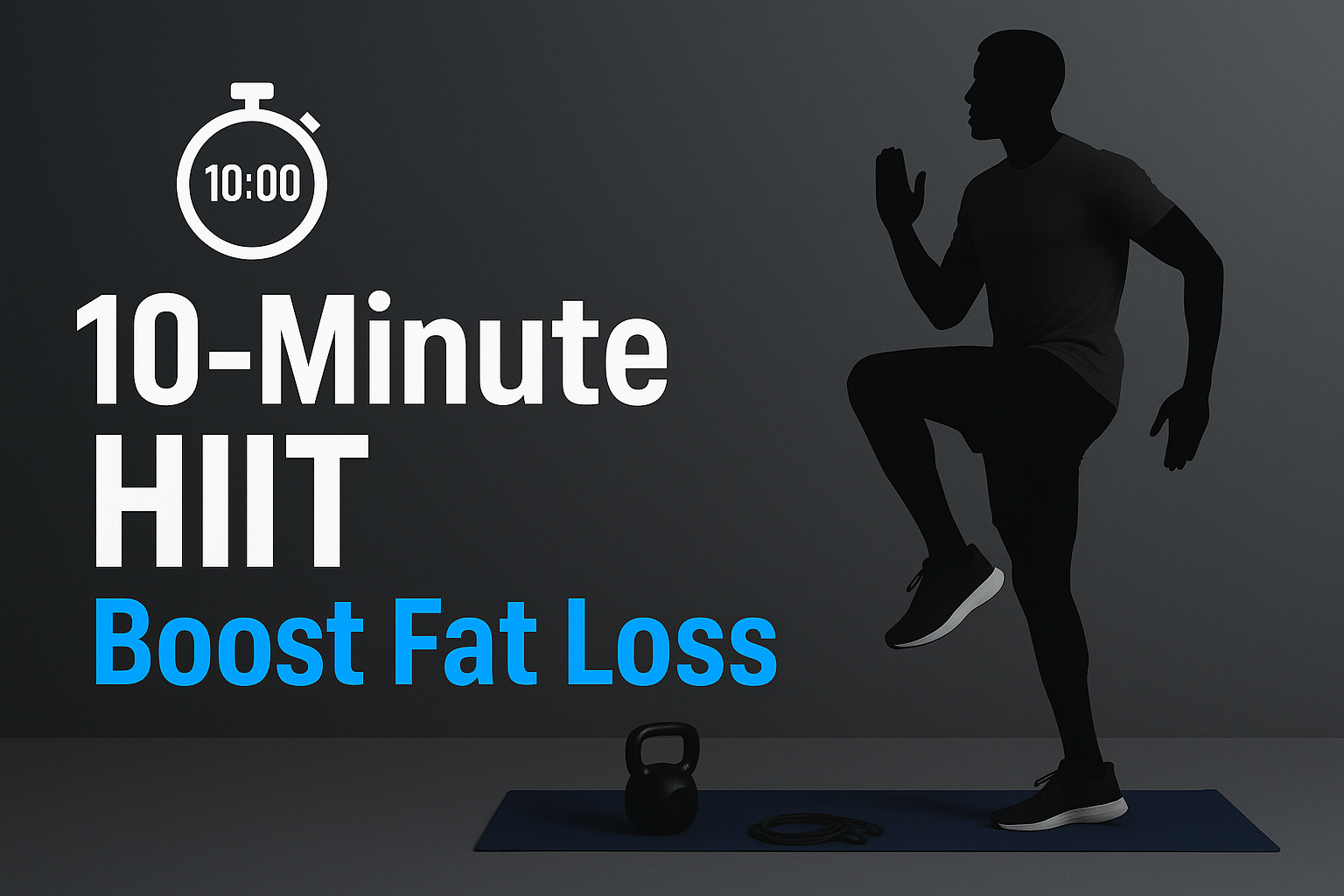
Pressed for time but serious about trimming body fat? High-intensity interval training is built for days when your schedule is chaos. Short, structured bursts of near-all-out effort followed by brief recovery periods make 10-minute HIIT workouts to boost fat loss not only possible, but highly effective for busy beginners and seasoned exercisers alike. In this guide, you’ll learn exactly how HIIT supports fat loss, how to warm up fast, how to gauge intensity (with or without a watch), and—most importantly—10 plug-and-play workouts you can start today.
Medical disclaimer: The information below is educational and not a substitute for medical advice. If you have a health condition, are pregnant, take medications that affect heart rate, or are returning after injury, talk with a qualified healthcare professional before starting HIIT.
Key takeaways
- Ten-minute HIIT really works when you push hard during the “work” intervals and keep recovery truly easy.
- Fat loss still hinges on your weekly activity and nutrition. HIIT is a time-efficient way to move the needle.
- Warm up smart in 2–5 minutes to protect joints and unlock power.
- Measure intensity with heart rate, RPE, or the talk test—no gadgets required.
- Start with 2–3 sessions per week, progress gradually, and track objective metrics (rounds, reps, distance, watts).
Why HIIT helps fat loss (and where it fits)
HIIT alternates short, near-maximal efforts with brief recovery periods. Those intense spikes raise total energy use, drive a strong cardiovascular response, and can create a small “afterburn” effect (excess post-exercise oxygen consumption) after you’re done. Over weeks, HIIT can match the body-fat reductions of longer, moderate-intensity cardio, while reliably boosting fitness.
What HIIT does well:
- Time efficiency. Vigorous intervals help you rack up meaningful training stimulus in minutes.
- Cardio gains. Intervals consistently improve aerobic capacity.
- Enjoyment & adherence. Many people prefer hard-easy patterns over long steady sessions.
Where expectations need reality:
- HIIT isn’t magic. It doesn’t automatically beat steady cardio for fat loss; both can work.
- Energy balance still rules. Pair HIIT with a sustainable eating plan for best results.
- Dose matters. Two or three 10-minute bouts per week help, but weekly totals (plus lower-intensity movement) add up most.
Quick-start warm-up (2–5 minutes)
A smart warm-up reduces injury risk and primes power without eating your whole session. Use this anytime you do HIIT.
- Pulse-raiser (60–90 sec): brisk walk/jog, easy bike, or marching high knees.
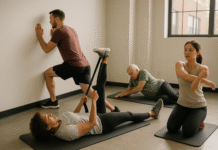
- Dynamic mobility (60–90 sec): 6–8 reps each—hip circles, arm swings, ankle rocks, cat-camel, world’s greatest lunge.
- Rehearsal sets (30–60 sec): 2–3 light reps of the day’s main moves or 10–15 seconds at the intended cadence on your machine.
- Primer (30–60 sec): one short build-up at ~70–80% effort, then back to easy for 30–45 seconds.
If you truly have only 10 minutes total: compress to 60–90 seconds of brisk movement plus one rehearsal set, then extend your first interval rest by 15–30 seconds.
How hard should HIIT feel? (Intensity without guesswork)
You can nail intensity three ways:
- Heart rate: Work intervals ≈ 80–90% of max HR (vigorous); recover below ~70%. If you don’t know max HR, a rough estimate is 220 minus age, or use the updated 208 − 0.7×age formula.
- RPE (rating of perceived exertion, 0–10): Work at 7–9/10, recover at 3–4/10.
- Talk test: During work, you can speak only a few words; during recovery, you can hold a brief sentence.
Pick one method and be consistent week to week.
Equipment key
- No gear? Bodyweight options below cover you.
- Nice-to-have: jump rope, step/bench, resistance band, one kettlebell/dumbbell, cardio machine (bike, rower, treadmill).
- Shoes: any supportive training shoe; secure laces for sprints/jumps.
- Space: a 2×2 m area works for most bodyweight sessions.
Workout 1 — The 40/20 Bodyweight Burner
What & why: Classic 40 seconds hard / 20 seconds easy cycles using big, simple patterns to drive heart rate without equipment.
You need: Clear floor space; optional mat. No cost.
Step-by-step (10 minutes):
- Set a timer for 10 rounds of 40s work / 20s rest.
- Rotate through 4 moves: bodyweight squat → push-up (incline if needed) → fast mountain climbers → alternating reverse lunges (add a knee drive).
- Keep work intervals aggressive; shake out during rests.
Beginner modifications & progressions:
- Easier: Elevate push-ups to a bench/wall; step your mountain climbers.
- Harder: Add jump squats or switch lunges; elevate feet for push-ups.
Frequency & metrics: 2–3×/week max. Track total reps across all rounds; try to beat last time by 3–5 reps.
Safety & common mistakes: Don’t let knees cave during squats/lunges; keep wrists stacked under shoulders for climbers. Avoid holding your breath.
Mini-plan example:
- Week 1 Day 1: 10×(40/20).
- Week 1 Day 4: Repeat, aim +1 rep per move.
Workout 2 — Beginner Tabata Double-Block
What & why: The famous 20 seconds on / 10 seconds off repeated eight times (4 minutes) is brutally efficient. Two different 4-minute blocks with a 1-minute breather make ~9 minutes of work plus transition.
You need: Bodyweight or light dumbbells.
Step-by-step (10 minutes):
- Block A (4 minutes): 8 rounds 20/10 of air squat.
- 1 minute easy walk/breathe.
- Block B (4 minutes): 8 rounds 20/10 of plank jack → push-up combo (1 push-up + 4 jacks).
- Final minute: slow walk and deep breaths.
Modifications & progressions:
- Easier: Half squats; plank jacks from elevated hands.
- Harder: Goblet squats; push-ups on parallettes or add a clap every other round.
Frequency & metrics: 1–2×/week. Track best and worst round reps; narrow the gap week by week.
Safety & mistakes: Don’t chase speed with sloppy depth—hips below parallel only if your control allows. Keep ribs down in planks.
Mini-plan example:
- Week 2 Day 1: Blocks A & B as written.
- Week 2 Day 5: Swap B for high-knee sprints 20/10.
Workout 3 — Power-Walk Hill Sprints (Low-Impact)
What & why: Hills (or treadmill incline) let you work hard without pounding your joints.
You need: Hill, stairs, or treadmill with incline.
Step-by-step (10 minutes):
- Warm-up minute walking.
- 6 rounds: 45s power walk uphill (or fast up the stairs) + 45s easy walk down/flat.
- Final minute: flat walk and nose-breathing cool-down.
Modifications & progressions:
- Easier: Shorten work to 30s, lengthen recovery to 60s.
- Harder: Jog the uphill; increase incline 1–2% each round.
Frequency & metrics: 2×/week. Track distance covered uphill or treadmill speed/incline.
Safety & mistakes: Short strides, tall posture; don’t grip treadmill rails. On real hills, watch footing.
Mini-plan example:
- Week 1 Day 2: 6×(45s up/45s down).
- Week 1 Day 6: 8×(30s up/30s down).
Workout 4 — Kettlebell Swing + March EMOM
What & why: Hip-hinge power plus brisk marching spikes heart rate and trains posterior chain.
You need: 1 kettlebell or dumbbell you can swing safely (or substitute a hip hinge).
Step-by-step (10 minutes):
- Set a timer EMOM (every minute on the minute) × 10.
- Minute 1: 15–20 hard swings (or 12 hip-hinge rows with a dumbbell).
- Minute 1 remainder: fast in-place march until the next minute.
- Repeat for 10 minutes.
Modifications & progressions:
- Easier: Fewer swings; swap to deadlifts.
- Harder: Heavier bell or add 3–5 swings per minute.
Frequency & metrics: 1–2×/week. Track total swings and lowest march cadence (steps/min).
Safety & mistakes: Neutral spine; hinge at hips, not spine. If new to swings, learn with a coach or stick to deadlifts until confident.
Mini-plan example:
- Week 2 Day 3: EMOM 10 @ 15 swings.
- Week 3 Day 3: EMOM 10 @ 18 swings.
Workout 5 — Bike Smarts: 30/30 Cadence HIIT
What & why: Intervals on a stationary bike are joint-friendly and precise.
You need: Stationary bike or spin bike.
Step-by-step (10 minutes):
- 1 minute easy pedal.
- 8 minutes of 30s hard (high cadence, heavy-ish resistance) / 30s easy spin.
- 1 minute soft pedal.
Modifications & progressions:
- Easier: 20/40 work:rest or reduce resistance.
- Harder: 40/20 work:rest; add a final all-out 30s push.
Frequency & metrics: 2–3×/week. Track average watts or distance during the 8 hard minutes.
Safety & mistakes: Keep hips square; avoid rocking. Don’t jam your knees—set proper saddle height.
Mini-plan example:
- Week 1 Day 1: 16×(30/30).
- Week 1 Day 4: 12×(40/20).
Workout 6 — Jump Rope Pop-Ins
What & why: Skipping rapidly alternates elastic, springy work with active breath control.
You need: Jump rope (or mimic without).
Step-by-step (10 minutes):
- 5 rounds of: 90s jump rope (steady but snappy) + 30s walk/breathe.
- Focus on quiet feet, wrists driving the rope.
Modifications & progressions:
- Easier: 45s jump / 45s rest; or do imaginary rope.
- Harder: Add double-unders every 30s; last round max reps.
Frequency & metrics: 1–2×/week. Track total jumps or fewest misses.
Safety & mistakes: Land softly, mid-foot; keep jumps low. Stop if shins or Achilles bark.
Mini-plan example:
- Week 2 Day 1: 5×(90/30).
- Week 3 Day 1: 6×(60/30).
Workout 7 — Stairs or Step Intervals
What & why: A step or staircase lets you climb your heart rate without high impact.
You need: Stairs or sturdy step/box.
Step-by-step (10 minutes):
- 10 rounds of 35s step-ups fast (change lead leg each round) + 25s easy march.
- Keep arms pumping and foot contacts light.
Modifications & progressions:
- Easier: Lower step; 25s work / 35s rest.
- Harder: Add light dumbbells; switch to alternating lateral step-overs.
Frequency & metrics: 2×/week. Track total step-ups.
Safety & mistakes: Entire foot on the step; push through heel; keep knee tracking over toes.
Mini-plan example:
- Week 1 Day 3: 10×(35/25).
- Week 2 Day 3: 12×(30/20).
Workout 8 — Rowing Machine Pyramid
What & why: Rowing uses legs + hips + back for a huge cardio hit.
You need: Rower (erg).
Step-by-step (10 minutes):
- 1 minute easy row.
- Pyramid (8 minutes): 30s hard / 30s easy → 40/20 → 50/10 → 60/30 → then come back down 50/10 → 40/20 → 30/30.
- 1 minute easy.
Modifications & progressions:
- Easier: Keep all sets at 30/30.
- Harder: Increase damper slightly or chase stroke rate 30–34 spm during work.
Frequency & metrics: 1–2×/week. Track meters rowed in 10 minutes.
Safety & mistakes: Drive with legs first; maintain neutral spine; don’t overreach on recovery.
Mini-plan example:
- Week 2 Day 2: Pyramid as written.
- Week 3 Day 2: Repeat, aim +50–100 m.
Workout 9 — Shadow Boxing + Fast Feet
What & why: Upper-body speed with footwork is sneaky-hard and fun.
You need: Open space; light hand wraps optional.
Step-by-step (10 minutes):
- 5 rounds of 75s fast shadow boxing (1–2s, hooks, uppercuts; pivot and move) + 45s fast feet (quick in-place steps).
- Keep guard up and rotate from hips.
Modifications & progressions:
- Easier: 45/45 per round.
- Harder: Add 10 burpees at the end of each round.
Frequency & metrics: 1–2×/week. Track punch count (estimate) or cadence in fast feet.
Safety & mistakes: Don’t hyperextend elbows; keep core braced; hit the air, not full extension “snaps.”
Mini-plan example:
- Week 1 Day 5: 5×(75/45).
- Week 2 Day 5: 6×(60/30).
Workout 10 — Strength-Metcon EMOM (Total-Body)
What & why: Blend strength patterns to drive heart rate while reinforcing movement quality.
You need: Bodyweight or pair of light dumbbells.
Step-by-step (10 minutes):
- EMOM x 10 minutes, alternate minutes:
- Odd minutes: 10–12 reverse lunges per leg (bodyweight or goblet), then max hollow hold until the minute ends.
- Even minutes: 10 push-ups + 10 bent-over rows (or band rows), then fast march to fill remaining time.
Modifications & progressions:
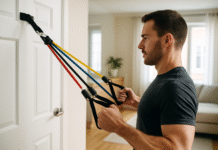
- Easier: Reduce reps; incline push-ups; swap rows for band pull-aparts.
- Harder: Heavier load or add 5–10 jump squats after rows.
Frequency & metrics: 1–2×/week. Track completed reps and rest left in each minute.
Safety & mistakes: Keep knees in line with toes; neutral spine in rows; avoid holding breath.
Mini-plan example:
- Week 3 Day 4: EMOM as written.
- Week 4 Day 4: Add 2 reps to each movement.
Troubleshooting & common pitfalls
- Going too hard, too soon. New to HIIT? Cap work intervals at 20–30 seconds for week 1–2 and extend rests.
- Skipping the warm-up. Two minutes is better than none. Rehearsal sets matter.
- All work, no recovery. If your fifth interval is half the output of your first, lengthen recovery by 10–20 seconds.
- “Light” rests that aren’t light. Recovery should feel like a 3–4/10 RPE—slow down more than you think.
- Messy technique under fatigue. If form breaks, switch to a low-skill cardio move (march, bike, step-ups) for the remaining interval.
- Chasing scale weight only. Track fitness markers (pace, reps, watts), not just kilograms.
How to measure progress (so fat loss doesn’t feel like guesswork)
Weekly checks (pick 2–3):
- Performance: total reps in a fixed 10-minute session; distance covered in hill sprints; average watts on bike.
- Heart-rate recovery: how fast you drop from peak to <70% max in the first minute post-interval.
- Clothes/measurements: waist/hip circumference every 2 weeks; how your favorite jeans fit.
- Photos: same lighting, weekly.
- Energy & sleep: a 1–5 rating each day to spot overreaching.
Monthly checks:
- 10-minute benchmark: Repeat the exact session from Week 1 and compare.
- Lifestyle alignment: Are you consistently walking more on non-HIIT days? Is your eating plan sustainable?
A simple 4-week starter plan (10–20 minutes per day)
Goal: Build a realistic rhythm, improve fitness, and create a weekly calorie deficit without burning out.
Weekly structure (repeat with progressions noted):
- Mon – HIIT A (10–15 min): Workout 1 (40/20 Bodyweight).
- Tue – Low-intensity movement (20–40 min): brisk walk, easy bike, or mobility flow.
- Wed – HIIT B (10–15 min): Workout 5 (Bike 30/30) or 3 (Hill Power-Walk).
- Thu – Strength base (15–25 min): full-body circuit (squats, hinges, rows, presses) easy-moderate.
- Fri – HIIT C (10–15 min): Workout 2 (Tabata Double-Block) or 7 (Step Intervals).
- Sat – Optional play (20–60 min): hike, sports, long walk.
- Sun – Recovery: mobility + light walk.
Progressions by week:
- Week 1: Keep work:rest conservative; focus on technique.
- Week 2: Add 1–2 rounds or +5 seconds to work intervals.
- Week 3: Raise one session to RPE 8–9; keep others at 7–8.
- Week 4: Retest a Week-1 workout and aim for a 3–10% improvement in reps/distance.
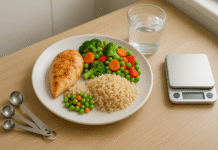
Nutrition nudge (keep it simple): Build meals around lean protein + fiber-rich carbs + colorful produce; keep beverages mostly water/tea/coffee; plan one satisfying treat daily to avoid “all-or-nothing” swings.
Safety notes you shouldn’t skip
- Stop intervals if you feel chest pain, dizziness, unusual shortness of breath, or sharp joint pain.
- If you take heart-rate–affecting medications, rely on RPE and the talk test rather than HR targets.
- New to exercise? Start with 2 HIIT days and 3–5 easy movement days; progress gradually.
- Land softly, maintain neutral spine, and keep knees tracking over mid-foot. Good form beats more reps.
FAQs
1) Are 10 minutes of HIIT really enough to boost fat loss?
Yes—if you work hard. Ten focused minutes increase daily energy expenditure and fitness. Over weeks, combined with a sensible eating plan and added lower-intensity activity, that helps reduce body fat.
2) How many 10-minute HIIT sessions should I do per week?
Start with 2–3 sessions, separated by at least a day, plus walking/strength on other days. More is not always better; quality and recovery matter.
3) Do I need a heart-rate monitor?
Helpful, not required. The RPE scale and talk test are reliable ways to hit vigorous intensity.
4) What’s the best work-to-rest ratio?
For beginners, 20–30 seconds work / 30–60 seconds rest. As you adapt, try 30/30, 40/20, or Tabata (20/10).
5) Is HIIT better than steady cardio for fat loss?
Not categorically. Both can reduce body fat; HIIT just packs the stimulus into less time. Pick the style you’ll stick with.
6) Can I do HIIT on consecutive days?
Occasionally, yes, if you rotate modalities (e.g., bike one day, bodyweight the next) and keep one of them sub-maximal. Most people feel better with a day between hard sessions.
7) I have knee pain. Which 10-minute option is lowest impact?
Try bike intervals, hill power-walks, rower pyramids, or step-ups with a low box. Keep ranges of motion pain-free and prioritize form.
8) Where does strength training fit?
Add 2 short strength sessions weekly to preserve muscle while losing fat. Think squats/hinges/rows/presses in 15–25 minutes.
9) Should I do HIIT fasted?
Personal preference. Some feel fine fasted; others perform better with a small snack (banana, yogurt) 30–60 minutes before. Hydration always helps.
10) How do I know I’m progressing?
Your performance metrics (reps, distance, watts) improve, your recovery between intervals speeds up, and clothes fit better. Re-test a Week-1 workout at the end of Week 4.
11) How does HIIT affect appetite?
Responses vary. Some people feel less hungry right after intense sessions; others get hungrier later. Plan balanced meals with protein and fiber to steady appetite.
12) Can I stack two 10-minute HIITs in a day?
Advanced trainees sometimes split sessions (morning/evening). If you try it, keep at least one session sub-maximal and monitor recovery closely.
Conclusion
You don’t need an hour to make real progress—10 minutes of focused HIIT can move the scale, sharpen fitness, and fit any day. Warm up fast, push purposefully, recover fully, and track something objective each week. Stack small wins, and your results will compound.
CTA: Pick one workout above, set a timer for 10 minutes, and start your first interval today.
References
- High-intensity interval training is not superior to continuous aerobic training in reducing body fat: A systematic review and meta-analysis of randomized clinical trials. National Library of Medicine (PMC). 2023. https://pmc.ncbi.nlm.nih.gov/articles/PMC10624584/
- HIIT (High Intensity Interval Training). Harvard T.H. Chan School of Public Health – The Nutrition Source. Last reviewed November 2021. https://nutritionsource.hsph.harvard.edu/high-intensity-interval-training/
- Physical Activity Guidelines – Overview and recommendations for adults. American College of Sports Medicine. (Accessed August 2025). https://acsm.org/education-resources/trending-topics-resources/physical-activity-guidelines/
- Effects of moderate-intensity endurance and high-intensity intermittent training on anaerobic capacity and VO₂max (original “Tabata” study). PubMed. 1996 Oct. https://pubmed.ncbi.nlm.nih.gov/8897392/
- Magnitude and duration of excess post-exercise oxygen consumption between high-intensity interval and moderate-intensity continuous exercise: A systematic review. PubMed. 2021. https://pubmed.ncbi.nlm.nih.gov/32656951/
- Excess post-exercise oxygen consumption after HIIT versus moderate-intensity continuous exercise (adult women): Scientific Reports. 2024. https://www.nature.com/articles/s41598-024-81644-4
- Eating & Physical Activity to Lose or Maintain Weight. National Institute of Diabetes and Digestive and Kidney Diseases (NIDDK). (Accessed August 2025). https://www.niddk.nih.gov/health-information/weight-management/adult-overweight-obesity/eating-physical-activity
- Adult Activity: An Overview. U.S. Centers for Disease Control and Prevention. December 20, 2023. https://www.cdc.gov/physical-activity-basics/guidelines/adults.html
- Measuring Physical Activity Intensity (Talk Test and intensity basics). U.S. Centers for Disease Control and Prevention. December 6, 2023. https://www.cdc.gov/physical-activity-basics/measuring/index.html
- Target Heart Rates Chart (includes 220 − age estimate). American Heart Association. August 12, 2024. https://www.heart.org/en/healthy-living/fitness/fitness-basics/target-heart-rates
- Rated Perceived Exertion (RPE) Scale. Cleveland Clinic Health Library. Last reviewed November 1, 2023. https://my.clevelandclinic.org/health/articles/17450-rated-perceived-exertion-rpe-scale
- World Health Organization 2020 guidelines on physical activity and sedentary behaviour. National Library of Medicine (PMC). 2020. https://pmc.ncbi.nlm.nih.gov/articles/PMC7719906/
- Revisiting the “Whys” and “Hows” of the Warm-Up: Are We Asking the Right Questions? National Library of Medicine (PMC). 2023. https://pmc.ncbi.nlm.nih.gov/articles/PMC10798919/
- Potential effects of dynamic stretching on injury incidence of athletes: A narrative review. National Library of Medicine (PMC). 2023. https://pmc.ncbi.nlm.nih.gov/articles/PMC10289929/