

























Strength training is the most reliable way to build muscle, get stronger, and protect your joints—at any age. This guide distills the 10 Strength Training Basics for Beginners into clear actions you can follow today. You’ll learn how to choose exercises, nail form, pick the right weights, and plan your week without burning out. In one sentence: strength training means performing resistance exercises 2–3 days per week with good technique and gradually increasing load to drive adaptation, supported by adequate recovery and nutrition. Quick start, if you’re itching to lift: warm up, pick 4–6 compound moves, do 2–3 sets of 8–12 reps, finish with 1–2 accessories, rest 1–2 minutes between sets, and add a little weight next time.
Brief, common-sense disclaimer: this article is educational—not medical advice. If you have a health condition, are pregnant, or recently injured, speak with a qualified healthcare professional before you begin.
1. Set Clear Goals and Establish Your Baseline
Start by defining a realistic goal for the next 8–12 weeks, then measure where you are now. Clear goals—“do 3 pull-ups,” “back squat my bodyweight,” or “lift twice weekly without missing”—anchor your plan and make progress measurable. Your baseline should include simple mobility checks, a few strength markers (e.g., push-ups to good form, a 30–60 second plank), and a comfortable starting load you can lift with 2–3 reps in reserve. For most beginners, that lands around an 8–12 rep range that feels challenging but controlled. Capture this in a training log so you can track workload and recovery. With a baseline and a plan, you avoid guesswork and reduce your injury risk from day one.
1.1 Why it matters
Specific, time-bound goals improve adherence and steer your program choices. Baselines let you personalize volume and intensity, rather than copying a friend’s workout or a random social post.
1.2 How to do it
- Write one performance goal and one consistency goal for 8–12 weeks.
- Test: max quality push-ups; 30–60s plank; light goblet squat for 8–12 reps.
- Pick starting loads that leave 2–3 reps “in the tank” (no grinding).
- Log sets, reps, load, and a 1–10 effort score after sets.
- Schedule two nonconsecutive training days this week (e.g., Mon/Thu).
Mini-checklist: Is your goal specific? Is your week scheduled? Did you record today’s numbers? Close each session knowing what to increase next time.
2. Learn the Five Fundamental Patterns First
Mastering the main movement patterns gives you the best return on effort. Those patterns are squat, hinge, push, pull, and carry (or brace). Prioritize exercises like goblet squat (squat), hip hinge/RDL (hinge), push-up or dumbbell press (push), row or pulldown (pull), and loaded carry or plank (carry/brace). The first 4–6 weeks are about learning positions, controlling range of motion, and building confidence. Keep your spine neutral, brace your midsection, and move through a range you can own. These basics transfer to everyday life—standing, lifting, reaching, and moving things safely—while setting a foundation for barbells later.
2.1 Tools/Examples
- Squat: bodyweight box squat → goblet squat → front squat.
- Hinge: dowel hip hinge → kettlebell deadlift → RDL.
- Push: incline push-up → floor push-up → dumbbell press.
- Pull: chest-supported row → 1-arm DB row → lat pulldown.
- Carry/Brace: suitcase carry → farmer’s carry; plank progressions.
2.2 Numbers & guardrails
- 2–3 sets of 8–12 reps per exercise, resting 1–2 minutes.
- Move through full, controlled range of motion you can stabilize.
- Progress a pattern when you own it (balanced reps, stable tempo, no pain).
Synthesis: Invest early in pattern quality—you’ll lift more, safer, sooner.
3. Nail Technique and Use Full, Controlled Range of Motion
Good form is a performance multiplier. The simplest rule: move the load through the largest, controllable range without losing position. Full or long ranges of motion generally improve strength and hypertrophy compared with partial ranges, especially for lower body, though there are useful exceptions at long muscle lengths. Keep reps smooth: avoid bouncing at the bottom and jerking at the top. Control the eccentric (lowering) ~1–2 seconds, steady up on the concentric, and finish each rep the same way you started—stable and braced. If form slips, reduce load or range until you can own it.
3.1 Why it matters
- More range recruits more muscle through more joint angles, improving strength carryover and functional capacity.
- Consistent technique makes your progress measurable, so increases truly reflect adaptation, not sloppier reps.
3.2 Common mistakes
- Cutting depth to lift heavier than you can control.
- Losing spinal neutrality on hinges/squats.
- Rushing eccentrics, bouncing at end range, or locking out aggressively.
- Chasing PRs before you can repeat clean reps across sets.
Mini example: A beginner moves from a quarter squat (60 kg) to a parallel goblet squat (20 kg) with stable depth. Two months later they front squat 50 kg to the same depth. Strength improved because range and form were standardized.
4. Choose the Right Starting Loads, Sets, and Rep Ranges
For beginners, 8–12 reps at a moderate load is the sweet spot to learn form and build muscle. A practical starting load is one you can complete for the target reps with 2–3 reps in reserve (you could do 10–12 when the target is 8–10). Perform 2–3 sets per exercise, aiming for 8–12 hard-but-clean reps each set. Rest 1–2 minutes between moderate sets; for heavier compound lifts, 2–3 minutes improves performance and technique. Use simple accessory work (rear delts, hamstrings, calves, core) for 1–2 sets of 10–15. You don’t need training to failure to progress—especially at the start.
4.1 How to pick weight quickly
- Warm up with an empty implement.
- Do a feeler set of ~10 reps.
- Add small increments until the last reps slow but stay crisp.
- Stop the set if form breaks—use that weight next time.
4.2 Numbers & guardrails
- Compounds: 2–3 sets × 8–12 reps; rest 2–3 min if reps slow.
- Accessories: 1–2 sets × 10–15 reps; rest ~60–90 sec.
- If you finish with >3 reps in reserve, add a little next session; if 0 RIR or form degrades, repeat or reduce.
Synthesis: Start lighter than you think, move perfectly, and let your logbook prove when to turn the dial.
5. Progress with Small, Consistent Overload
Strength improves when you ask for a bit more over time—more load, more reps, more sets, or better range. The most beginner-friendly method is double progression: pick a rep range (e.g., 8–12). When you can perform all sets at the top of the range with clean form, increase the load by ~2–5% next session. For dumbbells, that may be the smallest available jump (e.g., +2 kg total). If your gym’s jumps are large, add reps first or slow the eccentric to build capacity. Not every week will increase—plateaus are normal; zoom out and check your averages over 4–6 weeks.
5.1 Practical overload options
- Load: +1–2.5 kg per side (barbell) or the next dumbbell pair.
- Reps: 8 → 9 → 10 across sets before adding weight.
- Sets: 2 → 3 when recovery and time allow.
- Range/tempo: deeper, more controlled; 2-second lower.
- Density: same work in a bit less time while keeping quality.
5.2 Mini-checklist
- Did you hit the top of the rep range on all sets?
- Was technique unchanged from last week?
- How was recovery (sleep, soreness, stress)?
If all green, nudge the dial next time. If not, hold or deload a week.
Synthesis: Tiny, repeatable progressions beat sporadic big jumps—your joints and future numbers will thank you.
6. Set a Weekly Schedule You Can Keep (and Recover From)
Beginners make excellent gains on 2–3 nonconsecutive days/week of full-body training. Think Mon/Thu or Tue/Fri/Sun. Each session: 4–6 lifts covering the five patterns, 45–70 minutes total. Keep one rest day between sessions so your muscles and connective tissues adapt. As intensity rises, your rest between sets can lengthen; longer rests (2–3+ min) often lead to better strength and muscle gains on big lifts. Plan light activity (walking, easy cycling) on off-days to promote blood flow without adding stress.
6.1 Template: 2-day full-body (weeks 1–4)
- Day A: Goblet Squat, DB Row, Incline Push-up, Hip Hinge, Side Plank.
- Day B: Kettlebell Deadlift, Lat Pulldown, DB Press, Split Squat, Farmer’s Carry.
6.2 Progression: 3-day full-body (weeks 5–8)
- Rotate exercise variations; keep rep ranges; add 1 set to key lifts.
- Keep at least one rest day between heavy sessions.
Heat & humidity note (relevant in hot climates): Plan earlier or later sessions, hydrate well, and scale intensity in high heat indexes; safety always trumps sticking to a written load.
Synthesis: The best plan is the one you’ll actually do, consistently, with space to recover.
7. Warm Up, Mobilize, and Cool Down with Purpose
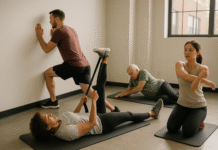
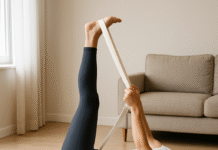
Your warm-up should raise temperature, rehearse patterns, and prepare joints—not exhaust you. Spend 5–10 minutes on light cardio, then use dynamic mobility focused on hips, ankles, shoulders, and thoracic spine. Finish with 1–2 ramp-up sets of each first exercise. Keep long static stretches for after training or separate sessions; brief static holds (<30–45s) are generally fine if they help your positions, but longer pre-lift holds can reduce power output. Cool down with easy walking and a few gentle, targeted stretches to restore calm breathing and range.
7.1 Quick warm-up flow (7–10 minutes)
- 3–5 min brisk walk or bike.
- Dynamic: leg swings, hip openers, arm circles, scap slides.
- Pattern rehearsal: bodyweight squats, dowel hinges, light rows/presses.
- Ramp-up sets: 1–2 lighter sets before work sets.
7.2 Common mistakes
- Skipping ramp-up sets and jumping into working weight.
- Doing long static stretches immediately before heavy lifts.
- Over-warming and starting the session fatigued.
Synthesis: Warm-ups should make your first set your best set—loose, stable, and focused.
8. Eat Enough Protein and Hydrate to Support Training
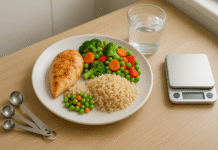
Muscles adapt when fed. Aim for ~1.4–2.0 g protein/kg/day, spread across 3–4 meals, with ~0.3 g/kg per meal a practical target. Whole foods first—dairy, eggs, poultry, fish, legumes, tofu—then consider whey/plant protein if you struggle to hit totals. Around training, a mixed meal 1–3 hours pre-workout and a protein-rich meal in the 3–4 hours after is plenty for beginners. Hydration matters for performance and safety: start sessions euhydrated, sip to thirst during, and prioritize fluids and sodium with meals in hot conditions.
8.1 Mini-checklist
- Daily protein target met (track for a week to calibrate).
- Pre-lift meal (carb + protein) 1–3 hours before.
- Post-lift protein meal within your normal eating window.
- In heat: bring a bottle; consider electrolytes for long or sweaty sessions.
8.2 Simple example (70 kg person)
- Protein: 1.6 g/kg ≈ 112 g/day → four meals ~28 g each.
- Pre: yogurt + fruit; Post: rice + chicken + veg; Fluids with meals.
Synthesis: Consistent protein and sensible fluids turn hard work into results.
9. Prioritize Safety, Spotting, and Pain vs. Soreness
Use collars on barbells, clear your lifting area, and set safety pins or rails at the right height for squats and presses. Use a spotter on barbell bench and challenging overhead work; agree on commands, liftoff, and when to help. Distinguish muscle soreness (peaks 24–72 hours after new or hard work) from pain (sharp, persistent, swelling, loss of function). If pain alters your form or persists beyond a few days, scale back and, if needed, consult a professional. In heat or poor ventilation, reduce intensity and session length, hydrate, and watch for dizziness or nausea.
9.1 Spotting basics
- Communicate reps and liftoff beforehand.
- Spot the bar, not the lifter’s torso.
- Track the bar path; assist only as needed.
- Use side spotters for heavy barbell bench or back squats.
9.2 Red flags (stop and reassess)
- Sudden sharp pain, popping, or immediate swelling.
- Dark urine or severe, persistent muscle tenderness after extreme exertion.
- Dizziness, confusion, or heat illness signs.
Synthesis: Safe habits are strength multipliers—protect your progress and the people around you.
10. Track, Review, and Adjust Every 4–6 Weeks
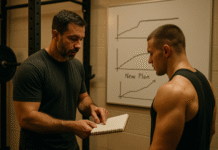
A simple logbook beats memory. Track exercises, sets, reps, load, session duration, and a 1–10 effort rating. Review every 4–6 weeks: if lifts stall, change one variable—exercise variation, rep range, or rest times—while preserving the pattern. If life gets hectic, reduce volume (sets) before intensity (load) so skills don’t erode. When motivation dips, anchor to your original goal and set a small challenge for the next two weeks (e.g., add one rep to your rows each session). Consistency compounds; even 2 days/week maintained beats a perfect program you don’t do.
10.1 Review prompts
- Are your main lifts up 2–5% or 1–2 reps versus last block?
- Are you sleeping 7–9 hours and feeling recovered?
- Do joints feel better, worse, or the same?
- What’s the one smallest change to unlock progress?
10.2 Mini-case
A beginner starts with goblet squats 12 kg × 8–8–8. Six weeks later they hit 18 kg × 12–12–12 with rock-solid depth, then move to front squats at 25 kg × 8–8–8. That’s progressive overload done right—measurable and repeatable.
Synthesis: Measure, tweak, repeat—this is how beginners become intermediates.
FAQs
1) How many days per week should a beginner lift?
Two to three nonconsecutive days per week is ideal for most beginners. This frequency allows enough stimulus to get stronger while giving joints and connective tissues time to adapt. If you can only manage two days, choose full-body sessions covering squat, hinge, push, pull, and carry. Add a third day once recovery and life rhythm allow.
2) How long should a workout take?
Plan 45–70 minutes, including warm-up and 4–6 exercises. Short on time? Do a focused 35–40 minutes with two compounds (e.g., squat, row), one push, one hinge, and a core finisher. Quality beats marathon sessions—leave a rep or two in reserve and come back fresher next time.
3) Do I need to train to failure?
No. Beginners progress well by finishing sets with 1–3 reps in reserve. Occasional hard sets are fine, but frequent failure can degrade form and recovery. Save true grinders for later phases after you’ve built skill and tolerance.
4) What rep range is “best” for beginners?
8–12 reps per set at moderate loads is a great starting point to learn form and build muscle. As you gain experience, include some heavier work (4–6 reps) on main lifts and higher-rep accessories (12–15) for targeted muscle endurance—all while keeping technique consistent.
5) How much rest between sets?
For compounds, 2–3 minutes rest often improves strength and total reps; accessories usually need 60–90 seconds. If your next set’s first reps feel slow or wobbly, rest longer. Longer rests support better performance without hurting gains.
6) What should I eat around workouts?
Have a normal mixed meal 1–3 hours pre-training (carbs + protein), then another protein-rich meal in the 3–4 hours after. Daily protein of ~1.4–2.0 g/kg supports growth; whole foods first, then shakes if needed. Hydrate consistently, and add electrolytes in heat or long, sweaty sessions.
7) Is cardio bad for strength?
Cardio isn’t the enemy. Moderate aerobic work improves work capacity and recovery. To minimize interference, separate long, hard cardio from heavy lower-body lifting (e.g., do it on off-days or after strength), and keep most cardio easy to moderate.
8) How do I know if soreness is normal DOMS or an injury?
DOMS peaks 24–72 hours after unfamiliar or hard training and fades within a few days. Injury pain is sharp, localized, often immediate, and may come with swelling or loss of function. If pain persists or changes your movement, scale back and consult a professional.
9) Do I need a spotter?
Use a spotter for barbell bench and challenging overhead lifts, and set safety pins/rails for squats. Agree on reps and commands, and spot the bar, not the lifter’s torso. For dumbbells and machines, you can usually train safely solo if you respect your limits.
10) How fast should I increase weight?
When you can complete all sets at the top of your rep range with clean form, add ~2–5%. If your gym’s jumps are big, add reps first, or use microplates/resistance bands to bridge gaps. Over a month, aim for small but steady increases—not weekly PRs at all costs.
Conclusion
Beginners thrive on simple, repeatable wins. Set one clear goal, master the five movement patterns, and commit to two or three full-body sessions each week. Choose weights that challenge you while leaving a couple of reps in reserve, and progress with tiny, consistent overloads. Warm up with purpose, move through full, controlled ranges, and treat recovery—sleep, protein, hydration—as part of training, not an afterthought. Track your work so you always know what to increase next. Do this for 8–12 weeks and you’ll be stronger, more capable, and more confident both in and out of the gym. Your next step: schedule two training days this week and log your first session.
References
- American College of Sports Medicine Position Stand: Progression Models in Resistance Training for Healthy Adults. Medicine & Science in Sports & Exercise, March 2009. https://pubmed.ncbi.nlm.nih.gov/19204579/
- Adult Physical Activity Guidelines—Overview. Centers for Disease Control and Prevention (CDC), December 20, 2023 & April 16, 2024 pages. https://www.cdc.gov/physical-activity-basics/guidelines/adults.html ; https://www.cdc.gov/physical-activity-basics/guidelines/index.html
- Longer Inter-Set Rest Periods Enhance Muscle Strength and Hypertrophy. Schoenfeld BJ et al., Journal of Strength and Conditioning Research, July 2016. https://journals.lww.com/nsca-jscr/fulltext/2016/07000/longer_interset_rest_periods_enhance_muscle.3.aspx
- International Society of Sports Nutrition (ISSN) Position Stand: Protein and Exercise. Jäger R. et al., Journal of the International Society of Sports Nutrition, 2017. https://jissn.biomedcentral.com/articles/10.1186/s12970-017-0177-8
- A Systematic Review and Meta-analysis: Protein Supplementation and Resistance Training. Morton RW. et al., British Journal of Sports Medicine, 2018. https://bjsm.bmj.com/content/52/6/376.abstract
- A Review of the Acute Effects of Static and Dynamic Stretching on Performance. Behm DG & Chaouachi A., European Journal of Applied Physiology, 2011 (overview via PubMed). https://pubmed.ncbi.nlm.nih.gov/21373870/
- Effect of Acute Static Stretch on Maximal Muscle Performance (Meta-analysis). Kay AD & Blazevich AJ., Medicine & Science in Sports & Exercise, 2012. https://pubmed.ncbi.nlm.nih.gov/21659901/
- Effects of Range of Motion on Resistance Training Adaptations (Systematic Review & Meta-analysis). Pallarés JG. et al., Scandinavian Journal of Medicine & Science in Sports, 2021 (index via PubMed). https://pubmed.ncbi.nlm.nih.gov/34170576/
- Exercise and Fluid Replacement (Position Stand). American College of Sports Medicine, 2007. https://pubmed.ncbi.nlm.nih.gov/17277604/
- Basics of Strength and Conditioning Manual (Spotting & Technique). National Strength and Conditioning Association (NSCA), 2012. https://www.nsca.com/contentassets/116c55d64e1343d2b264e05aaf158a91/basics_of_strength_and_conditioning_manual.pdf
- Pain and Injuries After Exercise (DOMS Guidance). NHS Inform, February 6, 2025. https://www.nhsinform.scot/illnesses-and-conditions/muscle-bone-and-joints/pain-and-injuries-after-exercise/
- NATA Position Statement: Exertional Heat Illnesses / Fluid Replacement for the Physically Active. National Athletic Trainers’ Association, 2015 & 2017. https://pmc.ncbi.nlm.nih.gov/articles/PMC4639891/ ; https://www.nata.org/news-publications/press-room/statements/nata-position-statements