























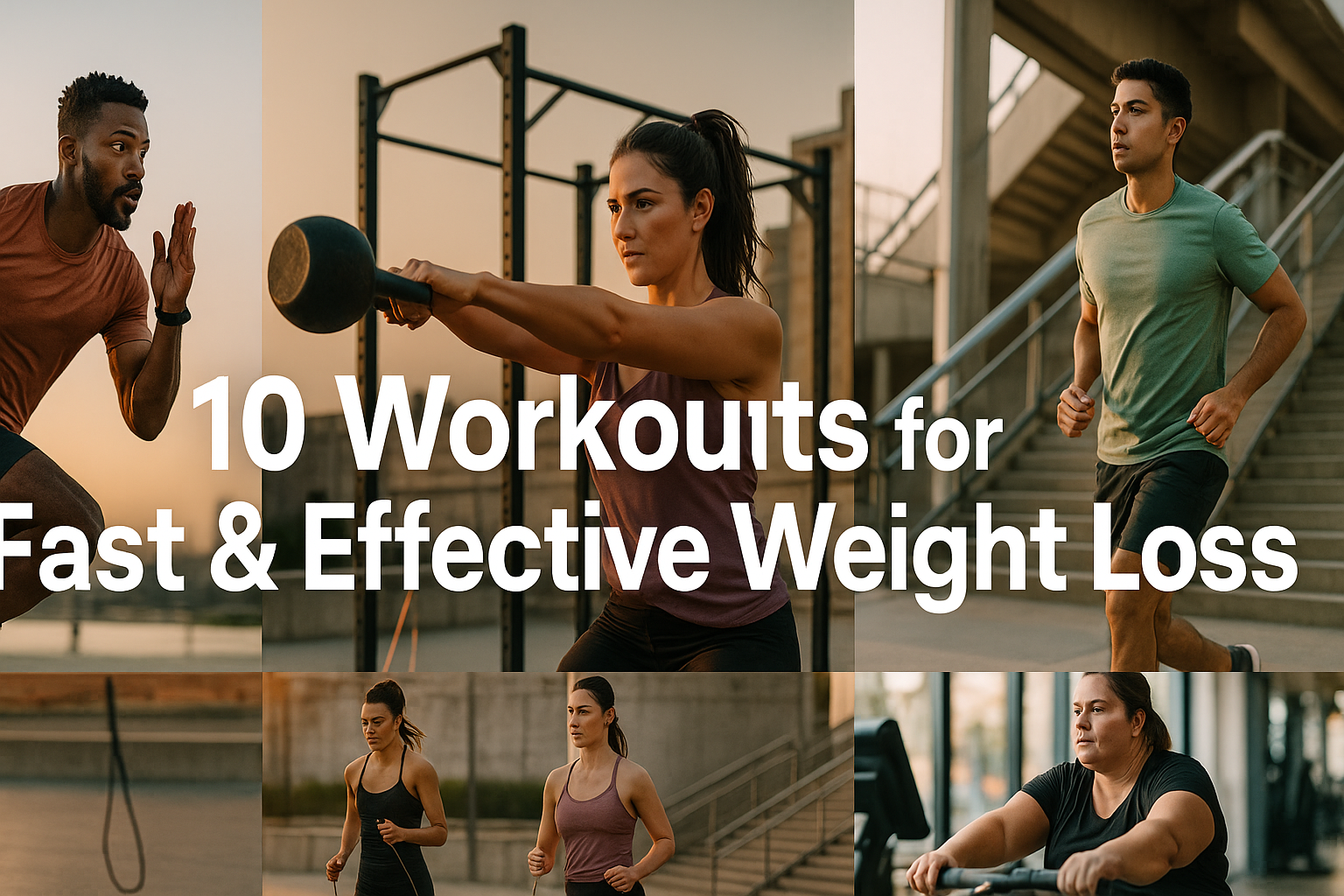
If you want workouts that burn serious calories, build stamina, and help you see measurable change, you’re in the right place. This guide breaks down ten proven training options—each designed to be fast, scalable, and practical—so you can choose the best match for your schedule and fitness level. Within the first few sessions you’ll know how to structure your week, what to track, and how to progress for effective weight loss.
Quick note: Exercise is powerful, but it works best alongside sleep, stress management, and nutrition. For medical conditions, injuries, pregnancy, or new-to-exercise situations, talk with a qualified health professional before making changes.
Key takeaways
- Short, intense sessions work as well as longer steady workouts when done properly and consistently.
- Strength plus cardio wins for fat loss and long-term maintenance; don’t skip resistance training.
- Simple metrics—time, RPE (effort), steps, and waist measurements—tell the truth about progress.
- Consistency beats perfection: 3–5 sessions per week is the sweet spot for most.
- Warm up dynamically, start easy, and progress weekly to prevent injury and plateaus.
- Aim for gradual loss (about 0.5–1.0 kg / 1–2 lb per week) and adjust volume or nutrition if progress stalls.
Warm-up: 5-minute quick-start checklist
- Raise: 2 minutes of easy movement (march in place, light cycling, or brisk walking).
- Mobilize: 30–60 seconds each of ankle circles, hip openers, arm circles, and gentle torso rotations.
- Activate: 10 bodyweight squats, 10 glute bridges, 10 push-ups (elevated if needed), 20-second plank.
- Prime: 2–3 short rehearsal bursts (10–20 seconds) at the intensity you’ll use in the workout, then rest fully.
This dynamic sequence warms tissue, rehearses movement patterns, and prepares your nervous system for higher effort.
How to measure intensity (you’ll use this everywhere)
- RPE (Rate of Perceived Exertion) 0–10:
- 3–4 = easy conversation pace
- 5–6 = steady “working” pace
- 7–8 = hard, short sentences
- 9–10 = very hard to all-out, only brief efforts
If you prefer heart rate, think moderate ≈ 64–76% max HR and vigorous ≈ 77–95% max HR. RPE is enough for most people.
1) HIIT Running (or Fast Walk) Intervals
What it is & why it works
High-intensity interval training alternates short bursts of hard work with recovery. It’s time-efficient, improves fitness, and supports fat loss when performed 2–3 times per week. Intervals can be done on a track, treadmill, or outdoors. If running isn’t your thing, use a fast walk on an incline.
Requirements & low-cost alternatives
- Optional: running shoes, a stopwatch or phone timer.
- Alternative: replace running with fast incline walking or light jogs.
Step-by-step (beginner)
- Warm up (5 minutes).
- Work: 30 seconds at RPE 8 (hard).
- Recover: 60–90 seconds easy walk (RPE 2–3).
- Repeat 8–10 rounds.
- Cool down 3–5 minutes.
Modifications & progressions
- Easier: 20s hard / 100s easy; use brisk walking.
- Harder: 45s hard / 45s easy, or 60s hard / 60s easy; add 1–2 rounds weekly up to 12–14.
Frequency / duration / metrics
- 2–3 sessions per week; 15–25 total minutes per session.
- Track rounds completed at target RPE and average recovery time.
Safety & common mistakes
- Don’t sprint cold; keep strides short and land softly.
- Avoid doing HIIT on back-to-back days at first.
Mini-plan sample
- Day 1: 8 × (30s hard / 90s easy).
- Day 2: 10 × (30s hard / 60s easy).
2) Brisk Walking Intervals (Interval Walking)
What it is & why it works
Interval walking alternates fast and moderate walking. It’s joint-friendly, excellent for beginners or those returning from a layoff, and shows meaningful improvements in fitness and body composition when matched for total work.
Requirements & low-cost alternatives
- Good shoes; a safe route or treadmill.
- Optional: slight incline to raise intensity without impact.
Step-by-step (beginner)
- Warm up 5 minutes easy.
- Fast walk: 3 minutes at RPE 6–7 (arm swing, strong push-off).
- Moderate: 3 minutes at RPE 3–4.
- Repeat 4–5 cycles.
- Cool down 3–5 minutes.
Modifications & progressions
- Easier: 2 min fast / 3 min moderate.
- Harder: 4 min fast / 2 min moderate; add mild hills; extend to 40–45 minutes.
Frequency / duration / metrics
- 4–6 days per week, 30–45 minutes.
- Track distance covered per session or average pace during fast segments.
Safety & common mistakes
- Posture tall, eyes forward; avoid overstriding.
- If shins ache, shorten steps and slow slightly.
Mini-plan sample
- Session A: 5 × (3 min fast / 3 min moderate).
- Session B: 6 × (2 min fast / 2 min moderate).
3) Bike Intervals (Indoor or Outdoor)
What it is & why it works
Cycling intervals deliver a big cardiovascular punch with low impact on joints. They’re great for “all gas, no pounding” days and scale perfectly from beginner to advanced.
Requirements & alternatives
- Stationary bike, spin bike, or road bike.
- No bike? Substitute stair machine or elliptical.
Step-by-step (beginner)
- Warm up 5–7 minutes easy pedaling.
- Work: 40 seconds at RPE 8 (increase resistance).
- Recover: 80 seconds easy.
- Repeat 8–10 rounds.
- Cool down 5 minutes.
Modifications & progressions
- Easier: 30s on / 90s off at RPE 7.
- Harder: 60s on / 60s off; or 8 × 20s all-out / 100s easy (“supra-hard” but brief).
Frequency / duration / metrics
- 2–3 times per week; 20–30 minutes.
- Track average watts (if available) or perceived resistance at target cadence.
Safety & common mistakes
- Keep knees tracking over mid-foot; avoid excessive rocking.
- Don’t grind at very low cadence—target 80–100 rpm during work bouts unless specifically sprinting.
Mini-plan sample
- Session A: 10 × (40s hard / 80s easy).
- Session B: 6 × (60s hard / 60s easy).
4) Rower (Erg) Pyramid
What it is & why it works
Rowing is a full-body, low-impact calorie burner that hits legs, core, and back. Short pyramids keep focus and technique sharp while elevating heart rate fast.
Requirements & alternatives
- Rowing machine (Concept2 or similar).
- Alternative: SkiErg if available.
Step-by-step (beginner)
- Warm up 5–6 minutes easy (focus on sequence: legs → hips → arms).
- Row hard for 1 minute (RPE 7), rest 1 minute.
- Row hard 90 seconds (RPE 8), rest 90 seconds.
- Row hard 2 minutes (RPE 8), rest 2 minutes.
- Descend: 90s hard, 1 min hard, with equal rests.
- Cool down 3–5 minutes.
Modifications & progressions
- Easier: Keep all hard intervals at 1 minute.
- Harder: Add a 2:30 or 3:00 peak; include a second pyramid.
Frequency / duration / metrics
- 1–2 times per week; 20–25 minutes total.
- Track split time (pace/500m) and strokes per minute (spm).
Safety & common mistakes
- Don’t lift with the arms first—drive with legs.
- Neutral spine; pause if lower back fatigue appears.
Mini-plan sample
- Pyramid: 1:00 / 1:30 / 2:00 / 1:30 / 1:00 hard with equal rest.
5) Jump Rope Finisher
What it is & why it works
Jump rope is portable, skill-building cardio that ramps up intensity quickly. It pairs well after strength sessions or as a standalone short workout.
Requirements & alternatives
- A properly sized rope (handles to armpits when stepped on).
- Alternative: low-impact “phantom” jumps without a rope.
Step-by-step (beginner)
- Warm up with 60 seconds of slow singles.
- Work: 45 seconds steady jumps (RPE 6–7).
- Recover: 45–60 seconds march or air rope.
- Repeat 8–10 rounds.
Modifications & progressions
- Easier: 30s on / 60s off; mix in side-to-side steps.
- Harder: 60s on / 30s off; add high knees or occasional double-unders.
Frequency / duration / metrics
- 2–4 times per week; 10–20 minutes.
- Count unbroken reps or total jumps per session.
Safety & common mistakes
- Stay on the balls of the feet, elbows tucked; keep jumps low.
- If calves get sore, alternate with cycling/walking days.
Mini-plan sample
- Session A: 10 × (45s jump / 45s rest).
- Session B: EMOM 12 minutes—40–60 smooth jumps, then rest the remainder.
6) Full-Body Strength Circuits (Metabolic Resistance Training)
What it is & why it works
Strength circuits train big movement patterns back-to-back with minimal rest. You’ll preserve or gain lean mass (critical for metabolism) while elevating heart rate enough to support fat loss.
Requirements & low-cost alternatives
- Dumbbells or kettlebells; substitute bands or bodyweight if needed.
- A timer.
Step-by-step (beginner)
Perform 3–4 rounds with 45 seconds work / 30 seconds transition:
- Goblet squat (or sit-to-stand)
- Push-up (hands on bench if needed)
- Hip hinge (DB/RDL or hip bridge)
- Row (dumbbell or band)
- Carry (farmer’s carry or suitcase carry)
Modifications & progressions
- Easier: 30s work / 30–45s rest; use lighter loads.
- Harder: Heavier weights; reduce rest; add a sixth station (lunges).
Frequency / duration / metrics
- 2–3 days per week; 25–35 minutes.
- Track loads used and quality reps per station.
Safety & common mistakes
- Own the basics: neutral spine on hinges, full foot in squats, ribs down during presses.
- Don’t rush through sloppy reps—speed comes from efficiency, not chaos.
Mini-plan sample
- Circuit: 4 rounds of 45s per move, 30s transition, 90s rest between rounds.
7) Kettlebell Swings & Complexes
What it is & why it works
Swings are a hip-dominant power move that spike heart rate and train posterior chain strength. Complexes (sequences without putting the bell down) create a cardio-strength effect in minutes.
Requirements & low-cost alternatives
- One kettlebell (start with ~8–12 kg for many beginners; adjust to capability).
- Alternative: dumbbell swings or hip hinges if no kettlebell.
Step-by-step (beginner)
- Learn the hinge: deadlift pattern → hike → swing to chest height.
- Swings: 15–20 swings, rest 60–90 seconds; repeat 6–8 sets.
- For a complex: 5 swings → 5 goblet squats → 5 presses per side; rest 90 seconds; repeat 3–5 rounds.
Modifications & progressions
- Easier: Deadlifts only or swing sets of 10.
- Harder: Heavier bell, reduce rest, or try cleans → presses → front squats.
Frequency / duration / metrics
- 2–3 times per week; 10–20 minutes focused work.
- Track total quality swings and bell weight.
Safety & common mistakes
- Swing from the hips, not the arms; lock lats; neutral spine.
- Park the bell safely between sets; don’t round on the pickup.
Mini-plan sample
- Session A: 8 × 15 swings, 60–75s rest.
- Session B: Complex—5 swings → 5 squats → 5 presses/side × 4 rounds.
8) Swim Intervals
What it is & why it works
Swimming is joint-friendly, full-body, and excellent when you need a lower-impact day. Intervals let you keep sessions short while boosting calorie burn and fitness.
Requirements & alternatives
- Pool access, goggles, and a kickboard (optional).
- Alternative: water jogging in the shallow end.
Step-by-step (beginner)
- Warm up 200m easy (or 5 minutes water jog).
- Work: 50m strong (RPE 7),
- Recover: 50m easy (RPE 3).
- Repeat 10–12 rounds.
- Cool down 100–200m easy.
Modifications & progressions
- Easier: 25m work / 50m easy; use fins or kickboard.
- Harder: 8 × 100m at RPE 7–8 with equal easy 100m.
Frequency / duration / metrics
- 1–3 times per week; 20–30 minutes.
- Track total distance and average pace per 50–100m.
Safety & common mistakes
- Keep a relaxed breathing rhythm; don’t fight the water.
- Alternate strokes to spread the load.
Mini-plan sample
- Session A: 10 × (50m strong / 50m easy).
- Session B: Ladder—25/50/75/100/75/50/25 strong with equal easy.
9) Stair Climbing Sessions
What it is & why it works
Stairs deliver vigorous intensity fast, using large leg muscles and elevating heart rate with minimal equipment. Excellent for apartment buildings, stadiums, or stair machines.
Requirements & alternatives
- Safe stairwell or stepmill; grippy shoes.
- Alternative: step-ups on a sturdy bench.
Step-by-step (beginner)
- Warm up on flat ground.
- Work: climb 1–2 flights at RPE 7.
- Recover: walk down slowly and rest 30–60s.
- Repeat for 15–20 minutes total.
Modifications & progressions
- Easier: Single flight at RPE 6; use handrail.
- Harder: Two steps at a time; add a weighted backpack (start light).
Frequency / duration / metrics
- 2–4 times per week; 15–25 minutes.
- Track flights climbed or floors on the stepmill.
Safety & common mistakes
- Keep posture tall; don’t yank on the rails.
- Descend carefully; slower down than up.
Mini-plan sample
- Session A: 12–15 rounds of 1–2 flights up, easy down.
- Session B: 5 × 2-min continuous climbs, 2-min easy.
10) Bodyweight EMOM (Every Minute on the Minute)
What it is & why it works
Short, structured sets at the turn of each minute keep intensity honest and rest controlled—perfect for home training without equipment.
Requirements & alternatives
- Timer.
- Substitute movements to fit you: elevated push-ups, chair squats, wall sits.
Step-by-step (beginner)
Set a 12-minute EMOM:
- Minute 1: 12 squats
- Minute 2: 8–10 push-ups
- Minute 3: 20–30 mountain climbers (each knee = 1)
Repeat for 4 total rounds.
Modifications & progressions
- Easier: Reduce reps; extend to E90S (every 90 seconds).
- Harder: Add reps; switch to jump squats or decline push-ups.
Frequency / duration / metrics
- 2–4 times per week; 12–20 minutes.
- Track total reps completed with good form.
Safety & common mistakes
- Maintain a neutral spine; set hands under shoulders for push-ups.
- Stop a few reps shy of sloppy form.
Mini-plan sample
- Session A: 12-min EMOM (squats, push-ups, climbers).
- Session B: 15-min EMOM—lunges (L), lunges (R), plank.
Troubleshooting & common pitfalls
- Doing HIIT every day. Intervals are potent—stacking them daily invites fatigue. Alternate hard and easier days.
- Skipping strength work. Cardio helps weight loss; strength preserves lean mass so the weight you lose is mostly fat.
- Underestimating recovery. Sleep 7–9 hours when possible; take easy days seriously.
- Going too hard, too soon. Start with conservative volumes; add only 5–10% more time, rounds, or load per week.
- All-or-nothing weeks. Two short sessions beat a “perfect plan” you can’t sustain.
How to track progress (simple, not obsessive)
- Body metrics:
- Scale weight, waist circumference, and progress photos once weekly under similar conditions.
- Fitness metrics:
- Total intervals completed at target RPE; distance per session; average split or pace; loads used for strength moves.
- Lifestyle metrics:
- Steps per day and sleep hours. Small improvements here often move the scale.
Adjust training or nutrition if two consecutive weeks show no change in scale or waist and workouts feel easy—add one session or extend one session by 5–10 minutes, or tighten portion sizes.
A simple 4-week starter plan (3–5 hours per week)
Weekly rhythm:
- Mon – Strength circuit (30–35 min)
- Tue – HIIT run/walk (20–25 min)
- Wed – Brisk walking or swim (30–40 min, easy-moderate)
- Thu – Kettlebell swings or EMOM (15–20 min)
- Fri – Rest or mobility (10–20 min casual)
- Sat – Bike or rower intervals (20–30 min)
- Sun – Stairs or hike (20–30 min) + optional easy walk
Progressions
- Week 1: Do the minimal volumes listed in each workout.
- Week 2: Add 1 round or 2–3 minutes to two sessions.
- Week 3: Increase intensity slightly (RPE +1) on one interval day and add weight to one strength day.
- Week 4: Keep intensity, add one easy zone session (20–30 minutes) or extend one recovery walk.
If fatigue climbs (sleep worsens, motivation drops), hold volume steady for a week before progressing.
Safety essentials
- Warm up dynamically before each session and cool down after.
- Favor progress over heroics—especially on stairs, swings, and sprints.
- Hydrate, and don’t train through sharp pain.
- For heart, metabolic, or orthopedic conditions, get individualized clearance and guidance.
FAQs
- How many days per week should I train for fast and effective weight loss?
Aim for 4–5 training days mixing 2–3 cardio interval sessions and 2–3 strength-focused sessions. At minimum, hit 150–300 minutes/week of moderate or 75–150 minutes/week of vigorous activity across the week, using combinations that suit your schedule. - What’s better for fat loss—HIIT or steady-state cardio?
Both work. Intervals are time-efficient and can reduce fat comparably to longer steady sessions when total work is similar. Many people do best with a mix of the two. - Do I need to lift weights if I’m mainly trying to lose fat?
Yes—include resistance training 2–3 days weekly to preserve lean mass and strength while you lose weight. That helps maintain your resting energy expenditure and improves body composition. - How fast should I expect results?
A realistic target is about 0.5–1.0 kg (1–2 lb) per week when you pair training with nutrition that supports a moderate calorie deficit. Faster rates are harder to maintain and may cost muscle. - How do I set interval intensity without a heart-rate monitor?
Use RPE. Work intervals at RPE 7–9 (hard to very hard, short sentences only) and recover at RPE 2–3. It’s simple and correlates well with physiological effort. - Can I do HIIT daily if I alternate exercises?
It’s better not to. Limit high-intensity days to 2–3 per week, separated by easier sessions or rest to avoid overuse and support recovery. - What if running hurts my knees?
Switch to cycling, rowing, swimming, or incline walking. You’ll still get vigorous intensity without the impact. - I’m short on time—what’s the single most efficient workout here?
Bike or rower intervals (15–20 minutes door to door) or a 12–15 minute bodyweight EMOM. Consistency beats complexity. - How do I know if I’m losing fat and not just water?
Combine the scale with waist measurements, progress photos, and performance metrics. Dropping waist size and holding or improving lifts or intervals usually indicates fat loss with muscle retention. - What should I eat around these workouts?
Keep it simple: protein across the day, carbs near harder sessions if tolerated, vegetables, fruits, and water. Precise nutrition varies—if you have medical or dietary needs, consult a professional. - Are stair workouts safe if I’m a beginner?
Yes—start with short bouts, use the handrail, and focus on controlled descents. Build gradually. - How do I break plateaus?
First, check sleep and steps. Then add one set, extend a session by 5 minutes, or increase intensity slightly (RPE +1) once or twice per week. Reassess nutrition if progress stalls for two straight weeks.
Conclusion
You don’t need marathon workouts to transform how you look, feel, and perform. Mix two to three short interval sessions with two to three strength-focused days, measure a few simple metrics, and progress a little each week. In a month you’ll feel the difference; in three, others will see it.
CTA: Pick two workouts from this list and schedule them for this week—then add one new session next week. Start today.
References
- Physical Activity Guidelines for Americans, 2nd Edition. U.S. Department of Health and Human Services (2018). https://health.gov/sites/default/files/2019-09/Physical_Activity_Guidelines_2nd_edition.pdf
- The Physical Activity Guidelines for Americans. Office of Disease Prevention and Health Promotion (2018). https://odphp.health.gov/healthypeople/tools-action/browse-evidence-based-resources/physical-activity-guidelines-americans-2nd-edition
- American College of Sports Medicine Position Stand: Appropriate Physical Activity Intervention Strategies for Weight Loss and Prevention of Weight Regain for Adults. Medicine & Science in Sports & Exercise (2009). PubMed. https://pubmed.ncbi.nlm.nih.gov/19127177/
- Is interval training the magic bullet for fat loss? A systematic review and meta-analysis. British Journal of Sports Medicine (2019). https://bjsm.bmj.com/content/53/10/655
- Comparable Effects of High-Intensity Interval Training and Prolonged Continuous Exercise Training on Abdominal Visceral Fat Reduction in Obese Young Women. Journal of Diabetes Research (2017). https://pmc.ncbi.nlm.nih.gov/articles/PMC5237463/
- The Effects of Free-Living Interval-Walking Training on Glycemic Control, Body Composition, and Physical Fitness in Type 2 Diabetes. Diabetes Care (2013). https://pmc.ncbi.nlm.nih.gov/articles/PMC3554285/
- Effects of aerobic and/or resistance training on body mass and fat mass in overweight or obese adults. Journal of Applied Physiology (2012). PDF. https://journals.physiology.org/doi/pdf/10.1152/japplphysiol.01370.2011
- Resistance Training Preserves Fat-Free Mass Without Affecting Resting Metabolic Rate During Weight Loss: Meta-analytical Findings. International Journal of Sport Nutrition and Exercise Metabolism (review). https://pmc.ncbi.nlm.nih.gov/articles/PMC4299870/
- Steps for Losing Weight. Centers for Disease Control and Prevention (2025). https://www.cdc.gov/healthy-weight-growth/losing-weight/index.html