


















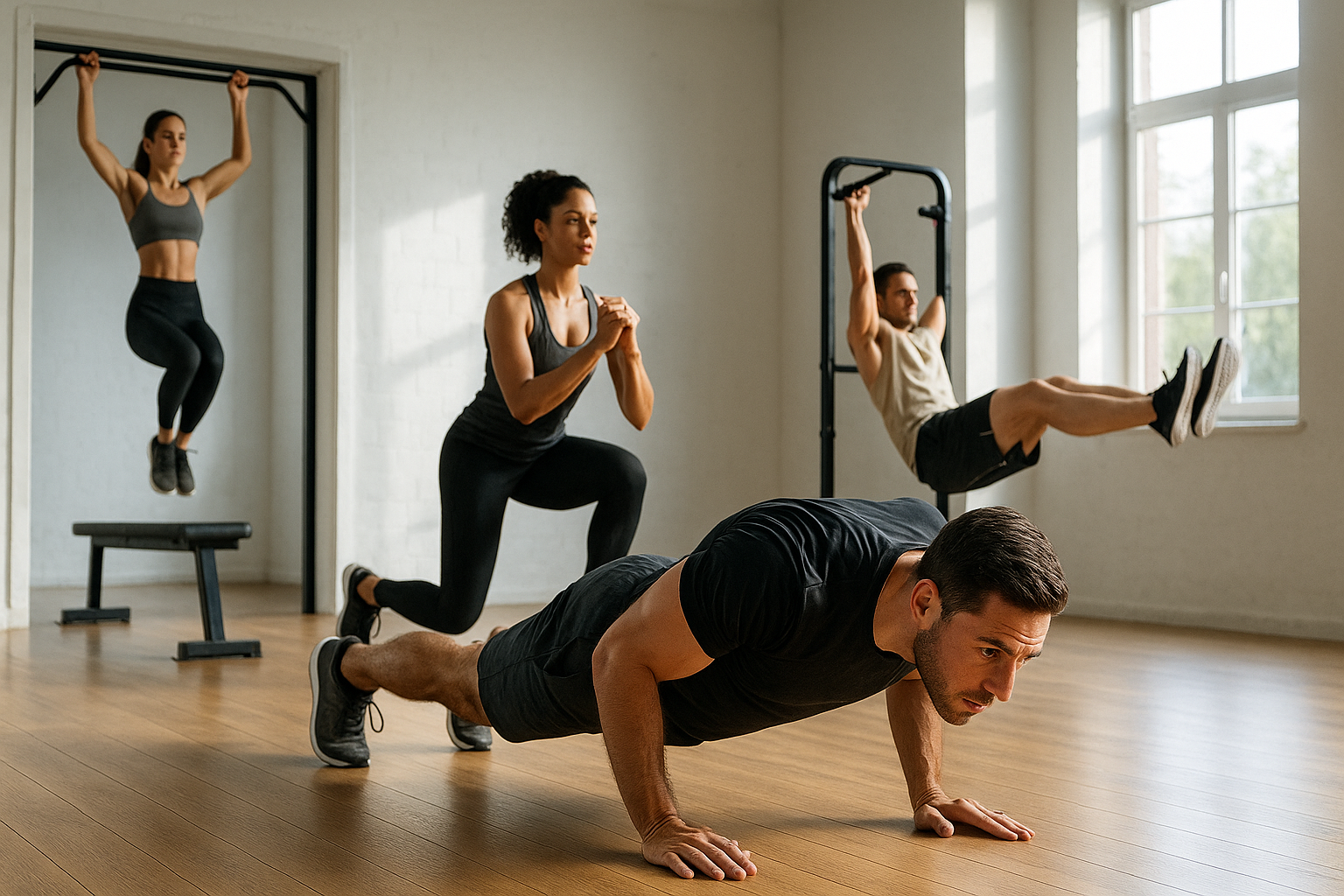
If you want to get stronger without a gym, these 12 movements are your foundation. The best bodyweight exercises for strength are big, multi-joint patterns that you can load by manipulating leverage, range of motion, tempo, and unilateral work. Below you’ll find exactly how to perform each exercise, smart progressions (beginner to advanced), and evidence-based rep ranges so you can train hard and safely at home. Quick answer: pick 4–6 of the exercises that fit your goals, perform 3–5 hard sets each at 0–3 reps in reserve (RIR), rest 2–3 minutes, and progress weekly by making one variable harder. This article is for beginners through advanced trainees who want real, measurable strength from minimal equipment. As with any training plan, if you have a medical condition or injury, speak with a qualified professional first.
Within the first weeks, expect faster neuromuscular gains; sustained strength increases follow with consistent progressive overload. For reference points on loading and proximity to failure, we’ll use the RIR-based RPE scale (how many reps you could have done if you kept going).
1. Push-Up (to One-Arm Push-Up)
Push-ups are the most scalable horizontal press for building chest, shoulder, and triceps strength at home. They’re “best” because they accept precise progression: elevating hands to regress, feet-elevating or narrowing base to progress, adding pauses/tempo to load, and ultimately moving toward archer and one-arm variations. When muscle activation and effort are matched, push-ups can drive strength similarly to the bench press, making them a legitimate main lift in a minimalist program. Program 3–5 sets at a hard but repeatable effort (0–3 RIR), resting 2–3 minutes for strength emphasis. Use full range, rigid midline, and aim for consistent rep speed.
1.1 How to Do It
- Set hands just outside shoulder width; screw palms into the floor.
- Brace ribs down, squeeze glutes, and keep a straight line ankles→hips→shoulders.
- Lower for ~2–3 seconds until chest is 2–5 cm above the floor.
- Pause 1 second; press up powerfully without flaring elbows.
- Keep neck neutral; finish with elbows locked and shoulders protracted slightly.
1.2 Numbers & Guardrails
- Strength focus: 4–6 sets × 5–12 reps with 2–3 min rest, 0–3 RIR.
- Tempo options: 3–1–X–1 (down–pause–up–pause) for added difficulty.
- Progress when you can complete all sets at target RIR; increase difficulty (see below).
- Monitor effort via RIR (RPE): aim RPE 7–9 for main sets.
1.3 Progressions & Regressions
- Easier: hands elevated on bench/table; knees down (short-term only).
- Lateral: close-grip; ring/suspension push-ups for stability demand.
- Harder: feet-elevated, archer, pseudo-planche (hands near hips), one-arm (use wide legs).
1.4 Common Mistakes
- Sagging hips or flared ribs; rushing the eccentric; half-reps; shrugging shoulders; hands too narrow too soon.
Mini-case: Week 1: 5×8 feet-elevated @ 2 RIR, 3–1–X–1. Week 4: 5×10 same setup @ 1 RIR; add 2-sec pause at the bottom next week. Bottom line: Treat the push-up like a main lift and it will return main-lift strength.
2. Pull-Up / Chin-Up
Pull-ups (pronated) and chin-ups (supinated) are the gold-standard vertical pulls for back and arm strength. Chin-ups generally bias biceps and pectoralis major a bit more; pull-ups hit lower trapezius a bit more—use both across cycles for balanced development. Start with controlled dead-hangs and scapular movement; progress via slower eccentrics, pauses, and harder grips. If you can’t yet perform a strict rep, use slow negatives, isometric holds, or band assistance as temporary tools.
2.1 How to Do It
- Grip bar just outside shoulder width; thumbs around.
- Set shoulders (depress/retract), brace, and pull chest toward bar.
- Pause briefly with chin over bar; lower under control to a full dead-hang.
- Keep ribs down; avoid excessive leg swing.
2.2 Numbers & Guardrails
- Strength mix: 4–6 sets × 3–8 reps, 2–3 min rest, 0–2 RIR.
- If 0–2 reps strict: 5–8 × 1-rep clusters or 6–8 eccentric-focused reps (4–6 s down).
- Advanced density: EMOM 3–5 reps × 10 min.
2.3 Progressions & Regressions
- Easier: band-assisted; foot-assisted on a box; isometric top holds.
- Harder: chest-to-bar; archer; thicker towel grips; slow 5–1–X–2 tempo.
- Variations: neutral-grip for wrists; L-sit pull-ups for core.
Notes: EMG studies show broadly similar lat, biceps, and posterior deltoid activity across strict variations; towel grips may reduce mid-trap versus straight bar. Program both grips across a training block. Takeaway: Own a smooth, paused strict rep before adding kipping or advanced grip tricks. ResearchGate
3. Dip (Parallel Bar or Stable Chairs)
Dips are a heavy bodyweight press that loads chest, anterior deltoids, and triceps through a deep range. They complement push-ups by emphasizing the lower fibers of the pecs and lockout strength. Because the shoulder is in extension, prioritize gradual depth exposure and strict control to protect the front of the shoulder. Rings increase stabilizer demand; bars allow higher loads and easier progression.
3.1 How to Do It
- Start atop supports with elbows locked; shoulders down and back.
- Lean torso slightly forward; descend until shoulders just below elbows.
- Keep forearms vertical; avoid shrugging.
- Pause lightly at bottom; press to full lockout without flaring ribs.
3.2 Numbers & Guardrails
- Strength work: 4–6 sets × 3–8 reps, 2–3 min rest, 0–2 RIR.
- If too hard: use band-assisted dips between bars or bench dips temporarily.
- Shoulder comfort rule: stop 1–2 cm short of painful range; add depth over weeks.
3.3 Progressions & Regressions
- Easier: band-assist; higher hand supports; limited ROM partials.
- Harder: slow eccentrics; 2-sec paused bottom; ring dips; archer dips.
Mini-checklist: neutral neck, ribs down, elbows tracking ~45–60°, full lockout each rep. Bottom line: Respect depth, control the bottom, and dips will build serious pressing strength with minimal gear. MDPI
4. Inverted Row (Table/Rings/Bar)
The inverted row is your horizontal pull: scalable, shoulder-friendly, and great for mid-back and grip strength. Unlike bent-over rows, it’s accessible at home with a sturdy table edge, low bar, or rings. Adjust your body angle to fine-tune difficulty; elevate feet to increase load. Pairing rows with push-ups balances pressing volume and supports shoulder health.
4.1 How to Do It
- Set a bar/rings around hip height; lie under with heels on the floor.
- Grip shoulder-width; body straight; squeeze glutes and brace.
- Row chest to the implement; pause 1 second with shoulder blades squeezed.
- Lower under control to straight elbows.
4.2 Numbers & Guardrails
- Strength emphasis: 4–6 sets × 5–12 reps at 0–2 RIR, 90–120 s rest for high-density sets or 2–3 min for heavier feet-elevated sets.
- Tempo: 2–1–X–2 or 3–1–X–2 for harder loading.
4.3 Progressions & Regressions
- Easier: raise the handles (more upright body), bend knees.
- Harder: feet elevated; pause at top; archer rows; towel/thick grips.
Tip: TRX/suspension versions can increase stabilization demand without necessarily reducing prime-mover activation—use both fixed and unstable setups across cycles. Synthesis: Own a strict, chest-to-bar row at multiple angles to support pull-ups and posture.
5. Bulgarian Split Squat (Rear-Foot-Elevated)
The Bulgarian split squat (rear-foot-elevated split squat) is a unilateral squat pattern that drives leg strength with minimal load. It emphasizes quads and glutes, challenges balance, and creates high local tension—excellent for strength when done for low-to-moderate reps with long rests. Research shows single-leg squats and RFESS can produce muscle activation comparable to back squats at lower external loads, with unique hip moments and hamstring activity profiles.
5.1 How to Do It
- Elevate back foot on a bench at mid-shin height.
- Step forward so the front knee can travel over toes without heel lift.
- Descend under control; slight torso forward; keep front knee tracking toes.
- Pause near bottom; drive through whole foot to stand tall.
5.2 Numbers & Guardrails
- Strength sets: 3–5 sets × 5–10 reps/leg, 2–3 min rest between hard sets.
- Depth guide: front thigh ~parallel or slightly below; avoid rear-hip cramping by adjusting bench height.
- Add difficulty via longer eccentrics, bottom pauses, or slow continuous reps.
5.3 Progressions & Regressions
- Easier: split squat flat (rear foot on floor); reduce depth.
- Harder: front-foot elevated; 3–1–X–1 tempo; heel-elevated to bias quads; hands-overhead for midline challenge.
Example: Week 1: 4×8/leg @ 2 RIR. Week 4: 5×6/leg @ 1 RIR with 3-s lowers. Bottom line: If you master RFESS, you’ll build serious unilateral leg strength and bulletproof knees and hips.
6. Pistol Squat (Single-Leg Squat)
The pistol squat is a high-tension single-leg squat that demands strength through full knee and hip flexion. It’s a top choice for advanced trainees because it produces high quadriceps and glute demand without external load and teaches control at deep ranges. If you’re newer, you’ll work through step-downs, box pistols, and assisted variations first. Keep reps crisp and symmetrical side-to-side.
6.1 How to Do It
- Stand tall on one foot; extend free leg forward.
- Reach hips back slightly, then sit down under control as the knee tracks over toes.
- Stay tight in the midline; lightly tap glute to box/floor; drive up through mid-foot.
- Keep heel down; avoid collapsing the arch.
6.2 Numbers & Guardrails
- Strength focus: 4–6 sets × 3–6 reps/leg, 2–3 min rest, 0–2 RIR.
- Early progressions use higher box targets and assistance (pole, band, doorframe).
- Guard the knee by controlling the eccentric (2–4 s) and limiting valgus.
6.3 Progressions & Regressions
- Easier: step-downs; box pistols; counterweight pistols.
- Harder: tempo pistols; pause pistols; Cossack squat work for mobility carryover.
Synthesis: Build to controlled, full-range pistols on both legs, and bilateral squats will feel lighter, too.
7. Nordic Hamstring Curl (Partner/Anchor)
The Nordic hamstring curl is the premier bodyweight knee-flexion exercise for eccentric hamstring strength. It’s simple (anchor heels, lower slowly) and brutally effective. Beyond strength, multiple trials and meta-analyses show including Nordics in sport programs roughly halves hamstring injury rates, making it a high-value addition even for general trainees who sprint or play field sports recreationally. Progress slowly: shallow range and strong assistance at first.
7.1 How to Do It
- Pad knees; anchor heels (partner holds ankles or use a sturdy couch/strap).
- Knees hip-width; body straight from knees to head; arms crossed.
- Lower forward as slowly as possible; catch with hands before you drop.
- Push lightly off the floor to return (assisted concentric), or use bands.
7.2 Numbers & Guardrails
- Strength emphasis: 3–5 sets × 3–6 eccentric reps (4–6 s down), 2–3 min rest.
- Injury-prevention dose used in sport (for context): 1–3 sessions/week, low-to-moderate volume.
- Expect intense soreness initially; progress range gradually.
7.3 Progressions & Regressions
- Easier: shorten lever (band-assist at chest), reduce range, increase hand push-off.
- Harder: longer eccentrics, isometric holds en route, minimal hand support.
Bottom line: The Nordic is hard but worth it—evidence-backed for strength and resilience.
8. Hip Thrust / Single-Leg Glute Bridge
For hip extension strength, the hip thrust and single-leg bridge are your bodyweight go-tos. They heavily target the gluteus maximus with low back-friendly mechanics. In EMG studies, hip thrusts show high glute activation; single-leg bridges (with pauses and slow tempos) bring similar benefits without external load. Use a bench or couch edge if available; otherwise, floor bridges with long pauses are excellent. ACSM
8.1 How to Do It
- Set upper back on a bench (hip thrust) or lie on floor (bridge).
- Feet hip-width; shins vertical at top position.
- Drive hips up, ribs down; pause 1–3 seconds while squeezing glutes.
- Lower under control to just above floor, keeping pelvis neutral.
8.2 Numbers & Guardrails
- Strength focus: 4–6 sets × 6–15 reps (single-leg: 5–10/side), 90–180 s rest.
- Emphasize long top pauses and full hip extension for tension, not speed.
- Avoid excessive lumbar extension—keep belly-brace and neutral ribcage.
8.3 Progressions & Regressions
- Easier: two-leg bridge; short range (1–2 sec top holds).
- Harder: single-leg with 3–5 s top holds; slow 3–1–X–3 tempos; feet-elevated.
Synthesis: Locking in strong, symmetrical hip extension carries over to running, jumping, and squatting.
9. Pike Push-Up → Handstand Push-Up
For vertical pressing strength without weights, pike push-ups progressing toward handstand push-ups are your path. The pike shifts load toward the shoulders and triceps; elevating feet and stacking hips increases intensity. Handstand push-ups add a true overhead press stimulus using only bodyweight. Keep cervical spine neutral, control the eccentric, and build range with partials and target depth (e.g., yoga blocks or books).
9.1 How to Do It
- Start in a pike: hips high, hands shoulder-width, elbows locked.
- Lower head toward a tripod base (two hands + head form a triangle).
- Pause gently near the floor/target; press back to locked elbows.
- For HSPU: work from wall-assisted partials to full range.
9.2 Numbers & Guardrails
- Strength: 4–6 sets × 3–8 reps, 2–3 min rest, 0–2 RIR; longer rests as you near max strength.
- Start with elevated-feet pike for load; progress to wall HSPU negatives and partial ROM.
9.3 Progressions & Regressions
- Easier: downward-dog push-ups; hands-elevated piked.
- Harder: feet-elevated piked; wall HSPU with 2–3 s eccentrics; freestanding HSPU.
Bottom line: Treat pike/HSPU like heavy presses—slow down, pause, and add range to keep progressing safely.
10. Hanging Leg Raise (to Toes-to-Bar)
Hanging leg raises are a high-tension anterior chain exercise that strengthen the abs and hip flexors while training grip and shoulder stability. Compared with many floor moves, hanging raises often produce high abdominal activation; they can also increase spine loads, so progress gradually and keep ribcage tucked to avoid over-arching. Start with hanging knee raises, then extend the lever as you get stronger.
10.1 How to Do It
- Hang from a bar; engage lats lightly and keep ribs down.
- Raise knees (easier) or straight legs (harder) by posteriorly tilting the pelvis first.
- Pause 1 second; lower under full control without swinging.
- Keep head neutral; avoid yanking with hip flexors alone.
10.2 Numbers & Guardrails
- Strength: 4–6 sets × 5–12 reps, 90–180 s rest; slow eccentrics (2–4 s) and pauses amplify load.
- If grip fails early, alternate sets with floor-based anti-extension work.
- Posture guardrail: initiate with pelvic tilt, not lumbar flexion alone.
10.3 Progressions & Regressions
- Easier: captain’s chair/knee raises; leg tuck holds.
- Harder: straight-leg raises; toes-to-bar; L-sit pull-ups.
Synthesis: Control motion with the pelvis and brace—quality reps outrun wild kipping every time. Semantic Scholar
11. Hollow Body to L-Sit (Isometric Core Strength)
The hollow body position teaches total-body tension that transfers to pull-ups, handstands, and pressing. Progressing that tension to an L-sit (on the floor, parallettes, or boxes) challenges hip flexors and deep abdominal control under longer levers. These isometrics are strength work: short, high-quality holds at near-max effort, accumulated across sets.
11.1 How to Do It
- Hollow: lie supine, ribs down; raise arms and legs to create a shallow “banana.”
- Press low back gently into the floor; breathe quietly without losing tension.
- L-sit: support on the floor/blocks; depress shoulders; extend legs to 90°.
- Keep quads tight and toes pointed; avoid shrugging.
11.2 Numbers & Guardrails
- Strength holds: 5–8 sets × 10–30 s (hollow) or 5–12 s (L-sit) with 45–90 s rest.
- Stay within positions you can control—no shaking or rib flare.
- Progress by lengthening levers (arms overhead, legs lower/straighter) or by extending hold times 2–5 s.
11.3 Progressions & Regressions
- Easier: tuck/L-sit with bent knees; one-leg extensions; hollow rock regressions.
- Harder: advanced tuck→full L-sit; L-sit to V-sit micro-pulses; weighted shoes for micro-loading.
Takeaway: Build a rock-solid trunk with short, repeatable holds that you can stack without form decay.
12. Reverse Nordic Curl (Quad Strength & Knee Control)
The reverse Nordic curl targets the quadriceps eccentrically through large knee-extension ranges, helping build anterior-chain strength without machines. Start with a very short range and ample padding; progress by increasing depth and slowing the eccentric. Recent research suggests RNE can increase quadriceps fascicle length and strength over 8 weeks—use it as a complement to split squats and pistols.
12.1 How to Do It
- Pad knees; kneel upright with hips extended and torso tall.
- Squeeze glutes and abs; slowly lean back as a unit, keeping a straight line from knees to head.
- Pause near end range; contract quads to return or use minimal hand support.
- Limit depth early; progress cautiously.
12.2 Numbers & Guardrails
- Strength: 3–5 sets × 6–10 controlled reps (3–5 s down), 2–3 min rest.
- Range increases of just 2–3 cm per week are enough; keep hips extended.
- If you feel knee joint discomfort (not muscle), reduce range and tempo.
12.3 Progressions & Regressions
- Easier: partial range with support; thicker pads; band-assisted.
- Harder: longer eccentrics; isometric holds near end range; slow continuous reps.
Bottom line: Dose RNE sparingly but consistently to round out quad strength and knee tolerance, especially if you run, jump, or do field sports.
FAQs
1) How many of these exercises should I do per workout for strength?
Choose 4–6 moves that cover key patterns: a horizontal press (push-up), vertical pull (pull-up), horizontal pull (row), a squat pattern (split squat or pistol), a hip hinge/extension (bridge/hip thrust or Nordic), and a core slot (hollow/L-sit or hanging raises). Perform 3–5 hard sets each at 0–3 RIR, resting 2–3 minutes for your heaviest sets. Rotate grips/variations weekly to keep progressing without overuse.
2) What rep ranges are best for bodyweight strength?
Train most sets in the 3–8 rep (or 10–30 s hold) zone with longer rests. If an exercise is too easy at that range, manipulate leverage (elevate feet, lengthen tempo, add pauses) to bring you back to 0–3 RIR. This mirrors standard resistance-training guidance for strength while acknowledging you’re “loading” via body position rather than plates.
3) Can push-ups really replace bench press for strength?
When effort and muscle activation are matched (for example, with band-resisted or advanced push-ups), studies show similar strength gains to bench press over short training cycles. That means push-ups can be your primary press if you progress them logically (feet-elevated, archer, one-arm) and respect heavy-set rest times. ScienceDirect
4) I can’t do a pull-up yet—what’s the fastest route?
Use a two-pronged approach: (1) build vertical pulling strength with slow negatives (4–6 s down) and top/mid-range isometric holds; (2) accumulate horizontal pulling (inverted rows) for volume and scapular control. Train 2–3×/week, 20–30 total quality reps per session, and reduce assistance weekly. EMG data support similar prime-mover activation across strict pull-up variations—so choose the grip you can control best.
5) Are Nordic curls safe for the knees?
Yes—when progressed slowly. Start with small ranges and high assistance. Evidence from randomized trials and meta-analyses shows Nordics robustly reduce hamstring injury rates in athletes and build eccentric strength. Soreness is normal early; regulate exposure to 1–2×/week until tolerance improves.
6) How should I progress week to week without adding weight?
Use one of four levers: (1) leverage (e.g., feet-elevated push-ups), (2) range of motion (deeper dips, full ROM pistols), (3) tempo/pauses (3–1–X–2), and (4) volume (more quality reps at the same RIR). Keep notes on RIR to autoregulate loading on good and bad days—a method validated for strength programming. Frontiers
7) What if my wrists or shoulders complain during push-ups/dips?
Modify the angle and implement. Neutral-grip handles or fists reduce wrist extension; ring or parallettes allow natural shoulder rotation. Shorten ROM temporarily, add scapular control work (protractions), and progress depth patiently—studies show different dip variations shift joint angles and muscle activation, so pick the version that’s symptom-free.
8) Are pike and handstand push-ups enough for overhead strength?
Yes, if you program them like heavy presses: low-to-moderate reps, long rests, slow eccentrics, and range progression (e.g., deficit HSPU using books/blocks). Combine with pull-ups for shoulder balance and you’ll create a robust overhead system—especially when you keep hollow body tension throughout the set. Paulo Gentil
9) Hanging leg raises bother my lower back—what now?
Regress to supported versions (captain’s chair, knee raises) and emphasize posterior pelvic tilt at initiation. McGill’s work shows hanging raises can increase spine loads—keep reps strict, avoid kipping, and stop short of lumbar extension. Build capacity with hollow holds and body-saw variations first, then re-introduce hanging work.
10) How often should I train for best results?
Most will thrive on 3–4 full-body sessions per week, each 45–75 minutes. Hit each pattern 2–3×/week with at least one day between hard sessions. Keep one easier “practice” day for skills (L-sit, handstands) and mobility. Track performance (reps at a given RIR/tempo) to confirm progressive overload.
Conclusion
You don’t need a barbell to get seriously strong—you need smart progressions and consistency. The 12 exercises above cover every major movement pattern with options to scale from your first push-up to one-arm work, from assisted negatives to strict pull-ups, and from split squats to full pistols. Use RIR to guide daily effort; manipulate leverage, range, tempo, and density to keep the stimulus “heavy” without weights. Anchor each session with 4–6 of these moves, train in low-to-moderate rep zones with long rests, and log your sets so you can nudge one variable forward each week. Within months, you’ll see real-world strength: more pull-ups, deeper pistols, steadier handstand push-ups, and a midline that refuses to bend.
Start with this template:
- Day A: Push-Up, Pull-Up, Bulgarian Split Squat, Hanging Leg Raise, Hip Thrust.
- Day B: Dip, Inverted Row, Pistol or Step-Downs, Nordic Curl, Hollow→L-Sit, Pike/HSPU.
Alternate A/B three to four times per week, keeping 0–3 RIR on work sets. Keep notes, film key sets for technique, and make one smarter change per week. You’ll build muscle and mastery simultaneously—no gym card required. Ready? Pick your 4–6 movements, set a timer for 60 minutes, and get your first strong session done today.
References
- Progression Models in Resistance Training for Healthy Adults, American College of Sports Medicine (ACSM) Position Stand, 2009. https://journals.lww.com/acsm-msse/Fulltext/2009/03000/Progression_Models_in_Resistance_Training_for.26.aspx PMC
- Bench Press and Push-up at Comparable Levels of Muscle Activity Results in Similar Strength Gains, Journal of Strength & Conditioning Research, 2015. Lippincott Journals
- Comparison of Kinematics and Muscle Activation Between Push-up and Bench Press, Sports Medicine International Open, 2019. Thieme
- Surface Electromyographic Activation Patterns and Elbow Joint Motion During the Pull-Up and Chin-Up, Journal of Strength & Conditioning Research, 2010. PubMed
- Electromyographical Comparison of a Traditional, Suspension Device, and Towel Pull-Up, Journal of Human Kinetics, 2017. PubMed
- Bench, Bar, and Ring Dips: Do Kinematics and Muscle Activity Differ?, International Journal of Environmental Research and Public Health, 2022. PMC
- Can Different Variations of Suspension Exercises Provide Similar Muscle Activation to Conventional Exercises?, PLOS ONE, 2023. PLOS
- Muscle Activity in Single- vs. Double-Leg Squats, Journal of Sport Rehabilitation, 2014. PMC
- Biomechanical Differences Between the Bulgarian Split-Squat and Back Squat, Journal of Strength & Conditioning Research, 2021. PMC
- Hip and Knee Extensor Activation During the Hip Thrust and RFESS in Trained Females, Journal of Strength & Conditioning Research, 2021. PubMed
- Including the Nordic Hamstring Exercise in Injury Prevention Programmes Halves the Rate of Hamstring Injuries: Systematic Review & Meta-analysis, British Journal of Sports Medicine, 2019. PubMed
- Application of the Repetitions-in-Reserve-Based RPE Scale for Resistance Training, Strength & Conditioning Journal, 2016. PMC
- Electromyographic Analysis of Traditional and Nontraditional Abdominal Exercises, Physical Therapy, 2006. Oxford Academic
- Muscle Activity and Spine Load During Anterior Chain Whole-Body Linkage Exercises, Journal of Sports Sciences, 2014. backfitpro
- Core Muscle Activity During Physical Fitness Exercises: A Systematic Review, International Journal of Environmental Research and Public Health, 2020. PMC
- The Effects of Reverse Nordic Exercise Training on Measures of Physical Fitness in Youth Athletes, Biology of Sport (PMCID Preprint/Article), 2024. PMC