
























A smart daytime nap can sharpen focus, stabilize mood, and improve learning—without sabotaging your night’s sleep. This guide distills what research shows about doing naps right for working adults, students, caregivers, and shift workers. Quick disclaimer: the information here is educational, not medical advice. If you struggle with persistent daytime sleepiness or a sleep disorder, talk to a qualified clinician.
Quick answer: Healthy daytime napping means short, planned naps (10–20 minutes) in the early afternoon in a dark, quiet, cool space, with a buffer to shake off sleep inertia, and without replacing your 7–9 hours of nightly sleep. Set an alarm, consider a caffeine-before-nap strategy if appropriate, and never use naps to push through dangerous drowsy driving.
1. Keep it short: aim for 10–20 minutes (or a full 90 minutes if you truly need it)
Short naps deliver a fast boost in alertness and mood while minimizing grogginess. The first 10–20 minutes of sleep (light N1–N2 stages) are enough to restore attention and reaction time for a few hours. Crossing into deeper slow-wave sleep (SWS) and waking mid-cycle is what drives sleep inertia—that heavy, foggy feeling. If you absolutely need a longer recovery (e.g., after a night of curtailed sleep), plan for a full 90-minute cycle so you’re more likely to wake from lighter REM/N2 instead of SWS. Evidence across lab and field studies shows that 10–30 minute naps can improve alertness and performance, while 30–60 minute naps increase the risk of short-term inertia; a 90-minute nap can work if you can protect the time and won’t disrupt the upcoming night.
- Mini-checklist
- Set an alarm for 20 minutes (counting from eyes closed).
- If you must go long, block 90 minutes, not 45–60.
- Track how you feel at +15, +60, +120 minutes post-nap; adjust next time.
1.1 Numbers & guardrails
- 10–20 minutes: quick alertness, minimal inertia; benefits often last up to ~2–3 hours.
- 30–60 minutes: higher inertia risk immediately after waking; benefits may arrive later.
- ~90 minutes: full cycle recovery; use sparingly to avoid pushing bedtime later.
Bottom line: Default to 10–20 minutes. Only stretch to ~90 minutes when you can afford the time and won’t jeopardize night sleep.
2. Time your nap with your body clock: early afternoon wins
The post-lunch dip (roughly 1–3 p.m. for most day-active people) is when sleep pressure and circadian rhythms align to make falling asleep easier—without stealing too much from nighttime sleep. Napping late (after ~3–4 p.m.) lowers evening sleep pressure, delays bedtime, and increases the odds of nighttime wakings. Your exact sweet spot depends on your chronotype and schedule; if you’re an early riser, target closer to 12:30–1:30 p.m.; if you skew later, 2–3 p.m. works better. Shift workers are different (see Guideline 9).
- Practical timing rules
- Nap ~8 hours before your intended bedtime or in the 1–3 p.m. window.
- Avoid napping in the 3 hours before bedtime.
- If you can’t fall asleep in 10–15 minutes, switch to quiet rest/relaxation and try again another day.
2.1 Region & routine notes
Work culture matters. In siesta-friendly contexts, earlier afternoon naps are often socially supported; in standard 9–5 workplaces, a brief break around 2 p.m. is realistic and physiologically aligned.
Bottom line: Earlier is better—plan your nap for the early afternoon to ride your natural dip and protect night sleep.
3. Make your nap space sleep-ready: dark, quiet, cool, and comfortable
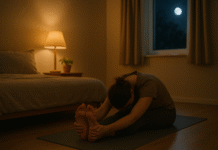
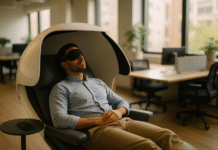
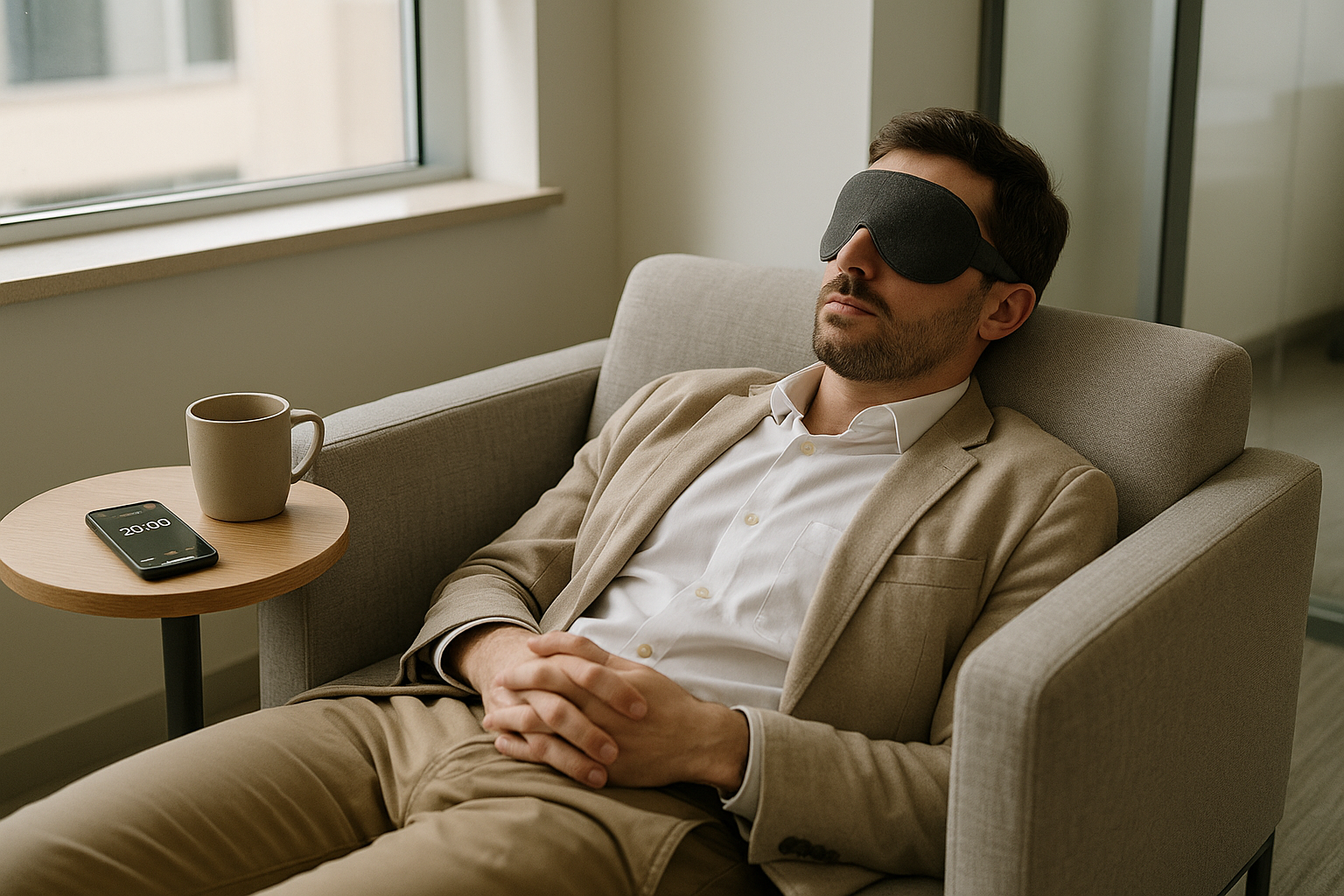
Even a 10-minute nap is easier if the environment invites sleep. Darkness reduces alerting light signals, quiet reduces micro-arousals, and cool temperatures lower core body temperature to promote sleep onset. Simple tools—eye mask, earplugs, and broadband sound (white or brown noise)—can meaningfully improve nap quality, especially in busy homes or offices. Prioritize a reclined position (sofa, recliner, cot), comfortable neck support, and a breathable throw or light blanket. If you’re at work, scout a private room, unused conference space, or a wellness room; at home, keep eye mask + earplugs in a small pouch so you can nap anywhere.
- Setup checklist (2 minutes)
- Eye mask on, earplugs in; start broadband sound on a timer.
- Thermostat/vent to slightly cool (roughly 18–22°C / 65–72°F).
- Phone on Do Not Disturb, alarm set, screen face-down.
3.1 Tools & examples
- Apps and devices that generate broadband sound can mask sporadic office or street noise.
- A simple travel eye mask + foam earplugs kit costs little and works almost anywhere.
Bottom line: A dark, quiet, cool micro-environment plus eye mask/earplugs can be the difference between “I tried” and “I actually slept.”
4. Try a “coffee nap” when you need a faster reboot
A coffee nap pairs 100–200 mg of caffeine (about one strong cup) with a 15–20 minute nap. Caffeine starts absorbing quickly and peaks roughly 30–60 minutes after ingestion; a short nap during the onset window may clear some adenosine and reduce sleepiness just as caffeine’s alerting effect ramps up. Controlled studies in drivers show that a brief nap + caffeine can reduce lane drifting and errors for a short period—useful for post-nap tasks demanding vigilance. Guardrails: avoid coffee naps late in the day, if you’re caffeine-sensitive, pregnant, or advised to limit caffeine; don’t rely on caffeine to mask chronic sleep loss; and remember that caffeine’s half-life can be 3–7+ hours, so it can bleed into bedtime.
- How to do it (in 3 steps)
- Drink ~150 mg caffeine quickly (coffee or caffeine gum).
- Lie down immediately; set a 20-minute alarm.
- On waking, give yourself a 15-minute buffer (see Guideline 5) before complex tasks.
4.1 Common mistakes
- Sipping slowly (caffeine kicks in while you’re trying to fall asleep).
- Using this after 3 p.m. if you have trouble sleeping at night.
- Treating caffeine as a substitute for adequate nightly sleep.
Bottom line: A coffee nap can be a potent, short-term alertness tool when timed well and used judiciously.
5. Plan for sleep inertia: build a 15–30 minute reactivation buffer
Even perfect naps can leave you groggy for 10–30 minutes—that’s normal sleep inertia. It’s more pronounced after longer naps, with sleep deprivation, or when waking from deep sleep. Never schedule a high-stakes meeting, complex code deploy, or critical call in the first 10–15 minutes after your alarm. Instead, build a reactivation routine: bright light, light movement, hydration, and a simple cognitive warm-up.
- Reactivation routine (5–10 minutes)
- Light: step into daylight or turn on a bright lamp.
- Move: 20–30 bodyweight squats or a brisk 3-minute walk.
- Hydrate & splash: drink water; splash cool water on face.
- Prime the brain: skim a checklist or do 1–2 easy emails.
5.1 Safety note
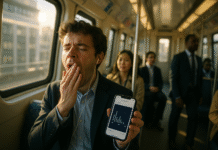
If you must operate a vehicle or machinery after napping, wait out inertia. For driving, authoritative guidance recommends coffee + a 20-minute nap at a safe rest stop and a brief wake-up period before driving again.
Bottom line: Protect 15–30 minutes post-nap for a deliberate, light-boosted restart—it pays off in productivity and safety.
6. Don’t let naps replace night sleep: protect your 7–9 hours
Naps are a supplement, not a replacement. Adults function best with 7+ hours of nightly sleep; chronic short sleepers often feel an urge to nap, but over-relying on afternoon sleep can create a vicious cycle—you nap because you’re sleep-deprived, then can’t fall asleep at night because you napped. Break the loop: prioritize consistent bed and wake times, morning light, and caffeine cutoffs. Keep naps short and early, and skip them entirely if you’re actively repairing your night sleep. If you’re older or managing cardiometabolic risks, be extra conservative with long daily naps, which are linked (in observational data) to higher rates of adverse outcomes; correlation isn’t causation, but it’s a sensible caution.
- Guardrails
- If night sleep is <7 hours, fix nights first; use rare, short naps only.
- If a nap makes it harder to fall asleep, shorten or skip the next day.
- Keep a one-week sleep diary to catch patterns (see Guideline 11).
6.1 Quick reset alternatives
Can’t nap today? Try 10 minutes of daylight + a brisk walk, 2–3 minutes of breathwork, or a glass of water + light snack.
Bottom line: Night sleep comes first. Use naps judiciously so they help today and protect tonight.
7. Keep naps intentional: frequency, fit, and feedback
Healthy napping isn’t random dozing—it’s planned. Pick your purpose (e.g., boost vigilance before a dense task; stabilize mood before caregiving; recover from a short night), match the duration and timing to that purpose, and review the results. Most people do well with 0–1 short naps on days you need them. Some days you’ll benefit more from quiet rest (eyes closed, no phone) than sleep; that’s okay. If you find yourself needing a nap every day, or nodding off inappropriately (meetings, stopped at a light), that’s a red flag for insufficient sleep or a sleep disorder.
- Intentional napping template
- Why today? (task, safety, recovery)
- Which nap? (10–20 min / 90 min)
- When? (early afternoon)
- Where? (prepared space)
- How did it go? (alertness + sleep that night)
7.1 When to pause naps
If you’re troubleshooting insomnia, pause naps for 2–4 weeks while you retrain your sleep drive at night.
Bottom line: Nap on purpose, not by accident—then refine the plan using your own feedback.
8. Use naps as a safety countermeasure, not a license to push limits
Drowsy driving and safety-sensitive work are high-risk when sleepy. A nap can be life-saving in the short term, but only if done safely. If you feel sleepy at the wheel, pull off, drink coffee, set a 20-minute alarm, nap, and then give yourself a wake buffer before driving again. Treat naps and caffeine as temporary measures—the real fix is adequate sleep.
- Safety playbook
- Stop at a safe, well-lit area (rest stop).
- Coffee + 20-minute nap; alarm on; doors locked.
- Reactivate (light, movement) before driving.
- Don’t rely on loud music, open windows, or willpower.
8.1 Workplace considerations
For jobs with safety implications (healthcare, transport, manufacturing), planned naps during long shifts are recognized by professional bodies and safety agencies as viable fatigue countermeasures. Advocate for safe nap spaces and policies.
Bottom line: In safety scenarios, a planned short nap is evidence-based—but it’s not a substitute for proper rest.
9. If you work nights or long shifts, schedule planned recovery naps
Shift work scrambles circadian alignment. Here, planned naps (before shift, during a long night shift, or on the commute break) are legitimate tools to maintain alertness and reduce errors. Before a night shift, try a 90-minute anchor nap in the late afternoon and a 10–20 minute top-up around 2–4 a.m. if your workplace allows it. Aviation, space, and clinical settings have long used structured nap protocols (with trained teams and alarms) to protect performance under fatigue.
- Shift nap framework
- Pre-shift: 60–90 minutes late afternoon (protects sleep debt).
- Mid-shift: 10–20 minutes during circadian low (2–5 a.m.).
- Commute caution: if sleepy, nap before driving home.
9.1 Policy & culture
Ask about formal fatigue policies; many organizations now include planned rest in safety guidelines. Even a recliner + eye mask in a quiet staff room helps.
Bottom line: For shift work, planned naps are professional fatigue countermeasures—use them strategically, with alarms and wake buffers.
10. Use naps to enhance learning, memory, and creativity
Naps don’t just lift energy; they can strengthen memory encoding and consolidation, particularly for material learned right before the nap. Even 10–30 minutes can stabilize attention for study sessions; ~30 minutes may support certain forms of memory encoding, though inertia needs planning; 90 minutes (with REM) can benefit insight and creative problem-solving in some contexts. Apply this on busy days: study → 10–20 minute nap → light reactivation → quick recall drill.
- Study-nap workflow
- Chunk a learning block (30–50 minutes focused study).
- Nap 10–20 minutes.
- Reactivate, then do 5 minutes of retrieval practice (flashcards, summary).
10.1 Realistic expectations
Benefits vary by task type and your prior sleep. If you’re significantly sleep-deprived, any nap may primarily restore vigilance rather than deeper learning.
Bottom line: When timed near learning, short naps can improve focus and memory—stack them with retrieval practice for best results.
11. Track and personalize with a simple sleep & nap diary
What gets measured gets managed. A one-page diary captures bed and wake times, nap start/stop, caffeine, exercise, alcohol, and next-day alertness. After 7–14 days, patterns pop: perhaps 2:00 p.m. is your sweet spot, or coffee after noon disrupts bedtime. Share your diary with a clinician if you’re troubleshooting insomnia or sleepiness; it’s the fastest way to a tailored plan.
- Diary fields to log
- Night: bed/wake, awakenings, estimated sleep time, alcohol/caffeine cutoffs.
- Day: nap start/stop, place, alarm set, pre-nap caffeine, post-nap inertia (minutes).
- Outcomes: afternoon sleepiness (0–10), bedtime sleep onset (minutes).
11.1 Tools to try
Your phone’s notes app works. Many wearables export sleep stages and nap flags—use with caution but they’re fine for pattern-spotting.
Bottom line: A simple diary turns anecdotes into data so you can fine-tune nap timing, duration, and frequency.
12. Build your personal nap playbook (and share it with your team)
Turn these guidelines into a repeatable playbook you can run on busy days. Decide in advance your default nap (e.g., “20 minutes at 1:45 p.m., eye mask + earplugs, white noise, alarm, 10-minute wake buffer”). Draft if-then rules (e.g., “If I have a high-stakes 3 p.m. presentation, I nap at 1:30 p.m.; if I can’t nap, I do 5 minutes of box breathing + daylight walk”). Share norms with your household or team so your nap isn’t interrupted and your wake buffer is respected.
- One-page playbook template
- Default window: ________ to ________.
- Duration: ____ minutes (or 90 minutes on ________).
- Spot & setup: _________________ (mask, earplugs, white noise).
- Coffee nap? Y/N; dose: ____ mg; cutoff time: ________.
- Post-nap buffer: ____ minutes (light + movement).
- No-nap alternatives: ____________ (walk, breathwork, hydration).
12.1 Keep it visible
Print it, pin it, or set it as a note on your phone’s lock screen. Consistency is your friend.
Bottom line: A written playbook removes friction, prevents interruptions, and makes good naps automatic.
FAQs
1) What’s the best length for a daytime nap?
For most people, 10–20 minutes balances quick benefits with minimal grogginess. If you must go long, plan a full ~90 minutes to complete a sleep cycle. Avoid the 30–60 minute “middle” unless you can tolerate brief inertia and won’t be doing safety-critical work immediately afterward.
2) When is the ideal time to nap?
Aim for the early afternoon, typically 1–3 p.m., aligning with the body’s post-lunch dip. Napping much later (after ~3–4 p.m.) can make it harder to fall asleep at night, especially if you already struggle with insomnia or delayed bedtimes.
3) Do coffee naps really work?
Yes, for short-term alertness. Drink ~100–200 mg caffeine, immediately lie down for 15–20 minutes, and give yourself a 10–15 minute wake buffer. This approach is well-studied for short-term performance and drowsy-driving countermeasures. Skip late-day coffee naps if caffeine affects your sleep.
4) Will napping ruin my night sleep?
Not if you keep it short and early. Long or late naps reduce sleep pressure and can delay bedtime. If you’re actively improving night sleep or dealing with insomnia, pause naps for a few weeks to retrain your sleep drive.
5) Is a 90-minute nap okay?
Sometimes. A full-cycle (~90 minutes) nap can help after a severe short night or before a demanding shift, but it’s time-intensive and more likely to bump into your evening sleep window. Use sparingly and protect your bedtime.
6) What if I wake up feeling worse after napping?
That’s sleep inertia. It usually fades within 15–30 minutes, faster with bright light, movement, and hydration. If inertia is a persistent problem, shorten your nap to 10–15 minutes and schedule a longer buffer before complex tasks.
7) Are naps safe for older adults?
Short, early naps can be helpful. However, long daily naps are linked in observational studies to higher rates of cardiovascular events and other risks. These findings don’t prove causation, but they justify a conservative approach: keep naps brief, and discuss frequent or long naps with your clinician.
8) Should I nap if I’m sleepy while driving?
Yes—pull over safely, use coffee + a 20-minute nap, and allow a short wake buffer. This is a temporary fix to reach safety, not a license to drive while chronically sleep-deprived. The only real solution is adequate nightly sleep.
9) I can’t fall asleep in 10 minutes—should I force it?
No. If sleep doesn’t come, practice quiet rest: eye mask on, deep breathing, and no screens. Many people still feel refreshed. Try again another day, and adjust timing, environment, or caffeine habits.
10) How often should I nap?
As needed. Many high-performers nap 0–3 times per week depending on workload and sleep debt. If you need a nap every day or doze off unintentionally, get evaluated for insufficient sleep or conditions like obstructive sleep apnea or narcolepsy.
11) Are white-noise machines helpful for naps?
They can be—especially in noisy settings—by masking unpredictable sounds. Evidence is mixed across studies, but many people report shorter sleep onset and fewer awakenings. Keep volume modest and put the source a few feet away.
12) Do naps help with studying?
Yes. Short naps can improve attention and memory encoding, especially when placed right after focused study. Pair a 10–20 minute nap with 5 minutes of retrieval practice after your wake buffer for a reliable learning boost.
Conclusion
Daytime naps are a powerful, flexible tool—when used intentionally. The core recipe hardly changes: short duration (10–20 minutes), early afternoon timing, sleep-ready environment, and a 15–30 minute wake buffer. For shift workers, naps become planned countermeasures to protect safety and performance. For students and knowledge workers, pairing a short nap with retrieval practice produces real learning gains. And for everyone, naps should support, not undermine, nightly sleep—protect those 7–9 hours with consistent bed and wake times, morning light, and smart caffeine habits. Start with one or two of the guidelines that fit your life (for many, it’s setting a 20-minute alarm and keeping an eye-mask/earplugs kit handy). Iterate with a simple diary, and within two weeks, you’ll have a personal nap playbook that delivers energy on demand without costing you the night.
Ready to try it? Block 20 minutes at 1:45 p.m. tomorrow, set the alarm, mask on, and give yourself a 10-minute wake buffer—then notice the difference.
References
- Module 7: Napping—An Important Fatigue Countermeasure (Nap Duration & Timing), NIOSH/CDC, last reviewed Mar 31, 2020. https://www.cdc.gov/niosh/work-hour-training-for-nurses/longhours/mod7/05.html and https://www.cdc.gov/niosh/work-hour-training-for-nurses/longhours/mod7/04.html
- Sleep Inertia (Module 7), NIOSH/CDC, last reviewed Mar 31, 2020. https://www.cdc.gov/niosh/work-hour-training-for-nurses/longhours/mod7/03.html
- Drowsy Driving—What to Do if You’re Sleepy, NHTSA, accessed Aug 2025. https://www.nhtsa.gov/risky-driving/drowsy-driving
- Crew Factors in Flight Operations IX: Effects of Planned Cockpit Rest on Crew Performance and Alertness, NASA Technical Memorandum 108839 (Rosekind et al.), 1994. https://ntrs.nasa.gov/api/citations/19950006379/downloads/19950006379.pdf
- The Benefits of Napping for Safety & How Quickly Can Napping Improve Alertness?, NASA Ames (Hilditch), 2019. https://ntrs.nasa.gov/api/citations/20190033981/downloads/20190033981.pdf
- Combination of Caffeine with a Short Nap Reduces Sleepiness in Drivers, Reyner & Horne, Psychophysiology, 1997. https://pubmed.ncbi.nlm.nih.gov/9401427/
- Waking Up Is the Hardest Thing I Do All Day: Sleep Inertia and Sleep Drunkenness, Trotti, Sleep Medicine Reviews, 2016. https://pmc.ncbi.nlm.nih.gov/articles/PMC5337178/
- Influence of Mid-Afternoon Nap Duration and Sleep Stages on Cognitive Performance and Positive Moods, Leong et al., Nature and Science of Sleep, 2023. https://pmc.ncbi.nlm.nih.gov/articles/PMC10091091/
- Napping: Do’s and Don’ts for Healthy Adults, Mayo Clinic, Nov 6, 2024. https://www.mayoclinic.org/healthy-lifestyle/adult-health/in-depth/napping/art-20048319
- Napping—Benefits and Tips (Best Time & Environment), Sleep Foundation, updated Mar 11, 2024. https://www.sleepfoundation.org/napping
- Seven or More Hours of Sleep per Night: A Health Necessity for Adults, American Academy of Sleep Medicine, updated Jul 30, 2024. https://aasm.org/seven-or-more-hours-of-sleep-per-night-a-health-necessity-for-adults/
- Researchers Study How Daytime Naps May Influence Health (Siesta & Blood Pressure), NHLBI/NIH, May 11, 2023. https://www.nhlbi.nih.gov/news/2023/researchers-study-how-daytime-naps-may-influence-health
- About Sleep (Sleep Diary Guidance), CDC, May 15, 2024. https://www.cdc.gov/sleep/about/index.html
- What Is White Noise? Sleep Foundation (noise & sleep), updated Mar 8, 2024. https://www.sleepfoundation.org/noise-and-sleep/white-noise
- Effects of Earplugs and Eye Masks on Sleep, Hu et al., Critical Care, 2010; and Karimi et al., Nursing Open, 2021. https://pmc.ncbi.nlm.nih.gov/articles/PMC2887188/ and https://pmc.ncbi.nlm.nih.gov/articles/PMC8678458/
- Sleep & Caffeine (Pharmacokinetics), Sleep Education by AASM, Oct 6, 2022; plus EFSA “EFSA Explains: Caffeine,” May 27, 2015. https://sleepeducation.org/sleep-caffeine/ and https://www.efsa.europa.eu/sites/default/files/corporate_publications/files/efsaexplainscaffeine150527.pdf