























Mental rest is the deliberate act of unloading your mind so attention, emotions, and energy can recalibrate. In practice, mental rest techniques are short, repeatable habits—like quiet time, mindfulness, or unplugged hobbies—that reduce cognitive load and help your brain recover. Done in small bites (often 2–20 minutes), these practices counter constant connectivity, interruptions, and decision fatigue without demanding major life changes. Quick note: this article is educational, not medical advice—if you’re experiencing persistent distress, insomnia, or symptoms of a condition, please consult a qualified professional.
Quick definition: Mental rest techniques are structured routines that interrupt overstimulation and restore focus by lowering inputs (noise, screens, tasks) and engaging gentle, present-moment attention.
Fast start (5 steps): Pick one practice below → schedule a 10-minute window → silence notifications → do the practice exactly as written → jot a one-line “before/after” note to track benefits.
1. Schedule Daily Quiet-Time Blocks (no screens, no asks, just stillness)
Quiet time is a deliberate pause with minimal sensory input and zero obligations; it is the simplest, most transferable mental rest technique you can start today. In the first 1–2 sentences: set a boundary (e.g., 10–20 minutes), put your phone in another room, and sit somewhere comfortable without trying to “achieve” anything. Over 5–8 sentences, here’s what to expect: your mind will likely fidget at first; that is normal. Within a few minutes, the sense of relentless urgency eases because you’ve removed the two biggest inputs—requests and screens. Physiologically, heart rate and breathing often settle when you’re not processing rapid-fire stimuli. Psychologically, you get exposure to boredom without reflexively fixing it with scrolling, which retrains attention. Many people also notice a clearer sense of priorities immediately afterward. Treat this as “white space for the brain,” not productivity time.
How to do it
- Choose a consistent slot (e.g., 10:30 a.m. and/or 4:00 p.m.), 10–20 minutes each.
- Place the phone in another room; close your laptop lid; reduce noise (soft earplugs or a fan).
- Sit somewhere comfortable facing a calm view (a wall, plant, or window), hands relaxed; no reading.
- Let thoughts pass without engagement; if you fidget, simply notice and soften the shoulders.
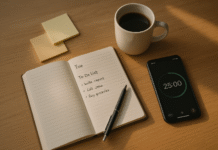
- End by writing one sentence: “After quiet time, I feel ____ and will do ____ next.”
Numbers & guardrails
- Start with 10 minutes; extend to 20 minutes if helpful.
- Keep ambient noise as low as you reasonably can (quieter rooms promote relaxation); if you can’t, use earplugs or simple white-noise masking.
- If drowsy, try sitting more upright or opening a window for fresh air.
Synthesis: Treat quiet time like brushing your teeth—brief, daily, and non-negotiable. The win is cumulative calm, not any single “aha.”
2. Mindfulness Breath Anchoring (6 breaths per minute to downshift)
Mindfulness centers attention on an anchor—often the breath—so the mind can rest from ruminative loops and multitasking. The direct answer first: breathing slowly and noticing sensations (air in the nose, chest rise, belly movement) reduces mental noise and supports emotional regulation. Over the next few sentences, here’s what to expect: slow, paced breathing around 6 breaths per minute increases heart-rate variability (a sign your nervous system is flexible), and even short sessions can improve mood. Compared with mind-wandering or doomscrolling, an anchored breath gives your attention a single, simple job. It’s portable (you can do it at your desk) and needs no gear. If focus drifts, you gently return—no scolding. With practice, the “return” gets faster and the calm more reliable.
How to do it (5-minute protocol)
- Sit upright. Inhale through the nose ~4–5 seconds, exhale ~4–5 seconds (≈ 6 breaths/min).
- Eyes soft; notice three sensations (air temp, ribcage expansion, belly movement).
- When distracted, mentally label it (“thinking,” “planning”) and return to the next inhale.
- End by noticing one word for your current state (e.g., settled, lighter).
Tools/Examples
- Timers or pacers can help (any metronome app, smartwatch breathe feature).
- If you prefer structure, try box breathing (inhale 4, hold 4, exhale 4, hold 4) for 1–3 minutes.
- Pair with transitions: before meetings, after email, pre-commute.
Synthesis: Think “slow, steady, and kind.” Consistency beats intensity—five minutes, most days, wins.
3. Single-Tasking to Cut Context Switching (batch, protect, finish)
Single-tasking is choosing one cognitive lane at a time so your brain stops paying the hidden “switching tax.” The direct answer: work on one item until a clear checkpoint, then switch; you’ll feel calmer and waste less energy reloading context. Over the next few sentences, expect this: interruptions raise stress and speed without quality; sustained focus improves accuracy and leaves more mental energy for later. You don’t need a perfect system—simple boundaries help a lot: batch messages, work in 25–50-minute focus blocks, and schedule a daily “admin pile.” When your environment demands responsiveness, set two or three daily windows for replies. The benefit you’ll notice first is not mystical—it’s fewer open loops tugging at your attention.
Mini-checklist
- Define the next clear checkpoint (e.g., draft first paragraph, analyze 10 rows, outline steps).
- Silence non-urgent pings; keep only mission-critical alerts.
- Batch communication (e.g., 11:30, 2:30, 5:00) and use away messages when needed.
- Close tabs unrelated to the current task; keep one working doc visible.
- End with a note: “Next step tomorrow: ____.”
Numbers & guardrails
- Try 25–50 minutes of focus + 5–10 minutes of movement or admin.
- Protect 2 focus blocks/day; let colleagues know your responsive windows.
- If your role is reactive (support, caregiving), shorten blocks to 10–20 minutes.
Synthesis: Single-tasking returns interest on attention—less friction, more ease, cleaner finish lines.
4. Microbreaks & Movement Snacks (1–5 minutes away from screens)
Microbreaks are tiny, intentional pauses that prevent strain and restore alertness. The direct answer: step away for 1–5 minutes every 30–60 minutes to stretch, breathe, stand in daylight, or look at a distant point; you’ll return sharper. Over the next few sentences, expect this: short breaks raise vigor and can protect performance, especially when tasks are repetitive or demanding. The key is to make them truly “micro”—fast, screen-free, and non-scrolling. Movement helps metabolize stress hormones; a doorway chest stretch or a slow lap around the room is enough. Set cues (timer, finished email, natural task boundary) so you don’t forget.
What to do in 60–180 seconds
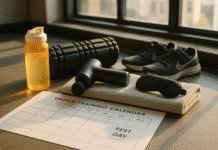
- Stand, roll shoulders, and stretch calves/hip flexors.
- Look out a window at something 20+ feet away for 20–60 seconds to relax eye muscles.
- Drink water or make tea; two slow breaths before you sit back down.
- If possible, step outside for direct daylight.
Numbers & guardrails
- 1–5 minutes every 30–60 minutes is a practical starting point.
- Keep phones out of hand; scrolling negates the rest.
- If you’re deep in flow, skip one break—take the next.
Synthesis: Microbreaks keep the mental engine cool. Think pit-stops, not detours.
5. Nature Micro-Doses (green views, mini walks, plants)
Interacting briefly with nature—seeing greenery, touching a leaf, or walking by trees—reliably soothes the mind. The direct answer: add brief nature “sips” to your day (a 2-minute window view, a plant on your desk, or a 10-minute park loop) to reduce rumination and refresh attention. Over the next few sentences, expect this: even seconds of a natural scene can recharge sustained attention; longer walks in green spaces help quiet repetitive negative thinking. You don’t need wilderness: potted plants, balcony herbs, or a single tree outside are enough to deliver a small lift. Combine with microbreaks for a double benefit—eyes and mind rest together.
How to do it
- Place a plant within your line of sight; water it during a break.
- When you pause, look at greenery for ~40 seconds before resuming.
- Take a 10-minute walk on streets with trees or gardens; notice colors and textures.
- If outdoors isn’t available, use nature photos on a wall or screensaver (then look away afterward).
Numbers & guardrails
- Aim for 1–2 nature looks/hour and 1 short green walk/day.
- Choose safe, accessible routes; hot climates may require early morning or evening walks.
- Allergies? Prefer visual contact over touch; keep windows closed during high pollen.
Synthesis: Nature is restorative by design—small, frequent contact adds up.
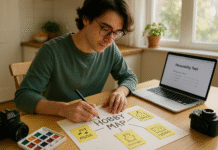
6. Unplugged Hobbies That Absorb (crafts, music, puzzles)
Unplugged hobbies replace passive scrolling with active, low-stakes focus that leaves you mentally brighter, not drained. The direct answer: pick an absorbing but gentle activity—knitting, sketching, guitar scales, origami, model building, sourdough shaping—and give it a 20–40-minute window a few times a week. Over the next few sentences, expect this: these activities create “soft goals” with immediate feedback and minimal pressure, which often nudges you toward a satisfying flow state. Your attention narrows to tactile/aural details, crowding out ruminative loops. Because your phone is out of reach, urges to check fade over the session. You finish with a small sense of completion—rare on fragmented days.
Starter set (choose one)
- Hands: drawing, calligraphy, clay, whittling, hand-sewing, Lego.
- Mind: crosswords, sudoku, jigsaw puzzles, analog chess problems.
- Body: easy guitar or piano practice, singing scales, Tai Chi forms.
Make it stick
- Leave tools visible and ready (open sketchbook, tuned instrument).
- Use a 20–40-minute timer; keep your phone in another room.
- Join a local or online group for gentle accountability.
Synthesis: Unplugged hobbies are “active rest”—they occupy just enough of you to let the noisy parts of the mind go quiet.
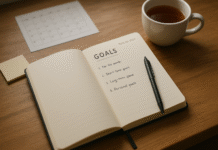
7. Journaling to Offload (brain dump, gratitude, or problem-solving)
Journaling externalizes mental clutter so your working memory can breathe. The direct answer: write by hand for 5–15 minutes—what’s on your mind, what you’re grateful for, or steps for a sticky problem—then close the notebook and proceed lighter. Over the next few sentences, expect this: expressive writing helps organize emotion; listing and planning reduce ambiguity; gratitude shifts attention toward resources rather than threats. You don’t have to be “a writer” to benefit; spelling and style don’t matter. Keep the bar low (one page, or even three lines) so you build a reliable release valve you can use anywhere.
Three journaling modes
- Brain dump: “Today I’m carrying…,” write nonstop for 5–10 minutes.
- Gratitude triad: three specifics from the last 24 hours; add a one-line why.
- Plan the next step: define the smallest next action and a time window.
Mini case
- Before bed, note: “Worried about presentation; next step: rehearse intro at 9:30, call Sam for slide 5, print notes.” Many people fall asleep faster when uncertainty is translated into a short plan.
Synthesis: Paper is a cheap cognitive off-ramp; once the thoughts have a page, your mind doesn’t need to hold them so tightly.
8. Deliberate Mind-Wandering Windows (boredom without the phone)
Letting the mind meander on purpose can support planning and creativity—if you don’t fill the space with notifications. The direct answer: schedule 5–10 minutes of device-free “mental strolling” (e.g., during dishes, a shower, or a slow walk) to allow diffuse thinking and gentle idea-forming. Over the next few sentences, expect this: your brain’s default mode network engages during wakeful rest; in this mode, thoughts hop among memories, goals, and self-stories. The trick is to invite this state and then return when the window ends. If rumination spikes, lightly guide attention back to a neutral sensation (steps, water, breath). Many people find a notebook helpful to capture one or two ideas afterward.
Boredom practice
- Choose a repetitive, low-effort activity (folding laundry, watering plants).
- Keep your phone out of sight; let thoughts roam without judgment.
- End with a one-line capture: “Idea: ask for a walking 1:1 next week.”
Guardrails
- If you’re prone to anxious loops, cap at 5 minutes and follow with breath anchoring.
- Use this window after focused work to incubate solutions.
Synthesis: Not all wandering is wasting; a small, time-boxed roam can knit ideas together while your “task mode” rests.
9. Focused vs. Open Mindfulness (pick what fits today)
Mindfulness comes in two main flavors that rest the mind differently. The direct answer: use Focused Attention (pick one target like the breath) when you feel scattered; use Open Monitoring (observe whatever arises without choosing a target) when you feel compressed or over-controlled. Over the next few sentences, expect this: FA trains stability—returning to one anchor improves stickiness of attention; OM trains flexibility—acknowledging sensations, thoughts, and feelings without getting hooked reduces reactivity. Both reduce mental load; many people alternate based on mood and goals. You don’t need long sessions—quality beats length.
How to choose
- If thoughts are racing: FA on breath, sounds, or a word (e.g., “calm”).
- If you feel tight or perfectionistic: OM—sit and notice body sensations, thoughts, sounds arising and passing.
- If sleepy: FA with eyes open; shorter sessions.
Numbers & guardrails
- Start with 5–10 minutes; extend to 15–20 if useful.
- Expect normal mind-drift; the skill is in the gentle return.
- If strong emotions arise, shorten, ground in the body (feet, seat), or seek guidance.
Synthesis: Two levers—stability and flexibility. Use the one your day asks for.
10. Sensory Diet at Your Desk (light, sound, visual load)
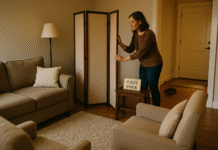
Shaping your immediate environment lowers baseline stimulation so the mind can idle more easily between tasks. The direct answer: soften harsh light, dampen noise, and reduce visual clutter; each small tweak reduces cognitive “micro-tension.” Over the next few sentences, expect this: glare and high-contrast light force eye strain; constant noise keeps your nervous system slightly vigilant; messy sightlines pull attention. You don’t need an office overhaul—think cheap, practical changes: matte desk surfaces, a plant as a visual anchor, soft furnishings that absorb sound. Combine with microbreaks for a compounding effect.
Practical tweaks
- Light: position lamps to avoid screen glare; use warm-neutral bulbs in task lamps; face windows sideways, not head-on.
- Sound: try foam earplugs or simple noise-masking (fan/air purifier); add soft materials (rug, curtain) if possible.
- Visual: clear the immediate field of 3–5 non-essentials; keep one tidy tray for “open projects.”
Numbers & guardrails
- Check your space at two times: morning and late afternoon—adjust as daylight shifts.
- If you share space, agree on quiet hours or hand signals (headphones on = “not now”).
- For sensitive tasks, aim for the quietest area available; if not possible, pair with breath anchoring.
Synthesis: Your desk is a stimulus diet—trim the sugar (glare, noise, clutter) and focus digests easier.
11. Short, Strategic Naps & Wind-Downs (when sleep pressure wins)
When your brain hits a wall, a short nap can reset attention better than stubborn effort. The direct answer: if daytime sleepiness peaks, a 10–20 minute early-afternoon nap often boosts alertness without post-nap grogginess; if naps aren’t feasible, do a 10-minute wind-down (dim lights, recline, eyes closed, slow breathing). Over the next few sentences, expect this: short naps avoid deeper sleep stages that can produce inertia; timing earlier in the afternoon reduces impact on nighttime sleep. If you can’t nap, a quiet recline plus paced breathing settles the nervous system enough to return to work. Treat naps as a tool, not a habit—if you need long or frequent naps, check your nighttime sleep quality.
Nap playbook
- Set a 20-minute alarm; lie down in a cool, dim space if possible.
- Optional coffee-nap: sip a small coffee/tea right before; caffeine kicks in as you wake.
- If you can’t sleep, simply rest with eyes closed—still helpful.
Guardrails
- Keep naps ≤20–30 minutes and before 3:00 p.m.
- If napping most days or needing >30 minutes, assess nighttime sleep or discuss with a clinician.
- For shift work, adapt windows to your schedule; keep them early in your “day.”
Synthesis: When sleep pressure is high, a tiny, well-timed nap is a clarity button—use sparingly but confidently.
12. Digital Boundaries & Notification Curfews (batch the buzz)
Constant pings fracture attention; batching them restores a sense of control and calm. The direct answer: set device rules that reduce interruptions—e.g., Focus/Do Not Disturb during deep work, notifications only from VIPs, and two or three daily check-in windows. Over the next few sentences, expect this: fewer alerts means fewer context switches; however, research on disabling notifications is nuanced—some people feel better, others worry about missing out. That’s why the boundary should include where your phone lives (out of sight) and a clear plan for when you’ll respond. At home, use “curfews” (e.g., devices docked an hour before bed) to protect wind-down and sleep. Over a week or two, most people report less mental static and more intention.
Build your boundary
- Decide windows for messages (e.g., 11:30, 2:30, 5:30) and tell teammates.
- Filter: allow calls from favorites; silence the rest during focus blocks.
- Out of sight: when resting, keep phones in another room or inside a bag.
- Evening curfew: plug devices in a fixed spot 60 minutes before bed.
Numbers & guardrails
- Trial a 7-day experiment: track mood/focus (0–10) before and after.
- If FoMO rises, shorten “off” periods but keep the place rule (out of sight).
- Pair with a quick autoresponder (“Heads down, back online at 2:30 p.m.”) where appropriate.
Synthesis: Interruption is a design choice. Curate your buzz, and your mind gets room to breathe.
FAQs
1) What are the best mental rest techniques if I only have 5 minutes?
Pick breath anchoring (about six breaths per minute), a microbreak with light movement, or a 40-second nature look followed by a one-minute shoulder roll. These options work because they’re simple, screen-free, and reset both attention and bodily tension quickly. If you repeat them every hour or two, the cumulative effect is noticeable by day’s end.
2) How is mental rest different from “doing nothing”?
Mental rest is intentional and structured—quiet time, mindful breathing, or an unplugged hobby with a start and end. “Doing nothing” often turns into passive, high-stimulation inputs (scrolling, TV in the background) that keep your mind engaged without recovery. Rest techniques lower sensory and cognitive load so your attention and nervous system actually downshift.
3) Will mindfulness make me sleepy or wired?
It can go either way depending on how you practice. Focused attention with upright posture can increase clarity; slow breathing with eyes closed may make you drowsy. Adjust posture, eye position, and breath pace to match your goal. If you feel spaced out, shorten sessions or shift to open-eyes, breath-anchored practice.
4) I tried turning off notifications and felt more anxious—what now?
That reaction is common. Try curating rather than fully disabling: allow VIPs, keep scheduled check-ins, and commit to out-of-sight placement during rest windows. Many people find anxiety drops when they know exactly when they’ll look again and where the phone lives in the meantime.
5) Do microbreaks really help productivity, or just make me lose time?
Well-timed microbreaks (1–5 minutes every 30–60 minutes) protect alertness and reduce strain. The goal isn’t to add leisure; it’s to keep cognitive friction low so you produce better work after the pause. If you’re mid-flow, skip the break and take the next one—flexibility matters more than rigid timing.
6) What if my job is highly reactive (support, caregiving, operations)?
Use shorter focus bursts (10–20 minutes) and lean on recovery tools that fit your environment: handful-of-breaths resets, doorway stretches, nature glances, and batch responses in the smallest safe windows. Clarify escalation rules so you can confidently silence non-urgent alerts during microbursts.
7) Are naps safe if I have trouble sleeping at night?
Short naps (10–20 minutes) earlier in the day usually don’t harm nighttime sleep and can restore alertness. If you’re wide awake at night, avoid late or long naps and focus on a consistent bedtime wind-down instead. Persistent insomnia warrants professional advice—naps should not be a band-aid for chronic sleep debt.
8) Which unplugged hobbies work best for mental rest?
Any hobby that’s tactile, gently absorbing, and low-stakes: sketching, knitting, puzzles, simple music practice. The “best” is the one you’ll actually do three times this week. Keep tools visible and sessions short, and track how you feel after 20–40 minutes—the goal is calm engagement, not perfection.
9) How long until I notice benefits?
Many people feel a shift after the very first 5–10-minute session (less mental static, steadier breathing). Stronger effects build over 2–4 weeks of consistent practice when your brain learns the routine and anticipates relief. Use a one-line daily note to see the trend you might otherwise miss.
10) Can these techniques help with creative blocks?
Yes. Single-tasking protects deep work; mind-wandering windows incubate ideas; nature micro-doses and quiet time lower noise so novel connections surface. A reliable pattern is: 25–50 minutes of focused work → 3-minute movement + 40-second green view → 5-minute mind-wandering walk → capture one idea.
11) How do I measure progress without gadgets?
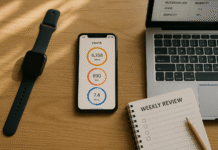
Use a simple daily log: energy (0–10), focus (0–10), stress (0–10), and the one practice you did. Review weekly. If numbers drift upward and the day feels less jagged, you’re winning. If not, shrink the dose (shorter, more frequent) and pair practices (e.g., microbreak + breath).
12) What if mindfulness or journaling stirs up tough emotions?
That can happen. Shorten sessions, keep eyes open, and choose grounding (feel feet, name five things you see). For journaling, shift to planning or gratitude entries until you have support for deeper work. If distress persists, seek guidance from a clinician or trained teacher.
Conclusion
You don’t need hours of free time to give your mind a genuine rest—you need reliable, bite-sized routines. Across the 12 techniques above, the through-line is deliberate reduction of inputs (noise, screens, demands) plus gentle, present-moment attention (breath, nature, tactile hobbies). Start with one or two that fit your context: a 10-minute quiet slot mid-morning, a 3-minute movement snack every hour, a 40-second green view, or a short, early-afternoon nap when sleep pressure hits. Pair these with single-tasking and simple notification curfews so your gains aren’t instantly erased by context switching. Over a few weeks, most people report clearer priorities, steadier moods, and more durable focus—the kind of calm that actually survives busy days.
Try this today: schedule two 10-minute quiet blocks and set three notification windows. Tomorrow, add one breath session and a nature look. Small, repeatable, device-light—your mind will notice.
References
- Meditation and Mindfulness: Effectiveness and Safety. National Center for Complementary and Integrative Health (NCCIH), June 3, 2022. https://www.nccih.nih.gov/health/meditation-and-mindfulness-effectiveness-and-safety
- “Give me a break!” A systematic review and meta-analysis on micro-breaks. PLOS ONE, 2022. https://journals.plos.org/plosone/article
- 40-second green roof views sustain attention. Journal of Environmental Psychology, 2015. https://www.sciencedirect.com/science/article/pii/S0272494415000328
- Nature experience reduces rumination and subgenual prefrontal cortex activation. Proceedings of the National Academy of Sciences (PNAS), 2015. https://www.pnas.org/doi/10.1073/pnas.1510459112
- The Cost of Interrupted Work: More Speed and Stress. Proceedings of CHI, University of California, Irvine (Gloria Mark), 2008. https://www.ics.uci.edu/~gmark/chi08-mark.pdf
- Emotional and physical health benefits of expressive writing. Advances in Psychiatric Treatment (Cambridge University Press), 2005. https://www.cambridge.org/core/journals/advances-in-psychiatric-treatment/article/emotional-and-physical-health-benefits-of-expressive-writing/ED2976A61F5DE56B46F07A1CE9EA9F9F
- Breathing practices for stress and anxiety reduction: A systematic review. Frontiers in Human Neuroscience, 2023. https://pmc.ncbi.nlm.nih.gov/articles/PMC10741869/
- The physiological effects of slow breathing in healthy humans. Breathe / European Respiratory Society, 2017. https://pmc.ncbi.nlm.nih.gov/articles/PMC5709795/
- Napping: Benefits and Tips. Sleep Foundation (updated March 11, 2024). https://www.sleepfoundation.org/napping
- Effects of task interruptions caused by notifications from mobile devices. Applied Cognitive Psychology, 2023. https://pmc.ncbi.nlm.nih.gov/articles/PMC10244611/
- Blocking mobile internet on smartphones improves sustained well-being. PNAS Nexus, 2025. https://academic.oup.com/pnasnexus/article/4/2/pgaf017/8016017
- Meditation for chronic insomnia (research result). NCCIH, 2014. https://www.nccih.nih.gov/research/research-results/mindfulness-meditation-may-benefit-people-with-chronic-insomnia
- Consensus recommendations for pediatric sleep duration (context on naps and timing). American Academy of Sleep Medicine, 2016. https://aasm.org/resources/pdf/pediatricsleepdurationconsensus.pdf
- Attention Restoration Theory: A systematic review (overview of ART). European Centre for Environment & Human Health, 2016. https://www.ecehh.org/research/attention-restoration-theory-a-systematic-review/