





















If your mind revs at bedtime, mindfulness can give it brakes. Mindfulness exercises for better sleep are short, repeatable practices—like breath counting, body scans, and guided imagery—that lower arousal and help you fall (and stay) asleep. In practice, they reduce pre-sleep rumination, quiet the nervous system, and make the bed feel safe again. Quick start: dim the lights, slow your breathing, scan the body from toes to head, and notice without judging. Many people feel calmer in minutes; with consistency over 2–4 weeks, sleep quality often improves. As with any health advice, this article is educational only—if insomnia persists (≥3 months), speak with a clinician; CBT-I is first-line care for chronic insomnia.
1. Diaphragmatic (Belly) Breathing
Diaphragmatic breathing is a simple way to tell your body it’s safe to sleep. By expanding the belly on each inhale and letting it fall on the exhale, you increase vagal tone and shift toward the parasympathetic “rest-and-digest” state. Start this the moment you get into bed or any time you wake at night. The first goal is comfort—slow, smooth breaths without strain. Within 2–3 minutes many people notice less muscle tension and fewer racing thoughts; within 5–10 minutes, heart rate often drifts down. This technique is gentle, requires no equipment, and pairs well with other practices like a body scan or progressive muscle relaxation.
1.1 Why it helps
Slow, deep breathing can increase markers of parasympathetic activity (e.g., high-frequency HRV) and reduce state anxiety, which supports sleep onset. Relaxation training—including abdominal breathing—is also a component of evidence-based insomnia care.
1.2 How to do it (steps)
- Lie on your back; place one hand on your belly, one on your chest.
- Inhale through the nose for ~4–5 seconds; feel the belly rise more than the chest.
- Pause briefly (1–2 seconds).
- Exhale gently through the nose or pursed lips for ~5–6 seconds.
- Continue 5–10 minutes; keep the breath quiet and comfortable.
- If dizzy, shorten the counts; never force.
Mini-checklist: mouth closed if comfortable, shoulders relaxed, jaw unclenched, pace steady. Close by noticing any shift—slower pulse, heavier limbs, or a calmer mind—then let yourself drift.
2. 4-7-8 Breathing (Relaxing Breath)
4-7-8 breathing adds structure to slow breathing with a short hold. The pattern—in for 4, hold 7, out 8—accentuates the exhale, which many people find sedating. Use it as a “pattern interrupt” when thoughts spiral. The first 2–4 cycles may feel effortful; by cycles 5–8 most people report softer muscles and fewer intrusive thoughts. If holding for 7 is uncomfortable, shorten the hold (e.g., 4-4-6) and work up gradually. Expect a slight urge to sigh—that’s normal as CO₂ rises a touch; stay gentle and never strain.
2.1 Why it helps
A brief series of 4-7-8 breaths can acutely improve heart-rate variability and lower blood pressure after stress or sleep loss, reflecting a parasympathetic shift that supports sleep onset. Evidence on exact “best” counts varies, but the longer exhale principle is consistent.
2.2 How to do it (steps)
- Sit or lie down; tip of tongue lightly at the ridge behind teeth (optional).
- Exhale fully.
- Inhale quietly through the nose for a mental count of 4.
- Hold for 7 (or a comfortable shorter hold).
- Exhale audibly through the mouth for 8.
- Repeat 6–8 cycles; stop if lightheaded.
Numbers & guardrails: Start with 4–5 cycles the first nights. People with cardiopulmonary conditions should use gentler ratios. Finish with two comfortable belly breaths and transition into stillness.
3. Body Scan Meditation
A body scan is mindfulness with a map: you move attention from toes to crown, registering sensations without judging or fixing them. It’s ideal when tension feels scattered because it gives the mind a job that’s intrinsically soothing. Begin with the feet; if you notice warmth, tingling, pressure, or even “nothing,” simply note it and shift upward. If the mind wanders (it will), notice that, and bring it back to the body part you’re on. Many people reach a “heavy blanket” feeling by the torso or shoulders; let that weight carry you into sleep. This practice works both at bedtime and during 3 a.m. wake-ups.
3.1 Why it helps
Randomized trials show mindfulness programs that include body scan practice improve sleep quality versus sleep-education controls in older adults with sleep disturbance. Guided body scans also appear on clinical and nonprofit sleep resources for good reason—they quiet cognitive arousal. PMC
3.2 How to do it (steps)
- Lie comfortably; dim lights completely.
- Take three slow belly breaths.
- Place attention on the toes; notice sensations for 10–20 seconds.
- Move to soles, ankles, calves…up through the body in 15–20 zones.
- If thoughts intrude, label “thinking” and return to the current zone.
- At the crown, sense the whole body at once; rest there.
Mini-checklist: small, steady attention; no judging; slow pace; no goal beyond noticing. Close with one long exhale and let the mind stay with the whole body’s weight.
4. Progressive Muscle Relaxation (PMR)
PMR systematically tenses and releases muscle groups to dissolve hidden tension. It’s especially helpful when stress “lives in the body” as clenched jaws, hunched shoulders, or a tight belly. You’ll tense gently for 5–7 seconds and release for 15–20 seconds, moving from feet upward. The contrast teaches your nervous system the feeling of “let go.” After two or three sessions, most people can skip the tensing and simply cue release, which works well when half-asleep.
4.1 Why it helps
Relaxation therapies—including PMR—are recommended as components of behavioral treatment for insomnia. Laboratory work shows PMR can reduce physiological arousal and may even influence sleep architecture (e.g., more slow-wave sleep) in some contexts.
4.2 How to do it (steps)
- Starting at the feet: inhale and tense gently (not painful) for 5–7 seconds.
- Exhale and release fully for 15–20 seconds; notice the difference.
- Move to calves, thighs, glutes, belly, hands/forearms, shoulders, face.
- Keep the jaw soft and breath easy.
- If cramps or pain occur, skip that area.
Mini-checklist: gentle tension only, longer release than hold, steady breath, comfort first. End with two easy belly breaths and sense the whole-body softness.
5. Constructive Worry & “To-Do” Brain Dump
When the mind loops through tomorrow’s tasks, bring worry out of the bed and onto paper. Constructive worry is a brief evening practice—not at bedside—where you list top concerns and one next step for each. A related five-minute “to-do list” at night has been shown to shorten sleep-onset latency compared with journaling about completed tasks, especially when the list is specific. The aim isn’t to finish everything; it’s to externalize tasks so your brain can power down at lights-out.
5.1 Why it helps
In a controlled sleep-lab study, participants who wrote a to-do list for five minutes fell asleep significantly faster than those who wrote about completed activities, with more specific lists linked to even quicker sleep. Constructive worry worksheets from CBT-I programs use the same principle of scheduling problem-solving outside the bedroom to reduce cognitive arousal at night.
5.2 How to do it (steps)
- 1–2 hours before bed, set a five-minute timer.
- Write 3–7 tasks or worries; add one concrete next step to each.
- Close the notebook; place it outside the bedroom.
- At lights-out, if worries arise, tell yourself “scheduled for tomorrow.”
- If needed, read the first next step in the morning and act.
Mini-checklist: not in bed; short and specific; capture next steps; reuse the same notebook. Finish bedtime with a few belly breaths and nothing to “solve.”
6. Guided Imagery (Safe-Place Visualization)
Guided imagery uses your imagination as a calm-down button. You picture a safe, soothing place—often a beach, forest, or memory—using all five senses. Because the brain responds to imagery with real physiological changes, this can slow heart rate and ease muscle tension. It’s especially useful when you feel “wired and tired” but not physically restless. You can self-guide (silently describing the scene) or use a brief audio.
6.1 Why it helps
Clinical sleep resources commonly include guided imagery among evidence-backed techniques for nights when you can’t sleep, alongside PMR, breathing, and mindfulness. The mechanism is straightforward: attention shifts from rumination to neutral sensory detail, reducing arousal.
6.2 How to do it (steps)
- Dim lights; get comfortable.
- Pick a scene you know well (e.g., shore at sunset).
- Describe 2–3 details per sense: sights, sounds, textures, smells, temperature.
- Breathe slowly; linger on exhalations.
- If thoughts intrude, gently return to one vivid detail (e.g., water lapping).
Tools: short audios from reputable health organizations or your own recorded script. Close by letting the scene fade as you follow the breath into sleep.
7. 5-4-3-2-1 Sensory Grounding
Grounding gets you out of your head and back into the room. The 5-4-3-2-1 sequence asks you to name five things you can see, four you can feel, three you can hear, two you can smell, and one you can taste (or are grateful for). It’s discreet and works in bed or during nighttime awakenings. The point isn’t to find “perfect” items; it’s to occupy attention with neutral facts until the alarm system stands down.
7.1 Why it helps
NHS and hospital behavioral health guides teach 5-4-3-2-1 as a practical way to de-escalate anxiety by anchoring attention in the senses—a core mindfulness move that lowers cognitive arousal and supports sleep onset.
7.2 How to do it (steps)
- Eyes open: name 5 visual details (shapes, shadows, textures).
- Touch: name 4 tactile sensations (sheets, pillow, cool air).
- Hearing: name 3 sounds (fan, distant traffic, your breath).
- Smell: name 2 scents (linen, room).
- Taste: notice 1 subtle taste (toothpaste, tea), or simply swallow.
Mini-checklist: whisper or think the items; move slowly; if counting is stressful, use “3-2-1.” End by resting attention on your breath and the heaviness of your body.
8. Loving-Kindness (Compassion) Meditation
If your brain picks fights at bedtime, offer it warmth. Loving-kindness meditation (LKM) cultivates goodwill toward self and others using phrases like “May I be safe; may I rest.” Done gently, it replaces threat detection with a felt sense of safety. People who are hard on themselves often find LKM softens self-criticism that spikes at night. It can be practiced seated before bed or lying down as the final step.
8.1 Why it helps
Growing evidence links self-compassion with better subjective sleep quality, and compassion-focused practices are used in mindfulness programs that benefit insomnia. By reducing pre-sleep arousal and negative affect, LKM can make it easier to drift off. PMC
8.2 How to do it (steps)
- Place a hand on the heart or belly; breathe slowly.
- Silently repeat 2–3 phrases for yourself (e.g., “May I feel safe. May I sleep.”).
- Extend to a loved one, a neutral person, then “all beings,” if you wish.
- If difficult emotions arise, return to breath and the hand-on-heart anchor.
- Continue 5–10 minutes.
Mini-checklist: phrases short and sincere; no forcing a feeling; warmth over perfection. End by sensing your body’s weight and letting the phrases fade.
9. Mindful Evening Walk (Wind-Down Movement)
A 10–20-minute mindful walk in dim light can discharge the day’s stress without overstimulation. The intention isn’t exercise “performance”; it’s present-moment movement—slow pace, relaxed shoulders, and attention on breath and footfalls. Finish at least an hour before bed. For shift workers or hot climates, indoor pacing or gentle stretching works too. Pairing this with a consistent lights-down routine conditions your body to expect sleep.
9.1 Why it helps
Regular movement supports sleep, while vigorous late-evening workouts can be too activating for some people. Sleep-medicine groups advise keeping intense exercise away from bedtime and using calmer activities (like gentle walks) in the evening wind-down.
9.2 How to do it (steps)
- Choose a quiet loop; silence notifications.
- Walk slowly; inhale for 3–4 steps, exhale for 4–5 steps.
- Relax your gaze; notice three sights, three sounds, three bodily sensations.
- End with two minutes of standing still, feeling your feet and breath.
- Head inside to dim lights and continue your routine.
Numbers & guardrails: Aim for RPE (effort) 2–3/10. Avoid bright streetlights if you can; wear low, warm light indoors after. Transition directly into breathing or a body scan.
10. Yoga Nidra (“Yogic Sleep”)
Yoga nidra is a guided practice that moves you through body awareness, breath, and imagery while you rest still—often between wake and sleep. Despite the name, you’re not trying to stay alert; you’re letting yourself hover in relaxed attention as the guide cues sensations and visualization. Many people experience deep heaviness or floating as the nervous system downshifts. It can be a standalone nap-replacement or a bedtime practice.
10.1 Why it helps
Preliminary randomized trials suggest yoga nidra can improve sleep in chronic insomnia, and early sleep-lab work shows it’s well-tolerated and feasible. As a structured body-mind protocol, it blends several calming mechanisms: interoceptive focus, breath awareness, and imagery.
10.2 How to do it (steps)
- Lie down with a thin pillow under knees; cover for warmth.
- Play a 15–30 minute yoga nidra audio from a reputable source.
- Follow prompts: rotate awareness through body parts, notice breath, visualize simple scenes.
- If you fall asleep, fine; if you wake, rejoin at the current prompt.
- Stop the audio just before the “re-awakening” cues if practicing at bedtime.
Mini-checklist: low light, no tight clothing, airplane mode on. Let the voice be background; ride the waves between awareness and sleep.
11. Coherent/Resonance Breathing (~5.5 Breaths/Minute)
Coherent (resonance) breathing aims for an even, slow pace—about 5–6 breaths per minute (roughly 5-second inhale, 5-second exhale). This frequency can maximize heart-rate variability in many people, signaling a parasympathetic tilt ideal for sleep. It’s great for those who dislike breath holds or counting beyond 10. Because it’s simple and quiet, you can keep it going until you drift off.
11.1 Why it helps
Research suggests breathing near ~5.5 breaths/min with a balanced inhale:exhale can boost HRV, a marker of vagal tone and flexibility under stress. The exact “best” rate is individual; treat 5–6 as a starting zone and adjust by feel.
11.2 How to do it (steps)
- Set a timer for 10 minutes or use an app with a visual pacer (no bright light).
- Inhale 5 seconds, exhale 5 seconds; keep breaths gentle and nasal.
- Rest the tongue on the palate; relax jaw and shoulders.
- If you lose count, simply return to an easy, even rhythm.
- After 2–3 nights, adjust to 4–6 seconds per phase to find your sweet spot.
Numbers & guardrails: If you feel air hunger, shorten the inhale; if drowsy, keep the breath quiet rather than deep. Close with two natural breaths and stillness.
12. Mindful Tech & Light Shutdown
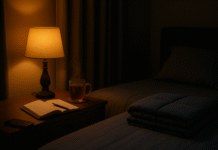
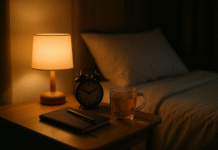
Light dictates biology at night. Build a mindful “lights-down” ritual: one hour before bed, switch to warm, low lighting; mute notifications; place your phone outside the bedroom; and choose one analog wind-down (paper book, stretching, journaling). If screens are unavoidable, use night-shift modes at minimum brightness and keep them far from your face. Combine this with any breathing or body-based practice above for a one-two punch.
12.1 Why it helps
Blue-enriched light in the evening suppresses melatonin more than longer-wavelength light and can shift circadian timing, delaying sleepiness. Sleep-medicine groups routinely advise minimizing bright light before bedtime to support the body clock and make it easier to fall asleep.
12.2 How to do it (steps)
- Set an alarm titled “Dim & Unplug” one hour before bed.
- Turn off overheads; use lamps with warm bulbs or candles safely.
- Park devices to charge outside the bedroom; if needed, enable night mode.
- Choose one analog cue (breathwork, body scan, stretching, or gratitude list).
- Keep the bedroom cool, dark, and quiet.
Mini-checklist: warm light, no doomscrolling, analog wind-down, simple breath practice. End by noticing darkness, the weight of blankets, and the ease of breathing.
FAQs
1) How long until these exercises improve sleep?
Some people feel calmer the first night, especially with breathing, PMR, or a body scan. For more stable changes in sleep quality, give consistent daily practice 2–4 weeks. If sleep remains poor after 3 months or you have significant daytime impairment, consult a clinician; CBT-I is first-line treatment for chronic insomnia and can incorporate many of these techniques.
2) Which exercise should I start with if my mind won’t stop racing?
Begin with diaphragmatic breathing or the 5-4-3-2-1 grounding sequence—they work fast and don’t require audio or long instructions. If worry about tomorrow is the main issue, schedule a five-minute to-do list or constructive worry session an hour before bed to “park” tasks outside the bedroom.
3) Are these safe if I wake during the night?
Yes. Use belly breathing, a mini body scan, or guided imagery without turning on bright lights. If you’re awake >20–30 minutes and frustrated, get out of bed to a dim-light chair and practice there to keep the bed paired with sleep (a CBT-I principle), returning when sleepy.
4) Is 4-7-8 breathing better than coherent breathing?
They share the same goal: slow, comfortable breathing with a long exhale. 4-7-8 uses a hold that some find soothing; coherent breathing targets ~5–6 breaths/min without holds. Try both and choose the one you’ll actually use—consistency matters more than the specific ratio. PMC
5) Does evening exercise ruin sleep?
Moderate movement earlier in the evening can help many sleepers, but vigorous training late at night may keep some people wired. If evenings are your only window, favor gentle activity (e.g., a calm walk or light yoga) and finish at least an hour before bed. PMC
6) What about blue-light-blocking glasses?
Limiting bright, blue-enriched light in the evening is helpful. The evidence for blue-blocking glasses specifically is mixed and not yet standardized; dimming and warming household lights, increasing distance from screens, and using device night modes remain reliable first steps.
7) Are apps okay, or should I avoid phones entirely?
If an app is the only practical way to access guided practices, use it with the screen dimmed, night mode on, and the phone placed face-down or across the room once audio starts. Many nonprofit and medical sources offer body scans and yoga nidra as audio files you can preload.
8) Can these replace therapy or medication?
They can complement care and sometimes resolve mild, short-term insomnia. For persistent insomnia (≥3 months), CBT-I has the strongest evidence, and medications may be considered if CBT-I isn’t accessible or as an adjunct. Speak with your clinician for personalized guidance. AASM
9) Is yoga nidra just a nap?
Not quite. It’s a structured, guided practice blending body awareness, breath, and imagery while you lie still. You may drift in and out of light sleep—that’s okay—but the intent is deep relaxation that often supports later nighttime sleep. Early trials suggest benefits for insomnia.
10) How do I measure progress?
Track three simple metrics for two weeks: time to fall asleep, night awakenings (number + duration), and how rested you feel on waking (0–10 scale). Look for trends, not perfection. If nothing improves after consistent practice, consider a CBT-I program. AASM
11) Are there risks?
These practices are low-risk. If breath holds (e.g., 4-7-8) cause dizziness, shorten or skip the hold. People with complex sleep disorders (e.g., untreated sleep apnea, RLS) should seek medical evaluation; mindfulness won’t correct underlying conditions. Use common-sense comfort as your guide.
12) What should my nightly routine look like?
An example 30-minute wind-down: dim lights → five-minute constructive worry/to-do list → mindful walk or stretch (optional) → shower/teeth in low light → 10 minutes diaphragmatic or coherent breathing → body scan in bed → lights out. Keep it simple and repeatable.
Conclusion
Mindfulness works for sleep because it changes where—and how—your attention rests. When you slow the breath, relax muscles, and anchor in the senses, the body gets a clear signal: it’s okay to power down. On nights of mental static, reach first for quick tools like belly breathing or 5-4-3-2-1 grounding. On nights filled with unfinished business, take five minutes in the evening for a constructive worry session or a detailed to-do list to park tomorrow outside the bedroom. Layer in a body scan, guided imagery, or yoga nidra to dissolve the last bit of tension and let drowsiness do the rest. Practice these consistently for 2–4 weeks and you’ll likely notice shorter sleep-onset times, fewer wake-ups, and calmer mornings. Start tonight with one exercise, keep the lights warm and low, and let your breath lead you to bed.
CTA: Pick one exercise from this guide, dim the lights, and try it for five minutes tonight.
References
- Black DS, O’Reilly GA, Olmstead R, Breen EC, Irwin MR. Mindfulness Meditation and Improvement in Sleep Quality and Daytime Impairment Among Older Adults with Sleep Disturbances: A Randomized Clinical Trial. JAMA Internal Medicine, 2015. JAMA Network
- Edinger JD, et al. Behavioral and Psychological Treatments for Chronic Insomnia Disorder in Adults. Journal of Clinical Sleep Medicine, 2021. PMC
- NCCIH. Meditation and Mindfulness: Effectiveness and Safety. National Center for Complementary and Integrative Health, June 3, 2022. NCCIH
- Sleep Foundation. Meditation and Sleep. SleepFoundation.org, Feb 26, 2024. Sleep Foundation
- Harvard Health Publishing. Blue light has a dark side. Harvard Health, July 24, 2024. Harvard Health
- Scullin MK, Krings BM. The Effects of Bedtime Writing on Difficulty Falling Asleep. Journal of Experimental Psychology: General, 2018. (open-access summary: ) PubMedPMC
- Datta K, et al. Yoga nidra practice shows improvement in sleep in patients with chronic insomnia: A randomized controlled trial. National Medical Journal of India, 2021. PubMed
- Sharpe E, et al. A closer look at yoga nidra: early randomized sleep-lab findings. Journal of Psychiatric Research, 2023. (open-access overview: ) ScienceDirectPMC
- Magnon V, et al. Benefits from one session of deep and slow breathing on stress and anxiety in adults. Scientific Reports, 2021. Nature
- Lin I-M, et al. Breathing at 5.5 breaths/min with equal inhale:exhale increases HRV. International Journal of Psychophysiology, 2014. PubMed
- Sleep Foundation. What to Do When You Can’t Sleep. SleepFoundation.org, n.d. Sleep Foundation
- American Academy of Sleep Medicine. Cognitive Behavioral Therapy for Insomnia (CBT-I) (patient page). SleepEducation.org, June 29, 2023. Sleep Education
- AASM. Bright Light Therapy (patient page). SleepEducation.org, May 6, 2021. Sleep Education
- AASM. Worried and wired: What’s keeping America awake. aasm.org, Aug 2025. AASM
- Hull University Teaching Hospitals (NHS). 5-4-3-2-1 Grounding Technique (patient leaflet). hey.nhs.uk, Dec 31, 2022. Hey NHS
- Dr. Colleen Carney. Constructive Worry Worksheet. drcolleencarney.com, 2013. Dr. Colleen Carney
- Simon KC, et al. Progressive muscle relaxation increases slow-wave sleep (overview). Frontiers in Sleep / PMC, 2022. PMC