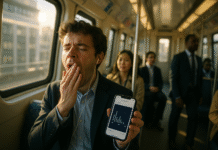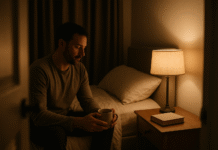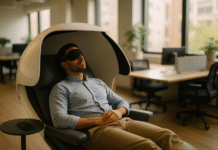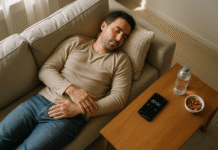
















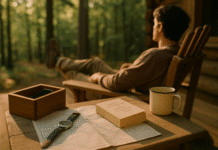
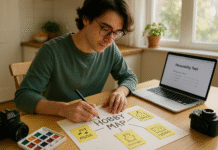



If you’re trying to cut back on doomscrolling at night, you don’t have to trade your phone for pure boredom. The best alternatives to nighttime screen use are low-stimulation, rhythmic activities that downshift your nervous system and keep light exposure minimal so your body can ease into sleep. In practice, that means things like paper books under warm light, gentle stretching, breathwork, journaling, and soothing sounds. In a sentence: pick a quiet ritual that’s easy to start, kind to your senses, and repeatable most nights.
Quick answer: Alternatives to nighttime screen use are screen-free wind-down rituals—reading paper books, light stretching, breathing exercises, journaling, warm baths, calm audio, herbal tea, or scent cues—that reduce arousal, limit light, and help you fall asleep faster.
Note: The ideas below are for general wellness, not medical treatment. If you have persistent insomnia, pain, anxiety, or a sleep disorder, speak with a qualified clinician.
1. Read a Paper Book Under Warm, Dim Light
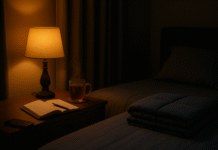
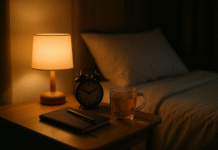
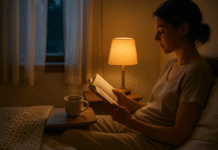
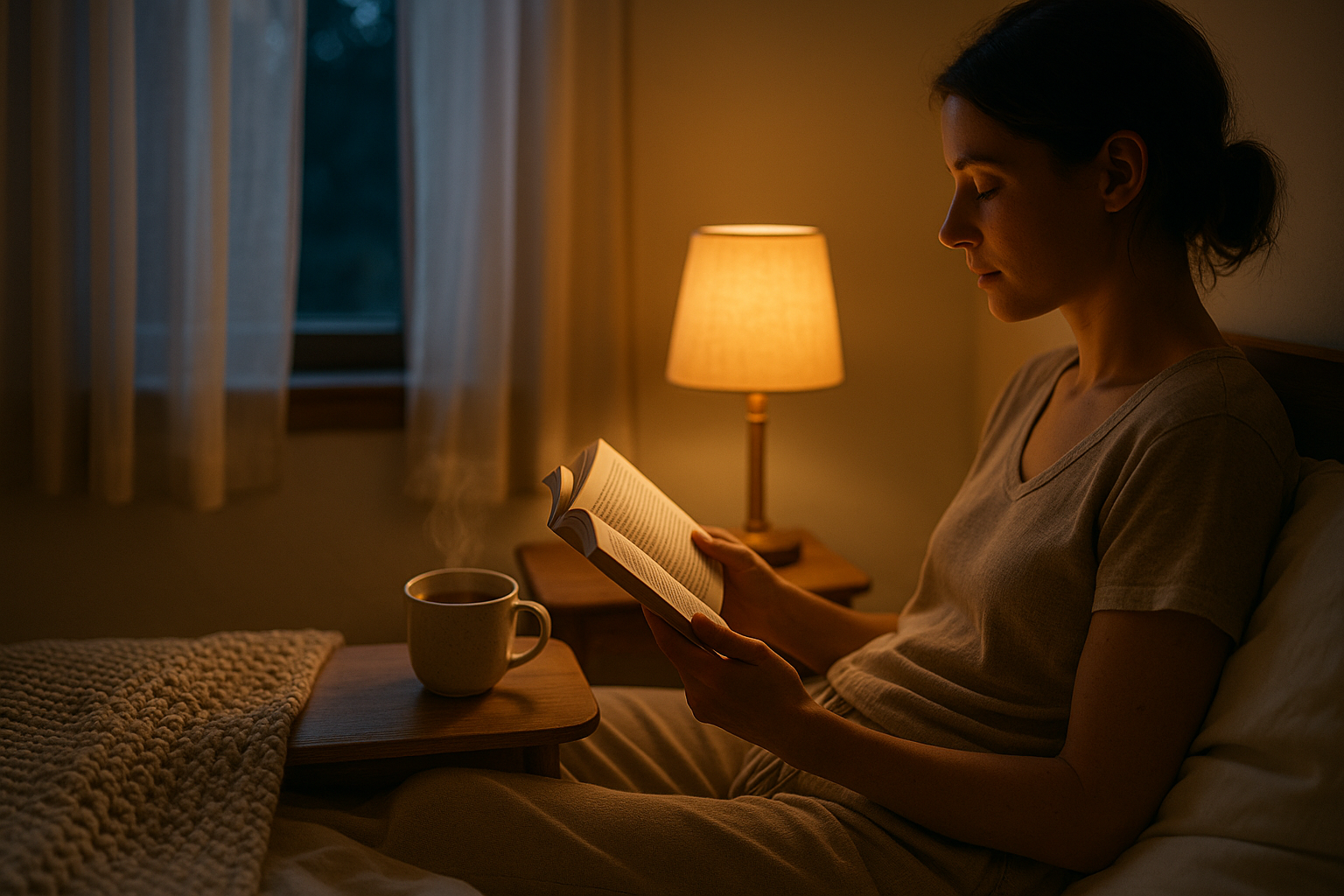
Reading a paper book (not an e-reader with a glowing screen) is one of the simplest, most effective swaps for nighttime scrolling. It engages your attention just enough to crowd out rumination without pumping adrenaline or blasting blue light into your eyes. Choose fiction or gentle nonfiction that won’t spike your stress. Keep lighting warm and low—think a bedside lamp with a soft, amber bulb focused on the page, not your face. This maintains a low-light environment so melatonin can rise as you wind down, while the steady pace of reading naturally slows breathing and heart rate. If you’re sleepy mid-chapter, that’s a feature, not a bug—close the book and let sleep happen.
How to do it
- Pick a paperback you can pick up and put down easily (short chapters help).
- Use a warm (~2700K) bedside lamp angled away from your eyes.
- Sit propped up with good neck support; stop as soon as your eyelids feel heavy.
- Keep a bookmark and a pencil for a quick note so you don’t “think back” to remember a passage.
- Avoid page-turning thrillers or work reading that could trigger arousal.
Numbers & guardrails
- Keep light levels low 1–2 hours before bed; dimmers or lampshades help.
- If you use an e-reader, choose e-ink (no glow) and turn off front-light or set to very warm, very low.
- Put the book down at the first yawn; pushing through can get you wired again.
Close by reminding yourself that reading is a bridge, not a destination: your goal isn’t a chapter count—it’s a calmer body ready for sleep.
2. Try a Restorative Yoga Micro-Sequence
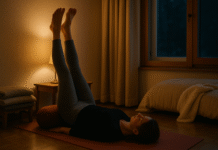
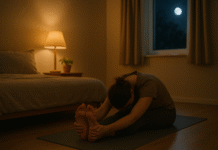
A brief, restorative yoga flow quiets the body without spiking heart rate. The combination of slow movement, long exhales, and supported shapes (like Child’s Pose or Legs-Up-the-Wall) reduces muscular tension and downshifts the nervous system. Unlike vigorous flows, restorative poses are held passively; you’re letting gravity do the work. Most people feel softer shoulders, warmer hands and feet, and a quieter mind in about 10 minutes. This screen-free ritual doubles as a cue—your body learns, “These shapes mean bedtime.”
Mini sequence (8–12 minutes)
- Seated neck/shoulder rolls (1 minute)
- Cat–Cow on all fours, slow, with long exhales (1–2 minutes)
- Thread-the-Needle each side (1 minute total)
- Child’s Pose with pillow support (2–3 minutes)
- Reclined Butterfly (supta baddha konasana) with a pillow under knees (2–3 minutes)
- Legs-Up-the-Wall or calves-on-couch (2–3 minutes), finish with 5 slow breaths
Why it matters / guardrails
- Keep it gentle in the last 2–3 hours before bed; save sweaty workouts for earlier.
- Use props (pillows/blankets) to feel supported; discomfort defeats the purpose.
- If any pain appears, back off or skip that shape.
Wrap up by lying still for 60 seconds and noticing the weight of your body—this mindful pause helps the benefit “stick.”
3. Progressive Muscle Relaxation (PMR)
PMR systematically tenses and releases muscle groups to teach your body the difference between tension and ease. It’s ideal when your mind is busy and your body feels wired—PMR gives you a script to follow and a physical outlet for restlessness. Working from feet to forehead (or vice versa), you gently tense for 5–7 seconds, then release for 20–30 seconds, noticing the wave of softness that follows. Many people drift off mid-sequence; that’s okay—the point is to reduce arousal.
How to do it (10–15 minutes)
- Lie down; take 3 slow belly breaths.
- Feet & calves: gently tense → release.
- Thighs & glutes: gently tense → release.
- Abdomen & lower back: small brace → release.
- Hands & forearms: fist → release.
- Shoulders & upper back: shrug → melt.
- Jaw, lips, eyes, forehead: scrunch → smooth.
- Finish with 5 slow breaths, noticing warmth or heaviness.
Mini-checklist & tips
- Keep effort at ~30–40% of max—no straining.
- Move around injuries; skip any painful area.
- Pair PMR with a soft blanket or eye mask to deepen the relaxation cue.
The key is consistency: a few evenings each week can retrain your baseline tension, making sleep easier even on stressful days.
4. Slow, Guided Breathing (4-7-8, Box, or Cyclic Sighs)
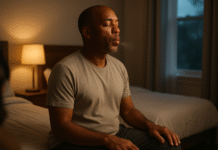
Your breath is a remote control for your nervous system. Slow, guided breathing extends exhales, nudging your body toward parasympathetic (“rest-and-digest”) mode. The rhythm gives your mind a job and dampens the swirl of bedtime thoughts. Three reliable patterns: 4-7-8 (inhale 4, hold 7, exhale 8), Box (inhale–hold–exhale–hold, each for 4), and Cyclic sighs (two short inhales, long unforced exhale). Try each and keep the one that feels most natural.
Quick start
- Sit or lie comfortably; place a hand on your belly.
- Choose a rhythm; breathe nasally if you can.
- Practice 2–5 minutes; stop if you feel light-headed.
- Pair with a word (“soft” on exhale) to anchor attention.
- End with a regular breath and a yawn if it comes.
Numbers & guardrails
- Aim for ~6 breaths/minute (10 seconds per breath) for a strong calming effect.
- If breath holds feel edgy at bedtime, skip holds and extend only the exhale (e.g., inhale 4, exhale 6–8).
- Consistency beats duration—2 minutes nightly is better than 15 minutes once a week.
With a little practice, your breath becomes a reliable “dim switch” for your body’s arousal.
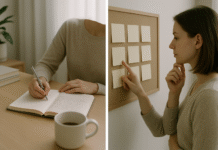
5. Journal: Gratitude or a Short To-Do Brain Dump
Nighttime worries often orbit unfinished tasks or what-ifs. A 5-minute journal gives those thoughts a home off your pillow. Two formats work well: gratitude (3 specific good things from today and why they mattered) and a to-do brain dump (write tomorrow’s tasks in concrete next-actions). Both reduce mental load; gratitude tilts your mood toward contentment, and to-dos offload working memory so your brain doesn’t rehearse all night.
Prompts
- Gratitude: “What went well today? Why?” (Aim for specifics, not platitudes.)
- To-Do dump: List tomorrow’s top 5 tasks as verbs (“Email Samran,” “Print forms”).
- If ruminating: Add, “I can’t control ___ tonight; my next step is ___ tomorrow at __.”
Mini-checklist & tips
- Keep it short (3–5 minutes) to avoid a productivity spiral.
- Use paper—screen light and app rabbit holes defeat the purpose.
- Close with one calming sentence: “Enough for today.”
You’ll be surprised how often writing the list trims your sleep latency; the brain rests when it trusts the page to remember.
6. Mindfulness Meditation or Body Scan
Mindfulness shifts you from problem-solving mode to a gentle, non-judgy noticing of breath and body sensations. A body scan is especially nighttime-friendly: you mentally sweep through the body, labeling sensations (“warm,” “heavy,” “tingly”) without fixing them. This trains attention away from spinning thoughts and softens cognitive arousal, a common insomnia engine.
A simple body scan (6–10 minutes)
- Lie down; place one hand on the belly.
- Start at toes; notice contact, warmth, or tingles for 5–10 seconds.
- Move upward: feet, calves, knees, thighs, hips, belly, lower back, chest, hands, arms, neck, face, scalp.
- If thoughts pull you away, note “thinking,” and return to the body part.
- End by noticing the whole body breathing.
Tips & guardrails
- Short and consistent beats long and rare.
- If sleepiness arrives, let meditation blur into sleep—mission accomplished.
- If sitting still feels edgy, try a mindful cup of tea or a 3-minute mindful hand massage as a moving meditation.
Think of mindfulness as mental de-cluttering at day’s end—less to carry into the night.
7. Take a Warm Bath or Shower (Thermal Wind-Down)
A warm bath or shower 60–90 minutes before bed helps your body cool after you step out. That gentle cooldown mimics the internal temperature drop that precedes natural sleep, easing you into drowsiness. It also washes off the day—literally and symbolically—so your brain files “the day is done.”
How to do it
- Water warm, not hot: think 38–40°C / 100–104°F for baths, a bit cooler for showers.
- Keep it brief (10–20 minutes) to avoid overheating.
- Afterward, dry off, slip into breathable sleepwear, and enter a cool, dim bedroom.
- Optional: add Epsom salt for the ritual (benefit is mostly sensory).
Numbers & guardrails
- Time it so you’re in bed ~60 minutes after finishing; adjust based on how your body feels.
- If you share a home, dim the bathroom lights to avoid a bright-light blast.
- Skip very hot soaks if you get light-headed or have heat-sensitive conditions.
Done right, bathing becomes a reliable cue: warm water, cool air, warm bed—sleep.
8. Play Calm Audio: Music, Audiobooks, or Gentle Noise
Soothing audio masks disruptive sounds and gives your mind a soft focus. Options include instrumental music, nature sounds, a mellow audiobook, or colored noise (pink/white). Music and pink/white noise can shorten the time it takes to fall asleep and improve perceived sleep quality for many people. Audiobooks work best when the narrator is calm and the plot low-stakes; think essays, nature writing, or familiar classics.
Setup tips
- Use a speaker or pillow speaker; avoid earbuds you could lose in bed.
- Set a 30–45 minute sleep timer so audio fades after you’ve dozed.
- Keep volume low—just enough to mask background noise.
- Prefer instrumental tracks or gentle narration without sudden dynamics.
Guardrails & options
- If you notice audio keeps you mentally “hooked,” switch to steady sounds (rain, fan, pink noise).
- For apartment noise, steady white noise can help mask spikes; many people find pink more pleasant.
- Keep your phone in Do Not Disturb and face down across the room so you don’t glance at the screen.
Think of calm audio as acoustic dimming—leveling noise peaks so your brain can settle.
9. Sip a Caffeine-Free Herbal Tea (Chamomile, Etc.)
A non-caffeinated herbal tea can be a powerful cue: hands warm, steam rising, breath slowing. Chamomile is the classic, with gentle, mixed-evidence benefits for sleep and anxiety; even when the biochemistry is modest, the ritual itself helps your brain transition. Other options: lemon balm, passionflower, or rooibos blends labeled “caffeine-free.”
How to do it safely
- Brew 1 cup 30–60 minutes before bed; sip mindfully.
- Keep it light to avoid middle-of-the-night bathroom trips.
- If you’re pregnant, nursing, on meds, or have allergies (e.g., ragweed), ask your clinician before trying herbs.
- Avoid added sugar late at night; go plain or a dab of honey.
Mini-ritual
- While it steeps, do 60 seconds of box breathing.
- Name one thing you’re grateful for on the first sip.
- When the mug is empty, lights go lower—bed is next.
Treat tea as a Pavlovian cue: mug → breath → bed.
10. Analog Puzzles, Knitting, or Adult Coloring
Hands-busy, mind-light activities like crosswords, sudoku, knitting, or adult coloring soothe by combining gentle focus with repetitive motion. They quiet rumination without the stimulation of screens. The tactile feedback is part of the magic—paper under pen, yarn moving across needles. Keep stakes absurdly low: the goal is not “finishing,” it’s settling.
Ideas that work
- A 10-minute crossword or a single sudoku grid.
- Knitting a few rows of a simple stitch pattern.
- Coloring a small mandala section with soft pencils.
- A 12-piece jigsaw if you’re truly wiped.
Guardrails & setup
- Good lamp, warm tone, no tiny parts you’ll step on later.
- Stop at the first yawn; set the puzzle down mid-grid to make it easy tomorrow.
- Avoid anything competitive or timed (no “just one more level” vibes).
These crafts create a rhythm that your nervous system recognizes as safe, calm, and pleasantly boring—perfect for pre-sleep.
11. Gentle Stretch-and-Stroll (Indoors or Low-Light)
When your body feels restless but a workout would wake you up, try a 5–10 minute stretch-and-stroll indoors (or a slow loop outside if it’s dark and safe). The aim is to move just enough to bleed off fidgets and invite yawns—think leisurely hallway laps with shoulder rolls and ankle circles, not cardio.
How to do it
- Dim your home’s lights; keep light exposure low.
- Walk slowly for 3–5 minutes, breathing through your nose.
- Add gentle mobility: ankle circles, calf stretch, chest opener in a doorway, forearm/wrist openers.
- Finish with 3 long exhales and a sip of water.
Guardrails
- Stop if heart rate creeps up; bedtime movement should calm you.
- Avoid bright streetlights or storefronts late at night; keep it indoors if you lack dark, quiet spaces.
- If you’ve been sedentary all day, schedule earlier light exercise (walks, yoga) to prime better sleep.
Consider this the “restless legs antidote”—it scratches the itch to move without waking your system.
12. Aromatherapy With Lavender (Optional, Gentle)
Lavender scent cues can be a pleasant add-on to other rituals. It won’t knock you out on its own, but inhaling a familiar, calming aroma can reduce bedtime anxiety for some people and nudge your brain toward rest by association. Think of it as environmental design for your wind-down.
How to try it
- Put 1–2 drops of lavender essential oil on a cotton pad near the bed (not on skin), or use a small diffuser for 15–30 minutes before lights out.
- Or choose a lavender-scented pillow spray; spritz lightly 10 minutes before bed.
- Keep the room well-ventilated and scents subtle; strong odors can be stimulating.
Safety & guardrails
- Essential oils are potent—avoid contact with eyes, do not ingest, and dilute before skin use.
- If you’re pregnant, nursing, or have asthma/sensitivities, skip it or consult a clinician.
- Use scent as a cue, not a crutch; pair with breathing or reading.
If you enjoy it, make it yours; if you don’t, skip without guilt—calm is the goal, not a particular smell.
13. Bedroom Reset: Cool, Dark, Quiet
Sometimes the best “activity” is a 5-minute environment tune-up that makes every other ritual more effective. Before bed, run a quick checklist: cool the room, dim lights, reduce noise, and tidy line-of-sight clutter so your brain isn’t scanning “unfinished business.”
5-minute reset
- Temperature: set the bedroom to ~18°C / 65°F (or your comfortable range).
- Light: close curtains, use a low amber lamp; cover LEDs.
- Noise: turn on a fan or pink/white noise if your home is loud.
- Clutter: put away 3 items in view; clear the nightstand.
- Bedding: straighten sheets, fluff pillows—comfort matters.
Guardrails
- Avoid bright overheads within an hour of bed; lamps are better than ceiling lights.
- If a partner prefers TV, use earplugs + eye mask and negotiate a screen curfew.
- Consistency beats perfection—do the reset most nights, not every detail every night.
Think of this as setting the stage so your body can play the role of “sleeper” without obstacles.
14. Next-Day “Mise en Place” (Prep Your Morning)
A calm night often hinges on a calm tomorrow. Spend 5–8 minutes doing a simple mise en place: lay out clothes, pack a bag, set the coffee maker, place keys by the door. The goal is to puncture worry loops by making tomorrow feel handled. This is especially powerful for students, caregivers, and shift workers.
Tiny prep list
- Choose tomorrow’s outfit; socks included.
- Pack bag: laptop, charger, ID, one snack, water.
- Set coffee/tea tools; place a clean mug by the kettle.
- Put keys/wallet in a visible, fixed spot.
- Post a sticky note with tomorrow’s one top task.
Guardrails
- Keep it brief; if you’re spiraling into inboxes or chores, you’ve drifted from prep to productivity.
- Stay in low light; save bright rooms for daytime.
- If you remember something in bed, whisper, “Tomorrow me will handle it,” and trust your sticky note.
This small routine trades late-night mental load for a few orderly minutes—better sleep, better morning.
15. Guided Imagery (A Pleasant “Mind Movie”)
When your brain wants to think, give it something gentle to think about. Guided imagery is daydreaming on purpose: you imagine a safe, soothing scene in vivid sensory detail, like walking a quiet beach at sunrise or sitting in a mountain meadow. The more senses you include—sight, sound, smell, touch—the more compelling the scene and the less room for intrusive thoughts.
How to do it
- Lie comfortably; close your eyes.
- Pick a location you love (real or imagined).
- Describe it internally: colors, temperature, textures, sounds, scents.
- Move slowly through the scene; if thoughts intrude, return to a detail (e.g., the sound of waves).
- Let the scene fade naturally into sleep.
Tips & variations
- Combine with slow breathing (inhale: “arrive,” exhale: “soften”).
- If visuals are hard, focus on soundscapes (wind in trees, distant surf).
- Reuse the same scene nightly so it becomes a reliable sleep switch.
Think of guided imagery as storytelling for your nervous system—comforting, repetitive, and sleep-friendly.
FAQs
1) What’s the single best alternative to nighttime screen use?
There’s no universal winner, but for most people it’s a two-part combo: 5–10 minutes of slow breathing or PMR to lower arousal, followed by a paper book under warm light. This pairs a body-based downshift with a gentle mental focus. If you’re noise-sensitive, add a low fan or pink noise in the background to mask environmental sounds.
2) How long before bed should I stop using screens?
A conservative target is 30–90 minutes before bed. What matters most is intensity and proximity: bright, blue-rich, close-to-eyes light suppresses melatonin more than dim, warm, far-away light. If you must use a device, turn brightness way down, enable the warmest night filter, and keep it physically distant—then switch to one of the screen-free activities above as soon as you can.
3) Are e-ink readers okay?
Yes—e-ink (non-glowing) devices are closer to paper, especially with the front-light off or very warm and dim. If your model has a front-light, angle it away from your eyes and keep the room otherwise dim. When in doubt, a physical paperback avoids the guesswork.
4) Do herbal teas or lavender really work?
Evidence is mixed but promising for mild sleep support, and many people find the ritual itself calming. Chamomile and lavender have small studies showing improvements in sleep quality for some groups. Safety first: herbs can interact with medications or allergies—check with a clinician if you’re unsure.
5) Is it okay to exercise in the evening?
Gentle movement (restorative yoga, stretching, leisurely walking) is usually fine and can help. Avoid vigorous workouts in the final hours before bed if they leave you wired. If late workouts are your only option, finish with long exhales or PMR to bring your system down.
6) What if my partner watches TV in the bedroom?
Set a shared curfew where the TV is off (or moved out), use wireless headphones for their shows, and add eye masks and noise masking for you. Better yet, create a joint wind-down routine—tea, puzzles, or audiobook—so you’re both relaxing without screens.
7) I fall asleep to audiobooks. Is that bad?
Not inherently. Use a sleep timer (30–45 minutes), pick low-stakes content and calm narration, and keep volume low. If you notice you’re staying up to hear “what happens next,” switch to instrumental music or steady rain sounds that don’t hook attention.
8) How cool should my bedroom be?
A cool room helps most people sleep—roughly 60–67°F (15.6–19.4°C) is the often-cited range. Individual comfort varies; aim for “a little cool under the covers,” not shivering. If feet get cold, warm socks paradoxically help your core cool.
9) I wake up at 3 a.m.—what should I do screen-free?
Stay dim, stay still-ish. Try 2 minutes of 4-7-8 breathing, a short body scan, or listen to pink/white noise. If you’re awake at ~20 minutes, get out of bed, keep lights low, and do a calm activity (paper reading, a few rows of knitting) until drowsy returns.
10) How many minutes should a wind-down take?
15–30 minutes is plenty. Pick one soothing anchor (breath, book, bath, or brew) and repeat most nights. Your brain learns the pattern, and you’ll slide into sleep more smoothly over time.
11) Can I combine activities?
Absolutely. Stacks that play well: warm shower → tea → book; gentle yoga → PMR → guided imagery; bedroom reset → to-do dump → pink noise. Keep the whole stack simple and low light.
12) What if nothing here works?
If you’ve tried consistent wind-downs for 2–4 weeks without meaningful change, consider CBT-I, the first-line, non-drug treatment for insomnia, delivered by a trained clinician or validated digital program. It targets the core drivers of insomnia beyond bedtime routines.
Conclusion
You don’t need heroic willpower to quit scrolling at night—you need better defaults. The alternatives above work because they respect how human sleep actually unfolds: dimmer light, slower breathing, lower muscle tone, quieter thinking, and cooler rooms. Pick one that appeals (paper reading, breathwork, a warm shower, a tiny journal, a few knitting rows), keep it easy and repeatable, and give it a couple of weeks to become your brain’s new bedtime cue. If you like rituals, stack two or three into a simple routine. If you’re busy, choose the shortest: two minutes of slow breaths and a single page of reading can be enough.
The ultimate test is not whether a routine looks perfect—it’s whether you fall asleep sooner and wake more refreshed. Experiment, adjust, and keep what works. Your next great night’s sleep might be one small habit away.
Try this tonight: dim the lights, write a 3-item to-do list for tomorrow, and read a paper book for 10 minutes—then turn out the light and let sleep happen.
References
- Evening use of light-emitting eReaders negatively affects sleep, circadian timing, and next-morning alertness, PNAS (Chang et al.), 2015. https://www.pnas.org/doi/10.1073/pnas.1418490112
- About Sleep — What to Do (turn off devices ≥30 minutes before bed; cool, quiet rooms), Centers for Disease Control and Prevention, May 15, 2024. https://www.cdc.gov/sleep/about/index.html
- Keep light levels low 1–2 hours before bedtime (sleep tips for shift/long hours), CDC/NIOSH, reviewed Mar 31, 2020. https://www.cdc.gov/niosh/work-hour-training-for-nurses/longhours/mod6/07.html
- The Best Temperature for Sleep, Sleep Foundation, updated Jul 11, 2025. https://www.sleepfoundation.org/bedroom-environment/best-temperature-for-sleep
- Mindfulness Meditation and Improvement in Sleep Quality and Daytime Impairment, JAMA Internal Medicine (Black et al.), 2015. https://jamanetwork.com/journals/jamainternalmedicine/fullarticle/2110998
- Breathing Practices for Stress and Anxiety Reduction (parasympathetic effects), Frontiers in Human Neuroscience (Bentley et al.), 2023. https://www.ncbi.nlm.nih.gov/pmc/articles/PMC10741869/
- The Effects of Bedtime Writing on Difficulty Falling Asleep (to-do list vs. completed tasks), Journal of Experimental Psychology: General / Baylor University summary, 2018. https://www.ncbi.nlm.nih.gov/pmc/articles/PMC5758411/
- A randomized controlled trial of bedtime music for insomnia disorder, Journal of Sleep Research (Jespersen et al.), 2019. https://onlinelibrary.wiley.com/doi/abs/10.1111/jsr.12817
- Can Pink Noise Help You Sleep? (overview and studies), Sleep Foundation, updated Jul 29, 2025. https://www.sleepfoundation.org/noise-and-sleep/pink-noise-sleep
- Effects of white noise on sleep in individuals with difficulty sleeping, Sleep Medicine (Ebben et al.), 2021. https://pubmed.ncbi.nlm.nih.gov/34049045/
- Tailored individual Yoga practice improves sleep quality in chronic insomnia, Frontiers in Psychiatry (Turmel et al.), 2022. https://www.ncbi.nlm.nih.gov/pmc/articles/PMC9012014/
- The effect of progressive muscle relaxation on sleep quality (multiple RCTs overview), Menopause (Sucu et al.), 2024. https://journals.lww.com/menopausejournal/fulltext/2024/08000/the_effect_of_progressive_muscle_relaxation.4.aspx
- Chamomile and sleep — systematic review and meta-analysis, Phytotherapy Research (Hieu et al.), 2019. https://pubmed.ncbi.nlm.nih.gov/31006899/
- Aromatherapy and sleep quality in older adults, Medicine (Baltimore) (Xu et al.), 2024. https://pubmed.ncbi.nlm.nih.gov/39654196/
- How Electronics Affect Sleep (practical tech tips and blue-light guidance), Sleep Foundation, updated Jul 10, 2025. https://www.sleepfoundation.org/how-sleep-works/how-electronics-affect-sleep