



























Building a daily journal habit is less about inspiration and more about design: clear purpose, tiny steps, dependable cues, and forgiving guardrails. In simple terms, you keep a daily journal habit by making it small, scheduling it next to an existing routine, preparing a repeatable template, and tracking progress with flexible accountability. Quick start: choose a 2–3 minute format, anchor it after a stable cue (like brushing your teeth), pre-load a simple template, set a gentle reminder, and mark your streak—if you miss, restart the next day without drama.
A brief note: journaling can support well-being and reflection, but it’s not a substitute for professional care. If writing surfaces distressing memories or symptoms, consider speaking with a qualified clinician.
1. Define Your “Why” and What Success Looks Like
A daily habit sticks when it answers a real need. The first step is to clarify exactly why you want to journal and how you’ll recognize progress. Are you trying to lower stress, capture ideas, clarify priorities, or notice patterns in mood or sleep? Put the purpose in a sentence you can read in ten seconds before you write. Then add simple success markers—things you can see, feel, or measure. For instance, “I want to reduce bedtime overthinking. Success looks like falling asleep within 20–30 minutes most nights and fewer spirals.” This framing matters because motivation fluctuates, but a well-defined outcome becomes a compass. Research on mental contrasting (imagining the desired future and the present obstacles together) shows that clear goal-context pairing improves follow-through. You’ll also use your “why” to choose the best format, time, and prompts so the habit fits your life instead of fighting it.
1.1 Why it matters
- A specific, emotionally meaningful goal increases the odds you’ll show up when energy dips.
- It narrows choices: if your “why” is mood regulation, three short prompts beat long narrative entries.
- It turns journaling from a vague ideal into a tool with a job.
1.2 How to do it
- Write a one-sentence purpose: “I journal daily to ______ so that ______.”
- Choose two observable signals aligned to that purpose (e.g., “3+ nights/week I note one anxiety trigger and one coping step”).
- Place that purpose at the top of your journal or as your app’s first page.
Mini-checklist: Clear purpose? Two success signals? Visible reminder? If yes, you’ve given your habit a job to do.
2. Make It Tiny (2–3 Minutes) So It’s “Too Small to Fail”
Consistency beats intensity. Starting with a brief, lightweight format reduces friction and lets repetition encode the behavior. Aim for a 2–3 minute window you can keep on hectic days; this creates a reliable baseline while leaving room to go longer when you want. Habit research shows that repetition in a stable context is what forms automaticity, not the size of each session. Practically, that means a short daily entry is more effective than sporadic, long catch-ups. You’re building a groove first, depth second. A tiny habit also lowers the emotional barrier—“I can do two minutes” is a different proposition from “I must craft a page of wisdom.”
2.1 Numbers & guardrails
- Duration: 2–3 minutes baseline; cap early sessions at 5 minutes to avoid perfection traps.
- Word count: 50–150 words or 3–5 bullet points.
- Trigger: same place, same time daily for the first month.
2.2 How to do it
- Choose a micro-format (examples below) and stick with it for at least 14 days.
- Set a hard stop: when your timer rings, close the notebook even if you want more.
- Save “long writes” for a separate weekly block.
Example micro-formats:
- “3 lines”: Today I will… / I’m grateful for… / One small win yesterday was…
- “ABCDE”: Aware (feeling), Body (sensation), Concern, Decision, Experiment for today.
- “1–1–1”: One priority, one fear, one thing I’ll enjoy.
Synthesis: If you keep the habit tiny, you’ll keep it alive—then you can grow it without breaking it.
3. Use an If-Then Plan (Implementation Intention)
If-then plans (“After I brew my coffee, then I’ll journal for three minutes at the table”) convert intention into a concrete behavior bound to a specific cue. They work because they pre-decide when and where the habit occurs, reducing the cognitive load of choice in the moment. This simple structure has repeatedly improved goal attainment across domains. For journaling, the key is to tie the action to a stable daily cue you already perform almost every day (brew coffee, sit on the bus, brush teeth). The more precise you get, the easier your brain can “auto-complete” the sequence.
3.1 How to do it
- Write one sentence: “If it’s [time] and I [reliable cue], then I will journal for [2–3 minutes] at [location].”
- Put that sentence on a sticky note where the cue happens.
- Practice the sequence once during the day to prime it (a 30-second rehearsal is enough).
3.2 Common mistakes
- Using vague cues (“after work”)—choose something precise (“after I put my keys in the bowl”).
- Picking an unstable cue (e.g., a meeting that moves times).
- Making the action too big for your energy at that time.
Mini case: A commuter writes on her phone after she sits on the bus. Cue: sitting. If-then: “If I sit on the 8:05, then I open Notes and fill my 1–1–1 template.” Result: 23 of 28 days in month one.
Synthesis: When your plan is “if X then journal Y at Z,” you’ve moved from hoping to scripting.
4. Stack It on a Stable Routine You Already Do
Habit stacking pairs a new behavior with an existing one so the old routine becomes the launchpad. This is cousin to if-then planning but emphasizes piggybacking on rhythms your body already runs automatically. For journaling, the best stacks attach to non-negotiables: morning beverages, lunch breaks, school drop-off returns, teeth brushing, bedtime plug-in. The magic is stability—attach the new step where variability is low. Over time, the original action becomes a contextual cue; your brain anticipates, “I floss, then I write three lines.”
4.1 How to do it
- List five stable daily actions; pick the one with the fewest exceptions.
- Place your journal or app shortcut exactly where that action happens.
- Script the stack: “After I [existing action], I will [open journal] and [fill template].”
4.2 Tools/Examples
- Physical: Keep a slim notebook and pen in the mug cabinet.
- Digital: Add a homescreen widget for your notes app; set “open journal” as the first Shortcut.
- Work: Leave your notebook on your keyboard at day’s end; tomorrow begins with three lines.
Pitfalls to avoid: Stacking onto an action you occasionally skip, chaining too many steps at once, or stacking onto high-chaos moments (e.g., right when kids wake up).
Synthesis: When journaling rides an existing routine, you’re no longer “fitting it in”—you’re just following the groove you already have.
5. Engineer Your Environment to Remove Friction
We do what’s easy to start and satisfying to finish. Environment design aims to make journaling the path of least resistance and reduce everything that makes it harder. That means having a pen that always works, a notebook that opens flat, a chair and light you like, and a phone setup that puts your journal one tap away without distractions. On the flip side, remove friction sources: dead pens, buried app icons, competing notifications, perfectionist standards. The effect is subtle but powerful—fewer obstacles mean more starts, and more starts mean more days logged.
5.1 How to do it
- Pre-position: Put your journal where your cue lives; add a backup pen; keep your charger nearby.
- One-tap entry: Pin your journal app to your dock; create a “New Entry” shortcut.
- Reduce digital noise: Use Focus/Do Not Disturb for 5 minutes during your slot.
5.2 Mini-checklist
- Journal visible at the cue spot
- Working pen or keyboard ready
- Comfortable seat and light
- Phone set to open journal first, not social apps
Example: You place a pocket notebook with your kettle; when the kettle clicks, the notebook is there. You also archive old pens and keep two gel pens clipped inside. Result: zero scavenger hunts, faster starts.
Synthesis: By making the right action the easy action, you’ll do it more often—no willpower pep talk required.
6. Use a Simple Template and Prompts to Beat Blank-Page Syndrome
Blank pages invite procrastination. A repeatable template lowers decision cost and directs attention to what matters for your goal. Good templates are short, structured, and flexible. They guide you but don’t hem you in. For mood regulation, try prompts that name feelings and actions; for planning, capture priorities and constraints; for gratitude, note specifics rather than generalities. Keep the core template constant for a month so your brain recognizes the pattern and slips into it faster.
6.1 Templates you can steal
- Focus trio: Top priority, one constraint, one support you’ll use.
- Regulate & act: Feeling → Thought → One helpful action.
- Gratitude specifics: Three people/things + what you appreciate specifically about each.
- Evening audit: What went well? What didn’t? What to change tomorrow?
6.2 How to enhance
- Keep a running list of prompts at the back of your notebook or pinned note.
- Rotate prompts weekly rather than daily to reduce novelty pressure.
- Add tags (e.g., #energy, #wins) so weekly reviews are easier.
Pitfalls: Over-designing your template, switching formats too often, or chasing the “perfect prompt.” The simplest template you’ll actually use wins.
Synthesis: A small, stable structure replaces dread with momentum—open, fill, done.
7. Reserve a Protected Slot (and Use Soft Alarms)
Time you don’t protect gets filled by other people’s priorities. Choose a daily slot that realistically survives your life’s traffic: early morning before notifications ramp up, a lunch nook, a post-commute decompression, or a pre-sleep wind-down. Put it on your calendar for 5–10 minutes, not to “make it official,” but to create a tiny boundary you respect. Use soft alarms—subtle reminder chimes, a calendar nudge, or a smart speaker routine—to prompt you without jarring your nervous system.
7.1 How to do it
- Pick a same-time, same-place slot that’s already calm.
- Add a repeating calendar entry titled “3-minute journal.”
- Use one reminder (not five); the goal is a cue, not alarm fatigue.
7.2 Region & routine notes
- If your weekend pattern shifts (e.g., Friday vs. Sunday weekly rest), choose two slots: weekday and weekend.
- During holidays or Ramadan/fasting schedules, temporarily move the slot to the most stable daily anchor.
Mini case: A parent blocks 8:40–8:45 p.m. after the kids’ bedtime story. A smart speaker says, “Journal time.” Five minutes later, lights dim and the entry is done. Consistency jumps from “sometimes” to 6 nights/week.
Synthesis: A small, protected window signals that journaling matters, even when days are messy.
8. Track Your Streak (and What Helped)
What gets measured gets managed—and remembered. Progress monitoring improves goal attainment, partly because it keeps the goal top of mind and provides feedback loops. For journaling, track two things: the streak (days you showed up) and one brief note on what helped (cue, mood, environment). You’re not judging; you’re noticing patterns. Over a few weeks, you’ll see which slots, templates, and setups make writing almost automatic.
8.1 How to do it
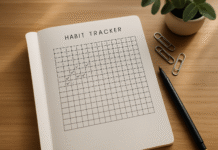
- Put a tiny checkbox calendar on the inside cover; tick each day.
- Or use a habit app that shows a monthly grid; enable one gentle reminder.
- Add a two-word context tag under the tick (“bus ride,” “low energy,” “post-run”).
8.2 Numbers & guardrails
- Aim for 5–6 days/week average (an 80–85% hit rate).
- Celebrate streak milestones (7, 21, 50 days) with tiny rewards (see Strategy 10).
- Avoid “all-or-nothing” thinking: gaps are data, not failure.
Mini example: After 30 days of tags, you notice “post-dinner” entries are erratic; “post-commute” is nearly automatic. You move your slot and your 7-day rolling average rises from 4.1 to 5.8 days.
Synthesis: Streaks are motivational, but insights are transformational—track both.
9. Add Accountability That Fits Your Personality
Accountability isn’t about public shaming; it’s about gentle social gravity. Some people thrive with a buddy who checks in weekly; others prefer a private commitment contract with small stakes. You can also define “family-visible” accountability, like leaving your journal on the dining table after you write, so the act is seen (not the content). The key is fit: pick the lightest accountability that nudges you without anxiety.
9.1 Options
- Buddy text: Send a ✅ emoji after your entry; keep it silent unless you miss two days.
- Micro-stakes: If you skip two planned days in a week, you donate a small amount to a cause you like (not a “hate” charity).
- Group rhythm: Share “I showed up today” in a small, supportive chat—no content required.
9.2 How to do it
- Define the rule in one sentence.
- Agree on check-in day (e.g., Fridays).
- Keep the signal simple and automatable (scheduled text, shortcut, or shared habit app).
Pitfalls: Over-sharing private content, over-punishing lapses, or choosing accountability that adds stress. Keep it kind and minimal.
Synthesis: The right amount of social pull turns “maybe later” into “I’ll knock this out now.”
10. Pair Journaling With an Immediate Reward (Temptation Bundling)
Long-term benefits don’t motivate well in the moment, so add a small, immediate reward to the act of journaling. Pair your two-minute write with a treat you already enjoy: a favorite playlist, first sip of tea, or sitting in your comfiest chair. This “temptation bundling” increases the immediate attractiveness of the behavior and has been shown to boost follow-through in other domains. You’re not bribing yourself—you’re acknowledging how motivation actually works and designing for it.
10.1 How to do it
- Make a bundle list: 3–5 small pleasures that pair well with writing.
- Tie one pleasure exclusively to journaling (e.g., “I only play that 3-minute track when I journal”).
- Keep the reward adjacent to the action (simultaneous or immediately after).
10.2 Examples
- Morning: first sip of chai + “journal track” on headphones.
- Commute: window seat + favorite lo-fi playlist.
- Evening: lavender candle you only light during the entry.
Guardrail: Rewards should be small and healthy; avoid pairing with sugar binges or doomscrolling.
Synthesis: Make journaling feel good now, not just “good for you” later, and you’ll keep coming back.
11. Plan for Missed Days With a “Never Twice” Rule
Lapses happen. The difference between a wobble and a collapse is your recovery script. Decide in advance that you won’t chase perfection; you’ll prevent compounding by not missing twice in a row. That means if today slips, tomorrow you do the tiniest version—two lines is success. This compassionate rule keeps momentum alive, and over weeks it yields a surprisingly high adherence rate. Remember, habit formation takes time (often weeks to months); “never twice” ensures a blip doesn’t become an identity story (“I’m bad at habits”).
11.1 How to do it
- Write your recovery script on page one: “If I miss a day, tomorrow I write two lines.”
- Tag lapses neutrally in your tracker (○) and move on.
- Review the cause once a week, not in the moment.
11.2 Numbers & expectations
- Many daily habits feel “automatic” only after dozens of repetitions.
- Expect streak clusters and dips; aim for upward trend, not straight lines.
Mini case: You miss Saturday and Sunday while traveling. Monday morning, you write exactly two lines at the airport gate, then check ✅. The habit survives the trip and resumes at home.
Synthesis: The goal is resilience, not perfection—protect the chain by restarting fast and small.
12. Upgrade Slowly: From Micro-Entries to Deeper Reflection
Once the habit is consistent, you can selectively deepen it without risking collapse. That might mean expanding to 5–7 minutes a few days a week, switching to a richer prompt set, or adding one reflective paragraph on weekends. Upgrading slowly respects the brain’s need for stability. Think progressive overload, not a sudden leap. When adding depth, keep your tiny baseline intact—on busy days you still do the three-line version and count it.
12.1 How to do it
- After 21+ days at ~80% adherence, add one “deep day” per week (10–15 minutes).
- Use reflective prompts: What pattern did I notice this week? Where did I keep a promise? Where did I drift?
- Consider a thematic day: money, relationships, learning, health.
12.2 Tools/Examples
- Use headings or tags (#deepdive, #review) to find long entries easily.
- Try a separate section at the back of your notebook for weekly insights or a dedicated note in your app.
- Optional: add a 5-minute timer for the reflective add-on so it doesn’t sprawl.
Synthesis: Keep the micro-habit untouched and layer depth on top; the foundation holds while meaning grows.
13. Run a Weekly 15-Minute Review to Close the Feedback Loop
A weekly review turns scattered pages into insights and next actions. Set aside 15 minutes on the same day each week to skim entries, tag themes, and extract one or two adjustments for the coming week. The aim isn’t to critique your prose—it’s to connect inputs (sleep, stressors, meetings) with outputs (energy, mood, progress) and to notice which cues made journaling easiest. This meta-habit compounds learning and keeps the practice purposeful.
13.1 How to do it
- Schedule: Pick a quiet day/time (e.g., Sunday evening).
- Scan & tag: Mark entries with quick tags (#wins, #stuck, #ideas).
- Extract: Write 3 bullets: one insight, one action, one thing to keep.
13.2 Optional enhancements
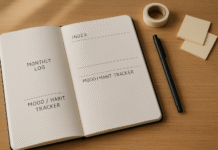
- Create a rolling index on the last page (topic → dates).
- Use an app’s search and tag filters to pull all #wins for a morale boost.
- Keep a “golden lines” list—phrases you want to remember.
Mini example: You notice “10 a.m. coffee + 3 lines” yields clear afternoon focus. You keep that stack and decide to switch evening entries to a shorter gratitude template.
Synthesis: Reviews transform journaling from a diary into a decision-support system.
14. Protect Privacy and Write Safely
Psychological safety fuels honest writing. Decide how you’ll keep entries private so you can write without self-censorship. For paper, store the notebook in a consistent, discreet spot (a locking drawer, backpack sleeve). For digital, enable device passcodes, app locks, or encryption. If you share devices, consider a separate notes app or account. Safety also means emotional pacing: expressive writing can stir strong feelings; take breaks, ground yourself, and seek support if needed. You control what you capture and when.
14.1 How to do it
- Paper: Use a slim notebook you can carry; add your name and “Please return” note.
- Digital: Turn on app passcode/Face ID; back up to a secure cloud; disable lock-screen previews.
- Emotional safety: If a topic feels overwhelming, time-box to 2 minutes and follow with a regulating action (breath, walk, call a friend).
14.2 Mini-checklist
- Do I know where my journal lives?
- Is access protected appropriately?
- Do I have a calming “after” routine if big feelings arise?
Synthesis: When you trust the container—physically and emotionally—you’ll write with honesty, which is where journaling shines.
15. Build Identity: Become “A Person Who Journals”
Identity cements habits. Move beyond “I’m trying to journal” toward “I’m the kind of person who writes a few lines each day.” Small actions are votes for that identity. Each checkmark, each two-minute session, reinforces the story you’re living. Identity framing reduces the need for negotiation; you simply do what people like you do. Support this with visible cues (a card on your desk that says “I write today”) and language (“I don’t skip my two lines”). Over time, journaling feels less like a task and more like self-maintenance.
15.1 How to do it
- Write an identity statement inside your cover: “I’m a person who journals daily, even when it’s short.”
- Create a first-domino ritual you enjoy (opening the notebook, uncapping the pen).
- Share the identity with one supportive person (“This is part of who I am now”).
15.2 Common mistakes
- Tying identity to output (“I’m a good writer”) rather than behavior (“I show up”).
- Waiting for inspiration instead of trusting the ritual.
- Letting a gap rewrite your story. It doesn’t—your next entry does.
Synthesis: Identity makes consistency feel natural; you act in alignment rather than wrestling with willpower.
FAQs
1) How long should a daily journal entry take?
For habit formation, start with 2–3 minutes or 50–150 words. The goal is a consistently repeatable unit you can complete even on chaotic days. Once the behavior feels automatic, you can add one deeper session per week. Many people land at 5–10 minutes on average, but the tiny baseline remains your safety net for travel, illness, or busy seasons.
2) What’s the best time of day to journal?
The best time is when your life is most stable. Mornings suit planning and intention; evenings suit reflection and decompression. Test both for a week each and track adherence. Whichever yields the higher 7-day average (e.g., 5/7 vs. 3/7) wins. If your weekends differ from weekdays, pick a secondary slot for those days.
3) Paper or digital—which keeps me more consistent?
Both work if you design them well. Paper offers low friction and focus; digital offers search, tags, and reminders. Choose the one that best fits your cue and environment. If you commute and write on a bus, digital might win. If you start with coffee at home, a notebook by the kettle is hard to beat. You can hybridize (paper daily; digital weekly review).
4) What should I write about if I feel stuck?
Use a stable template to skip decisions. Try “1–1–1” (one priority, one fear, one enjoyment) or “Regulate & act” (feeling → thought → one action). Keep a back-page list of prompts and pick one without thinking. Writer’s block usually melts once you start; your tiny timer ensures you finish even if the entry is basic.
5) How long does it take for journaling to become automatic?
It varies widely. In habit research, some behaviors felt automatic in a few weeks while others took months. Rather than aiming for a magic number, focus on a stable cue, a tiny baseline, and an 80% weekly completion rate. Use the “never twice” rule to prevent minor lapses from derailing momentum.
6) Is journaling good for mental health?
Reflective and expressive writing can support well-being—helping you name emotions, make sense of experiences, and plan small actions. Responses differ by person and topic; if writing surfaces intense distress or trauma, pause, ground yourself, and consider professional support. Journaling complements care; it doesn’t replace it.
7) Should I read old entries or just keep writing?
Both have value. Writing daily builds awareness and continuity; a weekly 15-minute review converts notes into patterns and next steps. If re-reading triggers self-criticism, switch to scanning for tags (e.g., #wins, #stuck) and choose one adjustment for the coming week.
8) Can voice notes or typing count as journaling?
Absolutely. The habit’s job is clarity and reflection, not a particular medium. If speaking your thoughts for two minutes is easier, do that, then optionally transcribe or jot three bullets. Pick the medium that best fits your cue and context so you actually show up.
9) How do I keep my journal private?
Decide your security level upfront. For paper, use a consistent storage spot, consider a locking drawer, and keep notebooks portable. For digital, enable device passcodes, app locks, and cloud backups. If sharing devices, use a separate profile or app. Emotional privacy matters too—write what feels safe today.
10) What if my days are unpredictable?
Use mobile-first design and flexible anchors. Attach journaling to a universal cue (e.g., “first sit on public transport,” “first hot drink,” “plugging in my phone at night”). Keep a pocket notebook or a pinned notes widget and rely on the 2-minute baseline. Imperfect days count when your system is small and portable.
Conclusion
A daily journal habit sticks when it’s designed to survive your real life. Start with a purpose that matters to you, shrink the behavior to two or three minutes, and tie it to a stable cue with an if-then plan or a simple stack. Pre-load a template to dodge the blank page, arrange your environment so writing is the easiest option, and track your streak lightly while noticing what helped. Add a touch of accountability and a small immediate reward to tilt behavior in your favor. Expect lapses; plan your restart; and layer depth only after consistency clicks. Most importantly, grow an identity around showing up—because “I am a person who journals” is a story you can live every day.
Set a tiny timer, open the page, and write your three lines—start today.
References
- Wood, W., & Rünger, D. (2016). The Psychology of Habit. Annual Review of Psychology. https://www.annualreviews.org/doi/10.1146/annurev-psych-010814-015030
- Lally, P., van Jaarsveld, C. H., Potts, H. W., & Wardle, J. (2010). How are habits formed: Modeling habit formation in the real world. European Journal of Social Psychology, 40(6), 998–1009. https://onlinelibrary.wiley.com/doi/abs/10.1002/ejsp.674
- Gollwitzer, P. M. (1999). Implementation intentions: Strong effects of simple plans. American Psychologist, 54(7), 493–503. https://doi.org/10.1037/0003-066X.54.7.493
- Milkman, K. L., Minson, J. A., & Volpp, K. G. (2014). Holding the Hunger Games Hostage: Using Temptation Bundling to Promote Exercise. Management Science, 60(6), 283–299. https://pubsonline.informs.org/doi/10.1287/mnsc.2014.1906
- Harkin, B., Webb, T. L., Chang, B. P. I., et al. (2016). Does monitoring goal progress promote goal attainment? A meta-analysis. Psychological Bulletin, 142(2), 198–229. https://psycnet.apa.org/doi/10.1037/bul0000138
- Baikie, K. A., & Wilhelm, K. (2005). Emotional and physical health benefits of expressive writing. Advances in Psychiatric Treatment, 11(5), 338–346. https://www.cambridge.org/core/journals/advances-in-psychiatric-treatment/article/emotional-and-physical-health-benefits-of-expressive-writing/7C64C1B6D7B8B351D5F15B7A3E7C5074
- Fogg, B. J. (n.d.). Fogg Behavior Model. BehaviorModel.org. https://www.behaviormodel.org/
- Oettingen, G., Pak, H., & Schnetter, K. (2001). Self-Regulation of Goal Setting: Turning Free Fantasies About the Future Into Binding Goals. Journal of Personality and Social Psychology, 80(5), 736–753. https://psycnet.apa.org/record/2001-05721-003
- Clear, J. (n.d.). Habit Stacking: How to Build New Habits by Taking Advantage of Old Ones. JamesClear.com. https://jamesclear.com/habit-stacking
- Clear, J. (n.d.). The 2-Minute Rule to Stop Procrastination. JamesClear.com. https://jamesclear.com/two-minute-rule