
























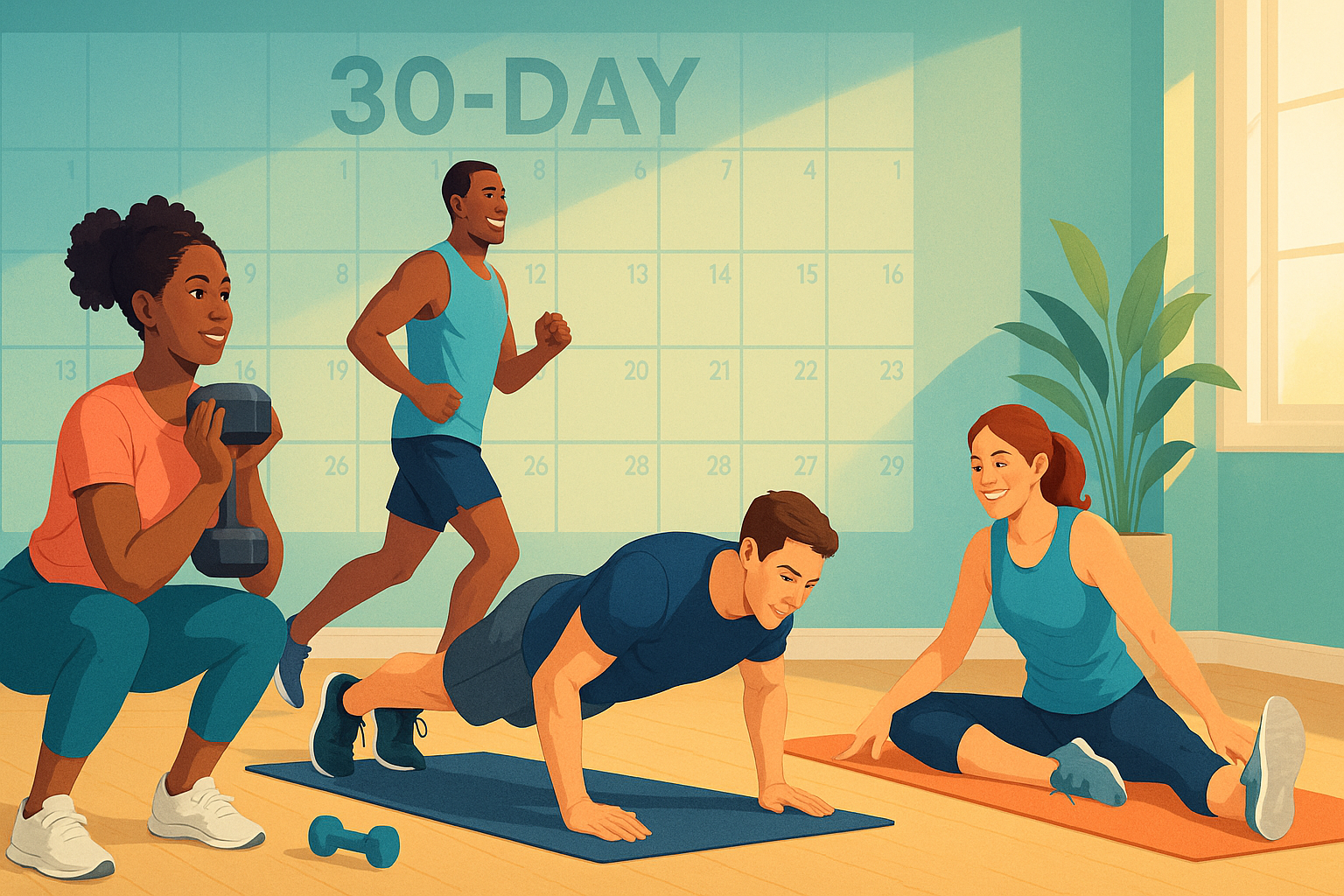
If you’ve been waiting for a sign to finally get consistent, this is it. A 30-day fitness challenge is a simple, structured way to build momentum, see measurable progress, and feel better in your body—fast. In this guide, you’ll get a complete, ready-to-use program that blends strength, cardio/HIIT, mobility, and recovery so you can transform your body in a month without living at the gym. You’ll learn exactly what to do each day, how to warm up and cool down, how to scale the work to your fitness level, and how to track meaningful results from week to week. The plan is designed for busy beginners through early intermediates and can be done at home with minimal equipment.
Disclaimer: The information here is educational and not medical advice. If you have a health condition, are pregnant, or haven’t been active recently, talk with a qualified professional before starting a new exercise program.
Key takeaways
- Consistency beats intensity. You’ll train 5 days per week with 2 active recovery days to build habits that stick.
- Simple metrics drive progress. You’ll track minutes, reps, and a few baseline tests to see results in real time.
- Strength + cardio + mobility = best results. This 30-day mix matches widely accepted guidelines for health and performance.
- Short, smart HIIT works. Brief intervals can boost fitness efficiently when used 1–2 times per week.
- Recovery is part of training. Sleep, hydration, and spacing strength days matter just as much as the workouts.
How this 30-day challenge works
This challenge organizes your month into four themed weeks that steadily increase volume or difficulty while keeping recovery on point. You’ll rotate:
- Strength days (full body): Build muscle, joint stability, and calorie-burning lean mass.
- Cardio base days: Improve aerobic engine with steady effort you can maintain and recover from.
- HIIT finisher or day: Short, punchy intervals for efficiency and conditioning.
- Mobility/flexibility sessions: Keep you moving well, reduce stiffness, and support better form.
- Active recovery: Light movement to accelerate recovery and maintain momentum.
Time commitment: 30–45 minutes per training day. Two days each week are lighter (active recovery + mobility).
Intensity guide (the “talk test”):
- Moderate: You can talk but not sing.
- Vigorous: Only a few words before you need a breath.
Equipment:
- Optional dumbbells or a kettlebell (5–25 lb for most beginners).
- A mat, a chair/bench, and an anchor point (sturdy table edge/doorframe).
- A timer (phone).
Low-cost alternatives: Fill backpacks with books, use water bottles as light weights, perform bodyweight-only options.
Quick-start checklist and warm-up
Checklist (print this if helpful):
- Pick your training time and place it on your calendar (same time daily if possible).
- Select your equipment (dumbbells optional; otherwise go bodyweight).
- Take baseline measures (push-up reps, 1-mile walk/jog time, 30-sec squat reps, plank time, hip/shoulder mobility notes, waist/hip in cm).
- Set two process goals (e.g., “Move 5 days/week” and “Log sleep each night”).
- Decide your hydration plan (water bottle within reach all day).
- Prep a sleep target (aim for 7+ hours; build a wind-down routine).
5–8 minute warm-up (every training day):
- Light cardio 2–3 minutes: March in place, brisk walk, easy cycling.
- Dynamic mobility 3–5 minutes:
- Arm circles x10 each way
- Hip hinges x10
- Walking lunges x10 per side (or stationary alternating reverse lunges)
- Inchworms x5
- Glute bridge x10
- Movement prep 1–2 minutes: 1 light set of your first strength exercise.
Flexibility notes: Hold gentle stretches ~30 seconds and repeat 2–4 times, ideally after workouts or on mobility days. Warm up first; don’t bounce; stretch to mild tension, not pain.
Pillar 1: Strength training (full body)
What it is & why it matters
Strength training uses resistance (your bodyweight, dumbbells, bands) to stimulate muscles to grow stronger and more resilient. It supports fat loss, improves posture, protects joints, and raises resting metabolic rate. Aim for at least two full-body sessions per week; our plan gives you three in some weeks for faster adaptation while spacing sessions to allow recovery.
Requirements & budget-friendly options
- Ideal: Pair of dumbbells (light to moderate).
- Budget: Bodyweight-only variations (e.g., squats, push-ups to a counter, hip hinges).
- Space: A few square meters and a doorframe/wall.
Step-by-step strength session (30–35 minutes)
- Warm up (5–8 minutes).
- Main circuit (3 rounds; rest 60–90 seconds between rounds):
- Squat or goblet squat — 10–12 reps
- Push-up (elevated if needed) — 8–12 reps
- Hip hinge: dumbbell deadlift or good morning — 10–12 reps
- Row: dumbbell row or towel row under table — 10–12 reps/side
- Split squat or reverse lunge — 8–10 reps/side
- Core: plank — 20–40 seconds
- Cool down: Easy walking 2–3 minutes + 2–3 stretches.
Beginner modifications & progressions
- Make it easier:
- Use a chair for sit-to-stand squats.
- Elevate hands for push-ups (counter, then table, then bench, then floor).
- Shorten range of motion on lunges or hold on to support.
- Progressions:
- Add load in 1–2 kg steps or add 1–2 reps per set.
- Slow the lowering phase (3 seconds down).
- Add a 4th round in Weeks 3–4 if you recover well.
Frequency, duration, & simple metrics
- Frequency: 2–3 days/week with ~48 hours before repeating the same muscle groups. This spacing supports recovery and strength gains.
- Duration: ~30–40 minutes/session.
- Metrics: Total sets completed, load used, best set reps, and plank time.
Safety, caveats, and common mistakes
- Move through a pain-free range; joint discomfort signals you to modify form or range.
- Keep ribs down and brace your core on squats/hinges to protect your back.
- Don’t add weight until technique is crisp for 2 sets.
- Honor rest days—change happens when you recover, not just when you push.
Quick sample mini-plan (2–3 steps)
- Day A: Circuit above x3 rounds; finish with calf and chest stretches.
- Day B: Swap push-ups for overhead press (light DBs) and add side planks 2×20–30s/side.
Pillar 2: Cardio base and HIIT
What it is & why it matters
Cardio base is steady, moderate effort you can maintain while breathing a little heavier—brisk walking, easy jogging, cycling, swimming. It builds endurance, supports heart health, and helps you recover between harder efforts. HIIT uses short bursts of high effort with rest or easy movement between. When done 1–2 times weekly, HIIT can efficiently improve fitness markers like VO₂max.
Requirements & low-cost options
- Cardio base: Shoes and a route you enjoy.
- HIIT: A timer and a safe space to move (yard, hallway, treadmill, bike).
- Indoor option: Shadow boxing, step-ups on stairs, jumping jacks (low-impact version if needed).
Step-by-step cardio day (25–40 minutes)
- Warm up 5 minutes easy.
- Main set 20–30 minutes at a pace where you can talk but not sing.
- Cool down 3–5 minutes light, then 2–3 stretches.
Starter HIIT session (15–20 minutes total)
- Warm up 5 minutes.
- Intervals 8–10 rounds: 20 seconds hard effort + 60–70 seconds easy; options: fast walk up a hill, stationary bike surge, brisk stair climb.
- Cool down 3–5 minutes.
Beginner modifications:
- Make the “hard” interval a strong power walk; shorten rounds (e.g., 6 sets).
- Use low-impact moves if jumping bothers your joints.
Progressions:
- Add 1–2 rounds, extend “work” to 30 seconds, or slightly shorten recoveries as fitness improves.
- Limit true HIIT to 1–2 times per week to recover well.
Frequency, duration, & metrics
- Base cardio: 2–3 days/week, 20–40 minutes.
- HIIT: 1–2 sessions/week.
- Metrics: Distance covered, average pace, perceived exertion, or how many rounds you complete at a given pace.
- Over the month, you’ll accumulate a weekly mix that aligns with common recommendations for adults: ~150 minutes of moderate activity, or ~75 minutes of vigorous activity, plus strength on 2+ days.
Safety, caveats, and common mistakes
- Keep hard days short and crisp; don’t turn every cardio session into a race.
- If breathing feels ragged early in a session, you started too fast—dial it back to the talk test zone.
- Prioritize posture: tall spine, relaxed shoulders, quick feet.
Quick sample mini-plan (2–3 steps)
- Base day: 30-minute brisk walk where you can talk in full sentences.
- HIIT day: After warm-up, 8×(20s hard / 70s easy) fast walk up a gentle incline, then 5-minute cool down.
Pillar 3: Mobility and flexibility
What it is & why it matters
Mobility is your ability to move joints through usable ranges with control. Flexibility is the passive range a muscle can achieve. Together, they reduce stiffness, make your strength work safer and more effective, and help you feel lighter and looser.
Requirements & budget options
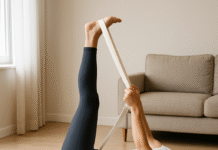
- A mat or carpet, optional strap/towel for hamstrings and shoulders, a wall or doorway.
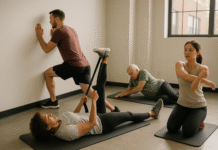
Step-by-step mobility session (15–25 minutes)
- Dynamic flow (5–8 min): Cat–cow x8, thoracic openers x8/side, hip circles x10, leg swings x10/side.
- Targeted stretches (8–12 min): Hip flexor, hamstring, glute figure-four, pec doorway, calf—hold ~30 seconds, repeat 2–4 times. Warm up first; stretch gently; no bouncing.
- Breathing reset (2–3 min): 4-second inhale, 6-second exhale, lying on your back with feet elevated.
Beginner modifications & progressions
- Use cushions to reduce joint pressure.
- Reduce hold times initially (10–20 seconds) and add rounds as tolerance grows.
- Add loaded mobility later (e.g., goblet squat sit, controlled articular rotations).
Frequency, duration, & metrics
- Frequency: 3–5 short sessions/week or 10 minutes tacked onto strength days.
- Duration: 15–25 minutes standalone, or 5–10 minutes post-workout.
- Metrics: Notes on range (e.g., “can now lunge with knee to floor”), movement quality ratings, and less stiffness on waking.
Safety, caveats, common mistakes
- Stretch warm muscles; cold muscles tolerate less.
- Mild tension is good; pain is a red flag.
- Breathe; holding your breath makes muscles guard.
Quick sample mini-plan (2–3 steps)
- After strength days: Hip flexor and hamstring stretches (2×30s each side), doorway chest stretch (2×30s), then diaphragmatic breathing.
Pillar 4: Recovery: sleep, hydration, spacing strength days, and protein
Why recovery matters
Training is a stress; improvement happens during recovery. The big rocks are sleep, hydration, spacing strength days, and getting enough protein to support repair and adaptation.
Sleep
Most adults benefit from at least 7 hours nightly. Build a 45–60 minute wind-down: dim lights, screens off, light stretching, consistent bedtime. If you wake unrefreshed, shorten late caffeine, cool the room, and keep a consistent schedule.
Hydration
Drink regularly through the day, especially before and after workouts. Dehydration can impact cognition, mood, thermoregulation, and digestion—none of which help your training. Keep a water bottle nearby and aim for pale-yellow urine most of the day.
Spacing strength days
Leave about 48 hours between hard strength sessions for the same muscle groups. This spacing supports muscle repair and performance on your next workout.
Protein (practical guidance)
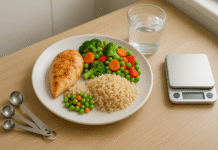
Distribute protein across meals—center plates on lean proteins, dairy/soy options, legumes, or high-protein grains. Evidence suggests muscle-building benefits level off around ~1.6 g/kg/day for many people; more than that doesn’t seem to add further gains for most trainees.
If you’re smaller, busy, or plant-based, you can still get there with planning (Greek yogurt, eggs or tofu, beans + grains, a scoop of whey/soy/pea protein when convenient).
How to measure progress (so you can actually see the transformation)
Before Day 1 and again on Days 15 and 30, collect:
- Performance:
- Push-ups (elevated or floor): max quality reps in one set.
- Air squats: max reps in 30 seconds.
- Plank: max quality hold time.
- Walk/jog: 1-mile time (or 1.5 km if that’s easier to measure).
- Body metrics: Waist at navel, hips at widest point (cm), body mass if you track it.
- Mobility notes: E.g., “can’t touch toes,” “right shoulder tight overhead.”
- Cardio intensity check: Use the talk test during base sessions to ensure you’re hitting the right zones without overreaching.
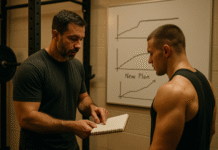
Weekly review (10 minutes):
- What improved? What felt hard? Did you meet your sleep and hydration goals?
- If a lift or movement stalls, lighten the load, clean up form, or add an extra rest day before pushing again.
Your 4-week starter plan (day-by-day)
How to use it: Treat each “Week” as seven days in a row. If you miss a day, don’t double up—just continue with the next day and keep going. You’ll see two tracks in some places: Beginner (B) and Progression (P). Choose the one that fits how you feel today.
Week 1 — Build the foundation
- Day 1 — Strength A (Full Body)
Warm-up → Circuit (3 rounds): Goblet or bodyweight squat 10–12; Counter push-up 8–12; Hip hinge 10–12; One-arm row 10–12/side; Reverse lunge 8–10/side; Plank 20–30s. Cool down stretches. - Day 2 — Cardio base (30 minutes)
Brisk walk or easy cycle at a pace where you can talk in sentences. Cool down 3–5 minutes. - Day 3 — Mobility + Core (20–25 minutes)
Dynamic flow → Hip flexor, hamstring, calf, and doorway chest stretches (2×30s each). Finish with 2× side planks 20–30s/side. - Day 4 — Strength B (Full Body)
Circuit (3 rounds): Sit-to-stand or squat 10–12; Overhead press (light DBs) 8–10; Romanian deadlift 10–12; Row 10–12/side; Step-back lunge 8–10/side; Dead bug 8–10/side. - Day 5 — HIIT (15–20 minutes)
Warm-up → 8×(20s hard / 70s easy) fast walk on an incline or bike → Cool down. - Day 6 — Active recovery (20–30 minutes)
Easy walk, gentle yoga, or casual cycling + long exhale breathing. - Day 7 — Optional mobility reset (15–25 minutes)
Repeat Day 3 or take a restful walk and stretch.
Week 2 — Groove the movements, add a little volume
- Day 8 — Strength A: Add 1–2 reps per exercise or slightly heavier weight.
- Day 9 — Cardio base: 35 minutes steady.
- Day 10 — Mobility + Core: Add thoracic rotation and 90/90 hip transitions.
- Day 11 — Strength B: Add a 4th round (P) or slow the lowering phase to 3 seconds.
- Day 12 — HIIT: 10×(20s hard / 60s easy) (P) or repeat Week 1 if new to intervals.
- Day 13 — Active recovery: Light walk + 10 minutes of stretching.
- Day 14 — Optional test/retest: Check push-ups and squat reps; note improvements.
Week 3 — Progressive challenge
- Day 15 — Re-measure key metrics (push-ups, squats in 30s, plank, 1-mile time).
- Day 16 — Strength A: 4 rounds or add load.
- Day 17 — Cardio base: 30–40 minutes; include 3×1-minute brisk pick-ups with 2 minutes easy between.
- Day 18 — Mobility + Core: Emphasize hip flexor and hamstring (3×30s holds), plus breathing reset.
- Day 19 — Strength B: Keep form crisp; if bar speed slows hard, hold volume steady.
- Day 20 — HIIT: 8–10×(30s hard / 60–75s easy) (P).
- Day 21 — Active recovery: Leisure walk + gentle full-body stretch.
Week 4 — Peak week, then deload to finish fresh
- Day 22 — Strength A: Hold volume steady; aim for best-quality reps.
- Day 23 — Cardio base: 30–35 minutes smooth and conversational.
- Day 24 — Mobility + Core: Longer holds where you feel tight; keep it easy.
- Day 25 — Strength B: Optional small load bump or tempo work (2s down, 1s up).
- Day 26 — HIIT (light): 6–8×(20s hard / 70s easy) to keep freshness.
- Day 27 — Active recovery: Walk with a friend, extra sleep tonight.
- Day 28 — Final prep: Easy 20–30 minutes cardio + mobility; visualize your Day 30 retest.
- Day 29 — Rest day: Hydrate and sleep well.
- Day 30 — Retest & reflect: Repeat baseline tests; jot down wins and what you want next month.
How this plan aligns with common recommendations: Across each week you’ll accumulate a mix of moderate and vigorous activity with at least two strength sessions—an evidence-informed template for health and fitness.
Troubleshooting & common pitfalls
“I missed two days. Start over?”
Nope. Continue with the next scheduled day. Fitness compounds—consistency over perfection.
“My knees hurt when I squat.”
Try a narrower stance, sit-to-stand from a chair, or elevate heels slightly on a small book. Keep knees tracking over midfoot. Reduce depth if needed.
“I’m wiped out before HIIT.”
Swap a HIIT day for base cardio and extra sleep that week. The body can’t adapt without recovery.
“Soreness lingers more than 48 hours.”
Scale back volume by a round, reduce load, or extend rest between strength days to ~48 hours for the same muscle groups.
“I’m not sure how hard to go on cardio.”
Use the talk test: moderate means you can talk in sentences; vigorous trims you to a few words.
“I’m not seeing changes on the scale.”
Measure performance and measurements, not just weight. Strength, stamina, and inches often change before weight.
“I’m thirsty all day.”
Carry water, sip regularly, and aim for pale-yellow urine. Dehydration can affect thinking and mood; don’t wait for extreme thirst.
“Protein feels hard to hit.”
Front-load breakfast (yogurt + fruit + oats, or eggs/tofu + toast). Consider a protein shake on busy days. Benefits for hypertrophy tend to level off around ~1.6 g/kg/day for many.
Beginner and intermediate scaling guide
If you’re brand new:
- Start with 2 rounds of the strength circuit in Week 1; move to 3 rounds in Week 2.
- Keep HIIT to one session per week; choose low-impact intervals.
If you’re returning and feel good:
- Use 3–4 rounds for strength by Week 3.
- On base cardio days, add 3×1-minute pick-ups at a brisker pace.
Signs you’re ready to progress:
- You finish sessions with 1–2 clean reps “in the tank.”
- Your talk-test pacing feels easier at the same route/time.
Sample daily templates (print-friendly)
Strength day (35–40 min):
- Warm-up 6 min → Strength circuit 3–4 rounds → Optional finisher (farmer carry 3×30–60s) → Cool down 5 min.
Cardio base day (30–40 min):
- Warm-up 5 min → 20–30 min conversational pace → Cool down 5 min.
HIIT day (15–20 min):
- Warm-up 5 min → 8–10 rounds 20s hard / 60–70s easy → Cool down 3–5 min.
Mobility day (20 min):
- Dynamic flow 6 min → Targeted stretches 10–12 min (30s holds, 2–4 rounds) → Breath 2 min.
Nutrition in one page (challenge-friendly)
- Anchor each meal with protein. Lean meats or fish, eggs or tofu/tempeh, Greek yogurt or cottage cheese, beans + whole grains. Evidence suggests benefits for gains level off around ~1.6 g/kg/day for many trainees; use snacks/shakes if needed to close gaps.
- Plants at every meal. Aim for color variety to cover micronutrients.
- Carbs fuel training. Oats, rice, potatoes, fruit around workouts.
- Fats for satiety. Nuts, seeds, olive oil, avocado in modest amounts.
- Hydrate all day. Keep a bottle nearby; sip before, during, and after sessions.
- Sleep is the multiplier. Protect 7+ hours when you can.
10 FAQs (quick, practical answers)
1) Can I split the workout into two shorter sessions?
Yes. For example, 15 minutes of strength in the morning and 15 minutes of walking later. What matters most is your total weekly mix and consistency.
2) How hard should HIIT feel?
During work intervals you should only be able to say a few words; recover fully between rounds so quality stays high. If that standard starts slipping, shorten the session.
3) What if I can’t do floor push-ups yet?
Elevate hands on a sturdy surface (counter or table). Lower the surface height over the month as you get stronger.
4) How do I avoid knee pain with lunges and squats?
Keep knees tracking over the middle toes, step back into reverse lunges if forward lunges bother you, reduce depth, and strengthen glutes with bridges.
5) How often should I stretch?
A few minutes after each workout is plenty; hold gentle stretches around 30 seconds and repeat a couple of times. Save deeper holds for mobility days or after training.
6) I’m short on time—what’s the minimum effective dose?
Two strength days and two 20–30 minute cardio sessions are a solid baseline; even brief sessions accumulated across the week help.
7) Do I need supplements?
Not required. Many people hit protein targets with food; if not, a simple whey, casein, or plant protein can help. Emphasize whole foods first; see the ~1.6 g/kg/day note.
8) How do I know if I’m overdoing it?
Persistent fatigue, poor sleep, falling performance, or soreness that lasts more than 48 hours are signals to ease up and add recovery. PMC
9) Can I swap exercises?
Absolutely. Keep the pattern (squat, push, hinge, pull, lunge, core). For example, swap rows for band pulls, or goblet squats for step-ups.
10) What happens after 30 days?
Run the plan again with small progressions: add weight, add a round, or advance an exercise variation. Or step into a focused goal (e.g., 5K plan or strength phase).
Conclusion
You don’t need perfection or complicated routines to change your body in a month. You need a simple plan, the discipline to show up most days, and a few smart checkpoints to confirm you’re improving. Follow the 30-day schedule, use the talk test to regulate intensity, prioritize sleep and water, and you’ll finish the month stronger, fitter, and more confident—ready for whatever comes next.
Copy-ready CTA: Start Day 1 tomorrow—put it on your calendar now and let the next 30 days change you.
References
- Adult Activity: An Overview, Centers for Disease Control and Prevention, December 20, 2023. https://www.cdc.gov/physical-activity-basics/guidelines/adults.html
- Measuring Physical Activity Intensity, Centers for Disease Control and Prevention, (accessed 2025). https://www.cdc.gov/physicalactivity/basics/measuring/index.html
- Effectiveness of High-Intensity Interval Training and Continuous Endurance Training for VO₂max Improvements: A Systematic Review and Meta-Analysis of Controlled Trials, PubMed (Sports Med), August 2015. https://pubmed.ncbi.nlm.nih.gov/26243014/
- A Guide to Basic Stretches, Mayo Clinic, (accessed 2025). https://www.mayoclinic.org/healthy-lifestyle/fitness/in-depth/stretching/art-20546848
- About Sleep, Centers for Disease Control and Prevention, May 15, 2024. https://www.cdc.gov/sleep/about/index.html
- Fast Facts: Data on Water Consumption, Centers for Disease Control and Prevention, January 19, 2024. https://www.cdc.gov/nutrition/php/data-research/fast-facts-water-consumption.html
- American College of Sports Medicine Position Stand: Progression Models in Resistance Training for Healthy Adults, PubMed (Med Sci Sports Exerc), March 2009. https://pubmed.ncbi.nlm.nih.gov/19204579/
- Effects of Consecutive Versus Nonconsecutive Days of Resistance Training on Strength, Journal of Strength and Conditioning Research (PMC article), August 2018. https://pmc.ncbi.nlm.nih.gov/articles/PMC6015912/
- A Systematic Review, Meta-Analysis and Meta-Regression of the Effect of Protein Supplementation on Resistance Training–Induced Gains in Muscle Mass and Strength in Healthy Adults, PubMed (Br J Sports Med), 2018. https://pubmed.ncbi.nlm.nih.gov/28698222/