

























Being healthy and fit means being able to move your body in different ways. People who are just starting out may be scared to start working on their flexibility because they don’t know how to do it right, how to prevent getting harmed, how to make progress, or where to obtain good information. But with the appropriate help, you may safely and efficiently enhance your range of motion, reduce muscular stiffness, and help your posture. Based on information from prominent groups like the American Council on Exercise (ACE), Harvard Medical School, and peer-reviewed studies, this article gives newcomers a clear and organized method for starting their road to flexibility with confidence.
These five suggestions will help you move around more easily, whether you work in an office and need to get up and move after sitting for a long period, want to get better at your sport, or just want to move around more easily. Each suggestion is based on science that explains how flexibility works, points out typical pitfalls, and provides you things to do. Not only will following these suggestions minimize your risk of getting wounded, but you’ll also develop a habit that will help you in the long run.
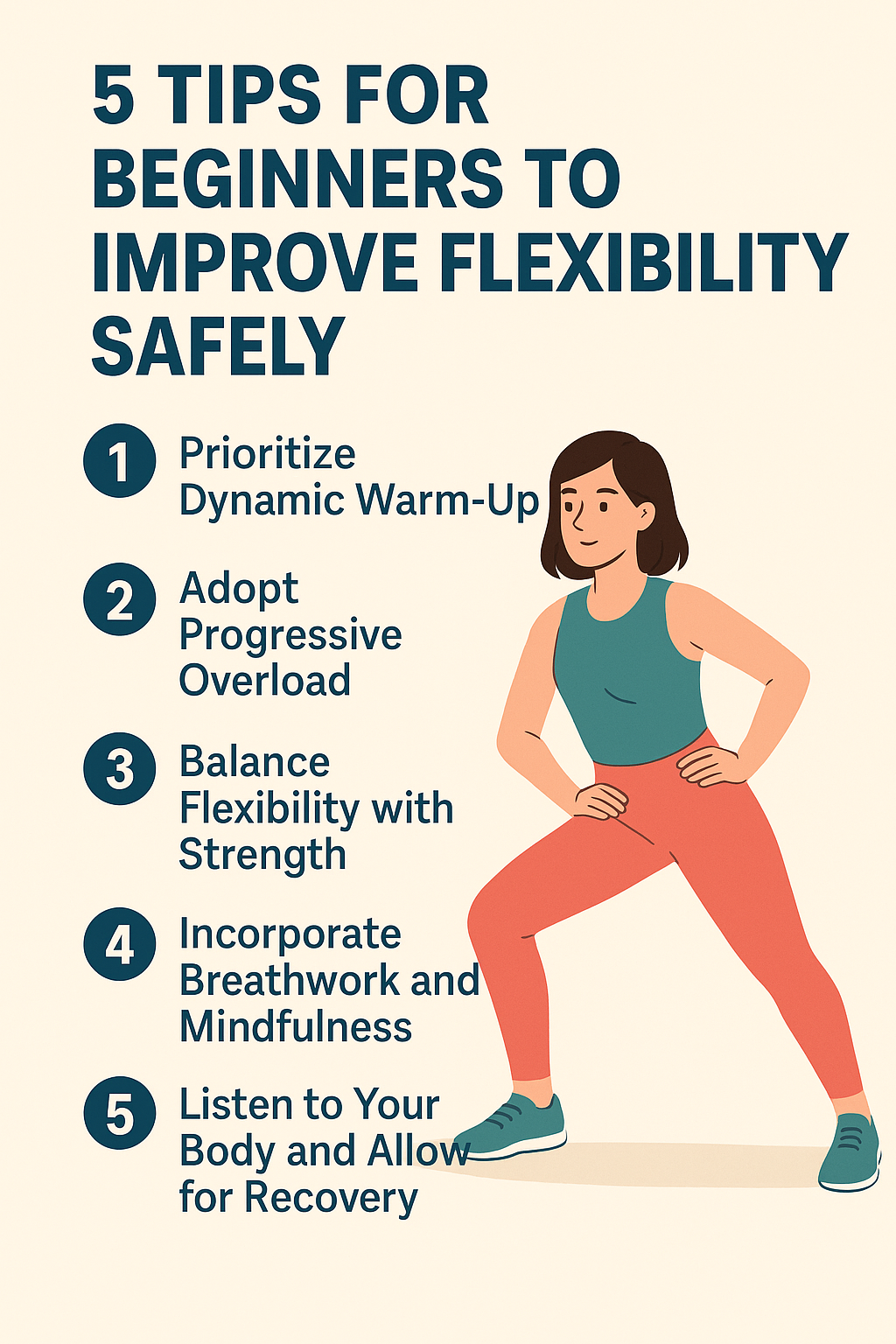
Tip 1: undertake some active warm-ups before you undertake static stretches.
How Science Helps You Get Warm
A warm-up gets the muscles ready to move, gets the blood circulating, and gets the neurological system ready to move. The American College of Sports Medicine (ACSM) claims that dynamic warm-up exercises are superior than static stretching for making muscles and joints more flexible and able to move more easily. Dynamic motions are like the exercises you’ll undertake later. They warm up your muscles so you can stretch more deeply, which minimizes the chance of strains.
Dynamic stretching vs. static stretching
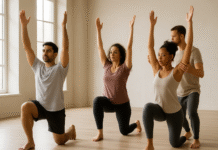
Dynamic stretches are motions that move joints through their complete range of motion. Some examples are swings of the legs, circles of the arms, and rotations of the torso.
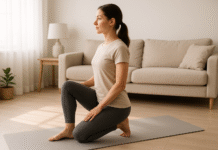
When you execute static stretches, you stay in a position at the end of a joint’s range. For instance, when you sit down and stretch your hamstrings.
A research in the Journal of Strength and Conditioning Research indicated that athletes who completed dynamic warm-ups before working out were better and more flexible than those who simply did static stretching.
How to Warm Up Dynamically
- Begin with a low degree of intensity: Start with 3 to 5 minutes of light aerobic exercise, like brisk walking or running in place, to steadily raise your heart rate.
- Add joint circles: For 30 seconds, move your wrists, ankles, knees, hips, and shoulders in simple circles.
- Do swings that are specific to the sport or activity you want to do. For example, if you want to run, practice 10 to 15 leg swings on each leg from front to back and side to side.
- Next, do lunges and reaches that move. Walking lunges with an overhead reach are a good way to work on your hip flexors and thoracic spine.
- Before you stretch, do some dynamic warm-ups for 5 to 10 minutes to get your muscles ready for deeper, more effective static stretches later in your session.
Tip 2: When you work on your flexibility, use progressive overload.
What does it mean to overload progressively?
Progressive overload occurs when the body gets more and more stressed over time. It works for both strength and flexibility training. The idea makes sure that things get better and change throughout time. For novices, this entails gradually making stretches longer, harder, or more often so they don’t get stuck.
Using Progressive Overload In a method that is safe
- Lengthen your stretches: Begin with 15 to 20 seconds and gradually go to 30 to 60 seconds as you become more comfortable.
- Stretch more: Only stretch further if you can hold the present level without too much pain or discomfort.
- Changing the frequency: Start with two to three stretches a week. Then, after your muscles are used to it, start doing it every day. Make sure your muscles have ample time to relax.
- On a scale from 1 to 10, how hard do you think you’re working? 1 means no stretch and 10 means agony that is too great to handle. The level of intensity should be between 4 and 6.
Suggestions and Evidence
A review in Sports Medicine found that persons who are new to stretching and do it for at least 30 seconds every day saw considerable changes in how flexible they are. The study also suggests that “ballistic” tactics, which are particularly vigorous, can tear muscles.
Tip 3: Find a way to be strong, flexible, and stable at the same time.
Why it’s important to have muscular support
If joints are flexible but not strong, they could not be as stable. Your lower back could suffer if your hamstrings develop longer but your glutes don’t get stronger. The National Academy of Sports Medicine (NASM) believes that adding strength training can assist retain the range of motion that has been gained.
Exercises that work well together
- After executing a static stretch, such a calf stretch, execute an isometric calf lift against resistance for 5 to 10 seconds.
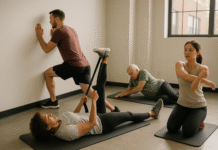
- Controlled active movements: Hold a static position at the end of your range and do the same movement slowly and with control at the same time. Wall slides, for instance, can help your shoulders move better.
- Bird-dogs, planks, and side bridges are all fantastic ways to work up your core. Having a strong core makes it easier to stand up straight and be flexible.
Lower Body Day: A good illustration of a routine
- Leg swings and hip circles are examples of dynamic warm-ups.
- Sit down and hold your hamstrings for 30 seconds.
- For three sets, execute 12 reps of the glute bridge.
Day for the Upper Body:
- Arm circles and chest openers are two examples of dynamic warm-ups.
- Static stretch: doorway pectoral stretch for 30 seconds
- Band of resistance Three sets of 12 rows for strength
You can protect your joints and get the most out of your flexibility by doing stretches and strength exercises that engage the same muscles at the same time.
Tip 4: Make sure you do mindfulness and breathing exercises every day.
The Link Between the Body and the Mind
When you breathe correctly when you stretch, your muscles relax more and the stretch goes deeper. Researchers at Frontiers in Physiology showed that diaphragmatic breathing during static stretching made it easier to stretch by modifying how pain is sensed.
How to Breathe: Through Your Belly (Diaphragmatic) Breathing:
- Breathe deeply through your nose. Your stomach will get bigger from this. Then, carefully let it out through your lips, which are closed.
- The 4-7-8 Method: Count to 4 while you breathe in, count to 7 while you hold your breath, and count to 8 while you breathe out. While you are doing each static stretch, do this again and over again.
- Rhythmic Breath Matching: To get into a stretch, breathe in and move a little, then breathe out and go deeper into it.
How to Be More Mindful
- Before you stretch, think about your whole body from head to toe and jot down any parts that seem tight.
- Progressive Relaxation: For a short time, tighten each muscle group, then relax thoroughly before stretching that area.
- Guided Imagery: Picture the muscle you wish to concentrate on getting longer and letting go of stress.
Mindfulness and breathwork together not only make sessions safer by relaxing muscles, but they also make them more fun and meditative, which helps individuals keep practicing them.
Tip 5: Pay attention to your body and let it heal.
Knowing the Difference Between Pain and Discomfort
When you do a safe flexibility practice, you could feel a little tense but not intense pain. If you feel pain, Mayo Clinic physical therapists suggest you should stop and think about how hard you’re working or how you’re doing it.
- Discomfort: A slight, manageable tension that lasts through the stretch.
- Pain: A sharp, abrupt, or chronic discomfort that could imply the tissue is injured.
Recovery Guidelines
- Take at least one full day off each week, or vary between working on your upper and lower body so your muscles have time to repair.
- Active Recovery: To keep your blood flowing on your days off, practice low-intensity activities like swimming, strolling, or yoga.
- Self-Myofascial Release: Use foam rollers or massage balls to alleviate trigger points and make the tissue better.
- Water keeps tissues flexible, so make sure you consume adequate protein and electrolytes.
Keeping an eye on progress and making modifications
To keep track of your flexibility, write it down in a journal.
- What type of activity it is and how long it lasts
- How bad is it (1–10)
- Notes concerning pain or discomfort
- Improvements that are personal, like being able to squat deeper or fold forward more easily
You can make wise modifications, avoid overtraining, and find out which tactics work best by keeping track of your progress.
Things You Shouldn’t Do
- If you don’t warm up and go straight into static stretches, you could damage yourself more easily. Every time, start with vigorous motions.
- Not breathing appropriately might make your muscles tighten when you hold your breath. Do the breathing exercises above to aid with this.
- Bouncing in Stretches: Ballistic stretching can cause tiny rips. Be careful and take your time.
- Seeing how you compare to others: Everyone is different when it comes to being flexible. Instead of thinking about what your friends want, concentrate about what you want.
- If you don’t stretch and strengthen at the same time, your joints may not be as stable.
If novices stay away from these obstacles, they can make a safe and long-lasting regimen for being flexible.
FAQs
1. How often should a beginner stretch to observe changes?
If you’re new to stretching, you should do it three to four times a week for 15 to 20 minutes each time. Being consistent over time will make a tremendous difference in how far you can move.
2. Is it normal to feel pain when you stretch?
No. You might feel some slight pain, but if you feel severe or intense pain, you should stop immediately away and assess your form or how hard you’re working.
3. Is it possible to get more flexible without performing yoga?
Of course. You don’t have to perform yoga to do the stretches that Tips 1 and 2 talk about.
4. How long does it take to get flexible?
Results differ for each person depending on their age, how flexible they were at first, and how consistent they are. Most beginners see improvements in their bodies after 4 to 6 weeks of consistent practice.
5. Should I stretch before or after I work out?
The greatest technique to warm up your muscles before a workout is to do dynamic stretching. Static stretching works best when your muscles are warm and loose.
Last Thoughts
You need to be patient, keep going, and obtain appropriate guidance if you want to be more flexible. You may make improvements that will last and minimize your chance of injury by completing dynamic warm-ups, employing progressive overload, balancing strength and flexibility, adding breathwork and mindfulness, and listening to what your body is telling you. Don’t think about flexibility as a competition. You should do it every day to get better posture, move better, and be healthier overall.
References
- American College of Sports Medicine. “Dynamic Warm-Up: Why It Matters.” ACSM Resource Library. https://www.acsm.org/read-research/resource-library
- Behm, D. G., & Chaouachi, A. “A Review of the Acute Effects of Static and Dynamic Stretching on Performance.” Journal of Strength and Conditioning Research. https://pubmed.ncbi.nlm.nih.gov/25202939
- American Council on Exercise. “The Principle of Progressive Overload.” ACE Expert Articles. https://www.acefitness.org/education-and-resources/professional/expert-articles/5990/the-principle-of-progressive-overload
- Behm, D. G., Blazevich, A. J., Kay, A. D., & McHugh, M. “Acute Effects of Muscle Stretching on Physical Performance, Range of Motion, and Injury Incidence in Healthy Active Individuals.” Sports Medicine. https://link.springer.com/article/10.1007/s40279-014-0150-0
- National Academy of Sports Medicine. “Integrated Flexibility Training.” NASM Articles. https://www.nasm.org/articles/integrated-flexibility-training
- Latorre-Román, P. Á., & García-Pinillos, F. “Breathing Techniques and Stretching.” Frontiers in Physiology. https://www.frontiersin.org/articles/10.3389/fphys.2018.01630/full
- Mayo Clinic Staff. “Stretching: Focus on How You Stretch, Not How Far.” Mayo Clinic Healthy Lifestyle. https://www.mayoclinic.org/healthy-lifestyle/fitness/expert-answers/stretching/faq-20057924
- Thakur, A., Schatzker, J., & Barry, B. “Does Frequency of Static Stretching Affect Flexibility Outcomes?” Journal of Strength and Conditioning Research. https://pubmed.ncbi.nlm.nih.gov/22007429
- Harvard Health Publishing. “Stretching to Improve Flexibility.” Harvard Medical School. https://www.health.harvard.edu/staying-healthy/stretching-to-improve-flexibility
- American College of Sports Medicine. “ACSM’s Guidelines for Exercise Testing and Prescription.” Lippincott Williams & Wilkins.