























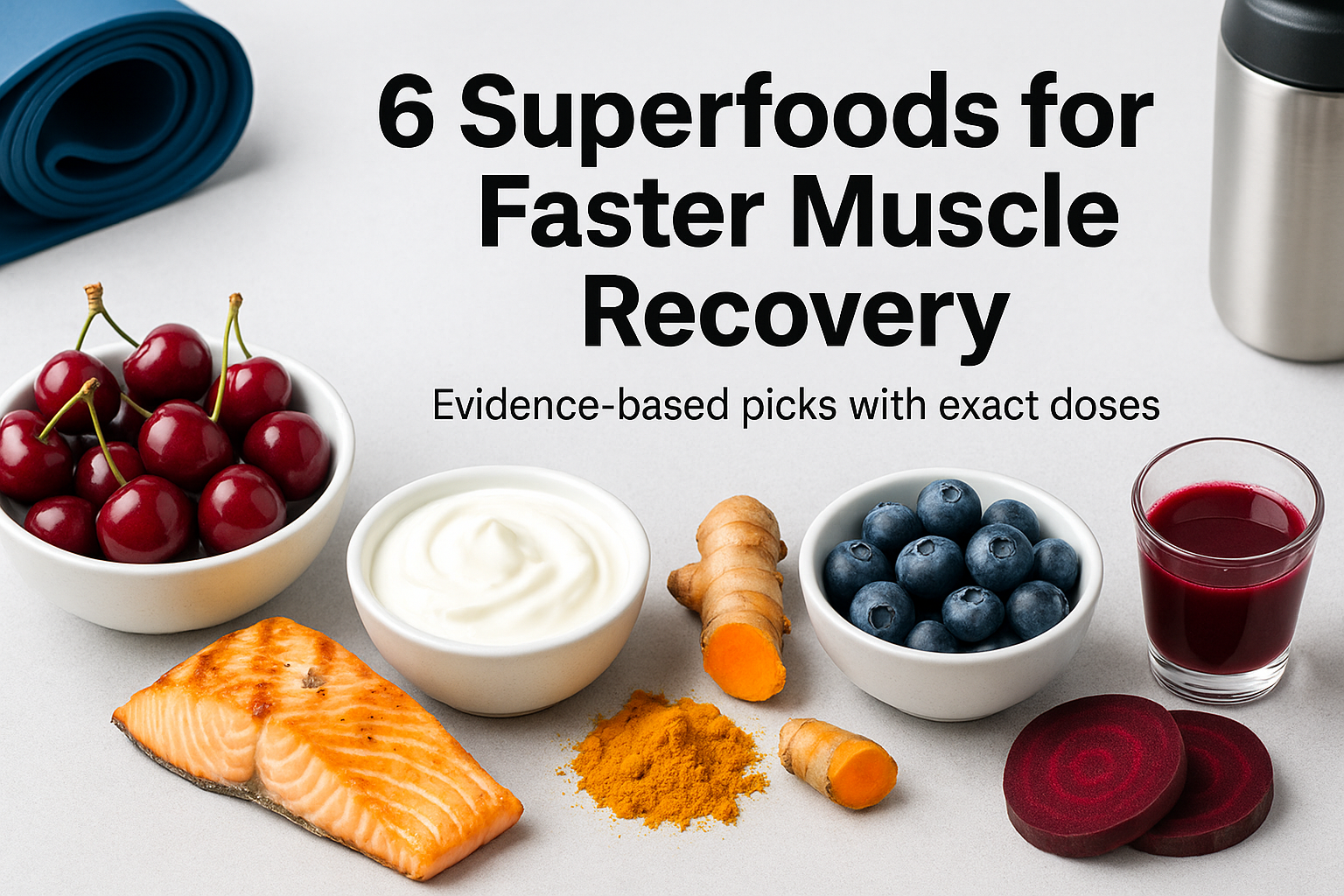
Push hard. Recover smarter. The fastest way to turn today’s session into tomorrow’s progress is to rebuild muscle fibers, reduce inflammation, replenish glycogen, and sleep deeply enough to do it all again. This guide breaks down six evidence-backed superfoods that speed up muscle recovery after exercise, with exactly how to use them, what to watch for, and a simple plan to make them part of your routine.
Disclaimer: The information below is educational and not a substitute for medical advice. If you have a medical condition, take prescription medications (especially blood thinners, diabetes meds, or blood pressure drugs), are pregnant, or have food allergies, consult a qualified professional before changing your diet or starting supplements.
Key takeaways
- Food-first recovery works: Whole foods rich in protein, polyphenols, omega-3s, and nitrates help repair tissue, ease soreness, and support performance between sessions.
- Timing matters: Aiming key foods around hard training (within ~2 hours after, and consistently across the week) improves results.
- Dose makes the difference: Use practical serving sizes shown to help recovery; “a sprinkle” won’t move the needle.
- Safety counts: More is not always better—mind interactions (e.g., turmeric with certain meds), added sugars, and tolerance.
- Track what changes: Judge by soreness ratings, strength “next day,” sleep quality, and how quickly you’re ready to train again.
Tart Cherries (Juice or Concentrate)
What it is & why it helps
Tart cherries (especially Montmorency varieties) are packed with anthocyanins and other polyphenols that help blunt exercise-induced oxidative stress and soreness while supporting recovery of muscle function. Research using tart cherry juice or concentrate has found reductions in post-exercise pain and faster return of strength in many—but not all—studies. Effects are strongest when you “load” for several days before and continue after a heavy effort.
Requirements & low-cost alternatives
- What to buy: 100% tart cherry juice or a tart cherry concentrate (often 30 mL “shots”).
- Cost: Moderate; concentrates are cost-efficient per serving.
- Alternatives: Frozen tart cherries (blend into smoothies). If you need a lower-sugar option, use concentrate with water rather than large volumes of ready-to-drink juice.
How to use it (step-by-step)
- Choose form: Concentrate (30 mL) or juice (240–355 mL).
- Load it: Take 30 mL concentrate twice daily (or ~240–355 mL juice twice daily) for 4–5 days before a big session or event.
- Keep it going: Continue the same dose for 2–3 days after. For regular training, 1 daily serving on heavy days is a practical compromise.
- Pair it smart: Combine with a protein-rich snack to cover both antioxidant and rebuilding needs.
Beginner modifications & progressions
- Beginner: Start with 30 mL once daily for a week to check tolerance.
- Progress: Bump to twice daily around very hard or novel workouts (heavy eccentrics, long runs).
- Advanced: Use a 7- to 10-day protocol when tapering into a competition block.
Frequency, duration & metrics
- Frequency: Daily during loading/recovery windows; otherwise use on heavy days.
- Duration: 4–8 days around a key effort; or 2–4 weeks during intense training blocks.
- Metrics: DOMS rating at 24/48 h, return-to-strength speed (e.g., isometric hold or daily jump), sleep quality.
Safety, caveats & common mistakes
- Watch sugars: Dilute concentrate with water; avoid added-sugar beverages post-workout if you don’t need the extra carbs.
- Mixed evidence in elite sport: Some highly trained teams see little benefit; individual response varies.
- GI tolerance: If you’re sensitive to sorbitol, build up gradually.
Mini-plan example
- Post-lift: 30 mL tart cherry concentrate in 250 mL water + Greek yogurt.
- Evening: Second 30 mL shot with dinner on heavy weeks.
Fatty Fish (Especially Salmon) or Omega-3s
What it is & why it helps
EPA and DHA (omega-3 fatty acids in marine foods) modulate post-exercise inflammation and may reduce muscle soreness while supporting cell membrane integrity and neuromuscular function. They also stack well with resistance training for strength and body-composition benefits over time.
Requirements & low-cost alternatives
- What to buy: Fresh, frozen, or canned salmon; sardines; mackerel.
- Cost: Varies—canned salmon/sardines are budget-friendly and shelf-stable.
- Alternative: If you don’t eat fish, consider an algae-based EPA/DHA supplement (talk to your clinician).
How to use it (step-by-step)
- Plan servings: Aim for 2–4 fish meals per week (90–120 g per serving).
- Distribute: Include one serving within 24 hours after your hardest session of the week.
- Supplement (optional): If food intake is low, consider ~1–3 g EPA+DHA/day with meals (confirm with your healthcare provider).
Beginner modifications & progressions
- Beginner: Start with 2 fish meals/week (canned counts—mix with yogurt, herbs, lemon).
- Progress: Add a third or fourth fish meal during competition blocks or trial a modest EPA/DHA supplement.
- Advanced: Periodize—higher omega-3 intake in peaking phases, maintenance during base.
Frequency, duration & metrics
- Frequency: 2–4 fish meals weekly or consistent daily supplementation.
- Duration: Benefits accrue over 3–6+ weeks of steady intake.
- Metrics: Next-day soreness, joint comfort, and readiness (RPE to start warm-up).
Safety, caveats & common mistakes
- Medication check: Omega-3s can interact with anticoagulants—clear with your clinician.
- Don’t chase megadoses: More isn’t better; high intakes may cause GI upset or affect bleeding time.
- Variety matters: Rotate salmon, sardines, mackerel; choose low-mercury options.
Mini-plan example
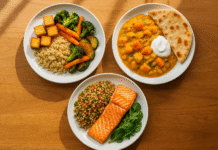
- Recovery dinner: Baked salmon, quinoa, roasted beets, olive oil–lemon dressing.
- Quick lunch: Canned sardines on whole-grain toast with tomato and arugula.
Greek Yogurt or Kefir (Dairy Protein + Probiotics)
What it is & why it helps
Greek yogurt and kefir provide high-quality dairy proteins (whey + casein) rich in leucine, the amino acid trigger for muscle protein synthesis. Kefir adds live cultures that may support gut function—useful during heavy training when GI stress is common. Casein’s slower digestion makes it ideal pre-sleep to support overnight repair.
Requirements & low-cost alternatives
- What to buy: Plain 2%–5% Greek yogurt or plain kefir (unsweetened).
- Cost: Low–moderate per protein gram versus most bars/shakes.
- Alternatives: Cottage cheese; or a whey/casein powder if dairy is hard to access/tolerate.
How to use it (step-by-step)
- Post-workout: Consume 20–40 g protein within ~2 hours of training (e.g., 250–300 g Greek yogurt or 350–500 mL kefir).
- Pre-sleep: For hard lifting days, have ~40 g casein-rich protein (e.g., 300–400 g Greek yogurt or 250 g cottage cheese) ~30–60 minutes before bed.
- Add carbs: Stir in fruit and oats or honey to replenish glycogen.
Beginner modifications & progressions
- Beginner: Start with 1 cup yogurt post-workout.
- Progress: Increase to 35–40 g protein on heavy days; add a pre-sleep serving during overload weeks.
- Lactose-sensitive: Choose lactose-free options or enzyme-treated products.
Frequency, duration & metrics
- Frequency: After most strength sessions; pre-sleep on tough days.
- Duration: Immediate effect on protein synthesis; strength/lean-mass changes accrue over weeks.
- Metrics: Next-day performance on your main lift; morning body weight and subjective recovery.
Safety, caveats & common mistakes
- Hidden sugar: Choose plain; flavor with fruit/spices.
- Undereating protein: “A few spoonfuls” is not enough—measure servings.
- Allergy/intolerance: If dairy is a no-go, use soy/whey/casein powders or lactose-free dairy.
Mini-plan example
- Post-session bowl: Greek yogurt + blueberries + oats + pinch of salt.
- Pre-sleep: Cottage cheese with cinnamon and a handful of tart cherries.
Turmeric (Curcumin) with a Fat Source (and, if appropriate, Black Pepper)
What it is & why it helps
Turmeric’s active compounds (curcuminoids) support recovery mainly via antioxidant and anti-inflammatory actions, with several trials showing reduced perceived soreness and favorable shifts in damage markers after muscle-damaging exercise. Curcumin absorbs better with fat; many people pair it with black pepper (piperine) to further enhance uptake.
Requirements & low-cost alternatives
- What to buy: Turmeric powder for cooking; or standardized curcumin capsules.
- Cost: Low for spice; moderate for quality supplements.
- Alternatives: Ginger can be a culinary anti-inflammatory option.
How to use it (step-by-step)
- Food first: Add 1–2 tsp turmeric to meals; include olive oil, ghee, or coconut milk.
- Supplement (optional): Common trialed ranges are ~500–1,000+ mg curcumin/day with meals during hard blocks.
- Pepper pairing: If you tolerate it and your clinician agrees, include a pinch of black pepper to potentially enhance absorption.
- Timing: Use daily during soreness-heavy weeks or 3–7 days around eccentric-heavy training.
Beginner modifications & progressions
- Beginner: Start with food-based turmeric 3–5x/week.
- Progress: Trial 500 mg curcumin daily for 1–2 weeks around a new program.
- Advanced: Consider specialized formulations (as advised by a clinician) if you need capsules and have used them safely before.
Frequency, duration & metrics
- Frequency: Daily in food; supplements as short cycles.
- Duration: Evaluate over 1–2 weeks, then cycle off if no clear benefit.
- Metrics: Soreness ratings, joint comfort, and “first warm-up set” feel.
Safety, caveats & common mistakes
- Medication interactions: Curcumin may interact with anticoagulants and other meds—clear with your clinician.
- Liver considerations: Rare cases of supplement-related liver injury have been reported, particularly with high-bioavailability formulas—avoid megadoses and monitor for symptoms (yellowing skin/eyes, dark urine, nausea).
- Stomach upset: Introduce gradually; always take with food.
Mini-plan example
- Recovery curry: Turmeric-ginger chicken with coconut milk, black pepper, and spinach served over rice.
- Post-meal tea: Turmeric latte (turmeric + milk or fortified plant milk + pinch black pepper).
Blueberries
What it is & why it helps
Blueberries deliver anthocyanins and related polyphenols that help counter oxidative stress and support inflammation resolution after hard training. Trials show benefits for protecting muscle function and shifting recovery-related signaling molecules in favorable directions.
Requirements & low-cost alternatives
- What to buy: Fresh or frozen blueberries (frozen often cheaper with the same nutrients).
- Cost: Low–moderate; buy in bulk and freeze.
- Alternatives: Mixed dark berries (blackberries, tart cherries) if blueberries are unavailable.
How to use it (step-by-step)
- Pre/post smoothie: Blend 1 cup (150 g) blueberries with kefir or yogurt.
- Training block habit: Eat 1 cup daily for 10–21 days during the block.
- Pair with protein: Combine with Greek yogurt, whey, or eggs at meals.
Beginner modifications & progressions
- Beginner: ½–1 cup daily for two weeks to learn your personal response.
- Progress: Increase to 1–2 cups on the days before and after big sessions.
- Advanced: Rotate with other dark berries to widen your polyphenol profile.
Frequency, duration & metrics
- Frequency: Daily during heavy blocks; otherwise use on hard days.
- Duration: Assess change over 2–3 weeks.
- Metrics: Next-day leg stiffness, grip strength or countermovement jump, and perceived freshness warming up.
Safety, caveats & common mistakes
- Hidden sugar: Whole berries are ideal; avoid heavy syrups.
- Allergies/intolerances: Rare, but possible—introduce gradually.
- Over-reliance: Berries support recovery; they don’t replace protein or sleep.
Mini-plan example
- Pre-lift snack: Blueberry–oat–yogurt parfait 60–90 minutes before training.
- Post-run: Smoothie with blueberries, kefir, banana, and a scoop of whey.
Beetroot (Juice or Concentrate)
What it is & why it helps
Beetroot provides dietary nitrates and betalains. Nitrates convert to nitric oxide, supporting blood flow and oxygen efficiency; betalains add antioxidant support. While best known for endurance performance, short-term beetroot protocols can also improve recovery of functional measures and soreness after muscle-damaging exercise.
Requirements & low-cost alternatives
- What to buy: Beetroot juice (250–500 mL bottles) or 70 mL nitrate-rich “shots.”
- Cost: Moderate; shots are convenient and consistent in nitrate content.
- Alternatives: Roast beets (prep ahead), though nitrate content varies.
How to use it (step-by-step)
- Pick a protocol: 1–2 shots (≈70 mL each) daily or 250–500 mL juice for 3–7 days around your hardest training.
- Time it: One serving 2–3 hours pre-workout; a second serving later the same day on heavy weeks.
- Stack with food: Combine with a protein-rich meal to support repair.
Beginner modifications & progressions
- Beginner: Start with 70 mL 2–3 h before your session to assess tolerance.
- Progress: Use daily for 3–5 days before and 2–3 days after a novel/hard session.
- Advanced: Periodize doses in peak weeks; avoid antibacterial mouthwashes near dosing (they can blunt oral nitrate reduction).
Frequency, duration & metrics
- Frequency: 1–2 servings/day in focused windows.
- Duration: Evaluate over 1–2 weeks of use around challenging sessions.
- Metrics: Wall-sit or jump recovery at 24/48 h, session heart rate for same workload, perceived leg heaviness.
Safety, caveats & common mistakes
- Blood pressure: Beetroot can lower it—monitor if you’re on antihypertensives.
- Kidney stones: Beets are high in oxalates; those with a history of stones should discuss with a clinician.
- Staining & beeturia: Red/pink urine or stools can occur—harmless but surprising.
Mini-plan example
- Pre-session: 70 mL beet shot 2–3 h before lifting.
- Post-session dinner: Salmon, roasted beets, citrus-olive oil salad.
Quick-Start Checklist (10 minutes)
- After today’s workout:
- Eat 20–40 g protein (Greek yogurt, kefir, or cottage cheese).
- Add 1 cup blueberries or a mixed dark-berry blend.
- If it was a very hard day, take 30 mL tart cherry concentrate now and another with dinner.
- Before your next heavy day:
- Start a tart cherry or beetroot mini-load 3–5 days out.
- Plan 2 fish meals this week (canned is fine).
- Cook 1 meal with turmeric (add fat + pinch of black pepper if appropriate).
- Track it:
- Rate soreness (0–10) each morning; note when legs feel “springy” again.
- Jot your best set speed/jump height or how your warm-up felt.
Troubleshooting & Common Pitfalls
- “I’m still sore.” Check your protein (are you actually hitting 20–40 g post-workout?), sleep, and total volume. Food helps, but it can’t fix under-recovery from programming.
- “My stomach’s upset.” Introduce concentrates/juices slowly; split doses; take turmeric with food; try lower-lactose dairy or lactose-free options.
- “No difference with tart cherries.” Some athletes respond less. Trial a full loading protocol (twice daily, 4–5 days before and 2–3 after). If still nothing, redirect focus to protein and sleep.
- “Beet shots taste like dirt.” Chill them; chase with citrus; or mix into a smoothie with orange and ginger.
- “Supplements feel complicated.” Start food-first: fish, yogurt/kefir, berries, and cooking with turmeric. Add concentrates only for peak weeks.
How to Measure Progress (Simple, Practical Metrics)
- DOMS scale (0–10): Record at 24 and 48 hours after key sessions—aim for a downward trend across weeks at similar training loads.
- Performance “next day”: Track a morning countermovement jump height or grip strength; faster rebound suggests better recovery.
- Session RPE vs. output: If the same warm-up weight feels easier or bar speed is higher at the same RPE, recovery strategies are helping.
- Sleep quality: Note time-to-sleep and wake-ups; pre-sleep casein and evening tart cherry may improve this indirectly.
- Training readiness notes: A quick 1–2 sentence log on leg heaviness, joint comfort, and mood.
Four-Week Starter Plan (Food-First, Simple, Adaptable)
Week 1 – Baseline, Protein & Berries
- Post-workout: 20–30 g protein from Greek yogurt or kefir after every session.
- Daily: 1 cup blueberries (fresh/frozen).
- Fish: 2 meals (salmon/sardines).
- Cook: 2 meals with turmeric + fat.
- Measure: DOMS at 24/48 h; note sleep.
Week 2 – Layer in Tart Cherry
- Keep Week 1 habits.
- Add load: 30 mL tart cherry concentrate twice daily for 4 days before your hardest session; continue 2 days after.
- Assess: Compare soreness and next-day performance to Week 1.
Week 3 – Add Beetroot Window
- Keep Weeks 1–2 habits.
- Beet protocol: 70 mL beetroot shot 2–3 h pre-workout for 3–5 days before your hardest training; optional second shot post-workout on the first 1–2 days.
- Fish: Increase to 3 meals this week if possible.
- Assess: Note wall-sit or jump test recovery at 24/48 h.
Week 4 – Personalize & Pre-Sleep Protein
- Keep the winners: Continue the superfoods you felt most.
- Pre-sleep casein: On your two hardest days, have ~40 g casein-rich dairy 30–60 minutes before bed.
- Re-test metrics: DOMS trend, warm-up feel, sleep notes, and lift velocity.
At the end of Week 4, keep the 2–3 superfoods that produced the clearest improvements and run them as your “standard operating procedure” during heavy phases.
FAQs
1) Do I really need all six foods?
No. Start with protein + one polyphenol source (e.g., Greek yogurt + blueberries). Add tart cherry or beetroot during peak weeks.
2) What’s the best timing for protein after training?
Within ~2 hours is practical, but the total 20–40 g per meal and daily protein (≈1.4–2.0 g/kg) matter most.
3) Can I just take a pill instead of eating fish?
If you don’t eat fish, an EPA/DHA supplement can help—discuss dose and interactions with your clinician. Many athletes still prefer 2–4 fish meals/week first.
4) I’m worried about sugar in juices.
Use concentrates diluted with water to control sugar. If you’re in a high-volume endurance phase, the carbs may actually help glycogen replenishment.
5) Are there risks with turmeric?
Food amounts are generally well-tolerated. High-dose supplements may interact with medications and, rarely, have been linked to liver issues—avoid megadoses and talk to your clinician.
6) Can I use frozen berries?
Yes. Frozen blueberries retain polyphenols and are usually cheaper. They’re perfect for smoothies.
7) How long until I notice less soreness?
Some notice changes within a week of consistent use, especially with tart cherry loading. Others need 2–3 weeks to see a pattern in their log.
8) I’m lactose intolerant—now what?
Try lactose-free dairy, lactase enzyme, or switch to whey/casein isolate powders (which are typically very low in lactose). Soy-based options can also work.
9) What about dark chocolate or ginger?
They can play supportive roles, but this list focuses on foods with the strongest recovery evidence you can deploy daily with clear dosing.
10) Will beetroot upset my stomach?
Start with one 70 mL shot and take it 2–3 hours pre-workout. Expect harmless pink urine/stool (beeturia) in some people. If you have a history of kidney stones, consult a clinician.
11) Should older athletes change anything?
Older lifters may benefit from ~40 g protein per serving and consistent omega-3 intake. Pre-sleep casein is particularly helpful.
12) Can I stack tart cherry and beetroot?
Yes—just monitor total calories and GI comfort. Use them strategically around hard or novel training weeks, not necessarily year-round.
Conclusion
Recovery isn’t luck—it’s a system. Build yours around protein-rich dairy, color-dense fruits (tart cherries and blueberries), fatty fish or omega-3s, beetroot, and smart turmeric use. Use the protocols above for four weeks, track your soreness and “next-day” performance, and keep the winners.
CTA: Pick one superfood from this list and put it in your very next post-workout meal—then build from there this week.
References
- Efficacy of tart cherry juice in reducing muscle pain during running: a randomized controlled trial, National Library of Medicine (PMC), 2010. https://pmc.ncbi.nlm.nih.gov/articles/PMC2874510/
- The effects of Montmorency tart cherry concentrate on recovery following strenuous exercise, National Library of Medicine (PMC), 2016. https://pmc.ncbi.nlm.nih.gov/articles/PMC4963917/
- Tart cherry supplementation and recovery from strenuous exercise: a systematic review and meta-analysis, International Journal of Sport Nutrition and Exercise Metabolism (Human Kinetics), 2021. https://journals.humankinetics.com/downloadpdf/journals/ijsnem/31/2/article-p154.pdf
- Understanding the role of cherry juice in exercise recovery, National Library of Medicine (PMC), 2022. https://pmc.ncbi.nlm.nih.gov/articles/PMC9306613/
- Effects of a tart cherry supplement on recovery from exercise-induced muscle damage, National Library of Medicine (PMC), 2023. https://pmc.ncbi.nlm.nih.gov/articles/PMC10443385/
- International Society of Sports Nutrition Position Stand: protein and exercise, Journal of the International Society of Sports Nutrition, 2017. https://jissn.biomedcentral.com/articles/10.1186/s12970-017-0177-8
- Achieving optimal post-exercise muscle protein remodeling in physically active adults through whole foods, National Library of Medicine (PMC), 2018. https://pmc.ncbi.nlm.nih.gov/articles/PMC5852800/
- The impact of pre-sleep protein ingestion on the skeletal muscle adaptive response to exercise in humans, National Library of Medicine (PMC), 2019. https://pmc.ncbi.nlm.nih.gov/articles/PMC6415027/
- Pre-sleep casein protein ingestion: new paradigm in post-exercise recovery, National Library of Medicine (PMC), 2020. https://pmc.ncbi.nlm.nih.gov/articles/PMC7451833/
- Omega-3 fatty acid supplementation on post-exercise inflammation, muscle damage, oxidative response, and sports performance: a systematic review of randomized controlled trials, National Library of Medicine (PMC), 2024. https://pmc.ncbi.nlm.nih.gov/articles/PMC11243702/
- Impact of varying dosages of fish oil on recovery and soreness after eccentric exercise, National Library of Medicine (PMC), 2020. https://pmc.ncbi.nlm.nih.gov/articles/PMC7468920/
- Omega-3 fatty acids and skeletal muscle health, National Library of Medicine (PMC), 2015. https://pmc.ncbi.nlm.nih.gov/articles/PMC4663562/
- Blueberry intake elevates post-exercise anti-inflammatory oxylipins: a randomized trial, National Library of Medicine (PMC), 2023. https://pmc.ncbi.nlm.nih.gov/articles/PMC10366094/