




























If you’ve ever finished the day feeling scattered or stuck, daily gratitude rituals can give your mind a small, steady anchor. This article distills the seven most practical, research-backed ways to practice gratitude in minutes a day, with step-by-step instructions, realistic guardrails, and examples you can use tonight. It’s for busy people who want more joy and calm without adding a complicated routine. Quick note: gratitude practices can support well-being, but they’re not a substitute for professional mental-health care when needed.
In one line: Daily gratitude rituals are small, repeatable practices for noticing and appreciating what’s going well; randomized trials and meta-analyses show they can reliably (if modestly) increase well-being and reduce anxiety and depressive symptoms.
Quick start (60 seconds): write three things that went well today, send one thank-you message, breathe and notice one pleasant detail where you are (a sound, color, or scent). Repeat tomorrow.
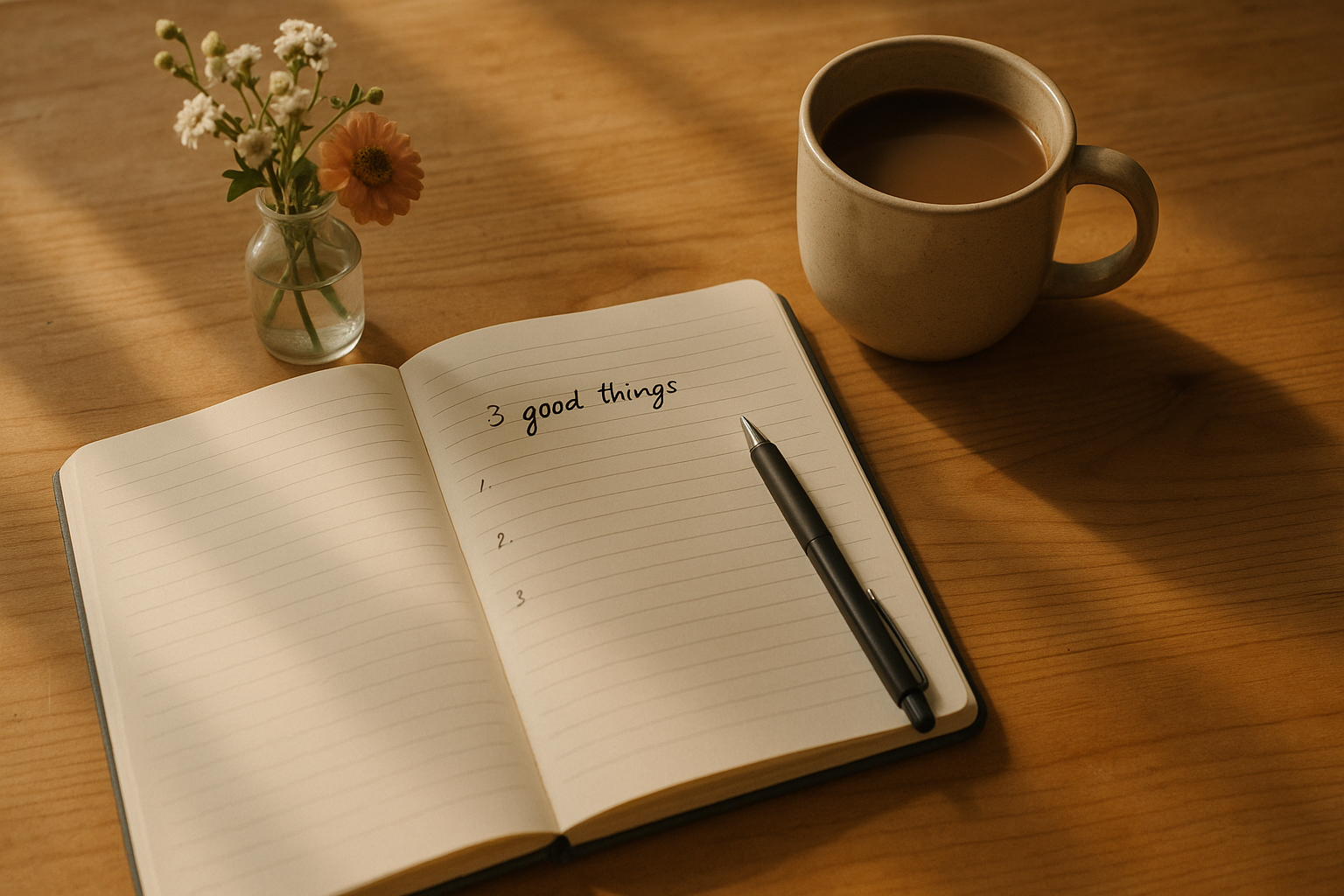
1. The “Three Good Things” Morning (or Evening) Journal
The fastest, most proven daily ritual is to write down three things that went well and why. This exercise, often called “Three Good Things,” delivers a direct mood lift and builds a habit of scanning for positives—without denying challenges. In randomized, placebo-controlled research, brief gratitude journaling increased happiness and reduced depressive symptoms for weeks to months compared with controls. It remains one of the most validated positive psychology practices for everyday people. The simplest format—three brief lines, each with a “because”—takes two or three minutes. If mornings feel rushed, do it at night; evening reflection can also help you sleep, especially if you pair it with a short wind-down (see Ritual 5). For days that feel objectively hard, focus on tiny specifics: a good cup of tea, a kind email, sunlight on your desk. The goal is not to invent perfection—it’s to widen your attention.
1.1 How to do it (2–3 minutes)
- Open a notebook or notes app; title today’s date.
- List 3 things that went well (big or tiny), each followed by why it happened.
- End with one sentence of appreciation (e.g., “I’m grateful for the way my team showed up today.”)
- Optional: star one item you want to repeat tomorrow.
1.2 Numbers & guardrails
- Frequency: daily for 1–2 weeks to feel the pattern; continue 3–5 days/week for maintenance (as of August 2025, studies commonly run 1–6 weeks).
- Length: 3–5 lines; keep it short so you’ll actually do it.
- Evidence note: “Three Good Things” is formally outlined by UC Berkeley’s Greater Good Science Center with simple, printable steps.
1.3 Mini case
A product manager wrote her list on her commute for 14 days. By week two she noticed fewer rumination loops before stand-up. She began steering one morning item (“clear agenda”) into a daily micro-goal.
Synthesis: This ritual trains your attention to notice wins and meanings; over time that attentional shift is a primary mechanism for the mood benefits seen in trials.
2. The Micro-Savoring Walk (Capture One Delight)
Savoring is gratitude’s close cousin: it’s about fully noticing a pleasant moment while it’s happening. A daily micro-savoring walk works because it stacks three helpful elements—movement, attentional focus, and appreciation—into five minutes. The instructions are deliberately light so you can do them anywhere: sidewalk, corridor, garden, or parking lot. Pick one sense to foreground (sight, sound, smell), then find a single “micro-delight” to linger on for 10–20 seconds: the geometry of leaves, echo of footsteps, or warmth on your skin. Take one photo if you like, but don’t turn it into a photoshoot; the point is attention, not documentation. When you return, write one line about the moment and why it mattered (“gold edges on the clouds on a day I felt rushed—reminded me to slow down”).
2.1 How to do it
- Set a 5-minute timer and step outside (or into a hallway with a window).
- Choose a sense; name one pleasant detail out loud or in your head.
- Breathe slowly for four cycles while you keep your eyes on the detail.
- Optional: snap one quick photo; caption it with a 5–10 word “because.”
2.2 Mini-checklist
- Keep it brief—no new app required.
- Skip music; you’re listening to the world.
- If the day is grim, look for the “least bad” thing (dry spot, working pen).
Synthesis: Micro-savoring builds the muscle of appreciation in real time; pairing it with a one-line note converts a fleeting sensation into a remembered micro-win.
3. The One-Message Gratitude Note (Text, Voice, or Letter)
Expressed gratitude is powerful because it improves your mood and strengthens relationships. A daily one-message ritual—one text, voice note, email, or occasional letter—creates a steady drip of social connection. Studies show that thanking helpers increases their prosocial behavior and motivation, which can improve team dynamics and collaboration at home or at work. Classic “gratitude letter/visit” exercises have also produced durable boosts in happiness in randomized trials. Keep the signal clear: specific, sincere, short. Instead of “You’re awesome,” try “Thanks for reviewing my draft before lunch; your note on the intro tightened the story.” Rotate who you thank: colleague, partner, neighbor, past teacher, delivery driver, yourself (yes, self-thanks counts).
3.1 The 3-S formula (Specific, Sincere, Short)
- Specific: name the deed or trait.
- Sincere: say how it helped you.
- Short: 2–4 sentences or a 20–30-second voice note.
3.2 Numbers & guardrails
- Pace: one message a day on weekdays.
- Variety: alternate people to avoid over-thanking the same person.
- Boundaries: gratitude ≠ tolerance of poor behavior; you can appreciate while still setting limits.
Synthesis: Expressed thanks reliably brightens relationships and nudges helpful cycles in teams; a one-message ritual makes it automatic without feeling performative.
4. The Mealtime Pause (10-Second Table Ritual)
Food is a built-in moment to reset attention, which makes mealtime perfect for a tiny gratitude ritual you can do solo or with others. This is not about performative speeches; it’s a quiet, 10-second pause to name one thing you appreciate about the meal or the people present. In a family, rotate speakers; on your own, whisper it or write it before you eat. The pause helps mark boundaries in the day and reduces “mindless eating” by inviting you into the moment. If your home already includes a faith-based grace, you can gently layer in a secular detail (“and thank you for the farmer who grew these tomatoes”). In shared houses or teams, keep the practice inclusive by focusing on contributions (“I’m grateful to Ayesha for washing up earlier; that gave us time to cook together”).
4.1 How to do it
- Before the first bite or sip, take one slow breath.
- Name one appreciation: ingredient, person, process, place.
- If with others, invite one sentence from anyone who wants to share.
4.2 Mini-checklist
- Keep it 10–20 seconds.
- No critiques or moralizing about food.
- Make it safe to pass—no one is pressured to speak.
Synthesis: Mealtime gratitude stitches a small, repeatable moment of appreciation into your day; shared out loud, it quietly changes the tone of a table.
5. The Sleep-Friendly Evening Gratitude Wind-Down
Evening gratitude supports happiness and sleep. Research has linked gratitude with better subjective sleep quality, longer duration, and less time to fall asleep—mediated by more positive pre-sleep thoughts and fewer negative ones. The practical takeaway: a brief, structured wind-down that ends with appreciative attention can redirect your mental spotlight from tomorrow’s loops to today’s small wins. Keep the process short (5–7 minutes) so your brain learns it’s always doable. If your mind races, try a simple “1–3–1” script: one slow breath, three gratitudes (with a “because”), one sentence to your future self (“You handled a tough call; tomorrow you’ll start with the easy email.”)
5.1 How to do it (5–7 minutes)
- Step 1 (2 min): jot any lingering tasks—get them out of your head.
- Step 2 (2–3 min): write three things that went well and why (yes, again).
- Step 3 (1–2 min): read your list slowly; close eyes and breathe for four cycles.
5.2 Numbers & guardrails
- Timing: last 10–15 minutes before lights out.
- Cues: leave your notebook on your pillow each morning so you can’t miss it.
- If you wake at night: repeat one item from the list in detail.
Synthesis: By curating pre-sleep cognitions, this ritual lowers rumination and improves sleep, which in turn boosts mood and energy the next day—creating a reinforcement loop you can feel.
6. The “Catch and Appreciate” Relationship Ritual
Gratitude strengthens bonds because it helps partners, friends, and teammates feel seen. The “catch and appreciate” ritual is simple: once a day, catch someone doing something helpful or kind—and say why it mattered. The theory aligns with the “find-remind-bind” function of gratitude: it helps us find good relationship partners, reminds us of their value, and binds us closer. This ritual is especially useful for couples and close teams, where negativity bias (noticing what’s wrong more than what’s right) can erode goodwill. Keep appreciations concrete: “You sent the meeting doc early; it lowered my stress.” If you’re in conflict, balance feedback with at least one daily appreciation to prevent global judgments from taking over.
6.1 How to do it
- Choose one person each day (rotate).
- Name the specific behavior, immediate impact, and your feeling.
- Invite reciprocation once a week (not every time; avoid scorekeeping).
6.2 Common mistakes
- Vague praise: “You’re great.” → Be specific.
- Delayed thanks: same-day is best; gratitude decays with time.
- Transactional tone: don’t turn thanks into a favor request.
Synthesis: When people feel accurately appreciated, they show more responsiveness and closeness—core ingredients of relationship happiness.
7. The Workplace “Thank-You Loop”
At work, gratitude fuels prosocial behavior and collaboration. Experiments have shown that when helpers receive genuine thanks, they’re more likely to help again—partly because appreciation boosts their sense of efficacy and social worth. A daily “thank-you loop” operationalizes this: before you log off, send one specific appreciation related to the day’s work, and close the loop by telling the person the impact their action had on a customer, colleague, or project. To prevent it from becoming a performative chore, keep it peer-to-peer and leader-to-peer (not just manager-down). Archive your sent thanks in a “Wins” folder; it becomes an antidote to impostor syndrome and a source for performance reviews.
7.1 How to do it (3 minutes)
- Scan your calendar and chat for one helpful action someone took today.
- Send a 2–4 sentence message: action → impact → appreciation.
- Once a week, surface a public shout-out in team channels (with consent).
7.2 Numbers & guardrails
- Cadence: one message per workday (Mon–Fri).
- Equity: vary recipients across roles; gratitude should not mirror power lines.
- Evidence note: expressed gratitude boosts prosocial behavior and willingness to help, a reliable lift for team climate.
Synthesis: A consistent, specific thank-you loop makes collaboration feel rewarding, which nudges a culture where people keep showing up for each other.
FAQs
1) How long before daily gratitude rituals start to “work”?
Most people notice a small mood shift within 1–2 weeks, especially with “Three Good Things.” In randomized and meta-analytic research, gratitude interventions produce modest but reliable increases in well-being; think of them like daily vitamins rather than instant painkillers. Consistency beats intensity—two minutes a day is enough to start.
2) Do I need a special app, or is paper better?
Use whatever you’ll stick with. Paper journals reduce distraction; apps add reminders and searchable archives. Early studies were paper-based; newer research on mobile gratitude apps shows mixed but promising results as of August 2025—useful if reminders help you.
3) What if my day was terrible—won’t gratitude feel fake?
Gratitude isn’t denial. On hard days, shrink the target: notice one neutral or slightly pleasant detail (a dry seat on the bus, a working charger). You can also pair gratitude with honesty: “Today was rough, and I’m grateful for the nurse who explained things clearly.” The point is widening attention, not sugarcoating.
4) Isn’t “toxic positivity” a risk?
Yes—forced cheerfulness can invalidate real pain. Healthy gratitude makes room for complexity: “This is hard, and I appreciate X.” If practices ever feel invalidating, slow down and use rituals that focus on tiny, sensory moments (savoring walk) rather than big “I’m so blessed” statements.
5) Does gratitude actually help with anxiety or depression?
Meta-analyses report small improvements in anxiety and depressive symptoms compared with control conditions. Gratitude is supportive, not a standalone treatment; if symptoms are persistent or severe, pair these rituals with evidence-based care (CBT, medication, or therapy) via a licensed professional.
6) Is it better to journal in the morning or evening?
Do whichever you’ll keep. Evenings can be extra helpful for sleep because they steer pre-sleep thoughts in a positive direction; mornings can set the day’s tone. Try each for a week and notice which leads to better follow-through.
7) What should I write if I keep repeating the same three things?
Repetition is fine. To keep it fresh, add a because clause (“I’m grateful for coffee because it signals a gentle start”) or zoom further into specifics (the mug’s weight, the aroma). Rotate categories through the week: people, places, body, learning, nature.
8) Will thanking people at work make me look like I’m angling for favors?
Not if it’s specific, proportionate, and evenly distributed. Focus on contributions, not personalities: “Thanks for catching the data mismatch; it saved us from a re-run.” Over time, clear appreciation is associated with more helping and better collaboration climates.
9) How do these rituals help relationships?
Gratitude helps you notice responsiveness—the felt sense that others “get and care” about you. That recognition deepens closeness and satisfaction over time. Deliberately catching and appreciating even small gestures counters our brain’s tilt toward criticism.
10) Are there cultural or faith-based ways to adapt these rituals?
Absolutely. Many traditions already include daily thanks (e.g., pre-meal blessings or evening prayers). Keep language inclusive in mixed settings by anchoring on contributions and specifics (“I’m grateful for the person who baked this bread”). The psychological mechanisms—attention, meaning, connection—are shared.
11) What if I skip a day (or three)?
Start again the next day—no backlog. Habit studies show that “never miss twice” is a realistic rule. Shrink the ritual to one line on busy days: “One thing I appreciated today was…” Consistency over time beats streaks.
12) How big are the effects, realistically?
They’re small to moderate on average, but meaningful when compounded over weeks—comparable to other simple behavioral strategies. Newer meta-analyses emphasize designing interventions that fit culture, context, and person—exactly what daily, customizable rituals are good at.
Conclusion
Gratitude isn’t about pretending everything is fine; it’s about training attention to notice what’s sustaining you—even on complicated days. The seven rituals above work because they are short, specific, and social: you reflect (journaling and wind-down), savor (micro-walk), appreciate (mealtime pause), and express thanks (one-message, relationship catch, and workplace loop). The research is encouraging but realistic: small actions, repeated often, create modest yet reliable lifts in well-being, sleep, and connection. That’s why the structure matters—clear steps, guardrails, and low friction help you stay consistent when life gets noisy.
Pick one ritual to start tonight—perhaps Three Good Things or a one-message thank-you—and run it for seven days. If it sticks, layer in a second ritual next week. In a month, you’ll have built a compact system that quietly improves your days and deepens your relationships.
Your next step: Open a note right now and write your first three good things—then send one sincere thank-you before you close your laptop.
References
- Counting blessings versus burdens: an experimental investigation of gratitude and subjective well-being in daily life. Journal of Personality and Social Psychology (American Psychological Association). February 2003. PubMed
- Positive Psychology Progress: Empirical Validation of Interventions. American Psychologist (American Psychological Association). July 2005. PubMed
- Three Good Things — Practice. Greater Good Science Center, UC Berkeley. Accessed August 2025. Greater Good in Action
- Gratitude influences sleep through the mechanism of pre-sleep cognitions. Journal of Research in Personality (Elsevier). 2009. PubMed
- A little thanks goes a long way: Explaining why gratitude expressions motivate prosocial behavior. Journal of Personality and Social Psychology (APA). June 2010. PubMed
- Find, Remind, and Bind: The Functions of Gratitude in Everyday Relationships. Social and Personality Psychology Compass (Wiley). 2012. Compass
- The effects of gratitude interventions: a systematic review and meta-analysis. Einstein (São Paulo) / SciELO. 2023. PMC
- A meta-analysis of the effectiveness of gratitude interventions. Proceedings of the National Academy of Sciences (PNAS). 2025. PNAS
- A systematic review of gratitude interventions: Effects on physical health and health behaviors. Journal of Research in Personality (Elsevier). 2020. ScienceDirect
- Gratitude Letter — Practice (PDF). Greater Good Science Center, UC Berkeley. Accessed August 2025. Greater Good in Action
- A Mobile App–Based Gratitude Intervention’s Effect on Mental Health: Mixed Methods Randomized Study. JMIR mHealth and uHealth. 2025. mHealth
- Three Good Things — printable guide (PDF). UC Berkeley/Kendal. 2021. kendal.org