




















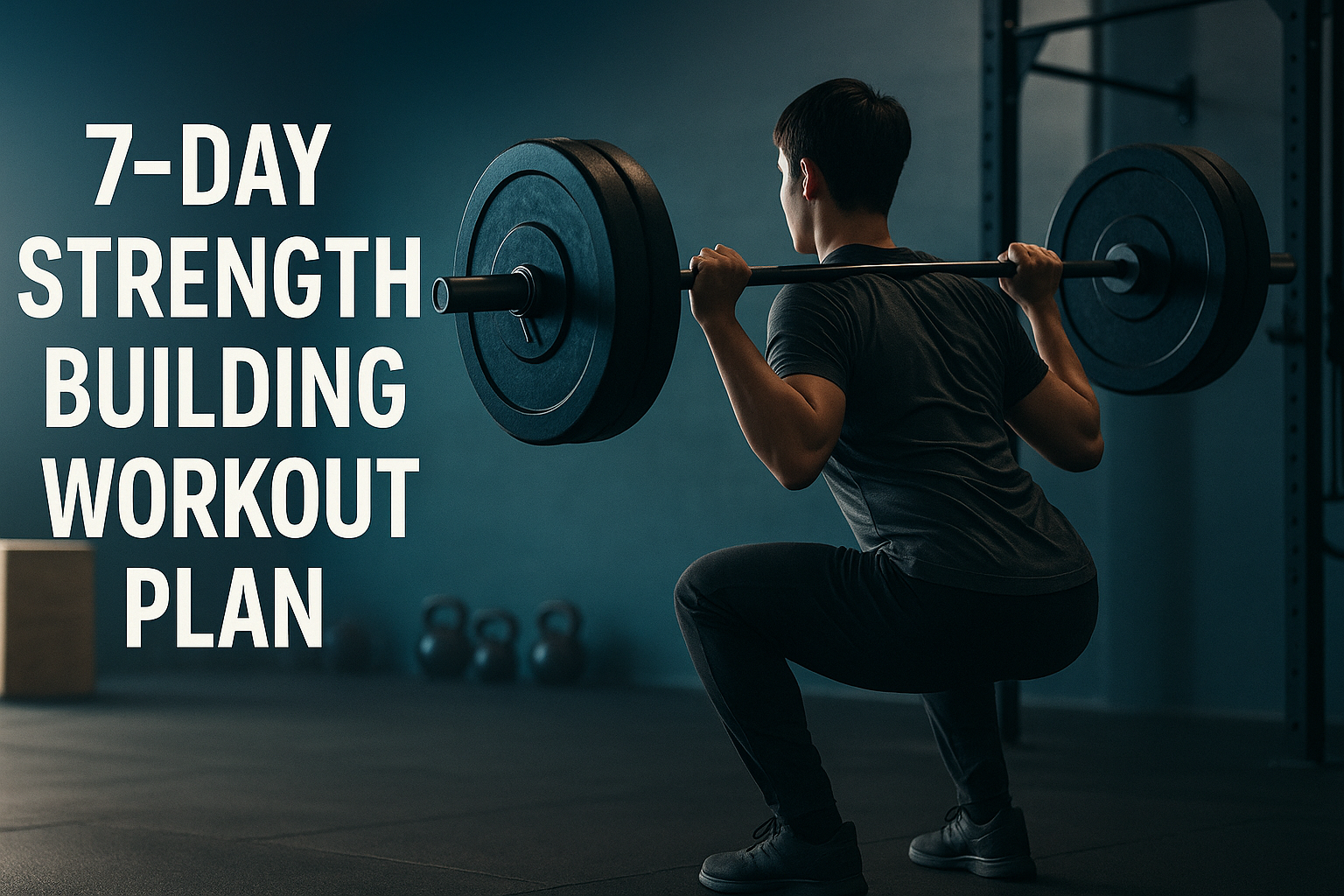
Want to get stronger in one week—without living at the gym or guessing what to do? This 7-Day Strength Building Workout Plan gives you a clear, practical schedule you can follow starting today. You’ll get day-by-day workouts, warm-ups, progress targets, at-home substitutions, and simple rules for recovery and nutrition. Whether you’re new to strength training or returning after a break, you’ll learn how to build a foundation safely and steadily while still feeling challenged.
Quick medical note: strength training is safe and beneficial for most people, but it’s not one-size-fits-all. If you have a medical condition, injury, or concerns, consult a qualified healthcare or fitness professional before starting or modifying any exercise program.
Key takeaways
- Simple split, big results: Two lower-body days, two upper-body days, one full-body capacity day, and two recovery days to build strength without burning out.
- Progression built in: Use clear load targets (RPE/RIR), rest times, and weekly rep/load bumps so you always know how to improve.
- Beginner-friendly options: Every barbell move has dumbbell, kettlebell, banded, and bodyweight alternatives.
- Recover like an athlete: Sleep, protein, and smart conditioning are part of the plan—so you get stronger between sessions too.
- Track what matters: Log sets, reps, RPE, and a few simple metrics to confirm you’re getting stronger.
How this plan works (and why it’s effective)
What it is & benefits
This 7-day plan uses a four-day lifting structure (Lower A, Upper A, Lower B, Upper B), plus one work-capacity day and two active recovery days. The big compound lifts (squat, deadlift, press, row/pull) are prioritized early in the week when you’re fresh. Accessories support weak links, improve joint health, and add muscle to drive long-term strength.
Requirements & low-cost alternatives
- Gym setup: Barbell, rack, adjustable bench, plates, dumbbells, cable or band station, pull-up bar.
- Home setup: A pair of adjustable dumbbells or kettlebells, a sturdy chair/bench, mini-bands/long bands, a backpack to load, a doorframe pull-up bar (optional).
- Timer (phone), notebook/app, and comfortable training shoes.
How to read the plan
- Sets × reps @ RPE: Example “4×5 @ RPE 7” means 4 sets of 5 reps at an effort where you have ~3 reps left in reserve (RIR≈3).
- Rest: Take the recommended rest; longer for heavy compound lifts, shorter for accessories.
- Tempo (optional): Use a steady 2–3 second lower, brief pause if needed, controlled up.
- Progression: When you complete all prescribed sets and reps at the target RPE, increase the load next week (guidelines included below).
Beginner modifications
- Swap any barbell move for dumbbells or bands.
- Reduce volume to 3 sets instead of 4 for your first week.
- Keep RPE in the 6–7 range for main lifts until movement feels crisp and repeatable.
Frequency & duration
- Lifting: 4 days (45–70 minutes each).
- Work capacity: 1 day (20–30 minutes).
- Active recovery: 2 days (15–30 minutes of light movement and mobility).
Safety & common mistakes
- Skipping warm-ups, going too heavy too soon, rushing rest intervals, ignoring joint discomfort, and letting technique erode under fatigue.
- Fix mistakes by filming the last set, reducing load if form breaks, and keeping your bracing and setup consistent.
Mini-plan example
- Pick the barbell or dumbbell version of each main lift.
- Complete the prescribed sets/reps at RPE 6–7 this week.
- Add 2–5 kg next week on lower-body lifts (or the next heavier dumbbell pair), 1–2.5 kg on upper-body lifts, if you hit all reps with solid technique.
Warm-up: the 8-minute ramp (use before every lifting session)
What it is & benefits
A short, repeatable warm-up that raises temperature, greases the specific movement pattern, and “primes” your nervous system for heavier sets.
Requirements
Timer and a small open space. For home training, bands and a broomstick/dowel help.
Step-by-step
- General prep (2–3 minutes): Brisk walk, easy cycle, or jump rope.
- Mobility & activation (3 minutes):
- T-spine openers or arm circles (30–45s)
- Hip hinges with a dowel (10–12)
- Glute bridges (10–12)
- Dead bug or plank (30–45s)
- Specific ramp (2–3 minutes): 2–3 lighter sets of your first lift, increasing load each set (e.g., empty bar → 50% → 70% of working weight).
Beginner modifications
Do extra ramp sets if you need more rehearsal. Keep the first work set conservative.
Frequency & duration
8–10 minutes total before each session. Never skip it.
Safety & mistakes
Don’t stretch aggressively when cold, and don’t fatigue yourself before your main lifts.
Mini-plan example
- 2 min brisk cycle → 3 rounds: 6 dowel hinges + 8 glute bridges + 20s dead bug → 3 ramp sets for squats.
Day 1 — Lower Body A (Squat Focus)
Purpose & benefits
Build strong legs and a resilient core with a squat-dominant day. Squats train the entire lower body and teach bracing you’ll use all week.
Main session
- Back Squat (or Goblet Squat): 4×5 @ RPE 7, rest 2–3 min
- Romanian Deadlift (barbell or dumbbells): 3×8 @ RPE 7, rest 2 min
- Split Squat (rear-foot elevated optional): 3×8/leg @ RPE 7, rest 90–120s
- Standing Calf Raise (machine or dumbbells): 3×12–15 @ RPE 8, rest 60–90s
- Core — Side Plank: 3×30–45s/side, rest 45–60s
Requirements & alternatives
- No rack? Use Goblet Squats heavy enough to challenge 5–8 reps.
- RDL substitute: Hip Hinge with Bands or Good Morning with a light bar/dowel to learn pattern.
How to do it (coaching cues)
- Squat: Feet shoulder-width, screw feet into the floor, big breath into your belly, sit between hips, drive up evenly through mid-foot.
- RDL: Soft knees, push hips back like closing a car door, keep lats tight and the bar close, stand by squeezing glutes.
Beginner modifications & progressions
- Start with 3×5 on squats if volume feels high; add a set next week.
- Progress by adding 2–5 kg to squats weekly when you hit 4×5 at RPE ≤7 with solid technique.
Safety & mistakes
- Don’t let knees cave or heels lift.
- Stop RDLs at your hamstring flexibility limit—no rounding to chase range.
Mini-plan example
- Warm-up ramp → Back Squat 4×5 → RDL 3×8 → Split Squat 3×8/leg → Calf Raise 3×15 → Side Plank 3×30s.
Day 2 — Upper Body A (Bench & Row Focus)
Purpose & benefits
Push and pull strength improve together. Bench builds pressing power; rows balance the shoulder and protect the rotator cuff.
Main session
- Barbell Bench Press (or Dumbbell Bench Press): 4×5 @ RPE 7, rest 2–3 min
- One-Arm Dumbbell Row (or Chest-Supported Row): 3×8/side @ RPE 7, rest 90–120s
- Overhead Press (barbell or dumbbells): 3×6 @ RPE 7, rest 2–3 min
- Lat Pulldown (or Assisted Pull-Ups): 3×8–10 @ RPE 7–8, rest 90–120s
- Accessory superset — Face Pulls + DB Curl: 2–3×12 each, rest 60s between moves
Requirements & alternatives
- No bench? Floor press with dumbbells.
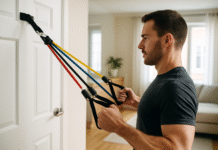
- No pulldown? Band pulldowns anchored in a door, or inverted rows under a sturdy table.
How to do it (coaching cues)
- Bench: Feet planted, shoulder blades pulled back and down, light arch, bar to lower chest, vertical forearms.
- Row: Pull elbow to your hip, keep ribs down, pause briefly at the top.
Beginner modifications & progressions
- If shoulder discomfort, use neutral-grip dumbbells and reduce range to pain-free.
- Add 1–2.5 kg to bench or the next dumbbell pair when you hit all reps at RPE ≤7.
Safety & mistakes
- Don’t bounce the bar off your chest.
- Keep wrists stacked over elbows on presses; avoid flared elbows.
Mini-plan example
- Ramp with push-ups and band rows → Bench 4×5 → DB Row 3×8 → OHP 3×6 → Pulldown 3×10 → Face Pulls + Curls 2×12.
Day 3 — Recovery & Conditioning
Purpose & benefits
Active recovery maintains blood flow, reduces stiffness, and builds an aerobic base that helps you recover better between sets and sessions.
Main session (pick one)
- Zone 2 cardio: 20–30 minutes continuous at a pace where you can talk in sentences.
- Intervals: 10×1 minute easy / 30 seconds brisk on a bike or rower.
- Mobility flow: 15–20 minutes focusing on hips, thoracic spine, and shoulders.
Requirements & alternatives
Walking, cycling, rowing, or light jogging. Indoors: marching in place, step-ups, or a mini-circuit of low-impact moves.
Beginner modifications
Keep it easy. The goal is to feel better after, not exhausted.
Frequency & duration
20–30 minutes once this week. Optional: add a 10-minute walk on other days.
Safety & mistakes
Stay in a conversational pace for most of the session. Hydrate and avoid new, high-impact activities on recovery day.
Mini-plan example
- 5-min brisk walk → 20-min easy cycle → 5-min mobility.
Day 4 — Lower Body B (Deadlift Focus)
Purpose & benefits
Pull heavy from the floor, then reinforce leg drive and hip strength. Deadlifts build total-body tension and posterior chain power.
Main session
- Conventional Deadlift (or Trap Bar Deadlift): 4×3–5 @ RPE 7, rest 3 min
- Front Squat (or Goblet Squat): 3×5 @ RPE 7, rest 2–3 min
- Hip Thrust (barbell or dumbbell): 3×8 @ RPE 8, rest 2 min
- Hamstring Curl (machine, band, or sliders): 3×10–12 @ RPE 8, rest 90s
- Core — Weighted Carry (farmer or suitcase): 4×20–30m, rest 60–90s
Requirements & alternatives
- No trap bar? Conventional with smaller jumps in load.
- No curl machine? Use a band or sliding heel curls on a towel.
How to do it (coaching cues)
- Deadlift: Mid-foot under bar, take tension before the pull, push the floor away, keep the bar close, stand tall then return with a hip hinge.
- Front Squat: Elbows high, chest tall, sit between hips, drive up in a straight bar path.
Beginner modifications & progressions
- Use a rack pull just below the knee to shorten the range while learning.
- Add 2–5 kg next week if all reps are crisp at RPE ≤7.
Safety & mistakes
- Don’t jerk the bar—pull the slack out first.
- If your back rounds, reduce load, elevate the plates (blocks), or switch to trap bar.
Mini-plan example
- Ramp pulls 3×3 (light) → Deadlift 4×3 → Front Squat 3×5 → Hip Thrust 3×8 → Ham Curl 3×12 → Carries 4×25m.
Day 5 — Upper Body B (Pull & Overhead Focus)
Purpose & benefits
Emphasizes vertical pulling and overhead strength to round out the week and protect the shoulders.
Main session
- Pull-Ups/Chin-Ups (assisted as needed) or Lat Pulldown: 4×5–8 @ RPE 7, rest 2–3 min
- Standing Overhead Press (or Seated DB Press): 4×5 @ RPE 7, rest 2–3 min
- Barbell or Cable Row: 3×8 @ RPE 7–8, rest 90–120s
- Dips (assisted or bench) or Push-Ups: 3×8–12 @ RPE 7–8, rest 90s
- Rear-Delt & Cuff — Reverse Fly + External Rotation: 2–3×12 each, rest 60s
Requirements & alternatives
- No pull-up bar? Door-anchor band pulldowns.
- Overhead bother your shoulders? Use neutral-grip dumbbells, reduce range, or press landmine style.
How to do it (coaching cues)
- Pull-Ups: Think “chest up to bar,” drive elbows down and back, keep ribs down.
- Overhead Press: Brace glutes and abs, squeeze the bar, press slightly back to finish over mid-foot.
Beginner modifications & progressions
- Use a band for pull-up assistance or a machine; reduce reps and build volume each week.
- Increase pressing load by the smallest available jump when you hit 4×5 smoothly.
Safety & mistakes
- Don’t hyperextend your lower back when pressing; squeeze glutes and ribs down.
- Prioritize shoulder health: keep face pulls and external rotations strict.
Mini-plan example
- Band pulldown warm-ups → Pull-Ups 4×6 → OHP 4×5 → Row 3×8 → Dips 3×10 → Reverse Fly + External Rotation 2×12.
Day 6 — Full-Body Hypertrophy & Work Capacity
Purpose & benefits
Moderate-load, slightly higher-rep circuits build muscle and work capacity without frying your nervous system. This day supports recovery while driving hypertrophy that will later turn into more strength.
Main session (circuit; 2–3 rounds)
- Goblet Squat — 10–12 reps @ RPE 7
- DB Romanian Deadlift — 10–12 reps @ RPE 7
- DB Bench Press — 10–12 reps @ RPE 7
- Chest-Supported Row — 10–12 reps @ RPE 7
- Plank — 30–45s
Rest
- Rest ~60–90 seconds between exercises; 2 minutes between rounds.
Optional finisher (choose one)
- Sled pushes: 6×20–30m, walk back recovery.
- Farmer Carries: 5×30–40m heavy.
- EMOM 10’: Minute 1 = 8 kettlebell swings, Minute 2 = 8 push-ups (repeat).
Beginner modifications
Use lighter loads and longer rests; do 2 rounds total.
Safety & mistakes
Choose loads that keep technique crisp for every rep. Don’t let back position deteriorate under fatigue.
Mini-plan example
- 8-minute warm-up → Circuit (2–3 rounds) → Optional carries EMOM 10’.
Day 7 — Active Recovery & Mobility
Purpose & benefits
You grow when you recover. Today cements that recovery so next week’s training feels better.
Main session (20–30 minutes total)
- Walk outdoors at a comfortable pace, or easy cycling.
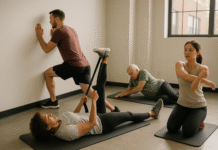
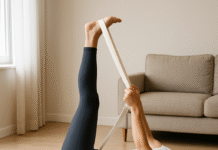
- Mobility: Hips (90/90), thoracic spine (open books), shoulders (wall slides).
- Breathing: 3–5 minutes of easy nasal breathing or box breathing (4-4-4-4).
Beginner modifications
If you’re very sore, shorten the session to 15 minutes or split into two short walks.
Safety & mistakes
Avoid any strenuous new activity today. Keep it restorative.
Mini-plan example
- 15-min walk → 10-min mobility flow → 3-min breathing drill.
Progression: exactly how to get stronger each week
Goal: increase load gradually while keeping reps and technique consistent.
Your simple rules
- If you complete all prescribed sets and reps at RPE ≤7–8, add load next week.
- Lower-body main lifts: add 2–5 kg; upper-body main lifts: add 1–2.5 kg.
- If you miss reps or technique slips, repeat the same load next week or reduce by 2–5%.
- Use AMRAP (as many reps as possible) only sparingly (e.g., last set on Day 6) and stop with 2 reps in reserve to avoid form breakdown.
- Keep accessories at RPE 7–8 and add small increases or 1–2 reps per set weekly.
At-home progression
- Move to the next heavier dumbbell pair or slow the tempo (3–1–1) to make the same weight harder.
- When you plateau, add a 4th set or use rest-pause: do 8 reps, rest 15 seconds, then 2–3 more.
Recovery, nutrition, and lifestyle (the invisible half of strength)
Sleep
Aim for consistent, adequate sleep each night to support recovery, hormone balance, and learning of motor patterns. Protect a regular sleep/wake time and a cool, dark bedroom.
Protein & fueling
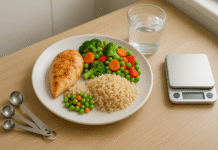
- Baseline daily protein at least the general recommended amount per body weight, and often more when training hard. Spread intake over 3–4 meals with 20–40 g protein each to support muscle repair.
- Include slow-digesting carbs before lifting (e.g., oats, rice, fruit) and a mixed meal within a couple of hours post-session.
- Hydrate: 500–750 ml water in the hour before training; sip as needed during sessions.
Soreness management
Mild soreness is normal. If soreness lingers >72 hours or affects technique, reduce load or volume by 10–20% the next week and emphasize sleep and protein.
Optional supplements
Stick to basics only if appropriate for you: a protein powder for convenience, creatine monohydrate, and a general health stack as advised by your clinician. If you choose creatine, use 3–5 g/day with adequate fluids.
Quick-start checklist
- Chosen gym or home setup and identified your lift variations (barbell vs dumbbell).
- Printed or opened a training log to track sets, reps, load, and RPE.
- Practiced the 8-minute warm-up once.
- Set progression rules (RPE targets, load increases).
- Planned training times for Days 1–6 and a walk/mobility block for Day 7.
- Stocked simple protein sources and planned sleep windows.
Troubleshooting & common pitfalls
“My form falls apart as I add weight.”
Lower the load, film sets from the side and front, and increase your ramp-up sets. Stay at RPE 6–7 for two weeks while you groove technique.
“I’m brutally sore after Day 1.”
Cut total sets by a third for a week and keep conditioning easy. Keep moving—light walking reduces soreness better than total rest.
“No progress on the bench press.”
Add a fourth bench set at RPE 6 as a “technique set,” or pause the bar on the chest for a one-count to improve tightness. Consider adding push-ups on Day 6.
“Lower back feels cranky on deadlifts.”
Elevate the plates (blocks), switch to trap bar or Romanian deadlifts temporarily, and focus on bracing: inhale, lock ribs down, push the floor.
“I don’t have heavier dumbbells at home.”
Slow the tempo (3-second lowers), shorten rest by 10–20 seconds, add a set, or use unilateral variations to make the same load harder.
“I’m tired all the time.”
You may be under-recovered. Prioritize sleep, reduce accessories by 1 set each, and keep Day 3 purely easy cardio. Eat enough total calories.
How to measure progress (so you know it’s working)
Primary KPIs
- Load lifted for main lifts at the same RPE.
- Total weekly volume (sets × reps × load) on major patterns.
- Reps at a fixed load (e.g., how many clean reps you can do at 60 kg).
- Perceived exertion at a fixed load and rep target (RPE trending down = stronger).
- Consistency (sessions completed as planned).
Weekly check-in (5 minutes)
- Scan your log and mark: ↑ if load increased, → if matched, ↓ if reduced.
- Note any joint gripes or technique flags to fix next week.
- Adjust only one variable at a time (load or volume).
Monthly snapshot
- Retest a conservative AMRAP with 2 RIR on your main lifts or estimate strength by repeating Week 1’s working sets and comparing RPE.
The 4-Week starter roadmap (repeatable)
Week 1 — Groove & calibrate
- Use the lower end of RPE targets (mostly 6–7).
- Film your last set of each main lift for a quick form check.
Week 2 — Standard progression
- Add 1–2.5 kg upper, 2–5 kg lower if you completed all reps within RPE guides.
- Keep accessories at RPE 7–8 and add 1 rep per set where possible.
Week 3 — Consolidate
- Hold loads steady on main lifts; aim to feel easier at the same weights.
- Slightly increase accessory load or add a fourth set on one weak-link exercise.
Week 4 — Small push, then reload
- Push main lifts to the top of RPE 7–8 ranges if form is rock-solid.
- End of week: take a light reload day (reduce loads 10–15%) if fatigue is high; otherwise proceed to the next 4-week block and repeat.
Equipment substitutions (home & travel)
Squats
- No rack: Goblet Squat, Double-DB Front Squat, Split Squat.
Deadlifts/hinges - Suitcase Deadlift (one or two dumbbells), Band Pull-Through, Hip Hinge with backpack.
Bench/pressing - Floor Press, Push-Ups (weighted backpack), Landmine Press (bar in a corner or T-handle).
Pulling - Inverted Rows (sturdy table), Band Pulldowns, One-Arm DB Rows.
Core - Side Plank, Dead Bug, Carries, Hollow Hold.
Technique snapshots (quick cues you can remember)
- Brace: Big breath into belly/ribs → lock it with a light “hiss.”
- Feet: “Screw into the floor” for squats/presses; even pressure mid-foot.
- Bar path: Straight and close—especially on deadlifts and rows.
- Shoulders: “Back and down” on presses; don’t shrug under load.
- Hips: Hinge back on RDLs; sit between hips on squats (not knees forward only).
Sample training logs (copy/paste or handwrite)
Main lift log line
- Exercise — Sets × reps @ load — RPE (notes)
- Example: Back Squat — 4×5 @ 70 kg — RPE 7 (felt stable; add 2.5 kg next week)
Accessory log line
- DB Row — 3×8/side @ 24 kg — RPE 7.5 (keep next week; focus elbow path)
Weekly summary
- Wins: Bench up 2.5 kg, pull-ups +1 rep.
- Fix next week: Reduce deadlift jumps; longer rest on sets 3–4.
Frequently asked questions
1) Can I run this plan if I’m a complete beginner?
Yes. Start with dumbbell or goblet variations, keep RPE at 6–7 for the first two weeks, and reduce each main-lift set count by one if needed. Add sets back as your technique stabilizes.
2) How long should each workout take?
Most sessions are 45–70 minutes, depending on rest times and gym crowding. Accessories move faster; main lifts deserve full rest.
3) What if I can only train three days per week?
Combine Day 1 + Day 4 into one lower day (reduce sets slightly), and Day 2 + Day 5 into one upper day. Keep Day 6 as a shorter full-body circuit. You’ll still make solid progress.
4) I don’t feel my glutes/hamstrings on hinges—what am I doing wrong?
Likely bending at the knees rather than hinging at the hips. Practice hip hinges with a dowel along your spine, push hips back, and keep the weight close to your body. Slow your descents.
5) How heavy is “RPE 7”?
It’s a set that leaves about 3 reps in reserve—challenging but repeatable with clean form. If your last rep speed crashes or form degrades, you’re too heavy.
6) Should I train to failure?
Not on the big compound lifts. Leave 1–3 reps in reserve most of the time. Occasional near-failure on small accessories is fine if technique stays crisp.
7) What if I have cranky knees or shoulders?
Use pain-free ranges, swap to neutral-grip dumbbells, shorten the motion slightly, and emphasize technique. If pain persists, consult a qualified professional.
8) Do I need cardio to get stronger?
A little helps. Low-to-moderate cardio on Day 3 improves recovery and work capacity, which supports better lifting performance without cutting into strength.
9) How much protein do I actually need?
Ensure at least the general recommended baseline, and active lifters often benefit from higher intakes distributed across the day. Prioritize whole foods and supplement only for convenience.
10) Is creatine necessary?
Not necessary, but it’s one of the most researched and well-tolerated supplements for strength and power when used appropriately. If you choose to take it, 3–5 g/day is typical. Always consider personal health and professional guidance.
11) I’m gaining weight—am I doing something wrong?
Early on you may retain water and build some muscle. Track progress by performance, how clothes fit, and measurements. If bodyweight changes aren’t desired, adjust calories modestly.
12) Can I add more sets or exercises?
You can, but add volume gradually. First nail the plan for two full weeks, then add a single set to one lagging exercise and assess recovery.
Conclusion
Strength doesn’t happen by accident—it’s built by showing up with a good plan and sticking to simple rules. This 7-Day Strength Building Workout Plan gives you the structure, progress targets, and flexibility to train anywhere and get stronger every week. Start today, log your first session, and let the numbers climb.
CTA: Copy this plan to your calendar, set your first training time, and complete Day 1 within the next 24 hours.
References
- Physical Activity Basics for Adults, U.S. Centers for Disease Control and Prevention, reviewed 2024, https://www.cdc.gov/physicalactivity/basics/adults/index.htm
- Physical activity: Key facts, World Health Organization, updated 2022, https://www.who.int/news-room/fact-sheets/detail/physical-activity
- Progression Models in Resistance Training for Healthy Adults, Medicine & Science in Sports & Exercise (American College of Sports Medicine Position Stand), 2009, https://doi.org/10.1249/MSS.0b013e3181915670
- Borg’s Rating of Perceived Exertion (RPE) and Training, ExRx.net, accessed 2025, https://exrx.net/Testing/RPE
- Protein — Fact Sheet for Consumers, National Institutes of Health, Office of Dietary Supplements, updated 2022, https://ods.od.nih.gov/factsheets/Protein-Consumer/
- A systematic review, meta-analysis and meta-regression of the effect of protein supplementation on resistance training–induced gains in muscle mass and strength, Journal of the International Society of Sports Nutrition, 2018, https://jissn.biomedcentral.com/articles/10.1186/s12970-018-0215-1
- International Society of Sports Nutrition position stand: safety and efficacy of creatine supplementation in exercise, sport, and medicine, Journal of the International Society of Sports Nutrition, 2021, https://jissn.biomedcentral.com/articles/10.1186/s12970-021-00403-6
- How Much Sleep Do I Need?, U.S. Centers for Disease Control and Prevention, reviewed 2024, https://www.cdc.gov/sleep/about_sleep/how_much_sleep.html
- Getting Started with Resistance Training, National Health Service (UK), reviewed 2023, https://www.nhs.uk/live-well/exercise/strength-and-flex-exercises/
- Strength Training: Principles of Exercise Prescription for Healthy Adults, National Academy of Sports Medicine (educational resource), accessed 2025, https://blog.nasm.org/workout-plans/strength-training-for-beginners