

























Treating fitness like “real work” is the simplest way to make it stick. When you adapt proven workplace methods—time blocking, Pomodoro, Kanban, OKRs—to your training, you remove decision fatigue, protect your schedule, and see progress consistently. This guide translates those tools into movement habits you can actually keep, whether you’re juggling a full-time job, caregiving, or travel. In one line: adapting productivity techniques to exercise means scheduling, prioritizing, and tracking workouts with the same clarity you bring to your job. If you’re short on time, start with these quick steps: block a recurring 30-minute slot, set a 25-minute timer, choose one focus (strength, cardio, or mobility), prep gear the night before, and review your week every Sunday.
Quick disclaimer: This guide is educational and not medical advice. If you have a condition, injury, or are new to exercise, consult a qualified professional before starting or changing your routine.
1. Time Blocking Your Training Like Non-Negotiable Meetings
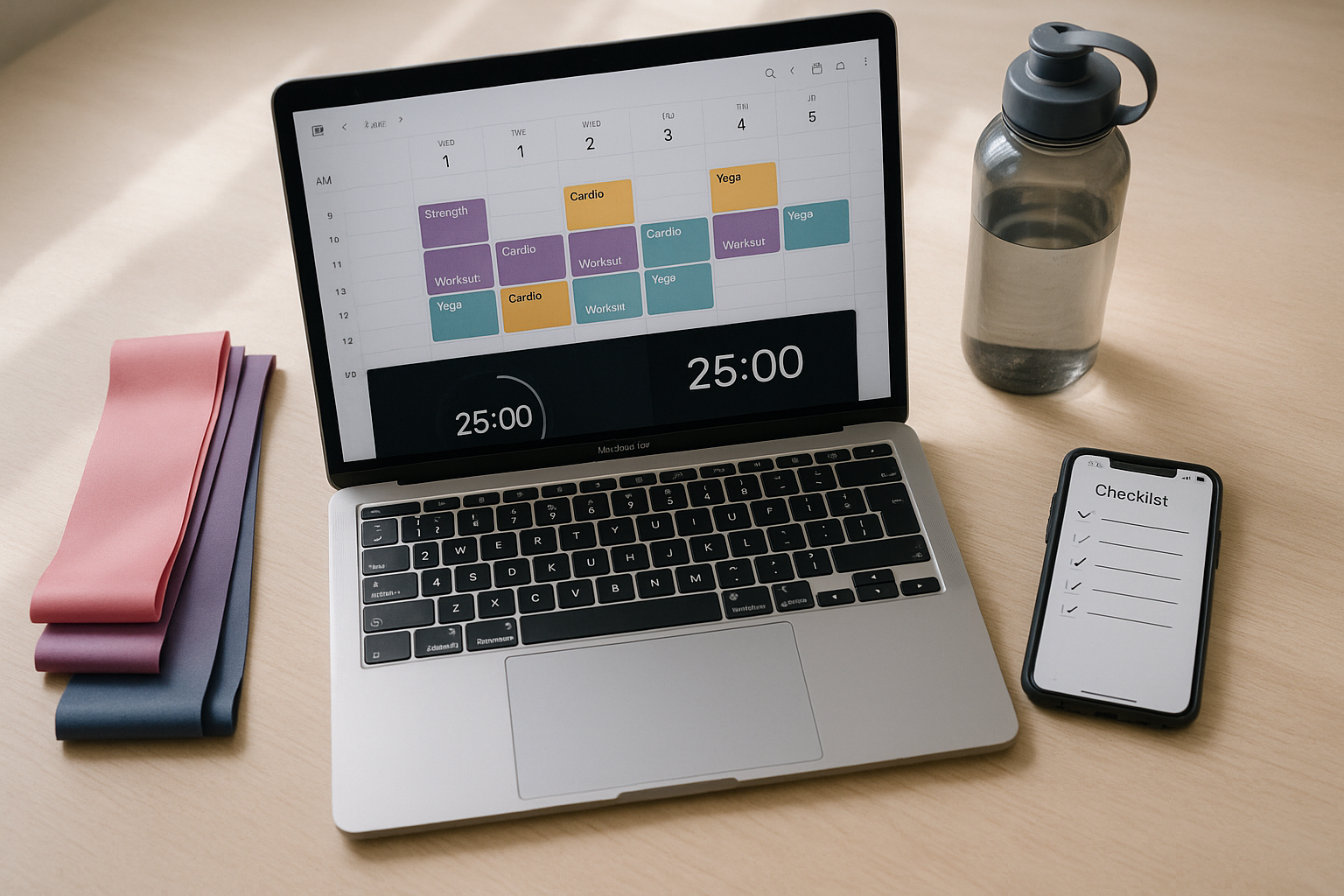
Time blocking works for exercise because it turns “I’ll try to work out” into “I train 7:30–8:00 a.m., M/W/F—calendar holds set.” The first two sentences are the entire point: block exercise in your calendar as you would a client call; defend it; then optimize. Most people don’t miss workouts because of motivation—they miss them because the time wasn’t truly allocated. By treating sessions as fixed appointments, you reduce rescheduling and eliminate same-day decision friction. As a bonus, people around you begin to recognize your block as protected time, just like any other meeting. Keep the blocks realistic (20–40 minutes is enough), tie them to existing anchors (right after school drop-off or before lunch), and keep a backup micro-block (10–12 minutes) for days that go sideways.
1.1 How to do it
- Choose 3–5 recurring blocks per week (e.g., M/W/F 7:30–8:00; Sat 10:00–10:30).
- Color-code: strength (blue), cardio (red), mobility (green) for fast context.
- Add location and prep in the event notes (gym address, mat at home, park route).
- Set reminders: 12 hours (prep gear), 60 minutes (nudge), and 10 minutes (go).
- Share availability as “busy” to prevent meeting conflicts.
- If needed, add a 12-minute “rescue block” on non-training days for mobility.
1.2 Numbers & guardrails
- Length: 25–40 minutes is a sweet spot for most schedules.
- Frequency: 3–5 blocks/week accumulates the recommended 150+ minutes/week when combined with walking and daily activity.
- Flex rule: Miss a block? Move it within 48 hours—don’t skip entirely.
Mini example: You block Tue/Thu 12:15–12:45 for lunch-break circuits and Sat 9:30–10:10 for a longer run. When a meeting overruns Tuesday, you immediately push the block to 5:30–6:00 p.m. the same day. No decision fatigue; just a drag-and-drop move.
Synthesis: Once exercise lives on your calendar, it happens—because everything else must route around it.
2. Pomodoro for Movement: Intervals, Micro-bursts, and Warm Starts
Pomodoro’s core insight—work in short, focused sprints—maps cleanly to training. Start with one 25-minute “movement Pomodoro”: 3–5 minute warm-up, 18–20 minutes of focused sets or intervals, and 2 minutes to log results and stretch. This structure removes the intimidation of a “full workout” and makes it easy to begin, since you only owe yourself one timer. On slammed days, use a “warm start” Pomodoro: press start and commit to just 5 minutes; if motivation shows up, ride it to 25; if not, you still bank a win. For desk-bound jobs, stack 5×5-minute micro-bursts across the day for mobility, breathwork, or brisk stairs—small doses add up.
2.1 Tools & examples
- Timer apps: Focus To-Do, Be Focused, or any built-in phone timer.
- Template: 25:00 block = 4–5 rounds of 45 seconds work / 45 seconds rest (bodyweight), or 6×2-minute intervals on a bike with 1-minute easy spins.
- Desk days: 5 minutes of hip hinges, T-spine rotations, and band pull-aparts every 90 minutes.
2.2 Numbers & guardrails
- One 25-minute block can include 8–12 hard sets or 12–18 minutes of moderate cardio.
- For beginners: keep RPE (effort) around 5–7/10; finish with one “easy” minute.
- Missed workout? Do a single 25-minute “movement Pomodoro” before dinner.
Mini example: You run a 25-minute block: 4 rounds of 90-second brisk incline walk + 60-second easy; finish with 2 minutes of calf/hip mobility.
Synthesis: Pomodoro reframes workouts as winnable sprints, which lowers the threshold to start and tightens your focus once you begin.
3. Habit Stacking and Cues: Turn Routines into Reliable Triggers
Habit stacking links a new behavior to an existing routine: “After I brew coffee, I do 10 minutes of mobility,” or “After I park at the office, I walk stairs for 6 minutes.” The first two sentences, again, are the essence: tie training to something you already do without fail. That link becomes your automatic cue and drastically reduces reliance on motivation. To strengthen the chain, make the first action friction-free (shoes by the door, mat already unrolled), and keep early wins small. Over time, your brain bundles the steps—coffee becomes the “start signal” for movement, and you’ll feel unfinished if you skip it.
3.1 How to do it
- Choose an anchor that already happens daily (wake-up, commute, lunch).
- Write the stack: “After X, I will Y for Z minutes at location.”
- Prepare a visual cue (resistance band on chair, shoes by bed).
- Keep the first week short (5–10 minutes), then add time or intensity.
- Track streaks visibly (calendar X’s, habit app, or whiteboard).
3.2 Common mistakes
- Choosing rare anchors (“after I visit the climbing gym”)—use daily anchors.
- Over-ambitious stacks (30 minutes from day one)—start micro.
- Invisible cues—out of sight, out of mind.
Mini case: Nadia ties her evening TV time to 10 minutes of floor core work: the remote sits atop her yoga mat. She hasn’t missed in 21 days.
Synthesis: When cues are reliable and visible, consistency follows with minimal willpower.
4. Task Batching & Prep Pipelines: Remove Friction Before It Strikes
Batching groups similar tasks so you don’t context-switch. For fitness, the high-friction tasks are rarely the lunges—they’re the micro-logistics: washing kit, charging earbuds, programming workouts, packing a gym bag. By batching these into a weekly “prep pipeline,” you lower activation energy for every session. Think of Sunday as your operations meeting: plan the week’s sessions, stage gear, and pre-load your watch or app. Then, each block during the week becomes “grab and go,” not “hunt and hope.”
4.1 Weekly prep pipeline (15–25 minutes)
- Plan: Pick 3–5 sessions, specify focus (strength/cardio/mobility), and set RPE.
- Stage: Lay out 2 complete outfits; pack a spare kit in your bag or car.
- Charge: Earbuds, watch, bike lights; plug them in simultaneously.
- Program: Pre-write sets/intervals in your notes or training app.
- Stock: Refill water bottle, protein sachets, and small snacks.
4.2 Numbers & guardrails
- 15 minutes of prep can easily save 30–45 minutes of friction across the week.
- Keep a go-bag with shoes, band, towel, deodorant—rebuild it every Sunday.
Numeric example: If lack of charged earbuds costs you 8 minutes twice per week and chasing a missing shoe costs 6 minutes once per week, that’s ~22 minutes lost. One 15-minute batch session prevents it entirely.
Synthesis: Batching shifts effort to low-stress moments so your training blocks start on time and on autopilot.
5. The Eisenhower Matrix & Energy Mapping: Do the Right Workout Today
Urgent vs. important is a helpful lens for training. Urgent is what feels pressing (you want a hard workout to blow off steam); important is what advances your goal (recovering, lifting technique, or long aerobic base). Energy mapping adds a second dimension: your actual state today (sleep, soreness, stress). Combine both and you choose the right session for the day rather than forcing the wrong one. This prevents the classic cycle of pushing intensity when you’re depleted and skipping movement when you could have banked an easy win.
5.1 How to do it
- Make a 2×2: Important & High-Energy (heavy lifts/intervals), Important & Low-Energy (technique/mobility), Urgent & High-Energy (short HIIT), Urgent & Low-Energy (walk + stretches).
- Every morning, rate sleep and stress (low/med/high) and place yourself in the grid.
- Pick a matching session from your pre-planned menu (Section 4.1).
5.2 Numbers & guardrails
- RPE guide: High-energy days: RPE 7–9; low-energy days: RPE 3–6.
- Time cap: If stressed or short on sleep, cap at 20–30 minutes and finish feeling better than you started.
- Swap rule: If the day changes (meeting overran), downshift to the adjacent quadrant, don’t cancel.
Mini case: After a poor-sleep night, Amir moves his heavy deadlifts (Important/High-Energy) to Friday and inserts 25 minutes of technique + brisk walk (Important/Low-Energy). He preserves momentum and recovers for the heavier session.
Synthesis: Matching workout type to energy ensures progress without burnout.
6. OKRs, SMART Milestones & Weekly Reviews: Measure What Matters
OKRs (Objectives and Key Results) and SMART goals translate beautifully to fitness because they force clarity and measurable outcomes. The objective is qualitative (“Build a durable 5K base”); the key results are quantitative (“Run 3×/week for 8 weeks, improve easy pace by 20–30 sec/km, complete one 5K at RPE ≤7”). SMART milestones (specific, measurable, achievable, relevant, time-bound) create checkpoints you can celebrate. A brief weekly review closes the loop: did you hit the blocks, what improved, what needs to change?
6.1 How to do it
- Quarterly Objective: 8–12 weeks aligned to a simple theme (e.g., “Full-body strength foundation”).
- 3 Key Results: Training frequency, a performance marker, and a process metric (sleep, steps, or protein).
- Weekly Review (15 minutes): Check blocks completed, adjust next week, log one lesson.
6.2 Numbers & guardrails
- Keep Key Results count to three to avoid dilution.
- Use a simple dashboard: sessions/week, RPE trend, one performance marker (pace, reps, or load).
- If you miss 2+ targets for two consecutive weeks, reduce volume by 20% and rebuild.
Mini example: Objective: “Be 5K-ready by September 30.” KR1: 3 runs/week for 10 weeks. KR2: Easy pace from 6:15/km → 5:45/km. KR3: One weekly strength circuit.
Synthesis: When you measure the few things that matter, training decisions become obvious and progress compounds.
7. Kanban & Sprints: Visualize Progress and Limit WIP
Kanban boards shine for fitness because they make invisible progress visible. Create columns for Backlog, This Week, Today, and Done. Populate Backlog with session cards (e.g., “Lower-body strength A,” “Mobility flow C,” “30-minute zone-2 cycle”). Each week, pull 3–5 cards into This Week, then each morning move one card to Today and do it. Sprints add focus: commit to a 2-week or 4-week mini-block (e.g., “Mobility Sprint: daily 12 minutes” or “Pull-Up Sprint: 3 sessions/week”). WIP limits (one card in Today) reduce overwhelm and decision fatigue.
7.1 Tools & examples
- Tools: Trello, Notion board, whiteboard with sticky notes.
- Columns: Backlog → This Week (max 5) → Today (max 1) → Done.
- Sprint themes: “Sleep & Steps,” “Core Stability,” “5K Base,” “Shoulder Resilience.”
7.2 Numbers & guardrails
- WIP limit: Only one Today card at a time.
- Sprint length: 2–4 weeks is ideal for noticeable gains without fatigue.
- Review cadence: End of sprint—promote what worked, archive what didn’t.
Mini case: A home-gym board shows 18 Backlog cards. Each Sunday, Maya pulls 4 to This Week, then moves one card to Today at lunch. She’s completed 27 workouts in 7 weeks with zero decision fatigue.
Synthesis: Visual flow + WIP limits create momentum you can see—and keep.
8. The Two-Minute Rule & Implementation Intentions: Beat Procrastination Fast
The Two-Minute Rule (start with something you can do in under two minutes) and implementation intentions (“If X, then I will Y at Z”) are a potent combo for days when motivation is low. The rule lowers the barrier to entry; the plan pre-commits a response to a predictable obstacle. For example: “If my 7:30 block gets overrun, then at 12:30 I will do a 12-minute bodyweight circuit in my office.” This keeps the streak alive and rewires the identity you’re building—someone who always does something, even when the day isn’t perfect.
8.1 Mini-checklist
- Write one if-then plan for the most common blocker (meetings, kids, traffic).
- Pre-load a 2-minute start: shoes on, timer set, first set of squats.
- Keep a 10–12 minute circuit as your “floor,” not your “ideal.”
- Celebrate the completion, not the duration; log it.
8.2 Numbers & guardrails
- Two-minute start examples: 20 air squats, 1 minute of brisk stairs, 60 seconds of box breathing, 1-minute plank.
- “Floor session” template (12 minutes): 3 rounds—30 seconds squats, 30 seconds push-ups (incline if needed), 30 seconds glute bridge, 30 seconds rest.
Mini example: Your 5:30 a.m. alarm feels impossible. You execute the two-minute start—put on shoes, set a 5-minute timer, and start marching in place. Five minutes later, momentum carries you through a full 20-minute circuit.
Synthesis: When in doubt, make it tiny and automatic; small starts grow into real sessions remarkably often.
FAQs
How do I start if my schedule is totally unpredictable?
Use micro-blocks and a “floor session.” Place two 12-minute rescue blocks on non-training days and keep a 2-minute start ritual (shoes on, timer set, first set). If a bigger window appears, extend. You’ll maintain momentum despite chaos, and your average weekly minutes will surprise you—consistency beats occasional perfection.
Can I time-block with kids, shift work, or caregiving responsibilities?
Yes—anchor blocks to transitions that still happen (after school drop-off, post-night-shift wind-down). Keep them short (20–30 minutes) and schedule a backup micro-block (10–12 minutes) within the next 48 hours. Share your calendar with partners so they see and respect your holds, just like they would any other meeting.
Is Pomodoro good for strength training or only for cardio?
It works for both. For strength, one 25-minute Pomodoro can cover 8–12 working sets if you cap rest at 60–90 seconds and keep lifts simple (squat, push, hinge, pull). For cardio, use 6×2-minute intervals with 1-minute easy spins or walk/jog repeats. The timer enforces focus and avoids endless scrolling between sets.
How short can a workout be and still “count”?
Very short sessions can be meaningful. Ten to fifteen minutes of moderate-to-vigorous work can build capacity when done consistently, and even brief vigorous bursts sprinkled through the day contribute to fitness. Pair short sessions with weekly reviews and progressive overload to make them add up over time.
What should I track weekly without getting obsessive?
Keep it light: sessions completed, perceived effort (RPE), and one performance marker (pace, reps, or load). Add one process metric (sleep hours or average daily steps). A single page or tiny dashboard is enough. If tracking creates stress, reduce it—consistency is the real metric.
How do I avoid overtraining when my calendar is packed?
Match the workout type to your energy and stress (Section 5). On high-stress or short-sleep days, downshift to mobility or zone-2 cardio and cap time to 20–30 minutes. End sessions feeling better than you started. Use a deload week every 4–8 weeks by reducing volume 20–30%.
Which tools or apps fit these methods?
Any calendar works (Google, Outlook, Apple). For timers, use Focus To-Do or your phone. Trello or Notion for Kanban, and a simple notes app for OKRs and reviews. Don’t overbuild the system; the goal is friction-free execution. If tech distracts you, go analog with a whiteboard.
What if I miss a block—do I double up?
Don’t stack hard sessions back-to-back to “make up.” Move the missed block within 48 hours, then resume the plan. If you miss multiple blocks in a week, shrink the next week’s volume by ~20% and rebuild. Protect the habit first; performance follows.
Can these systems work for beginners or older adults?
Absolutely—scale the intensity. Use RPE 3–6 for most sessions early, keep movements simple (sit-to-stand, wall push-ups, walking intervals), and emphasize frequency over duration. Time blocking and habit stacking are about structure, not intensity, so they’re safe to adapt for different abilities.
How do I integrate rest and recovery into time blocking?
Block recovery like a workout. Add 10–15 minutes of mobility on rest days, schedule earlier bedtimes during sprints, and protect one weekly longer walk or easy ride. A blocked calendar for rest prevents you from filling it with meetings—and your training quality improves.
Conclusion
Workplace tools stick because they simplify choices, protect time, and show progress—exactly what most fitness plans lack. By time blocking workouts like meetings, using Pomodoro to create startable sprints, stacking habits onto daily cues, and batching prep to kill friction, you make exercise easier to begin and harder to skip. The Eisenhower + energy map helps you pick the right session for today, while OKRs and weekly reviews keep outcomes crystal clear. Kanban visualizes momentum, and the Two-Minute Rule plus implementation intentions rescue tough days. Together, these methods build the only edge that matters in training: consistency.
Your next steps are simple: block three 30-minute sessions this week, set one Pomodoro for your first block, write one habit stack, and prep your go-bag tonight. Then run a 10-minute Sunday review to adjust. Repeat for eight weeks and enjoy the compound gains.
CTA: Block your first 30-minute session now—treat it like a meeting, and show up for yourself.
References
- WHO Guidelines on Physical Activity and Sedentary Behaviour, World Health Organization, 2020, https://www.who.int/publications/i/item/9789240015128
- Physical Activity Guidelines for Americans, 2nd Edition, U.S. Department of Health and Human Services, 2018 (updated resource page 2024), https://health.gov/our-work/physical-activity/current-guidelines
- Vigorous Intermittent Lifestyle Physical Activity and Mortality, Nature Medicine (Stamatakis et al.), 2022, https://www.nature.com/articles/s41591-022-02120-6
- Measuring Physical Activity Intensity, Centers for Disease Control and Prevention, page last reviewed 2024, https://www.cdc.gov/physicalactivity/basics/measuring/intensity.htm
- ACSM Position Stand & Resources on Exercise Volume and Intensity, American College of Sports Medicine, various pages (accessed 2025), https://www.acsm.org/education-resources/trending-topics-resources/physical-activity-guidelines
- The Pomodoro Technique®, Francesco Cirillo, official site (method overview), 2025, https://francescocirillo.com/pages/pomodoro-technique
- Implementation Intentions: Strong Effects of Simple Plans, American Psychologist (Gollwitzer), 1999, https://doi.org/10.1037/0003-066X.54.7.493
- The Fresh Start Effect: Temporal Landmarks Motivate Aspirational Behavior, Management Science (Dai, Milkman, Riis), 2014, https://pubsonline.informs.org/doi/10.1287/mnsc.2014.1901
- Borg RPE Scale and Perceived Exertion, CDC resource summary, 2024, https://www.cdc.gov/physicalactivity/basics/measuring/intensity.htm#rpe
- Atomic Habits (Habit Stacking concept overview), James Clear, 2018 (website summary accessed 2025), https://jamesclear.com/atomic-habits