



















Whether you’re logging daily 5Ks or racking up step counts on long walks, your calves do quiet, constant work. Tight calf muscles can limit ankle dorsiflexion, alter stride mechanics, and increase stress on the Achilles tendon and plantar fascia. This guide breaks down nine smart calf stretches—from simple wall holds to slant-board progressions—so you know exactly which move to use, when to use it, and how long to hold it. A quick answer up front: the best calf stretches for runners and walkers target both the gastrocnemius (knee straight) and the soleus (knee bent), performed after a warm-up or after your session, typically for 15–30 seconds per hold, 2–4 holds per leg.
Quick-start routine (post-run/post-walk):
- Wall gastrocnemius stretch (knee straight) × 2–4 holds each side →
- Bent-knee soleus stretch × 2–4 holds →
- Stair heel-drop stretch (eccentric focus if Achilles is cranky) × 2–3 sets of 10–15 reps →
- Optional slant board (gentle incline) × 2 holds if you need more range.
Medical note: Mild stretching discomfort is okay; sharp pain is not. If you have a recent calf strain, acute Achilles pain, or a suspected tear, consult a qualified clinician before starting any program.
1. Standing Wall Gastrocnemius Stretch (Knee Straight)
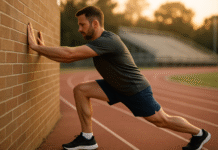
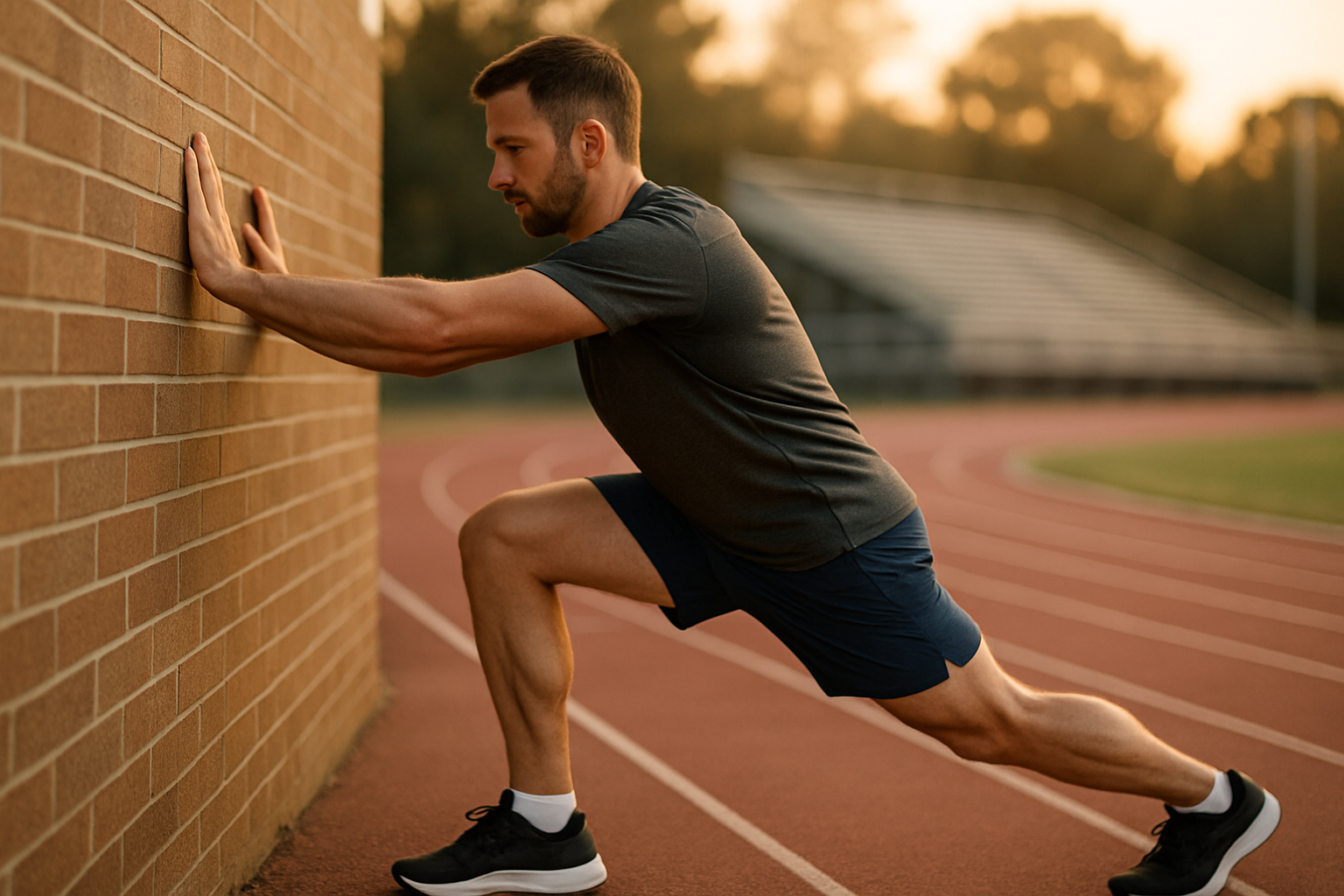
Start with the classic: a wall calf stretch with the back knee straight to bias the gastrocnemius. This is the most universal choice for post-run or post-walk stiffness and a reliable way to restore ankle dorsiflexion without equipment. Place your hands on a wall, step one foot back, keep that back knee straight and heel flat, and gently lean forward until you feel a stretch high in the calf. Hold 15–30 seconds, switch sides, and repeat 2–4 times. It’s simple, scales to any fitness level, and pairs well with bent-knee work for full-calf coverage. If your heel pops up or your arch collapses, slide closer to the wall or reduce the lean.
1.1 How to do it
- Stand facing a wall, hands at shoulder height.
- Step the right foot back 30–60 cm (12–24 in), toes forward, heel down.
- Keep the back knee straight; bend the front knee and lean hips toward the wall.
- You should feel the stretch high in the back leg’s calf (gastrocnemius).
- Hold 15–30 seconds; repeat 2–4 times per side.
1.2 Numbers & guardrails
- Best timing: post-run/post-walk or after a 5–10 minute warm-up.
- Dosage: 15–30 seconds × 2–4 holds per leg (older adults may benefit from up to 30–60 seconds).
- Frequency: 2–3+ days/week; daily for tight calves.
1.3 Common mistakes
- Letting the back heel lift (loses the stretch).
- Turning the toes out (changes alignment).
- Arch collapsing inward (keep a light tripod foot).
Bottom line: The straight-knee wall stretch is your versatile, no-equipment move to target the gastrocnemius and reclaim comfortable stride length.
2. Bent-Knee Soleus Stretch (Wall or Step)
To reach the deeper soleus muscle, keep the heel down but bend the back knee during a wall or step stretch. This is essential if high-calf holds always “miss the spot” or if hills and stairs give you low-calf/Achilles tightness. From a wall stance, place the stretching leg behind you, drop that heel, and gently bend the back knee forward over the toes while keeping the heel planted. You’ll feel the stretch lower in the calf and closer to the Achilles. Hold 15–30 seconds and repeat 2–4 times per side. This move complements the straight-knee version; together they cover both major calf components so you reduce compensations and toe-off stiffness.
2.1 How to do it
- Face a wall; stagger your stance with the stretching leg back.
- Hips square, both feet pointing forward, both heels down.
- Bend the back knee without letting the heel rise; move just to a firm stretch.
- Keep the front knee soft and the rib cage stacked over the pelvis.
- Hold 15–30 seconds; repeat 2–4 times each side.
2.2 Mini-checklist
- Target: lower calf/soleus and Achilles line.
- Common fault: back heel creeping up—shorten your stance.
- Progression: place the ball of the stretching foot on a low step for more range.
Bottom line: If you only ever do straight-knee holds, you’re leaving half the calf unstretched. Add bent-knee work to unlock ankle mobility for smoother push-off.
3. Slant Board / Incline Calf Stretch
A slant board (or a firm wedge like a curb ramp) lets you dial in a repeatable incline, relax your upper body, and settle into a deeper, safer stretch. For walkers with stiff ankles or runners transitioning back from time off, the board removes balance demands so you can focus on consistent holds. Stand facing uphill on a 10–20° incline with both heels fully supported. For the gastrocnemius, keep knees straight; for the soleus, unlock them slightly. Start with 15–20-second holds and build to 30 seconds, repeating 2–4 times per leg. The predictable angle helps maintain alignment and is a gentle entry point before trying deeper stair drops or loaded eccentric work.
3.1 How to do it
- Stand on a slant board with heels fully on the surface.
- Keep toes forward and arches lifted; don’t let ankles collapse.
- For high-calf focus, keep knees straight; for low-calf, bend slightly.
- Lean into the board just enough to feel a firm, non-painful stretch.
3.2 Numbers & guardrails
- Holds: 15–30 seconds, 2–4 times per leg.
- When: after sessions or after a short warm-up.
- Safety: avoid sharp pain or numbness; reduce angle if the heel wants to lift.
Bottom line: The slant board delivers a calm, controlled stretch you can standardize—ideal for consistency and gradual range gains.
4. Stair/Edge Heel-Drop Stretch (Eccentric-Friendly)
The stair heel-drop is a stretch and a classic eccentric exercise for the Achilles-calf complex, often used in rehab plans. Stand on a step with the balls of both feet supported and heels hanging free. Rise up, shift weight to one foot, and slowly lower that heel below the step until you feel a strong stretch. For a pure stretch, hold at the bottom; for eccentric training, return up with both feet and repeat controlled lowers. Use a rail for balance. This move is excellent when morning stiffness or hill running makes the Achilles grumpy, but keep it painless and progress gradually in volume.
4.1 How to do it
- Start with both forefeet on a step; hold a rail.
- Raise up with both feet, shift weight to the working leg, and lower the heel slowly (3–4 seconds).
- For stretch: pause at bottom 10–20 seconds, 2–4 holds.
- For eccentric: perform 2–3 sets of 10–15 slow lowers; rise up using both legs.
4.2 Numbers & guardrails
- Tempo: slow, controlled; no bouncing.
- Pain rule: mild tension is okay; stop if sharp pain appears.
- Progression: add a backpack load only if symptom-free for 1–2 weeks.
Bottom line: If you need both length and tendon capacity, heel-drops give you a two-for-one—stretching plus proven eccentric stimulus for the Achilles-calf unit.
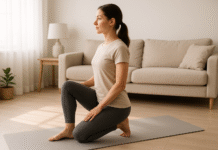
5. Runner’s Lunge Calf Stretch (Ankle Dorsiflexion Focus)
When your calves limit knee-over-toes motion, your stride and squat both feel jammed. The runner’s lunge positions you to bias ankle dorsiflexion in a functional stance. With your front foot flat and knee tracking over the second toe, slide the back leg long and keep its heel down. Lean your hips forward until you feel a stretch in the back calf; optionally, drive the front knee gently toward the wall for extra dorsiflexion practice. This stretch helps restore the “spring” you need at mid-stance and toe-off and can carry over to hills and stairs. Use small pulses only if they’re controlled and pain-free.
5.1 How to do it
- Face a wall; place the front toes 5–10 cm (2–4 in) from it.
- Step the other leg back, heel down, toes forward.
- Guide the front knee toward the wall without the heel lifting; feel the back calf stretch.
- Keep ribs stacked and hips level; don’t rotate the pelvis.
5.2 Why it matters
- Static and active calf work can increase ankle dorsiflexion, supporting more efficient gait mechanics. Gains are often modest per session but meaningful over weeks.
Bottom line: Use the runner’s lunge to marry calf length with usable ankle motion—key for stride comfort and hills.
6. Dynamic Ankle Pumps & Tiptoe Walks (Warm-Up)
Before you run or set off on a brisk walk, dynamic moves prep your calves without sapping power. Think ankle pumps, ankle circles, and 10–20 meters of slow tiptoe walks. These moves elevate tissue temperature, cue the neuromuscular system, and take the ankle through range at low load. Do 2–3 sets of 12–20 reps per leg for pumps/circles and one or two 10–20 m passes of tiptoe walks. Dynamic work is especially useful on cool mornings or after sitting, and it sets you up to save longer static holds for afterward. Pair with 5–10 minutes of easy walking or jogging for an effective warm-up.
6.1 Mini-checklist
- Sequence: easy walk/jog → ankle pumps/circles → tiptoe walks → main session.
- Reps: 12–20 per movement, 1–2 rounds.
- Cues: tall posture, quiet feet, smooth range (no snapping).
- Avoid: aggressive static holds immediately before hard sprints.
6.2 Tools/Examples
- Use a resistance band for gentle plantarflexion/dorsiflexion pumps.
- Walk on level ground; save uneven surfaces for after warm-up.
Bottom line: Dynamic prep wakes up the calf complex and preserves power—ideal for pre-run or pre-walk routines.
7. Foam Roller Calf Release + Active Stretch
If your calves feel ropey, a brief soft-tissue session can make static holds more comfortable. Sit on the floor, calf on a roller, and sweep from Achilles to just below the knee. Linger 20–30 seconds on tender spots, then immediately stand for a wall stretch. The roller won’t permanently “lengthen” muscle, but it can reduce perceived stiffness and improve stretch tolerance, making subsequent holds more productive. Cap the rolling at 60–120 seconds per calf and don’t grind; the goal is to desensitize, not bruise. Finish with 1–2 sets of wall or slant-board holds while tissues are calmer.
7.1 How to do it
- Place the roller under the calf; hands on the floor for support.
- Slow sweeps heel-to-knee for 45–60 seconds; add small ankle circles on tight spots.
- Switch sides; stand and perform a straight-knee or bent-knee stretch immediately after.
7.2 Numbers & guardrails
- Dose: 1–2 minutes per calf, then 2–4 static holds.
- Intensity: 4–6 out of 10 pressure; avoid sharp pain or tingling.
- Add-on: a light banded ankle mobilization if tolerated.
Bottom line: Use the roller as a primer—then lock in gains with purposeful stretching right after.
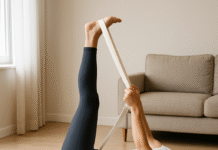
8. Supine Strap/Towel Calf Stretch (With Gentle Contract-Relax)
The strap (or towel) stretch shines when balance is limited or you want precise control. Lie on your back, loop a strap around the midfoot, and pull the foot toward you until you feel a firm stretch along the calf and behind the knee. To add a gentle contract-relax (CR) element, press the ball of the foot into the strap for 3–5 seconds, then relax and pull a centimeter closer; repeat 2–3 times before moving to the other leg. This position minimizes compensations and lets you track progress by recording strap length or thigh angle week to week. Keep the knee straight for gastrocnemius or bend slightly for soleus bias.
8.1 How to do it
- Lie supine; loop a towel/strap around the midfoot.
- Gently pull into dorsiflexion until you feel a firm stretch.
- Optional CR: press the forefoot into the strap (as if pointing toes) 3–5 seconds, then relax and pull a little further.
- Hold 15–30 seconds, repeat 2–4 times per leg.
8.2 Numbers & guardrails
- When: great on rest days or evenings.
- Who: useful for those who fatigue with standing holds.
- Rule: never yank; keep breathing calm and even.
Bottom line: Supine strap stretching offers control, safety, and measurable progression—ideal for steady, repeatable gains.
9. Downward Dog Calf “Pedals” (Yoga-Inspired)
Downward Dog with alternating heel presses adds a rhythmic, whole-chain feel to calf work. From a plank, lift hips into an inverted V, hands shoulder-width, feet hip-width. Keep a soft bend in the knees, lengthen the spine, and “pedal” by pressing one heel toward the floor while the other knee bends. You’ll feel the stretch migrate from high calf to low calf and into the plantar fascia. Use this as a cool-down flow or on easy days to circulate blood and gently mobilize ankles without long static holds. If wrists bother you, place hands on yoga blocks or perform against a wall to offload.
9.1 How to do it
- Form a stable Downward Dog: hands and feet planted, hips high, spine long.
- Alternately bend one knee while pressing the opposite heel down.
- Move slowly—2–3 seconds per pedal—for 45–90 seconds.
- Finish with 1–2 static holds in the tightest position you find.
9.2 Why it works
- Alternating loads translates to real gait patterns and can ease plantar fascia tension when paired with calf work; calf-focused stretching is associated with symptom improvements for plantar heel pain in several trials. Wiley Online Library
Bottom line: “Pedals” blend mobility with circulation—perfect on recovery days or as a gentle finish to your session.
FAQs
1) Should I stretch calves before or after a run/walk?
For performance and comfort, use dynamic prep (ankle pumps, tiptoe walks) before your session and save static holds (15–30 seconds, 2–4 times) for after or on recovery days. Static stretching is generally most effective when tissues are warm, such as post-run or after a short warm-up.
2) How long should each calf stretch last?
Most adults do well with 15–30-second holds repeated 2–4 times per side. Older adults may benefit from up to 30–60 seconds per hold. Always stop shy of pain and avoid bouncing.
3) What if my heel keeps lifting during stretches?
Shorten your stance, reduce the lean, or use a slant board so the heel stays fully supported. A lifted heel unloads the calf and shifts stress to the forefoot, reducing effectiveness of the stretch.
4) Will calf stretching improve my ankle dorsiflexion?
Yes, though gains are typically modest per session. Systematic reviews show small but statistically significant increases in dorsiflexion after consistent calf stretching over minutes to weeks. Pair with consistent practice and strength work for best carryover.
5) Which is better for plantar fasciitis—calf or plantar fascia–specific stretching?
Both help, but reviews suggest plantar fascia–specific stretching may provide greater symptom relief; calf stretching is still recommended as part of a program because the fascia and calf/Achilles system are functionally linked. ScienceDirect
6) How many days per week should I stretch my calves?
For durable changes, aim for at least 2–3 days/week, and consider brief daily work if stiffness returns quickly. Consistency matters more than aggressive intensity. Harvard Health
7) Is “eccentric” heel-drop work a stretch or a strength exercise?
It’s both—held at the bottom it behaves like a stretch; performed as slow lowers it loads the tendon and muscle in lengthening. Rehab programs often include slow eccentric lowers to build capacity in the Achilles-calf unit. orthoinfo.org
8) Are there risks to stretching if I’ve had a recent calf strain?
Yes. In the first days after a strain, aggressive stretching can aggravate healing tissue. Work with a clinician, start with pain-free range, and progress only as symptoms allow. If pain is sharp or swelling persists, seek assessment.
9) Do I need special equipment?
No equipment is required, but a slant board or wedge can make holds more comfortable and repeatable. A simple towel/strap helps with supine work, and a foam roller can reduce perceived tightness before you stretch. OrthoInfo
10) What’s the biggest form cue people miss?
Keeping the heel down and the toes straight forward. Turning out or letting the heel float drastically reduces the stretch to the intended tissue and may strain other structures. If alignment slips, ease off and re-stack your stance. CommonSpirit Health
Conclusion
Your calves operate every step you take—absorbing load, stabilizing the ankle, and propelling you forward—so it’s no surprise they tighten up under mileage and daily life. The simplest way to stay ahead of stiffness is to cover both sides of the calf complex: straight-knee holds for the gastrocnemius and bent-knee holds for the soleus. Layer in dynamic prep before sessions, use slant boards or straps for control, and consider stair heel-drops if you also want to build tendon capacity. Most adults will progress with 15–30-second holds, 2–4 reps per side, several days per week, adjusting angles and intensity to stay just shy of pain. Over time, expect modest but meaningful improvements in ankle dorsiflexion and a smoother, more comfortable stride. Pick two of the nine stretches that feel best today, perform them consistently for two weeks, and reevaluate—your calves (and your miles) will tell you you’re on the right track.
CTA: Try the quick-start routine after your very next run or walk and note how your calves feel at the first step tomorrow morning.
References
- Current Concepts in Muscle Stretching for Exercise and Rehabilitation, International Journal of Sports Physical Therapy, 2012. https://pmc.ncbi.nlm.nih.gov/articles/PMC3273886/
- A guide to basic stretches, Mayo Clinic, n.d. https://www.mayoclinic.org/healthy-lifestyle/fitness/in-depth/stretching/art-20546848
- Stretching exercises: Calf Stretch, Harvard Health Publishing, April 27, 2011. https://www.health.harvard.edu/blog/stretching-exercises-201104261595
- Foot and Ankle Conditioning Program (PDF), OrthoInfo — American Academy of Orthopaedic Surgeons, 2017. https://orthoinfo.aaos.org/globalassets/pdfs/2017-rehab_foot-and-ankle.pdf
- Achilles Tendinitis, OrthoInfo — American Academy of Orthopaedic Surgeons, n.d. https://orthoinfo.aaos.org/en/diseases–conditions/achilles-tendinitis/
- Radford JA, et al. Does stretching increase ankle dorsiflexion range of motion? A systematic review, Australian Journal of Physiotherapy, 2006. https://pmc.ncbi.nlm.nih.gov/articles/PMC2465055/
- Arif MA, et al. Effectiveness of Gastrocnemius–Soleus Stretching Program as a Treatment for Plantar Fasciitis, Cureus, 2022. https://pmc.ncbi.nlm.nih.gov/articles/PMC8956500/
- Exercises for calf and ankle problems, NHS inform, n.d. https://www.nhsinform.scot/illnesses-and-conditions/muscle-bone-and-joints/exercises/exercises-for-calf-and-ankle-problems/
- Calf muscle stretches (PDF), Oxford Health NHS Foundation Trust, n.d. https://www.oxfordhealth.nhs.uk/podiatry/wp-content/uploads/2013/12/Calf-muscles-stretches.pdf
- Achilles tendinopathy (PDF), University Hospitals Coventry and Warwickshire NHS, 2023. https://www.uhcw.nhs.uk/download/clientfiles/files/Patient%20Information%20Leaflets/Trauma%20and%20Neuro%20services/Trauma%20and%20Orthopaedics/Achilles%20tendinopathy.pdf