
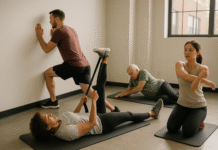
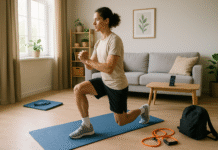

























Joint mobility is your ability to actively move a joint through a usable, pain-free range under control. In simple terms: flexibility is how far tissues can be stretched, while mobility is how far you can take a joint yourself with strength and coordination. Better mobility improves how you sit, stand, reach, lift, and play—while reducing stiffness and helping you feel and perform better day to day. As a quick definition: joint mobility = active, controlled range of motion; flexibility = passive tissue length.
Friendly disclaimer: This guide is educational and not a substitute for medical care. If you have pain, recent surgery, or a known joint condition, consult a qualified clinician first. For population-level activity guidance, see WHO’s recommendations (as of November 2020).
1. Define Mobility (vs. Flexibility) and Start With Active Range
Mobility is the active, strength-controlled movement of a joint; flexibility is the passive ability of muscles and connective tissues to lengthen. Knowing the difference matters because training mobility without strength or control can leave you unstable, while chasing only flexibility can increase range you can’t actually use. Start every session by checking your active range first, then only pursue more range if you can stabilize and move there with control. Most daily tasks—getting up from the floor, climbing stairs, reaching overhead—depend on active range more than passive stretch capacity, so prioritizing mobility has immediate payoffs in function and comfort. This distinction also helps you pick the right tools: dynamic drills and end-range strength for mobility; longer static or PNF holds for flexibility.
1.1 Why it matters
- Mobility transfers better to lifting, running, and sport because it’s strength plus range.
- It guides programming: dynamic first in warm-ups; longer static work later or on separate sessions.
- It helps avoid overstretching into ranges you can’t control.
1.2 Mini-checklist
- Can you actively reach the position you can passively get into?
- Do you feel stable and pain-free at end range?
- Can you breathe and lightly brace there for 5–10 seconds?
Bottom line: define terms clearly, then bias your training toward active, controllable motion rather than passive stretch alone.
2. Understand Joint Anatomy and Synovial Health
Synovial joints (shoulders, hips, knees, ankles, etc.) are lined with cartilage and bathed in synovial fluid, which lubricates and nourishes the joint surfaces. Movement literally feeds your joints: intermittent compression and decompression drive fluid exchange and help nutrients diffuse into cartilage, which has no direct blood supply. Prolonged immobility has the opposite effect—fluid movement slows, tissues stiffen, and your end ranges feel “sticky.” Knowing this physiology makes “little and often” movement a no-brainer: frequent, gentle ranges keep synovial fluid moving and cartilage happy.
2.1 Numbers & guardrails
- Aim to move each major joint through pain-free ranges several times daily (micro-sessions of 30–90 seconds).
- Keep end-range work sub-pain (0–2/10 discomfort). Stop with sharp pain, mechanical catching, or swelling.
- Warm joints first (walk 3–5 minutes) before deeper ranges.
2.2 Common mistakes
- Holding static end-range stretches before strength or sport (may reduce acute power).
- Forcing ranges with joint pinching or nerve-like pain.
- Ignoring small joints (wrists, feet) that anchor big lifts and gait.
Bottom line: joints are living tissues; motion is their maintenance plan—feed them frequently with controlled movement.
3. Assess Your Mobility Safely and Objectively
You don’t need a lab to get meaningful data. Quick active screens—like an overhead reach (thoracic/shoulder), knee-to-wall ankle dorsiflexion, a deep bodyweight squat, or a controlled hip rotation on the floor—reveal where to focus. If you like numbers, phone-based goniometer apps and simple inclinometers can be reasonably reliable with practice, though accuracy varies by joint and device; consistency in setup and tester matters more than the brand. Documenting today’s range lets you see progress and stops you from chasing novelty instead of results. If any test reproduces pain, pause and seek professional guidance. Nature
3.1 Mini-checklist (5 minutes)
- Overhead reach with ribs down: can you reach biceps near ears without low-back arching?
- Knee-to-wall test: knee touches the wall with heel down? Note distance.
- Deep squat: heels down, knees track over toes, torso tall?
- Controlled hip CAR: draw the biggest pain-free circle you can without pelvis shifting.
3.2 When to get help
- Night pain, swelling, locking/catching, or instability episodes.
- Recent trauma, fever with joint pain, or unexplained hot/red joints (urgent care).
Bottom line: measure what matters—simple active tests, done consistently, guide smarter, safer training. PMC
4. Warm Up With Movement: Dynamic First, Static Later
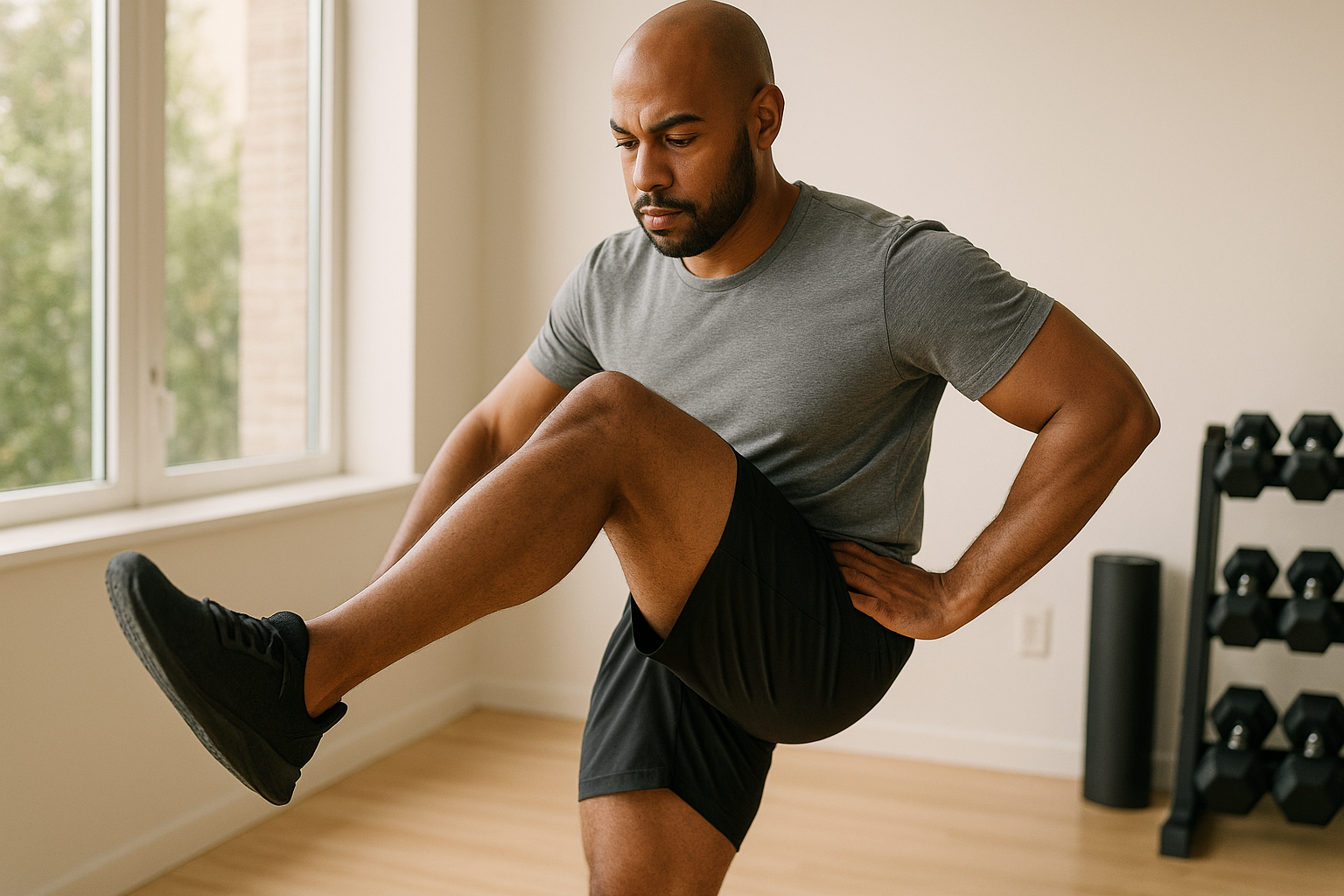
A well-built warm-up boosts temperature, blood flow, and nerve drive, then rehearses the ranges you’ll use. Evidence suggests dynamic stretching (leg swings, arm circles, controlled lunges) either preserves or improves performance, while longer pre-lift static holds can blunt peak power—save longer static or PNF stretches for separate sessions or cool-downs. A practical template: 3–5 minutes easy cardio → 5 minutes of large-amplitude dynamic ranges → 2–3 movement-specific drills. Keep the total at 8–12 minutes tops.
4.1 Quick dynamic sequence (sample)
- Marching to skips (60–90 seconds)
- World’s greatest lunge with thoracic reach (4–6/side)
- Squat-to-stand with ankle rocks (6–8)
- Arm circles + scapular CARs (6–8 each way)
4.2 Numbers & guardrails
- Do not bounce into painful end ranges.
- If you need static holds for a tight area pre-session, keep them brief (≤30 s) and follow with a dynamic move.
Bottom line: go dynamic to prep performance; relegate longer static work to cool-downs or off-days for ROM gains.
5. Build Usable Range With End-Range Strength (CARs, Isometrics, Eccentrics)
Once you can reach a range, own it with force. Controlled Articular Rotations (CARs) teach you to explore the biggest pain-free circle a joint can make using only your muscles; pairing CARs with isometrics at end range and slow eccentrics helps “map” new motion in your nervous system and improve joint stability. Think of this as strength training for your outer ranges—especially valuable for hips, shoulders, and ankles. Progress by increasing tension, time under tension (10–20 seconds), and precision rather than chasing bigger circles too soon. Evidence for CARs specifically is emerging; conceptually they integrate well with established mobility and motor-control principles. physioinq.com.au
5.1 How to program
- Daily micro-set: 1–2 slow CARs per major joint, no compensation.
- End-range isometrics: 2–3 sets × 10–20 s in the most challenging but pain-free angle.
- Eccentrics: 3–5 reps of slow lowers (e.g., calf-lower off a step, 4–5 s down).
5.2 Common mistakes
- Letting ribs, pelvis, or scapulae “cheat” instead of isolating the joint.
- Rushing through reps—speed hides control deficits.
- Forcing through pinching or nerve-like symptoms.
Bottom line: don’t just “get” range—strengthen it so your body keeps and uses it in real life.
6. Use Soft-Tissue Tools Strategically (Foam Rolling, Vibration, Massage)
Foam rolling can create small to moderate improvements in range of motion without hurting subsequent performance for most people, especially when used consistently for 4+ weeks. Vibration foam rolling may further reduce delayed-onset soreness and perceived fatigue while supporting ROM changes in the short term. Treat it like seasoning, not the main dish: 30–90 seconds on a hot spot followed by an active movement is often enough. If a tool leaves you bruised or numb, you’re overdoing it.
6.1 Practical sequence
- Roll calves → perform ankle rocks or heel-elevated squats
- Roll quads/hip flexors → do split-squat isometrics
- Roll lats/pecs → do controlled overhead reaches
6.2 Numbers & guardrails (as of Aug 2025)
- 30–90 s per region; total 5–8 minutes pre-session.
- Train the new range immediately after rolling.
- Evidence varies; long-term change still depends on loading and motor control. ScienceDirect
Bottom line: soft-tissue work opens the door; only movement and load walk you through it.
7. Train Proprioception and Balance to Protect Joints
Proprioception—your body’s sense of position and movement—acts like joint GPS. Targeted balance and sensorimotor training reduces recurrent ankle sprain risk and can improve control at the knee, hip, and shoulder. Adding single-leg stance, perturbations, and eyes-closed drills builds reflexive stability that carries over to cutting, landing, and everyday missteps. For older adults, integrating balance work also supports fall prevention. Keep doses small and frequent, and progress surfaces or speed only when control is rock-solid.
7.1 Progression ladder
- Level 1: single-leg stance 3×20–30 s (eyes open)
- Level 2: add reach patterns or head turns
- Level 3: unstable surface or light perturbations
- Level 4: add mini-hops, deceleration, and change-of-direction cues
7.2 Programming note
- 10–15 minutes, 2–3 days/week, added to warm-ups or finishers—especially after ankle/knee issues.
- Regress if you’re wobbling so much you must toe-tap constantly. PubMed
Bottom line: better joint position sense = better automatic control—and fewer oops moments.
8. Match Mobility to Ageing and Osteoarthritis—Keep Moving, Wisely
Mobility changes across the lifespan, but movement remains medicine. Guidelines for osteoarthritis (OA) emphasize therapeutic exercise—aerobic, strength, and mobility—in nearly every stage of management; modern recommendations are to keep people moving with education and load management rather than rest them indefinitely. NICE (UK) and the ACR/Arthritis Foundation both recommend exercise as a core treatment for hand, hip, and knee OA, tailored to symptoms and goals. If you have OA, think “calm it down, then build it up”: short pain-free ranges, progressive strength, and walk-based cardio. Add balance for fall risk reduction.
8.1 Guardrails
- Flare-ups happen; reduce volume/intensity but don’t stop entirely unless advised.
- Swelling/heat or sudden loss of motion warrants clinical review.
- Choose lower-impact options (cycling, pool work) on achy days.
8.2 Programming (as of 2025)
- WHO: accumulate 150–300 min/week moderate aerobic activity; include strength 2+ days/week; reduce sedentary time.
- Layer in gentle joint ranges daily (1–2 micro-sessions). NCBI
Bottom line: OA is compatible with movement; the right mix of range, strength, and aerobic work often eases pain and boosts function. NICE
9. Make Mobility a Habit: A Simple Week That Actually Fits
The best plan is the one you’ll do. Anchor mobility to routines you already have: a 10-minute dynamic warm-up before training, a 5-minute mobility snack on desk breaks, and end-range strength inside your lifts (e.g., deep split squats, overhead carries). Use quick screens weekly to retest and redirect. You’re aiming for consistency, not marathon sessions. Over time, the combo of daily micromovements plus 2–3 structured sessions per week yields more durable change than sporadic heroic stretching. Keep notes on what makes you feel and perform better—and do more of that.
9.1 Sample week (plug-and-play)
- Mon (40–50 min): Warm-up → lower-body strength → ankle/hip end-range isometrics → 5 min cooldown.
- Tue (15 min): Walk + global CARs (2 per major joint).
- Wed (40–50 min): Warm-up → upper-body strength → thoracic/shoulder CARs + carries.
- Thu (15 min): Balance/proprioception circuit + easy cycle.
- Fri (40–50 min): Full-body strength → deep squats/split-squat eccentrics.
- Sat/Sun (20–40 min): Hike, swim, or bike + light mobility snack.
9.2 Mini-checklist
- Move each major joint daily through pain-free ranges.
- Warm up dynamically; save long static holds for later.
- Strengthen end range; test weekly; adjust based on how you feel.
Bottom line: small, repeatable actions—stacked onto what you already do—turn mobility into a lifelong asset.
FAQs
1) What’s the fastest way to improve joint mobility?
Combine short daily mobility snacks (30–90 seconds per joint) with end-range strength during regular training. Foam rolling can help you access range acutely, but the lasting gains come from loading and control in those new angles. Keep intensity sub-pain and progress weekly by reps, time under tension, or precision.
2) Should I stretch before or after workouts?
Before workouts, prioritize dynamic moves that mirror the session (e.g., lunges, arm circles, skips). Longer static holds are best in a separate session or cool-down to chase ROM. This order helps preserve or boost performance while still improving flexibility over time.
3) How often should I train mobility?
Little and often wins. Move each joint daily through pain-free ranges, with 2–3 focused sessions per week layered into your strength or cardio days. This aligns with general flexibility guidance (accumulate ~60 seconds per muscle/joint) and broader physical activity recommendations.
4) Does foam rolling actually work?
It can produce small to moderate, short-term ROM improvements and may reduce soreness/fatigue—especially when you immediately follow with active drills to “lock in” the new range. Long-term change still depends on strength and motor control.
5) What if a joint feels pinchy at end range?
Back off the angle and explore nearby, pain-free ranges. Swap passive stretching for isometrics in the safest angle, then re-test. Persistent sharp pain, locking/catching, or swelling warrants a clinician’s assessment.
6) Are CARs evidence-based?
CARs are a method to train active control and awareness at end range. While research on CARs specifically is limited, they’re consistent with established motor-control and mobility principles, and many coaches and clinicians use them as a structured way to train joints through full, controlled circles. ACE Fitness
7) Can mobility training help osteoarthritis?
Yes—guidelines from NICE and the ACR/Arthritis Foundation list exercise (including mobility and strength) as core management for OA. Programs should be individualized, start with pain-free ranges, and build gradually. Aerobic activity and strength work are also recommended.
8) What role does balance play in joint health?
Balance and proprioceptive training meaningfully reduce recurrent ankle sprains and improve joint control, which protects knees, hips, and shoulders during daily tasks and sport. Add single-leg work, perturbations, and landing mechanics.
9) Is stretching enough to fix poor mobility?
Stretching alone can increase passive range, but it won’t guarantee usable range. Pair any new motion with end-range isometrics or eccentrics and movement practice in that angle to make gains “stick” for lifting, running, and life. PMC
10) How do long desk days affect mobility?
Long, continuous sitting reduces movement-driven synovial fluid exchange and can make tissues feel stiff. Insert movement snacks (1–3 minutes) every 30–60 minutes—neck/shoulder CARs, ankle rocks, brisk walks—to keep things moving. ScienceDirect
Conclusion
Mobility isn’t about circus-level flexibility—it’s about usable joint range you can call on for everyday life and the activities you love. When you understand how synovial joints thrive on movement, why dynamic prep beats pre-session static holds, and how to strengthen end range, you can build joints that feel better and perform better. The nine pillars above give you a practical framework: define the target, respect the physiology, assess actively, warm up dynamically, strengthen at the edges, use tools wisely, train balance, adapt for age and OA, and, most importantly, make it a habit. Start with five minutes today, stack it with your workouts, and let consistency do the heavy lifting.
CTA: Try the sample week for the next 14 days—track one test (like knee-to-wall), and watch your usable range grow.
References
- Anatomy, Joints — StatPearls, NCBI Bookshelf, 2023, NCBI
- A review of the acute effects of static and dynamic stretching on performance — Behm & Chaouachi, Eur J Appl Physiol, 2011, PubMed
- Effects of Dynamic and Static Stretching Within General Warm-Up Routines — Samson et al., J Strength Cond Res, 2012 (PMC), PMC
- American College of Sports Medicine Position Stand: Quantity and Quality of Exercise — Garber et al., Med Sci Sports Exerc, 2011, PubMed
- WHO Guidelines on Physical Activity and Sedentary Behaviour — World Health Organization, 2020, World Health Organization
- Osteoarthritis in over 16s: diagnosis and management (NG226) — NICE, 2022, NICE
- 2019 ACR/Arthritis Foundation Guideline for the Management of Osteoarthritis of the Hand, Hip, and Knee — Arthritis Care & Research, 2020 (PDF), https://assets.contentstack.io/v3/assets/bltee37abb6b278ab2/blt6aa092f0134cac9a/osteoarthritis-guideline-2019.pdf Contentstack
- Foam-Rolling Training Effects on Range of Motion — Konrad et al., Int J Environ Res Public Health, 2022 (PMC), PMC
- Effects of Vibration Foam Rolling on Pain, Fatigue, and ROM — Park et al., 2025 (PMC), PMC
- Nutrition and Degeneration of Articular Cartilage — Wang et al., 2012 (PMC), PMC
- Influence of Cyclic Loading on the Nutrition of Articular Cartilage — O’Hara et al., Ann Rheum Dis, 1990, PubMed
- Proprioceptive Training for the Prevention of Ankle Sprains — Rivera et al., J Athl Train, 2017 (PMC), PMC
- Validity, Reliability, and Efficiency of ROM Measurement Devices — Hanks & Myers, Int J Sports Phys Ther, 2023, ijspt.scholasticahq.com
- Flexibility vs. Mobility: What’s the Difference? — Medical News Today, 2025, Medical News Today