




























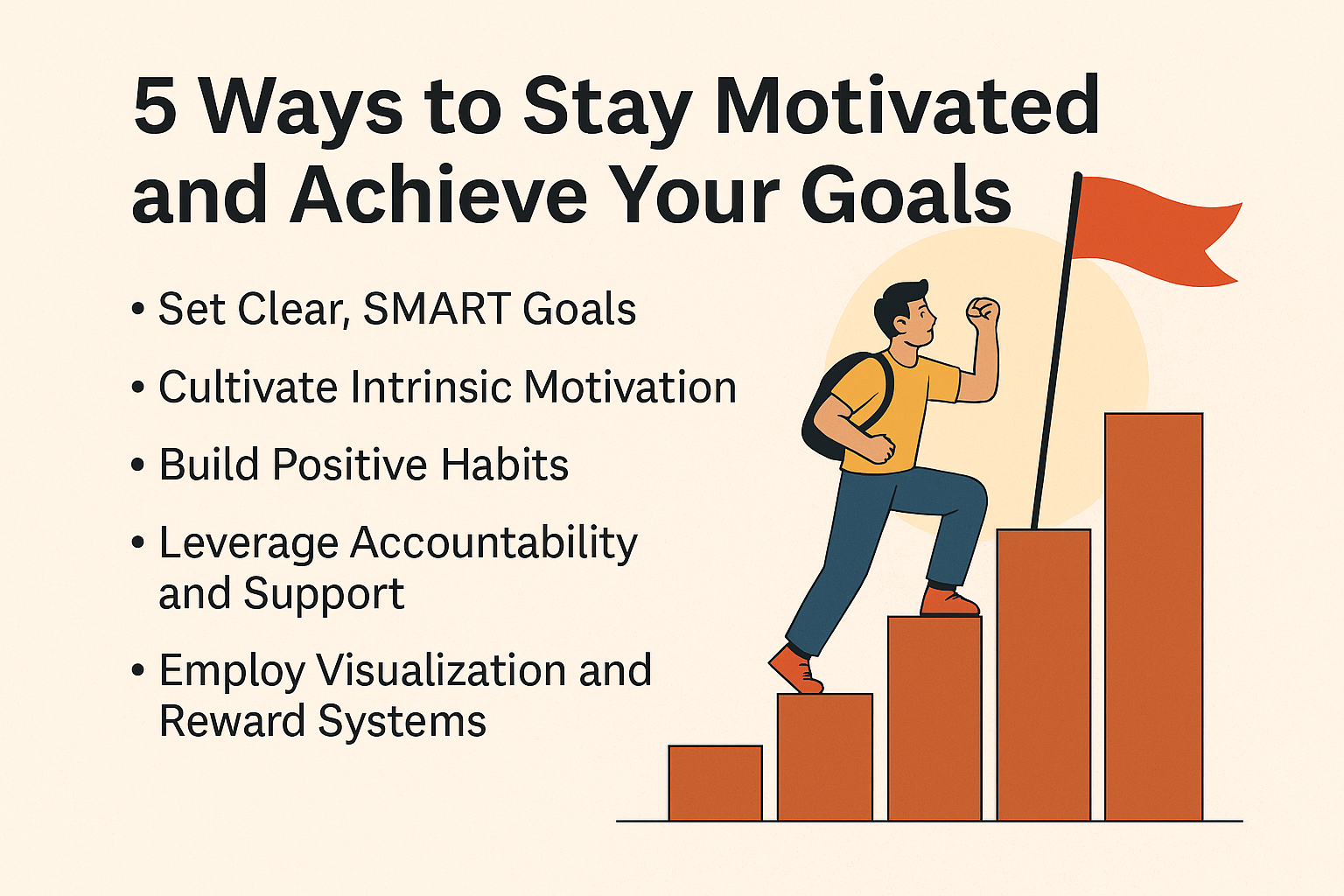
5 Research-Based Strategies to Maintain Motivation
One of the hardest things about reaching personal or professional goals is keeping your motivation up over time. Whether you’re starting a new business, training for a marathon, or working on a passion project, motivation often fades right when you need it the most. This full guide will show you five research-based ways to stay motivated and make sure you not only set meaningful goals but also follow through on them.
1. Set Clear and SMART Goals
Setting clear goals is the first step to getting yourself motivated. It’s easy to put things off or give up when your goals are too vague, like “I want to get fit.” Instead, use the SMART framework:
- Specific: Make it clear what you want to do.
- Measurable: Add metrics or milestones to make it possible to measure.
- Also, it means “achievable.” Check to see if you have the resources to make it happen.
- Relevant: Make sure it fits with your bigger goals and values.
- Time-bound: Make it clear when you want to finish it.
Instead of saying, “I’ll read more,” say, “Every month, I will read one leadership book and write a 300-word summary of it.”
Why SMART works:
- When things are clear, they are less overwhelming. Breaking your goals down into smaller steps can help you avoid decision fatigue.
- Keeping track of your progress will keep you going. Every time you reach a goal, your brain releases dopamine, which makes the habit loop stronger.
- Deadlines make things seem more important. A deadline makes people stop putting things off.
2. Encourage Internal Drive
People will work harder if they get bonuses and praise from outside sources, but these things lose their power over time. People stay interested over time because they are intrinsically motivated, or because they enjoy what they are doing. Research has found three main things:
- Being autonomous means being in charge of what you do.
- Mastery: feeling like you’re getting better all the time.
- Purpose: Connecting tasks to a bigger goal.
What to do:
- Choose projects that are important to you. Make sure that your goal is in line with your values. “I care about sustainability, so I’ll run a marathon with no waste.”
- Keep a record of your small successes. Every little thing you do is a step forward, like “I finished week one of training.”
- See problems as chances to learn and grow. Don’t think of setbacks as failures; think of them as chances to learn.
She joined an open-source project that fit with her love of teaching. She worked for two years straight because she chose a job that matched her values. This job lasted a lot longer than the others that paid more but felt pointless.
3. Use “If-Then” Plans to Help You Get into Good Habits
Even people who are very motivated can make mistakes if they don’t have good habits. The “if-then” plan, also called the implementation intention, is a well-known way to control yourself. It was made popular by psychologist Peter Gollwitzer. This is what it looks like:
“If [situation], then I will [behavior].”
How it works: By planning how you will react to certain triggers ahead of time, you can make the behaviors you want to do automatic and lower your need for willpower. Studies show that making plans to follow through on your goals, whether they are about getting healthier or making friends, makes it much more likely that you will reach them.
How to do it yourself:
- Find the most important things that set you off. “On weekdays at 7 AM…”
- What is the move? (“…then I’ll do my 20-minute cardio workout.”)
- Make it happen. Write it down and imagine what it would be like.
Quick Habit Maker:
I get a trigger after I brush my teeth…
What to do: …I will take five minutes to plan the three most important things I need to do tomorrow.
4. Get Help and Be Responsible
Your engagement goes through the roof when you have to answer to other people. Having social ties and accountability partners can help you keep your promises by giving you support and a little bit of pressure.
a. Find someone who will hold you responsible
- Find a partner who is working toward the same goal as you. Talk about successes and problems once a week.
- A professional coach or mentor knows what they’re talking about, is fair, and gives you feedback that is specific to you.
Every week, a group of writers would get together for a “accountabilibuddy” call. Each member sets a goal for how many words they want to write, tells the group how they’re doing, and gives suggestions. In six months, their combined output tripled.
b. Join organized groups of people
- Mastermind groups are small groups of people who meet on a regular basis to set goals, share ideas, and keep each other on track.
- Online forums and challenges: Websites like Reddit’s r/GetMotivated and goal-driven challenges like the “30 Day Fitness Challenge” make it easy to get help online.
c. Use tools that are based on technology
- Habit-tracking apps like Streaks, Habitica, and Beeminder show you how far you’ve come and send you reminders.
- People who are working together can stay on the same page with Google Calendar invites and shared spreadsheets.
5. Use Systems of Reward and Seeing Things
Getting Your Brain Ready to Succeed Through Visualization
When you think about doing something, the same neural pathways are activated as when you actually do it. When you picture yourself reaching your goal in great detail, including the sights, sounds, and feelings, you boost your confidence and lower your anxiety about what might happen.
- Vision boards are groups of pictures and quotes that show what you want to do. Put them in a place where you can see them every day.
- Mental rehearsal: Every morning for five minutes, think about the steps you’ll take and how good it will feel to reach your goal.
Reward Systems: Keep Moving Forward
People want to do more good things when they get real rewards, but they have to be set up just right:
- Immediate rewards: After you reach a small goal, like studying for a test, you can get a small reward, like a favorite snack.
- Variable rewards: Give yourself a bonus reward every now and then to take advantage of the “variable ratio” effect; scientists say this pattern keeps people very interested.
- Don’t reward yourself in ways that go against your goal, like eating cake after working out to lose weight. Choose rewards that help you reach your bigger goals.
The End
Motivation isn’t always there; it comes and goes. You can stay motivated by using SMART goal-setting, intrinsic motivation, implementation intentions, accountability frameworks, visualization, and rewards all at once. It’s normal to have setbacks along the way, so use them to make your plan better. These five tips will help you keep going and reach your goals for good.
Frequently Asked Questions (FAQs)
1. How long does it take to get used to something new? People think that a habit will become automatic after “21 days,” but studies show that it can take anywhere from 18 to 254 days, with an average of 66 days. Being consistent is more important than being quick.
2. Can you use all five strategies at the same time? Yes, using more than one strategy at the same time often works better than using just one. Learn one or two methods really well, like SMART goals and implementation intentions. Then, add in ways to keep yourself accountable and reward yourself.
3. What if I get bored halfway through? Think about your “why” again. If you need to, change your goals to fit your main goal. Micro-rewards and check-ins to hold people accountable can help things get back on track.
4. Are some strategies better for reaching certain goals?
- Learning to play an instrument is an example of skill mastery that focuses on intrinsic motivation and visualization.
- You can reach your health goals, like working out, by making plans (“if—then”) and asking friends and family for help.
- You need SMART planning, accountability partners, and rewards that change for hard projects like starting a business.
5. How can I best keep track of how I’m doing? You can use both quantitative measures (like how many pages you wrote or how many miles you ran) and qualitative reflections (like journal entries about your mood and confidence). Every week, look at your goals and change them as you find out what works best.
References
- “SMART criteria,” Wikipedia, updated July 20, 2025. https://en.wikipedia.org/wiki/SMART_criteria
- Doran, G. T. (1981). “There’s a S.M.A.R.T. way to write management’s goals and objectives,” Management Review, 70(11), 35–36.
- “Goal setting,” Wikipedia, updated July 22, 2025. https://en.wikipedia.org/wiki/Goal_setting
- Falk, S. (2023, March 8). “Understanding the Power of Intrinsic Motivation,” Harvard Business Review. https://hbr.org/2023/03/understand-the-power-of-intrinsic-motivation
- “5 Surprising Ways to Increase Motivation,” Verywell Mind, April 2024. https://www.verywellmind.com/surprising-ways-to-get-motivated-2795388
- Gollwitzer, P. M. (1999). “Implementation intentions: Strong effects of simple plans,” American Psychologist, 54(7), 493–503.
- “How to get started and staying motivated,” Healthdirect Australia, accessed July 2025. https://www.healthdirect.gov.au/motivation-how-to-get-started-and-staying-motivated
- “How to Manifest What You Really Want in Your Life,” Verywell Mind, March 2023. https://www.verywellmind.com/how-to-manifest-techniques-what-to-say-7487045
- “5 brain hacks to fight with procrastination (and increase productivity),” The Times of India, July 23, 2025. https://timesofindia.indiatimes.com/life-style/relationships/work/5-brain-hacks-to-fight-with-procrastination-and-increase-productivity/photostory/122812590.cms
- Lally, P., Van Jaarsveld, C. H. M., Potts, H. W. W., & Wardle, J. (2010). “How are habits formed: Modelling habit formation in the real world,” European Journal of Social Psychology, 40(6), 998–1009.