


























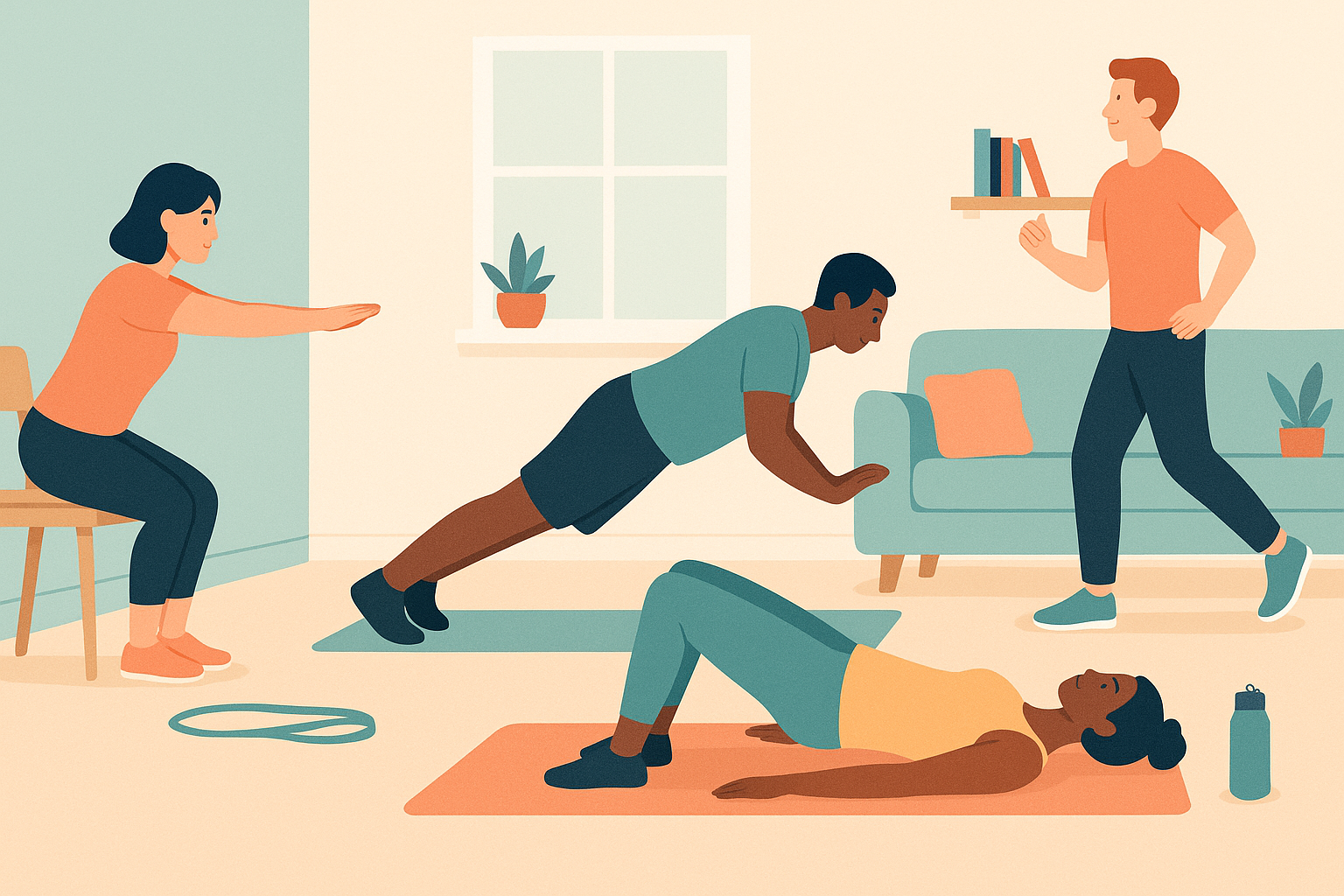
Starting a fitness routine at home doesn’t have to be complicated or expensive. With a few square feet, a little structure, and workouts designed for first-timers, you can build strength, improve mobility, and boost your cardio fitness—without a gym membership. In this guide, you’ll learn five beginner-friendly home workouts, exactly how to do them, how to modify each move, and how to progress week by week. You’ll also get a warm-up checklist, troubleshooting tips, ways to measure progress, and a simple 4-week plan to make it all stick. If you’re new to exercise or getting back into it, these workouts will help you start confidently and safely.
Disclaimer: This article provides general fitness information and is not a substitute for professional medical advice. If you have a health condition, are pregnant, or have concerns about exercise, consult a qualified health professional before starting.
Key takeaways
- Five zero- or low-equipment workouts cover strength, cardio, core, mobility, and flexibility so you build a balanced base.
- Clear step-by-step instructions plus beginner modifications and progressions help you start easy and advance safely.
- Simple metrics—time, reps, sets, and effort (RPE/talk test)—make it easy to track your improvements.
- A fast warm-up and troubleshooting guide keep you moving while avoiding common beginner mistakes.
- A 4-week starter plan shows exactly how to fit these workouts into busy days without burnout.
Before you start: a quick warm-up (5–8 minutes)
A short warm-up raises body temperature, wakes up your nervous system, and makes joints move more freely. Try this sequence before any workout:
- March in place – 60 seconds (swing arms naturally).
- Arm circles – 30 seconds each direction.
- Hip hinges – 10 slow reps (hands on hips; feel hamstrings load).
- Standing knee hug → heel-to-glute – 5 each side.
- World’s greatest stretch (lunge + rotation) – 3 each side.
- Fast step-touches or light shadowboxing – 60 seconds to finish.
Tip: Keep the warm-up light; you should feel warm but able to talk in full sentences.
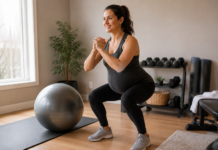
1) Bodyweight Strength Circuit
What it is & why it works
A full-body circuit of foundational movements—squat, push, hinge, pull (with a household substitute), and brace—builds basic strength and joint control. It also elevates heart rate enough to improve general fitness while keeping impact low. This is the fastest way to establish a “movement toolkit” you’ll reuse in every other workout.
Core benefits:
- Builds strength and endurance in major muscle groups.
- Teaches safe form for everyday movements (sitting, lifting, carrying).
- Minimal equipment; easy to scale up or down.
Requirements & low-cost alternatives
- Space: 2×2 meters (about a yoga mat).
- Equipment: Optional backpack with books (for goblet squats), sturdy table edge or doorframe (for incline push-ups/rows), towel for floor comfort.
- Footwear: Supportive sneakers or barefoot on a non-slip surface.
The beginner circuit (20–25 minutes)
Perform 2–3 rounds. Rest 60–90 seconds between rounds.
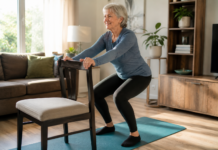
- Sit-to-stand squat – 8–12 reps (from a chair; control down).
- Incline push-up – 6–10 reps (hands on counter/table; straight line head-to-heels).
- Hip hinge to glute bridge – 10–12 reps (pause 1s at top).
- Doorframe row – 8–12 reps (hold doorframe with both hands, lean back slightly, pull chest toward hands).
- Plank (hands or elbows) – 15–30 seconds (brace ribs down, glutes on).
Repeat. Move slowly, breathe steadily.
Modifications & progressions
- Make it easier: Decrease reps; use higher surface for push-ups; shorten plank to 10–15 seconds.
- Make it harder: Add a loaded backpack to squats/hinges, lower push-up surface, extend plank to 30–45 seconds, add a second or third round.
- Next steps: Swap sit-to-stand for goblet squat, glute bridge for Romanian deadlift pattern with backpack, doorframe row for towel row (loop towel around a sturdy post).
Frequency, duration & metrics
- 2–3 sessions/week, non-consecutive days.
- Time: 20–30 minutes.
- Metrics: Total rounds completed; best-form reps per exercise; perceived effort (RPE 5–7 by the last reps—challenging but doable).
Safety & common mistakes
- Knees collapsing inward during squats (push knees slightly out).
- Sagging hips in planks (brace through glutes/abs).
- Rushing reps; prioritize control over speed.
Mini-plan (example)
- Week 1: 2 rounds, 8 reps each, 20s plank.
- Week 2: 2 rounds, 10–12 reps, 30s plank.
- Week 3+: 3 rounds or add load with a backpack.
2) Low-Impact Cardio Intervals
What it is & why it works
Alternating easy and moderate efforts improves cardiovascular fitness without pounding your joints. Think marching, step-touch, basic boxing footwork, or indoor walking. It’s perfect for beginners who want to boost energy and endurance quickly.
Core benefits:
- Improves heart-lung capacity and stamina.
- Burns calories with minimal equipment.
- Scales seamlessly using the talk test or RPE.
Requirements & low-cost alternatives
- Space: Clear hallway or room.
- Equipment: None (optional: step, mini trampoline, or a hallway for “laps”).
- Timer: Phone or kitchen timer.
The beginner interval session (15–25 minutes)
- Warm-up marching – 3 minutes easy.
- 10 rounds of: 30 seconds brisk (step-touch + arm swings or fast march) → 30 seconds easy (slow march).
- Cooldown walk – 2–3 minutes.
Use the talk test: brisk intervals = you can talk but not sing; recovery = full conversation.
Modifications & progressions
- Make it easier: Shorten to 6–8 rounds or lengthen the easy interval to 45–60 seconds.
- Make it harder: Increase brisk intervals to 40–60 seconds; add gentle knee lifts or light shadowboxing; extend to 15 rounds.
- Next steps: Graduate to outdoor walks with hills or “power minutes,” or add a stationary bike.
Frequency, duration & metrics
- 3 sessions/week on non-strength days.
- Time: 15–30 minutes.
- Metrics: Total minutes/week; average brisk interval pace (steps/minute if you track); RPE 4–6 on brisk intervals.
Safety & common mistakes
- Skipping the warm-up.
- Holding your breath (exhale on effort).
- Jumping to high-impact too soon. Keep landings soft; choose low-impact options until tendons adapt.
Mini-plan (example)
- Week 1: 8×(30s brisk/30s easy).
- Week 2: 10×(30/30).
- Week 3: 12×(40/20).
- Week 4: 12×(45/15) or add a gentle hill walk outdoors.
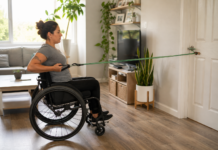
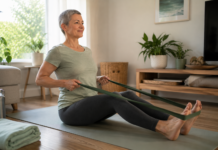
3) Resistance Band Basics (Full-Body)
What it is & why it works
Elastic bands provide smooth, joint-friendly resistance that challenges muscles through a full range of motion. They’re portable, inexpensive, and ideal for learning technique before moving to heavier loads.
Core benefits:
- Builds beginner strength and muscular endurance.
- Trains pulling patterns (rows, face pulls) that many home setups lack.
- Adds progressive resistance by swapping band thickness or stepping farther from the anchor.
Requirements & low-cost alternatives
- Equipment: One long loop band (light-to-medium) and one mini loop.
- Anchor: A sturdy door anchor or heavy post.
- Alternatives: Towel rows, backpack “deadlift,” water jugs for curls/presses if bands aren’t available.
The beginner band session (20–25 minutes)
Perform 2–3 rounds, 45–60 seconds rest between exercises.
- Band row (anchored at chest height) – 10–12 reps (elbows sweep back, squeeze shoulder blades).
- Band chest press (door anchor at chest height) – 8–12 reps (split stance, ribs down).
- Band Romanian deadlift – 10–12 reps (band under feet, hinge from hips).
- Mini-band lateral walk – 8–10 steps each direction (knees soft, toes forward).
- Band overhead press or face pull – 8–12 reps (choose one based on shoulder comfort).
- Dead bug or banded pallof press (anti-rotation) – 8–10 reps/side.
Modifications & progressions
- Make it easier: Use a lighter band; shorten range of motion; reduce reps to 8.
- Make it harder: Slower eccentrics (3 seconds lowering), pause 1–2 seconds at the hardest point, or use a thicker band.
- Next steps: Superset push/pull (press → row); add a fourth round; later, introduce dumbbells while keeping bands for accessory work.
Frequency, duration & metrics
- 2 sessions/week, 48 hours apart if you’re also doing the bodyweight circuit.
- Time: 20–30 minutes.
- Metrics: Band color/tension used; controlled reps; RPE 6–7 by the final reps.
Safety & common mistakes
- Bands snapping due to wear—inspect for cracks.
- Letting shoulders shrug toward ears (pack shoulders “down and back”).
- Standing too far from the anchor and losing control at end range.
Mini-plan (example)
- Week 1: 2 rounds, 10 reps each exercise, light band.
- Week 2: 3 rounds, 10–12 reps, add tempo (3s lower).
- Week 3+: Heavier band or an extra set.
4) Core Stability & Posture Routine
What it is & why it works
Your “core” is more than visible abs—it’s the system that stabilizes your spine so your hips and shoulders can move powerfully and safely. This routine targets anti-extension (planks), anti-rotation (pallof press), and cross-body coordination (bird dog, dead bug).
Core benefits:
- Improves posture and reduces “desk stiffness.”
- Supports safer lifting and better balance.
- Teaches bracing and breathing for all training.
Requirements & low-cost alternatives
- Equipment: Mat, optional light band for pallof press.
- Space: Just enough room to lie down.
The beginner core session (12–18 minutes)
Perform 2–3 rounds with 30–45 seconds rest between exercises.
- Dead bug – 6–8 reps per side (exhale to brace, lower opposite arm/leg).
- Bird dog – 6–8 reps per side (reach long; keep hips level).
- Side plank (knees or feet) – 15–25 seconds per side (imagine lifting bottom waist).
- Pallof press (band) – 8–10 reps per side (press straight out; don’t twist).
- Hip flexor stretch + thoracic rotation – 5 slow reps per side to restore mobility.
Modifications & progressions
- Make it easier: Shorter holds (10–15 seconds), fewer reps, elevate side planks on a bench.
- Make it harder: Longer holds (30–45 seconds), add a slow 3-second eccentric on dead bug, or a reaching variation on bird dog.
- Next steps: Add hollow body hold, stir-the-pot (on a counter or ball), or carry variations with a backpack/water jug.
Frequency, duration & metrics
- 2–4 sessions/week (short sessions fit as “movement snacks”).
- Time: 12–20 minutes.
- Metrics: Hold times; controlled reps without spinal movement; RPE 4–6.
Safety & common mistakes
- Holding your breath throughout sets—practice a gentle exhale as you brace.
- Arching the low back during dead bug/planks—tuck ribs slightly.
- Rushing rotations—slow wins.
Mini-plan (example)
- Week 1: 2 rounds, short holds (15–20s).
- Week 2: 3 rounds, longer holds (25–30s).
- Week 3+: Add an advanced variation to one exercise.
5) Beginner Yoga & Mobility Flow
What it is & why it works
A gentle flow of joint-friendly movements and static holds to improve flexibility, body awareness, and relaxation. This complements strength and cardio by restoring range of motion and reducing stiffness.
Core benefits:
- Improves flexibility and balance; supports recovery.
- Encourages diaphragmatic breathing and stress reduction.
- Easy to scale to your energy level.
Requirements & low-cost alternatives
- Equipment: Yoga mat or carpet; optional pillow/block/towel.
- Alternatives: If getting on/off the floor is tough, do seated versions (chair yoga).
The beginner flow (15–25 minutes)
Move slowly and breathe through the nose. Hold each pose 20–40 seconds unless noted.
- Cat-Cow – 6–8 slow cycles (mobilize spine).
- Child’s Pose – 30–45 seconds (hips back, arms forward).
- Half-Kneeling Hip Flexor Stretch with Reach – 20–30s/side.
- Downward Dog → Step to Low Lunge → Thoracic Rotation – 2 reps/side.
- Seated Hamstring Fold (long spine) – 20–30s.
- Figure-4 Glute Stretch (on back) – 20–30s/side.
- Supine Twist – 20–30s/side.
- Box Breathing – 3–5 rounds (inhale 4, hold 4, exhale 4, hold 4).
Modifications & progressions
- Make it easier: Use props to reduce range; shorten holds to 10–20 seconds.
- Make it harder: Flow between poses with control; add Warrior 1/2 for gentle strength.
- Next steps: Try a 20–30 minute beginner class video 1–2×/week.
Frequency, duration & metrics
- 2–4 sessions/week (great on rest days).
- Time: 15–30 minutes.
- Metrics: Range of motion (how easily you can assume positions), perceived tension reduction, better posture.
Safety & common mistakes
- Forcing deep stretches; aim for mild tension, not pain.
- Holding breath; maintain smooth, comfortable breathing.
- Pushing through joint discomfort—back out and adjust angles or use props.
Mini-plan (example)
- Week 1: 15 minutes, short holds.
- Week 2: 20 minutes, add Warrior 1/2.
- Week 3+: 25+ minutes or add a beginner class.
Troubleshooting & common pitfalls
“I’m sore after the first sessions.”
Mild to moderate muscle soreness 24–72 hours after a novel workout is common. Keep moving gently, hydrate, and sleep well. Reduce intensity/volume next time and build back gradually.
“I’m not sure how hard to go.”
Use the talk test for cardio (able to talk but not sing = moderate). For strength work, by the last 2 reps you should feel like 2–4 reps left in the tank.
“My knees feel creaky in squats.”
Use a chair to guide depth. Push knees slightly out, distribute weight mid-foot to heel, and shorten range as needed.
“I don’t have time.”
Pair workouts with daily anchors (after morning coffee, after work) and aim for 10–20 minute sessions. Consistency beats marathon workouts.
“I get bored.”
Rotate the five workouts. Keep the structure but change the playlist, room, or the sequence. Track small wins (more reps, longer plank, less huffing on intervals).
“I think I overdid it.”
Signs include sharp pain, dizziness, or lingering fatigue. Back off for 48–72 hours, prioritize sleep, and resume at a lower volume. Seek medical advice for severe or unusual symptoms.
How to measure progress (simple, objective, motivating)
- Reps and sets: Note reps completed with good form and how many rounds you did.
- Hold times: Track plank and side plank durations.
- Cardio minutes: Tally weekly minutes and longest continuous brisk block.
- RPE/talk test: Record perceived effort (0–10). Aim for the same work at a lower effort over time.
- Consistency streaks: Count sessions/week. Hitting 3–4 short sessions beats sporadic long ones.
- Mobility notes: Jot down a pose or movement that felt easier (e.g., deeper hip hinge without back rounding).
A simple 4-week starter plan
Goal: Build a base of strength, cardio, and mobility with enough recovery to stay consistent.
Weekly structure (repeat and progress each week):
- Day 1: Bodyweight Strength Circuit (Workout #1) + 10 minutes of the Yoga & Mobility Flow (#5).
- Day 2: Low-Impact Cardio Intervals (#2) + Core Stability (#4).
- Day 3: Rest or 15–20 minutes gentle Yoga & Mobility (#5).
- Day 4: Resistance Band Basics (#3).
- Day 5: Low-Impact Cardio Intervals (#2).
- Day 6: Core Stability (#4) + optional 10-minute walk.
- Day 7: Full rest or light stretch.
Progression by week:
- Week 1: Start at the lowest recommended sets/reps/intervals. Keep RPE 4–6.
- Week 2: Add 1–2 reps per exercise, +1 round to strength circuits if you recovered well, or +2 intervals to cardio.
- Week 3: Increase time under tension (3-second lowers), add 5–10 seconds to planks, or use a slightly thicker band.
- Week 4: Choose one “plus” goal: a third round on strength day, a 25–30 minute cardio session, or a 25-minute yoga flow. Keep at least one full rest day.
What success looks like after 4 weeks:
- You complete more reps at the same effort, or the same reps at lower effort.
- You move through daily tasks with less stiffness and more confidence.
- You’ve built a routine you can maintain—and scale.
FAQs
1) How many days per week should beginners work out?
Aim for 3–5 short sessions weekly, mixing strength, cardio, and mobility. Two non-consecutive strength days plus two cardio days is a solid start.
2) How hard should my workouts feel?
Use RPE (0–10) or the talk test. Strength sets should feel like you could do 2–4 more reps; brisk cardio should allow talking but not singing.
3) I don’t own any equipment—can I still build strength?
Yes. Bodyweight moves (squats, push-ups against a counter, bridges, planks) are enough at first. Add bands or a loaded backpack when sets feel too easy.
4) How fast will I see results?
Most beginners notice better energy and coordination within 2–3 weeks, with measurable strength/endurance gains by weeks 4–6, assuming consistent practice.
5) Should I do cardio before or after strength?
For short home sessions, it often doesn’t matter. If a move is skillful (e.g., learning squats), do strength first when fresh, then finish with light cardio or mobility.
6) I’m sore. Should I rest or move?
Light movement usually helps. Try an easy yoga flow or a short walk. If soreness is severe, take an extra rest day and reduce volume in your next workout.
7) How do I know I’m using good form?
Film a quick set from the side, check for a neutral spine, knees tracking over toes in squats, and controlled tempo. Reduce range/load if form slips.
8) What if I have knee or back discomfort?
First, scale the range of motion and intensity. Prioritize hinging from hips (not rounding the back), use a chair for squats, and keep planks short. Persistent or sharp pain warrants professional advice.
9) Can yoga replace strength training and cardio?
Yoga brings flexibility, balance, and stress relief, and some styles raise the heart rate. For a complete program, include dedicated strength and brisk cardio as well.
10) How do I progress without fancy gear?
Increase reps, sets, time under tension, or decrease rest. For bands, step farther from the anchor or use a thicker band. For bodyweight, lower your push-up surface or add a backpack load.
11) Do I need to talk to a doctor before I start?
Healthy adults can usually begin light-to-moderate activity without a medical visit. If you’re pregnant, have a chronic condition, or any concerning symptoms, check with a professional first.
12) What counts as “moderate” cardio at home?
Brisk marching, step-touches with arm swings, shadowboxing footwork, or stair walking. If you can talk but not sing, you’re in the right zone.
Conclusion
You don’t need a gym, perfect gear, or hour-long blocks to get fitter. Start where you are, keep sessions short and structured, and nudge the difficulty up a little each week. Combine these five home workouts—strength, cardio, core, and mobility—and you’ll build a durable foundation for whatever you want to do next.
Copy-ready CTA: Pick one workout above and do it today—10 minutes is enough to start.
References
- World Health Organization 2020 Guidelines on Physical Activity and Sedentary Behaviour — World Health Organization — 2020 — https://pmc.ncbi.nlm.nih.gov/articles/PMC7719906/
- Adult Activity: Physical Activity Basics — Centers for Disease Control and Prevention — December 20, 2023 — https://www.cdc.gov/physical-activity-basics/guidelines/adults.html
- Measuring Physical Activity Intensity (Talk Test) — Centers for Disease Control and Prevention — December 6, 2023 — https://www.cdc.gov/physical-activity-basics/measuring/index.html
- Physical Activity Guidelines for Americans, 2nd Edition (PDF) — U.S. Department of Health and Human Services — 2018 — https://health.gov/sites/default/files/2019-09/Physical_Activity_Guidelines_2nd_edition.pdf
- Guidelines and Recommended Strategies | Physical Activity — Centers for Disease Control and Prevention — February 5, 2024 — https://www.cdc.gov/physical-activity/php/guidelines-recommendations/index.html
- Physical Activity Guidelines (Overview) — American College of Sports Medicine — (Accessed 2025) — https://acsm.org/education-resources/trending-topics-resources/physical-activity-guidelines/
- Progression Models in Resistance Training for Healthy Adults (ACSM Position Stand) — Medicine & Science in Sports & Exercise via PubMed — 2009 — https://pubmed.ncbi.nlm.nih.gov/19204579/