

















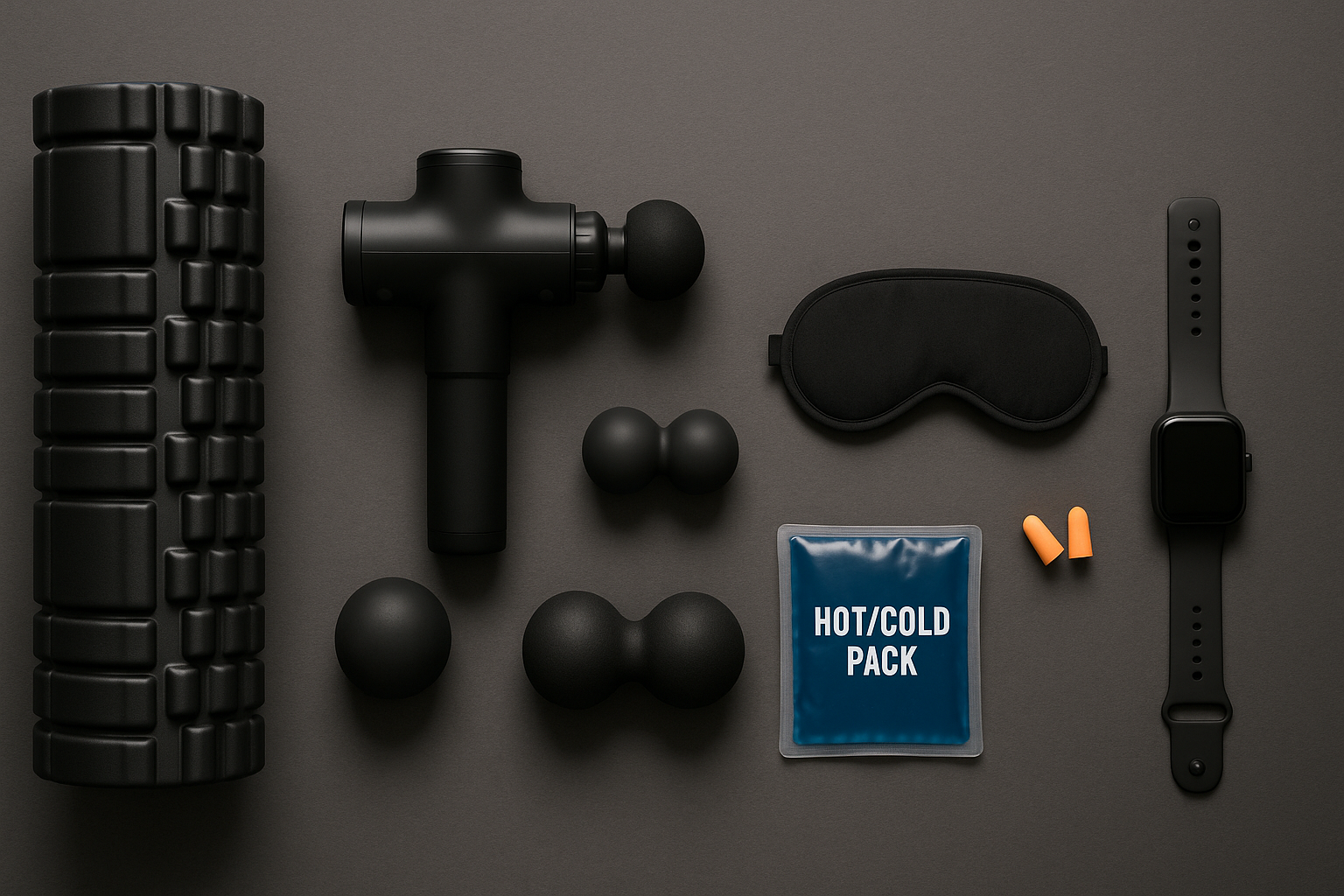
Recovery isn’t just what you do after a workout; it’s the quiet engine that powers your next one. The right recovery tools can help you move better, reduce lingering soreness, and string together consistent training weeks without feeling beat up. In this guide, you’ll learn which recovery tools actually earn their space in your gym bag, how to use them step-by-step, and how to build a simple four-week plan that translates into better performance. If you lift, run, ride, roll, swing, or just want to feel good between sessions, this one’s for you.
Medical note: The strategies below are general education, not medical advice. If you have an injury, chronic condition, or any health concerns (especially cardiovascular, neurological, or vascular issues), talk to a qualified professional before you change your routine.
Key takeaways
- Simple beats complicated. A few well-chosen tools, used consistently, outperform sporadic “fancy” treatments.
- Technique + timing matter. Most tools work best in short bouts (5–15 minutes) with light-to-moderate pressure or intensity.
- Warmup vs. cooldown is different. Use lighter, faster techniques before training; slower, longer techniques after.
- Track what you tweak. Use range of motion (ROM) checks, soreness ratings, sleep, and HRV trends to see if a tool helps.
- Don’t chase pain. Recovery tools should relieve tension, not create it. Back off if pressure causes guarding or numbness.
1) Foam Roller
What it is & why it helps
A foam roller is a cylindrical self-massage tool that applies broad pressure to muscles and surrounding tissues. In the short term, rolling can increase joint range of motion without hurting strength or power. Over several weeks, consistent rolling can produce small but real improvements in flexibility, especially for larger muscle groups like quads and hamstrings.
Core benefits
- Quick ROM boost without performance drop.
- Helps downshift nervous-system tension after hard sessions.
- Easy, low-cost, packable.
Requirements & low-cost alternatives
- Nice-to-have: Medium-density roller (30–60 cm), yoga mat.
- Budget: Any firm roller or even a rolled-up yoga mat.
- Upgrade options: Textured roller or vibrating roller (optional; not required).
Step-by-step (beginner-friendly)
- Pick the area. Common targets: calves, quads, hamstrings, glutes, upper back.
- Set the pressure. Support your weight with hands/feet so pressure feels 4–6/10 (mild–moderate).
- Slow rolls. 20–30 seconds per zone, breathing slow through the nose.
- Find a hot spot. Pause on tender areas for 10–20 seconds, but keep breathing and soften your muscles.
- Re-test ROM. Do a simple check (e.g., bodyweight squat depth or heel-to-butt quad stretch).
Warmup style: 1–2 passes each muscle (30–60 seconds), keep it light and brisk.
Cooldown style: 1–2 minutes per muscle, slower breathing, longer pauses.
Beginner modifications & progressions
- Make it easier: Use a softer roller; reduce body weight on the roller.
- Progress: Increase time on target areas (up to ~2 minutes each), switch to a firmer roller, add gentle contract–relax (press muscle into roller 3–5 seconds, relax, sink again).
Frequency, duration, metrics
- How often: 3–6 days/week around training.
- How long: 5–10 minutes total is plenty.
- What to track: Joint ROM tests (e.g., sit-and-reach, ankle lunge test), soreness (0–10), and next-day stiffness.
Safety, caveats & common mistakes
- Avoid rolling directly over bony points or the front of the neck.
- Tingling or numbness is a stop sign (nerve irritation).
- Don’t chase bruising; lighter pressure often works better.
Mini-plan (example)
- Before squats: 30 sec calves → 60 sec quads → 30 sec glutes, then dynamic leg swings.
- After squats: 90 sec quads → 60 sec glutes, slow nasal breathing throughout.
2) Massage Gun (Percussive Therapy)
What it is & why it helps
A massage gun uses rapid, small-amplitude pulses to create a local vibration/percussion effect. Brief bouts can acutely improve flexibility and muscle comfort, and multiple sessions across days may reduce soreness perception after hard training.
Core benefits
- Fast, targeted tension relief.
- Can prep a stiff area before lifts or runs without zapping power.
- Great for travel and tight schedules.
Requirements & low-cost alternatives
- Device: Any reputable massage gun with adjustable speed and interchangeable heads.
- Budget: Lower-cost models work if they have basic speed control.
- No device? Try a manual roller stick (slower, but effective).
Step-by-step
- Choose the head: Ball head (general), flat head (broad muscle), bullet (small trigger areas—advanced only).
- Set low speed: Start gentle; let the tool “float” on the skin.
- Sweep the muscle: 30–60 seconds per muscle group, keep the gun moving.
- Find tender spots: Micro-circles for 10–15 seconds, then move on.
- Re-test: Check your movement (e.g., hip hinge or overhead reach).
Warmup style: 30 seconds per muscle; lower-to-moderate speed; finish with activation drills.
Cooldown style: 60–90 seconds per area with slower breathing.
Beginner modifications & progressions
- Easier: Keep speed low, use a softer head, avoid bony landmarks.
- Progress: Increase time per muscle to 90 seconds; try slightly higher speed if you tolerate it.
Frequency, duration, metrics
- How often: Before and/or after training, plus rest days for stubborn hot spots.
- How long: 5–8 minutes total.
- What to track: ROM checks, tenderness rating (0–10), and perceived recovery score.
Safety, caveats & common mistakes
- Don’t press hard—let gravity do most of the work.
- Avoid fresh bruises, open wounds, and areas with decreased sensation.
- Keep away from the front/side of the neck and bony prominences.
- Discontinue if you feel numbness or sharp pain.
Mini-plan (example)
- Pre-run calves & hips: 30 sec each calf → 30 sec per glute/hip flexor; finish with 10 walking lunges.
- Post-run: 60 sec per quad → 60 sec per glute, easy diaphragmatic breathing.
3) Trigger-Point Ball (Lacrosse/Peanut Ball)
What it is & why it helps
A trigger-point ball provides more focused pressure than a foam roller. It helps you reach smaller or deeper tissues—think glutes, rotator cuff, pec minor, foot arch—where pinpoint tension often hides. Like rolling, ball work can boost ROM and reduce tenderness when used briefly and gently.
Core benefits
- Pinpoint areas a roller can’t reach.
- Excellent for desk-related hot spots (chest, hip flexors).
- Cheap, portable, and simple.
Requirements & low-cost alternatives
- Ball options: Lacrosse ball (firm), rubber massage ball (medium), tennis ball (softer).
- Peanut ball: Two balls attached—great for spinal muscles.
- Budget: Tennis ball + doorway = great starter kit.
Step-by-step
- Position: Lean against a wall or lie on the floor. Place the ball on the target (e.g., glute).
- Scan: Slowly shift your weight to find a tender-but-tolerable spot (4–6/10).
- Melt & breathe: Hold 20–30 seconds; slow nasal breathing; try to “let go” of guarding.
- Glide small: Add tiny 1–2 cm movements—up/down or side-to-side—for 10–15 seconds.
- Move the joint: Take the muscle through a gentle range (e.g., move the arm while ball is on rear shoulder).
- Re-test movement.
Beginner modifications & progressions
- Easier: Start on a wall; use a softer ball; reduce time.
- Progress: Floor pressure; firmer ball; add gentle contract–relax (5 sec light press into ball, relax, sink).
Frequency, duration, metrics
- How often: 3–6 days/week; sprinkle 2–5 minutes into work breaks.
- How long: 20–60 seconds per spot, 1–3 spots per muscle.
- What to track: Simple functional tests (reach behind back for shoulder; deep squat for hips/ankles), plus tenderness ratings.
Safety, caveats & common mistakes
- Avoid direct pressure on the spine or front of the neck.
- Numbness/tingling = stop.
- Less is more: lingering on one area too long can provoke guarding.
Mini-plan (example)
- Desk relief: 30 sec chest (pec minor) per side → 30 sec rear shoulder per side → 10 band pull-aparts.
- Runner’s hips: 45 sec glute per side → 10 bodyweight lateral lunges.
4) Heat & Cold Therapy Kit (Hot/Cold Packs, Contrast Showers)
What it is & why it helps
Temperature is a powerful input to your nervous system and circulation. Heat tends to relax muscles, increase tissue extensibility, and may speed certain recovery processes after intense eccentric work. Cold can reduce perceived soreness and swelling in the short term, especially after hard efforts or minor bumps. Used thoughtfully, both can make you feel better and move better between sessions.
Core benefits
- Heat: Eases stiffness, improves stretch tolerance, and pairs well with mobility work.
- Cold: Calms post-session aches, especially in the 24–48 hour window after hard training.
- Contrast (hot↔cold): Subjectively refreshing; may help you feel “reset” after heavy days.
Requirements & low-cost alternatives
- Heat: Reusable heat packs or a hot shower; warm towel.
- Cold: Reusable cold pack, bag of frozen peas, or cool shower.
- Contrast: Alternate hot and cool water in your home shower.
Step-by-step (practical setups)
Heat for mobility (pre-stretch):
- Apply heat to target muscle 10–15 minutes (comfortably warm, not hot).
- Immediately perform mobility/stretching for that joint 5–8 minutes.
- Re-test ROM.
Cold for hard-session soreness (post):
- Cool pack or cool shower for 5–10 minutes within 2 hours post-workout.
- Keep breathing slow; avoid teeth-chattering cold.
- Follow with gentle walking or easy spin for 5–10 minutes.
Contrast shower (feel-good reset):
- 2 minutes warm → 1 minute cool, repeat 3–4 cycles.
- End on cool if you like the alertness effect; end warm if you’re prepping for sleep.
Beginner modifications & progressions
- Start with mild temperatures—you should still breathe calmly.
- Increase duration or contrast cycles as tolerance allows.
Frequency, duration, metrics
- Heat for mobility: Before mobility sessions, 2–4 days/week.
- Cold for soreness: After the hardest days (intervals, heavy lifting), 1–3 times that day or the next.
- What to track: ROM improvements after heat+stretch; soreness and swelling 24–48 hours after cold/contrast.
Safety, caveats & common mistakes
- Temperature caution: Avoid extremes. Skin should never burn or go numb.
- Strength goals: Frequent, long-duration cold after lifting may blunt muscle-building signals. Save colder exposures for deloads or the most fatiguing sessions.
- Circulatory/heart conditions, Raynaud’s, neuropathy, or reduced skin sensation: Talk to a clinician first and err on the side of warm instead of cold.
- Sprains/strains: Mild cooling can calm symptoms, but gentle motion and appropriate loading still matter.
Mini-plan (example)
- Tight hips day: 12 min warm pack to hip flexors → 6 min hip mobility circuit → re-test deep squat.
- Post-race legs: 8 min cool shower to thighs → 10 min easy walk → calves/quad light rolling.
5) Sleep & Recovery Toolkit (Eye Mask, Earplugs, Wearable)
What it is & why it helps
Sleep is the most potent, legal recovery enhancer you have. Adults generally do best with at least seven hours per night, and athletes often need more. A simple toolkit—darkness (eye mask), quiet (earplugs or white noise), and a recovery wearable for habit feedback—helps you get more consistent sleep and spot trends in readiness.
Core benefits
- Better neuromuscular coordination, decision-making, and training quality.
- Lower perceived effort and injury risk over time.
- Wearables give you gentle nudges on bedtime consistency and strain.
Requirements & low-cost alternatives
- Basics: Comfortable eye mask, soft foam or silicone earplugs, phone on “Do Not Disturb.”
- Wearable (optional): Any mainstream watch/ring that tracks sleep duration/consistency and HRV.
- Budget: Eye mask + earplugs alone deliver big wins.
Step-by-step (sleep upgrade in 10 minutes)
- Same wind-down time: Choose a window you can protect most nights (e.g., 10:30–11:00 pm).
- Dark + quiet: Mask and earplugs by the bed; use them nightly for two weeks.
- Cooldown routine: 5–8 minutes nasal breathing or light mobility; dim lights/screens.
- Track trends: Use your wearable’s weekly averages for time in bed, sleep duration, and HRV. Judge success by trends, not single nights.
Beginner modifications & progressions
- Easier: Start with mask only; add earplugs later.
- Progress: Align wake-up time daily (±30 min), add a 10-minute daylight walk within an hour of waking, and limit late caffeine.
Frequency, duration, metrics
- How often: Every night.
- What to track: Weekly average sleep duration (aim ≥7 hours), bedtime consistency (±30 min), and HRV trends (higher/more stable tends to reflect better recovery).
Safety, caveats & common mistakes
- Wearables can misestimate absolute HRV; use trends more than single readings.
- If you snore loudly, stop breathing during sleep, or wake unrefreshed despite enough time in bed, consult a clinician—screening for sleep disorders is performance-enhancing.
Mini-plan (example)
- Race week: Lock bedtime window, mask/earplugs nightly → pre-sleep breathing 5 minutes → morning 10-minute daylight walk.
Quick-Start Recovery Checklist
- Daily: 7+ hours in bed, same wake time, 10-minute daylight walk.
- Before training: 3–5 minutes of light rolling or massage-gun passes on stiff areas, then dynamic warmup.
- After training: 6–10 minutes total of slow rolling/ball work on the day’s prime movers; optional mild cooling for hard sessions.
- Twice weekly: 10–15 minutes of heat + mobility for stubborn joints (hips/shoulders/ankles).
- Weekly: Glance at wearable trends (sleep duration, HRV trend), ROM checks, soreness rating.
Troubleshooting & Common Pitfalls
“I roll forever and still feel tight.”
Try shorter, targeted bouts (30–60 seconds per area) followed immediately by active movement. Often it’s a coordination/tolerance issue, not a “knot” that needs smashing.
“Massage gun makes me sore.”
Back off pressure and speed. Aim for 4–6/10 intensity. Keep the head moving—don’t drill one spot.
“Cold plunges leave me wired at night.”
Shift cold to earlier in the day or end your contrast on warm. Save intense cold for the days you don’t need to sleep within a few hours.
“Wearable scores stress me out.”
Use weekly averages and trends. If the number causes anxiety, hide the daily score and just track bedtime consistency.
“Heat doesn’t change my mobility.”
Apply heat 10–15 minutes, then stretch/move the joint immediately. The combo is what tends to help ROM.
“My calves/forearms cramp on the roller.”
Reduce pressure, add support with your hands, and keep breathing. Try the wall instead of the floor.
How to Measure Progress (Simple and Objective)
- ROM checks (weekly):
- Ankles: Knee-to-wall lunge distance.
- Hips: Deep bodyweight squat depth (film from the side).
- Shoulders: Overhead reach with ribs down; behind-the-back reach distance.
- Soreness & stiffness (daily): Quick 0–10 rating upon waking.
- Performance feel (session by session): RPE (rate of perceived exertion) vs. expected pace/weight.
- Recovery trends (weekly): Sleep duration (target ≥7 h), bedtime consistency, HRV trend direction.
If ROM improves and soreness dips without losing training quality, your tools are working. If not, reduce tool time, adjust intensity, and focus on sleep and basic movement.
A Simple 4-Week Starter Plan
Goal: Build consistent, low-effort recovery habits that support steady training.
Week 1 — Foundations
- Sleep kit: Mask + earplugs nightly; protect a 7+ hour window.
- Rolling (total 6–8 min/day):
- On training days: light 1-minute passes on primary movers pre-workout; 3–4 minutes slow post.
- On rest day: 5 minutes ball work to hips/shoulders.
- One heat session: 12 minutes heat to tightest area → 6 minutes mobility.
Week 2 — Add Specificity
- Massage gun (2–3 sessions): 30–60 sec per problem muscle before key workouts.
- Contrast shower (1–2 sessions after hardest days): 2 min warm / 1 min cool × 3–4 cycles.
- ROM checks: Knee-to-wall, deep squat, overhead reach—record quick notes.
Week 3 — Refine & Reduce
- Short and sharp: Keep each tool bout purposeful (no more than 10 minutes total).
- Heat + stretch (2 sessions): Hips/ankles or shoulders.
- Wearable trends: Look at weekly sleep average and HRV trend; adjust bedtime if needed.
Week 4 — Personalize
- Keep the two tools that changed your ROM/soreness the most.
- Deload the rest: Use only as needed.
- Assess: Compare Week-1 vs. Week-4 ROM, soreness, and training quality. Keep what works.
FAQs
1) Which tool should I buy first if I’m on a budget?
Start with a foam roller and a lacrosse/tennis ball. For under the price of a single dinner out, you’ll cover 80% of what most people need.
2) Foam roller or massage gun—do I need both?
Not necessarily. A roller is great for broad areas and post-session downshifting; a gun is great for quick, targeted prep. Many athletes prefer one and rarely need the other.
3) How much pressure is enough?
Aim for 4–6/10 intensity—noticeable but not bracing. If you’re holding your breath or tensing up, it’s too much.
4) Can I roll every day?
Yes, if you keep sessions short and you’re not creating bruising or numbness. Think minutes, not marathons.
5) Will cold plunges hurt my gains?
Occasional mild cooling can ease soreness. Frequent, intense cold right after lifting may dampen muscle-building signals, so save big cold exposures for off days or deloads if hypertrophy is your priority.
6) Do wearables give accurate HRV?
Consumer devices can under- or overestimate absolute HRV, but they’re useful for trends (e.g., a week of lower HRV when stressed). Don’t obsess over single numbers.
7) How long should a massage-gun session be?
Usually 5–8 minutes total across a couple key muscles. More isn’t better—especially right before you lift heavy.
8) Is heat or cold better for sore knees?
Heat can help stiffness and pairs well with gentle mobility. Cold can calm acute soreness or swelling sensations. Try each separately and keep whichever improves your function most.
9) Can I use these tools if I’m older or new to training?
Yes. Start with softer tools, lighter pressure, and shorter bouts. Focus on breathing and movement after the tool work.
10) What about compression boots—do they work?
They can improve perceived recovery and soreness for some people, though objective performance benefits are often small. If you like them and they fit your budget and health status, they’re a reasonable optional add-on.
11) What if I feel worse after using a tool?
Stop and reassess. Reduce pressure/time, switch to a different tool, or use gentle active mobility instead. Persistent pain warrants a professional evaluation.
12) How do I know if my plan is working?
Weekly: ROM up, soreness down, sleep consistent, and training feels steady. If not, simplify and prioritize sleep + two targeted techniques.
Conclusion
You don’t need a closet full of gadgets to recover well. With a foam roller, massage gun (or stick), trigger-point ball, a heat/cold kit, and a sleep toolkit, you can cover the most important bases in minutes a day. Keep the pressure moderate, pair soft-tissue work with movement, and measure progress with simple tests and trends. Consistency beats intensity—every time.
CTA: Pick one tool from this list and use it today for five minutes—then notice what changes when you train tomorrow.
References
- A Meta-Analysis of the Effects of Foam Rolling on Performance and Recovery, Frontiers in Physiology, 2019. https://pmc.ncbi.nlm.nih.gov/articles/PMC6465761/
- Foam Rolling Training Effects on Range of Motion: A Systematic Review and Meta-Analysis, Sports Medicine – Open, 2022. https://pmc.ncbi.nlm.nih.gov/articles/PMC9474417/
- An Acute Bout of Self-Myofascial Release Increases Range of Motion Without a Subsequent Decrease in Muscle Activation or Force, Journal of Strength and Conditioning Research, 2013. https://journals.lww.com/nsca-jscr/fulltext/2013/03000/an_acute_bout_of_self_myofascial_release_increases.34.aspx
- The Effectiveness of Self-Myofascial Release Using Mechanical Vibration: A Systematic Review, Journal of Athletic Training, 2015. https://pmc.ncbi.nlm.nih.gov/articles/PMC4637917/
- The Effect of Percussive Therapy on Musculoskeletal Performance and Experiences of Pain: A Systematic Literature Review, International Journal of Sports Physical Therapy, 2023. https://pmc.ncbi.nlm.nih.gov/articles/PMC10069390/
- Effects of Self-Myofascial Release Using Lacrosse Ball on Shoulder Internal Rotation Range of Motion in Collegiate Baseball Pitchers, Journal of KEMA, 2024. https://www.jkema.org/archive/view_article
- Local Heat Therapy to Accelerate Recovery After Exercise-Induced Muscle Damage, Exercise and Sport Sciences Reviews, 2020. https://pmc.ncbi.nlm.nih.gov/articles/PMC7492448/
- The Effect of Heat Applied With Stretch to Increase Range of Motion: A Systematic Review, Physical Therapy in Sport, 2012. https://pubmed.ncbi.nlm.nih.gov/22814453/
- The Effects of Cold Water Immersion and Active Recovery on Inflammation and Cell Stress Responses in Human Skeletal Muscle After Resistance Exercise, The Journal of Physiology, 2017. https://pmc.ncbi.nlm.nih.gov/articles/PMC5285720/
- Post-Exercise Cold Water Immersion Attenuates Acute Anabolic Signalling and Long-Term Adaptations in Muscle to Strength Training, The Journal of Physiology, 2015. https://pmc.ncbi.nlm.nih.gov/articles/PMC4594298/
- Sleep and Athletic Performance: Impacts on Physical Performance, Mental Performance, Injury Risk and Recovery, and Mental Health, Sleep Medicine Clinics, 2020. https://pmc.ncbi.nlm.nih.gov/articles/PMC9960533/
- Seven or More Hours of Sleep per Night: A Health Necessity for Adults, American Academy of Sleep Medicine, 2021. https://aasm.org/seven-or-more-hours-of-sleep-per-night-a-health-necessity-for-adults/
- Heart Rate Variability Measurement Through a Smart Wearable Device: Another Breakthrough for Personal Health Monitoring?, Sensors, 2023. https://pmc.ncbi.nlm.nih.gov/articles/PMC10742885/