




























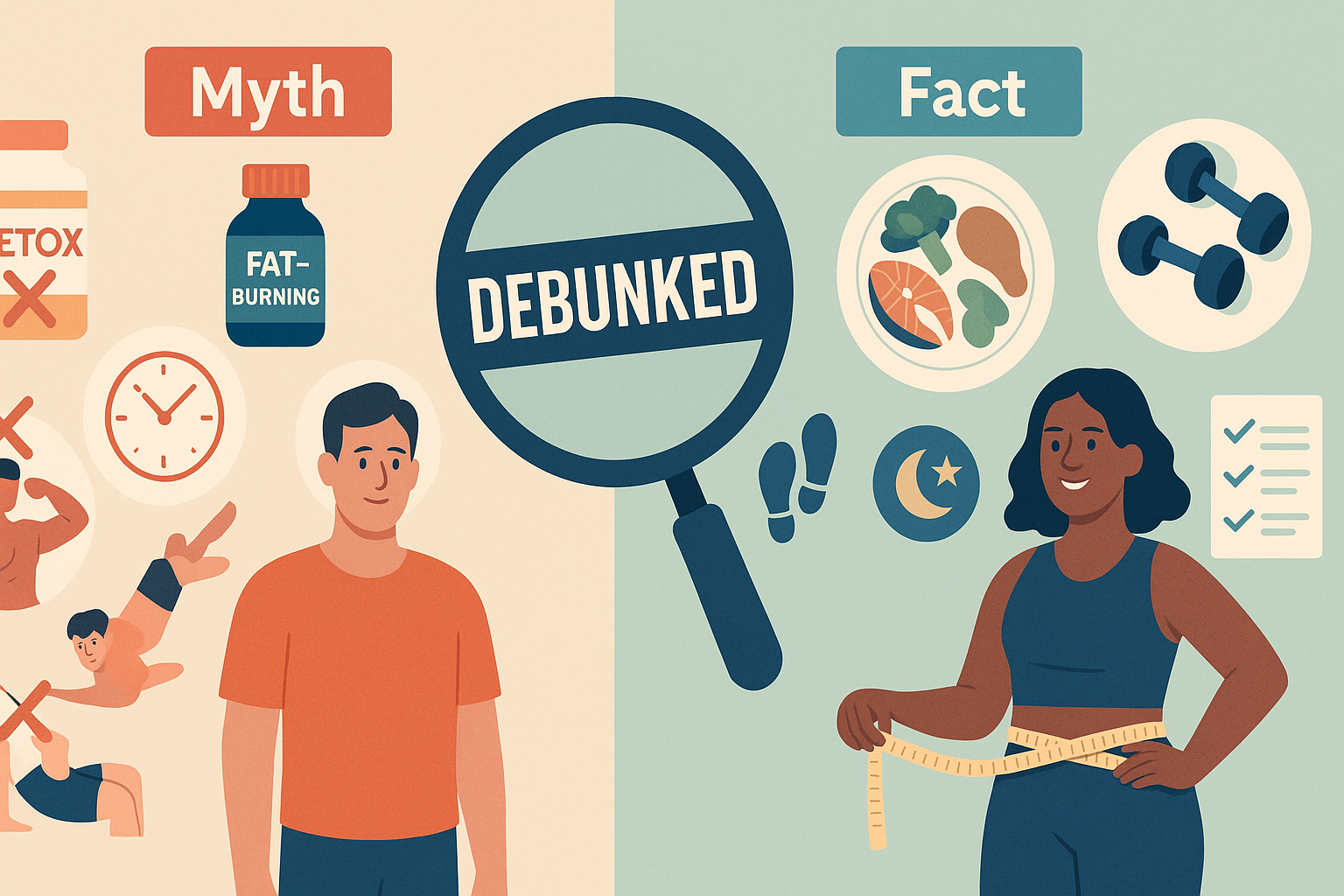
If you’ve ever felt whiplash from today’s weight-loss advice, you’re not alone. One guru swears carbs are the enemy; another says breakfast is non-negotiable; someone else promises you can “torch belly fat” with a single move. This article cuts through the noise. Below, we tackle five persistent myths about weight loss and replace them with practical, evidence-informed tactics you can actually use—whether you’re a beginner, coming back after a layoff, or trying to break a plateau.
Disclaimer: This article is educational and not a substitute for medical advice. If you have health conditions, take medications, or are considering major diet or exercise changes, consult a qualified healthcare professional for personalized guidance.
Key takeaways
- Energy balance matters most for weight change; the best diet is the one you can sustain while maintaining a moderate calorie deficit.
- You can’t target fat loss to one body part with a single exercise; train your whole body and measure overall progress.
- Meal timing and frequency don’t “stoke your metabolism” on their own; consistency and adherence beat rigid rules.
- Detoxes, cleanses, and “fat-burning” pills aren’t shortcuts and can carry risks; focus on real food, sleep, movement, and strength.
- Your metabolism isn’t “broken”; metabolic adaptation is real but manageable with protein, resistance training, activity, and patience.
Myth 1: “Carbs are the enemy—cut them to lose weight”
What this myth claims and what actually works
This myth says carbohydrates inherently cause fat gain and must be slashed to see results. The reality: weight loss comes from a sustained energy deficit—consistently taking in fewer calories than you expend. When total calories and protein are matched, low-carb and low-fat diets both work and often yield similar weight loss over time. The “best” diet is the one that helps you eat fewer calories without feeling deprived, supports your training, and fits your preferences and culture.
Requirements and low-cost alternatives
- Basic tools: a food scale or measuring cups, a free tracking app or paper journal, and a list of foods you enjoy.
- Low-cost staples: oats or brown rice; lentils, beans, chickpeas; eggs; yogurt; frozen vegetables; canned fish; chicken thighs; peanut butter.
- Optional: a step tracker or phone pedometer for daily movement.
Beginner-friendly implementation (step by step)
- Pick a style you’ll stick with. Prefer roti and rice? Choose a moderate-carb approach focused on whole grains, beans, and fruit. Love avocados and eggs? A moderate-fat plan can work.
- Center each meal on protein. Aim for a palm-sized portion (or more if your body size is larger). Add a generous serving of vegetables, then fill the remaining plate with carbs or fats based on preference.
- Eat mostly minimally processed foods. They’re more filling per calorie and make a deficit easier.
- Track for 7–14 days. Log meals (roughly is fine) to learn your maintenance intake, then trim 300–500 calories per day to start.
- Review weekly. If your scale trend is moving down and you feel good, keep going. If you’re starving, add more vegetables and protein or slow the deficit.
Modifications and progressions
- If you feel low energy on lower carbs: shift some calories from fats to carbs around workouts.
- If cravings spike at night: allocate more calories to dinner or add a structured snack (greek yogurt + fruit, protein smoothie, cottage cheese with tomato).
- Advanced: experiment with higher-protein targets and fiber-rich carbs to boost satiety.
Frequency, duration, and metrics to track
- Frequency: eat 2–4 meals/day—whatever curbs hunger best.
- Duration: commit for 4–12 weeks before major changes.
- Metrics: weekly average body weight, waist circumference, energy levels, and strength numbers (e.g., squat, push-up reps).
Safety, caveats, and mistakes to avoid
- Don’t vilify a whole macronutrient. Cutting carbs or fats too low can undermine performance and adherence.
- Don’t cut calories too aggressively. Extreme deficits are hard to sustain and can increase fatigue.
- Medical considerations: people with diabetes, kidney disease, or lipid disorders should personalize carb/fat choices with a clinician.
Mini-plan (example)
- Plate method: ½ vegetables, ¼ protein, ¼ carbs (or fats).
- Swap refined carbs for fiber-dense options at one meal per day for the first week, then two meals in week two.
Myth 2: “You can spot-reduce belly, arm, or thigh fat with targeted moves”
What this myth claims and what actually works
The idea: do endless crunches and your belly shrinks. In reality, fat loss is systemic—your body decides where it pulls stored energy from. While muscle training improves shape and tightness, you can’t meaningfully choose where fat leaves first. The winning formula is whole-body strength training + enough daily movement + a calorie deficit, measured with whole-body metrics like waist circumference and clothing fit.
Requirements and low-cost alternatives
- Gym access is helpful but not necessary.
- At home: resistance bands, a pair of dumbbells or water jugs, a sturdy chair for step-ups, and floor space for planks and split squats.
Beginner-friendly implementation (step by step)
- Train the full body 2–3 days/week. Emphasize big compound moves (squats, hip hinges, pushes, pulls, lunges, carries).
- Sprinkle in core work (planks, dead bugs, side planks) for strength and posture—not as a fat-loss “magic.”
- Add daily movement. Aim for more steps, short walks after meals, and standing breaks.
- Keep a modest calorie deficit. Combine with training for better shape changes.
Modifications and progressions
- New to lifting? Start with bodyweight movements: sit-to-stand, wall push-ups, glute bridges, rows with a backpack.
- Progression: increase reps, add weight, or slow the tempo.
- Joint-friendly options: choose goblet squats, split squats, Romanian deadlifts with dumbbells, and banded rows.
Frequency, duration, and metrics to track
- Frequency: strength 2–3x/week; steps or light cardio most days.
- Duration: give a program at least 8–12 weeks before judging body-shape changes.
- Metrics: waist and hip circumference, weekly average body weight, progress photos monthly, and strength improvements.
Safety, caveats, and mistakes to avoid
- Don’t chase “burns” in one area. It won’t drive local fat loss.
- Don’t skip progressive overload. Repeat the same light routine forever and your body adapts.
- Mind your back and shoulders. Use neutral spine, hinge at the hips, and keep elbows in natural paths; master form before loading heavy.
Mini-plan (example)
- Full-body A: goblet squat 3×8–12, push-up (incline if needed) 3×6–10, hip hinge (RDL) 3×8–12, row 3×10–12, plank 3×20–40s.
- Full-body B: split squat 3×8–12/leg, overhead press 3×8–10, hip bridge 3×10–12, pulldown/band pull 3×10–12, side plank 3×20–40s.
Myth 3: “Breakfast boosts metabolism and eating every 2–3 hours melts fat”
What this myth claims and what actually works
You may have heard breakfast is essential to “kickstart metabolism,” and that frequent mini-meals “keep the metabolic fire burning.” Research does not consistently show a metabolic advantage to more frequent eating or mandatory breakfast. What matters most is your total daily intake, your protein and fiber, and consistency.
That said, meal timing can help some people adhere—for example, earlier calorie distribution may improve appetite control for certain individuals. The practical move: choose a pattern that helps you eat the right amount without feeling out of control, then stick to it.
Requirements and low-cost alternatives
- A schedule you can keep. If mornings are chaotic, it’s okay to delay your first meal. If evenings are difficult, front-load calories earlier.
- Convenience proteins: eggs, yogurt, cottage cheese, canned fish, protein powder, tofu, lentils.
- Grab-and-go fiber: apples, carrots, berries, oats, chickpeas.
Beginner-friendly implementation (step by step)
- Pick a default pattern for two weeks: 2 meals + 1 snack, or 3 meals, or 2 meals inside a 10-hour window.
- Anchor protein in each meal and add volume with veggies and fruit.
- Evaluate satiety and performance. Shift calories earlier or later based on hunger and workouts.
Modifications and progressions
- If you train early: add a small pre-workout snack (banana + yogurt) and a balanced breakfast after.
- If late-night snacking derails you: eat a slightly larger dinner and cap the night with protein + fiber (e.g., cottage cheese + berries).
- Advanced: trial a consistent eating window (e.g., 10 a.m.–8 p.m.) for routine, not magic.
Frequency, duration, and metrics to track
- Frequency: 2–4 eating occasions daily works for most.
- Duration: hold one approach for at least 14 days before changing.
- Metrics: hunger (1–10), energy, workout quality, body-weight trend.
Safety, caveats, and mistakes to avoid
- Don’t force meals you can’t sustain. If breakfast makes you hungrier, it’s fine to eat later.
- Don’t mistake short-term water weight for fat loss when swapping meal timing.
- Medical considerations: people with diabetes, hypoglycemia, or on certain medications should discuss timing with their clinician.
Mini-plan (example)
- Three-meal rhythm: 8 a.m., 1 p.m., 7 p.m., each with protein + produce + starch or fat.
- Two meals + snack: 11 a.m., 6:30 p.m., and a 3 p.m. protein snack to curb evening hunger.
Myth 4: “Detoxes, cleanses, and fat-burning supplements are the shortcut”
What this myth claims and what actually works
Detox teas, juice cleanses, and “fat burners” promise rapid results by “flushing toxins” and revving metabolism. Evidence does not support detox diets for toxin removal or sustainable weight management. Any quick drop on the scale typically reflects water and glycogen, not lasting fat loss—and weight often rebounds when normal eating resumes.
Supplements marketed for fat loss are rarely game-changers and can carry side effects (jitteriness, sleep disruption, GI distress) or interact with medications. Your body already has a powerful detoxification system—liver, kidneys, lungs, and skin—that doesn’t require extreme diets.
Requirements and low-cost alternatives
- Real-food foundation: vegetables, fruit, legumes, lean proteins, whole grains, nuts/seeds.
- Hydration: water, tea, black coffee, or sparkling water.
- Optional supports: multivitamin for insurance if your diet is limited, creatine for training performance (not a fat burner, but helps strength).
Beginner-friendly implementation (step by step)
- Replace the cleanse with a “gentle reset” week. Build each plate around protein + produce.
- Choose high-fiber carbs (oats, beans, lentils, potatoes, brown rice) and include healthy fats (olive oil, nuts).
- Skip aggressive “burners.” If you use caffeine, keep it moderate and avoid late-day doses.
Modifications and progressions
- If appetite is low: opt for soups, smoothies, or yogurt bowls to meet protein needs.
- If you crave sweets: plan a controlled dessert (e.g., dark chocolate + fruit) rather than banning everything.
- Advanced: batch-cook proteins and grains on weekends for grab-and-go meals.
Frequency, duration, and metrics to track
- Frequency: eat balanced meals daily—no “on/off” weeks.
- Duration: evaluate after 4 weeks.
- Metrics: energy, digestion, sleep, body-weight trend, waistline.
Safety, caveats, and mistakes to avoid
- Avoid extreme restriction. Very-low-calorie cleanses can sap energy and backfire.
- Watch for interactions. “Natural” doesn’t mean safe—check supplements with your pharmacist or clinician.
- If you suspect toxin exposure or have liver/kidney issues, seek medical evaluation rather than self-detoxing.
Mini-plan (example)
- 7-day “whole-food refresh”: 3 balanced meals/day, 1 planned snack, water with each meal.
- Fill half your plate with produce at lunch and dinner; rotate legumes, grains, and lean proteins.
Myth 5: “My metabolism is broken—‘starvation mode’ makes weight loss impossible”
What this myth claims and what actually works
This myth says that after dieting, your body “shuts down” and won’t lose fat no matter what. The truth is more nuanced. Metabolic adaptation is real—your body burns fewer calories as you lose weight due to lower body mass, reduced spontaneous movement, and hormonal shifts. But it does not make fat loss impossible. It means you may need smarter strategies and more patience to keep progress moving.
Requirements and low-cost alternatives
- Protein-forward meals, resistance training, daily movement, and sufficient sleep.
- Tracking tools for steps, body weight, and waist circumference.
- Optional: kitchen scale to improve calorie awareness.
Beginner-friendly implementation (step by step)
- Prioritize protein across the day to preserve lean mass and stay full.
- Lift weights 2–3 times/week to signal your body to keep muscle.
- Elevate NEAT (non-exercise activity thermogenesis): more steps, standing tasks, short walking breaks.
- Sleep 7–9 hours and manage stress to reduce cravings and fatigue.
- Adjust gradually. If your trend stalls for 2–3 weeks, modestly tighten your calorie target or raise activity.
Modifications and progressions
- If hunger climbs: add vegetables and lean protein; consider a short diet break (1–2 weeks at maintenance calories) to restore training quality and adherence.
- If time-crunched: use brief full-body sessions (20–30 minutes) plus frequent walking.
- Advanced: periodize training (strength blocks, deload weeks) and fine-tune protein distribution across meals.
Frequency, duration, and metrics to track
- Frequency: strength 2–3x/week; walks most days; consistent protein daily.
- Duration: think in 8–16 week blocks with check-ins.
- Metrics: weekly average weight, waist, progress photos monthly, strength numbers, step counts, sleep hours.
Safety, caveats, and mistakes to avoid
- Don’t expect linear loss. Normal fluctuations come from water, glycogen, sodium, stress, and hormones.
- Don’t neglect muscle. Losing weight without lifting increases the chance of regaining fat later.
- Don’t slash calories repeatedly. Chronic aggressive deficits spike fatigue and can trigger bigger adaptations.
Mini-plan (example)
- Two full-body lifts + 8–10k steps daily for 4 weeks.
- Protein with each meal and a small bedtime snack if evening hunger is strong.
Quick-start checklist
- Pick a nutrition pattern you can sustain (moderate-carb or moderate-fat) and create a 300–500 kcal daily deficit to start.
- Protein in every meal, plenty of produce, and mostly minimally processed foods.
- Strength train 2–3x/week; add daily walking and movement breaks.
- Track weekly averages (weight, waist, steps, sleep, appetite rating).
- Sleep 7–9 hours and plan stress outlets (walks, breathing drills, journaling).
- Review every 2 weeks and adjust intake or activity modestly if progress stalls.
Troubleshooting & common pitfalls
- Plateau after early losses: You likely lost water and glycogen first. Reassess calories, increase NEAT, and keep lifting.
- Always hungry: You may be under-eating protein and fiber or cutting too aggressively. Increase vegetables, lean proteins, and potatoes/beans for fullness.
- Weekend wipeouts: Plan higher-protein breakfasts and a satisfying dinner. Keep a dessert you enjoy to prevent all-or-nothing swings.
- Program hopping: Give a plan 4–6 weeks before making major changes so you can see a trend.
- Scale anxiety: Use weekly averages and waist measurements. One-day spikes are noise, not failure.
- Low energy in training: Bring some carbs around workouts, even on lower-carb days, and ensure you’re not under-sleeping.
How to measure progress (beyond the scale)
- Waist circumference: track weekly under the same conditions.
- Clothing fit: jeans or belt holes are honest feedback.
- Strength markers: reps with a given weight, total volume, or timed sets.
- Endurance markers: walking pace, stairs without stopping, resting heart rate trends.
- Habit completion rate: how many days you hit your protein, steps, sleep goals.
A simple 4-week starter plan
Goal: establish habits that create a reliable, sustainable calorie deficit while preserving muscle and energy.
Weekly anchors (repeat for 4 weeks)
- Strength (2–3 sessions/week):
- Day A: Goblet squat, push-up (incline as needed), hip hinge (RDL), row, plank—3 sets each, 8–12 reps (planks 20–40 sec).
- Day B: Split squat, overhead press, hip bridge, pulldown/band pull, side plank—3 sets each.
- Daily movement: minimum 7–10k steps (or +2k above your current average). Short 10–15 min walks after meals if possible.
- Nutrition:
- Protein at each meal (palm-sized or more; scale to your body size).
- Half your lunch/dinner plate as vegetables or fruit; choose whole-food carbs and healthy fats.
- Start with a modest calorie deficit (e.g., ~300–500 kcal/day), then review every 2 weeks.
- Recovery: aim for 7–9 hours of sleep; schedule a 10-minute daily stress reducer (walk, breathwork, quiet time).
Week-by-week focus
- Week 1: Log what you eat and your steps without judgment; build two strength days.
- Week 2: Tighten portions slightly; add a third strength day if time allows; keep post-meal walks.
- Week 3: Assess trends; if weight/waist haven’t budged for 14 days, trim 150–200 calories/day or add 1,500–2,000 steps/day.
- Week 4: Consolidate habits; plan your next 4-week block. Consider a small diet break (maintenance calories for 7–10 days) if fatigue is high, then resume a gentle deficit.
FAQs (quick, practical answers)
- How fast should I lose weight?
A gradual pace—roughly about 0.5–1 kg (1–2 lb) per week—is more sustainable and tends to preserve more muscle. - Do I need to cut all carbs?
No. You can lose weight with low-carb or low-fat approaches if calories and protein are appropriate. Choose what you can stick to. - Is breakfast required?
Not for fat loss. If breakfast helps you avoid overeating later, keep it. If you’re not hungry in the morning and your total intake stays on target, that’s fine too. - How many meals per day is best?
There’s no single best frequency. Two to four eating occasions work well for most—go with the cadence that keeps you satisfied and consistent. - What’s the simplest way to structure meals?
Base each plate on protein + produce, then add carbs and fats to support your energy needs and preferences. - Can I burn belly fat with crunches?
Crunches strengthen muscles but don’t selectively burn belly fat. Use whole-body training, daily movement, and a calorie deficit. - Are detoxes or fat-burning supplements necessary?
No. They’re not required and often don’t produce lasting fat loss. Focus on food quality, sleep, movement, and strength. - Why did my weight loss stall?
Common reasons: you’re closer to maintenance than you think, NEAT dropped, or you’re under-recovering. Recheck intake, add steps, keep lifting, and reassess after 2–3 weeks. - How much should I exercise each week?
For general health, aim for moderate aerobic activity over the week and include muscle-strengthening on at least two days. Fit this to your schedule and training age. - How much protein should I eat?
Many people do well targeting a higher protein intake relative to body weight to support muscle maintenance during weight loss. Distribute it across your meals. - Is late-night eating bad?
Late eating isn’t automatically fattening; extra calories are. If nighttime tends to be your overeating window, plan a balanced dinner and a structured evening snack. - What if I feel like my metabolism is “broken”?
Metabolic adaptation is normal as you lose weight. Counter it with resistance training, protein-forward meals, more daily movement, quality sleep—and patience.
Conclusion
You don’t need gimmicks, cleanses, or extreme rules. You need a moderate calorie deficit you can live with, a simple strength-and-steps routine, adequate protein, and consistent habits you can keep practicing when life gets messy. Skip the myths, keep the fundamentals, and give your plan enough time to work.
Copy-ready CTA: Ready to ditch diet myths and get results? Pick your plan, start your 4-week block today, and take the first (confident) step forward.
References
- Steps for Losing Weight | Healthy Weight and Growth, U.S. public health site, January 17, 2025. https://www.cdc.gov/healthy-weight-growth/losing-weight/index.html
- Key Recommendations, National Heart, Lung, and Blood Institute, publication page. https://www.nhlbi.nih.gov/health/educational/lose_wt/recommen.htm
- Interested in Losing Weight?, U.S. Nutrition.gov, resource page. https://www.nutrition.gov/topics/healthy-living-and-weight/strategies-success/interested-losing-weight
- Optimal Diet Strategies for Weight Loss and Weight Maintenance, Journal of Obesity & Metabolic Syndrome, 2021. https://www.jomes.org/journal/view.html
- Impact of Calorie Restriction on Energy Metabolism in Humans, Nutrition Reviews (NIH/PMC), 2020. https://pmc.ncbi.nlm.nih.gov/articles/PMC9036397/
- Persistent Metabolic Adaptation 6 Years After “The Biggest Loser” Competition, Obesity (NIH/PMC), 2016. https://pmc.ncbi.nlm.nih.gov/articles/PMC4989512/
- Exercise, Metabolism, and Weight: New Research from The Biggest Loser, Harvard Health Blog, January 27, 2022. https://www.health.harvard.edu/blog/exercise-metabolism-and-weight-new-research-from-the-biggest-loser-202201272676
- Effect of Low-Fat vs Low-Carbohydrate Diet on 12-Month Weight Loss in Overweight Adults (DIETFITS Randomized Clinical Trial), JAMA, 2018. https://jamanetwork.com/journals/jama/fullarticle/2673150
- Comparison of Weight-Loss Diets with Different Compositions of Fat, Protein, and Carbohydrates, New England Journal of Medicine, 2009. https://www.nejm.org/doi/full/10.1056/NEJMoa0804748
- Effect of Breakfast on Weight and Energy Intake: Systematic Review and Meta-analysis of Randomized Controlled Trials, BMJ (PDF issue content), 2019. https://www.bmj.com/bmj/section-pdf/991103
- News: Breakfast Really Doesn’t Have Much Effect on Weight Loss, National Institutes of Health research news summary, 2020. https://www.ncbi.nlm.nih.gov/search/research-news/15105/
- Effects of Increased Meal Frequency on Fat Oxidation and 24-h Energy Expenditure, British Journal of Nutrition (NIH/PMC), 2013. https://pmc.ncbi.nlm.nih.gov/articles/PMC4391809/
- Meal Timing and Anthropometric and Metabolic Outcomes, JAMA Network Open, 2024. https://jamanetwork.com/journals/jamanetworkopen/fullarticle/2825747