




























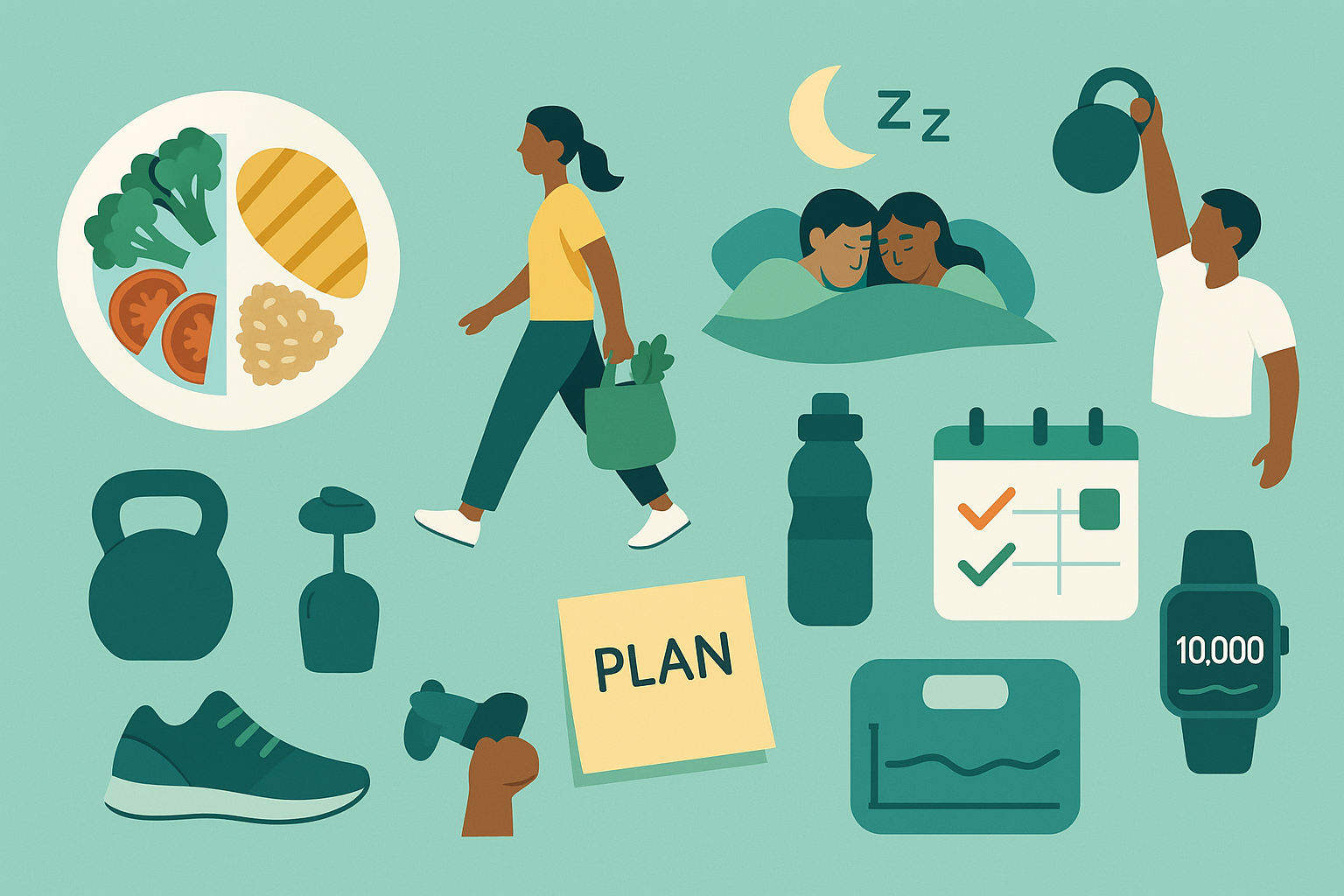
You did the hard part—now comes the part that actually changes your life: keeping the weight off. Maintaining weight loss isn’t about perfection, willpower, or all-or-nothing rules. It’s a practical skill set. In the next few minutes, you’ll learn seven essential, science-supported strategies to lock in your results, along with step-by-step guidance, sample mini-plans, and a simple 4-week roadmap you can start today. If your goal is long-term, low-stress weight maintenance, this guide is for you.
Disclaimer: The following is educational and not a substitute for personalized medical care. If you have health conditions (e.g., diabetes, kidney disease, heart disease), take medications, or are pregnant or breastfeeding, consult a qualified healthcare professional for individualized advice.
Key takeaways
- Structure beats motivation. A repeatable routine—meals, movement, and sleep—does the heavy lifting for long-term maintenance.
- Protein + plants keep you full. Aim for protein at every meal and plenty of fiber-rich foods to tame appetite and protect lean mass.
- Move your body, lift something. Regular activity plus 2+ strength sessions weekly help prevent weight regain.
- Track what matters. Light-touch self-monitoring (e.g., weight range, step count, simple logs) catches drift early.
- Guard your sleep and stress. 7–9 hours nightly and a simple stress toolkit reduce cravings and “screw it” eating.
- Plan for lapses. Expect them, script your “if-then” recovery steps, and keep going.
- Make it livable. Flexible boundaries beat rigid rules; your system should work on busy Tuesdays and on holidays.
1) Make Maintenance a Routine, Not a Project
What it is & why it works
Maintenance sticks when your days have a quiet rhythm: predictable meals, a consistent grocery pipeline, automatic movement, and a wind-down for sleep. Routines reduce decision fatigue and make the “right” choice the easy choice. Over time, repetition turns behaviors into habits, which need less mental energy to perform consistently.
Requirements / helpful tools
- A weekly calendar, notes app, or planner
- Reusable grocery list and 5–10 “default” meals
- Food scale/measure cups (optional); meal prep containers (optional)
- Phone reminders or calendar events
Step-by-step (beginner-friendly)
- Pick your anchors. Choose fixed daily anchors (breakfast time, lunch window, walk after dinner, lights-out time).
- Build around meals. Create 5–10 default meals you can rotate without thinking—protein + veg + smart carb + healthy fat. Keep ingredients stocked.
- Schedule movement. Put two strength sessions and two to four cardio/active sessions on your calendar. Treat them like appointments.
- Automate shopping. Shop the same day and time each week with a pre-saved list.
- Set “guardrails,” not rules. Examples: “No seconds until 20 minutes pass,” “Dessert only after dinner, not between meals.”
Beginner modifications & progressions
- Modify: Start with one anchor (e.g., nightly walk or consistent breakfast).
- Progress: Add a second anchor weekly until meals, movement, and sleep have predictable slots.
Recommended frequency & metrics
- Frequency: Plan once weekly, review daily.
- Metrics: “Routine streaks” (days hitting 2–3 anchors), grocery compliance (% of meals cooked from your plan), nights in bed by your set time.
Safety, caveats, mistakes
- Don’t plan a “perfect” week you can’t repeat.
- Avoid over-reliance on novelty; stability beats complexity.
- Beware of the weekend free-for-all—keep your anchors even when social plans change.
Mini-plan (2–3 steps)
- Sunday: plan 5 dinners + shop.
- Weeknights: eat dinner by 8 pm, 15-minute walk after.
- Bedtime: devices off 30 minutes before lights out.
2) Put Protein First at Every Meal
What it is & why it works
Protein helps control appetite, preserves lean mass after weight loss, and supports a higher energy expenditure at rest. Many successful maintainers aim for a protein target across the day and ensure every meal includes a meaningful serving.
Requirements / low-cost alternatives
- Protein sources you enjoy: eggs, fish, poultry, tofu/tempeh, legumes, Greek yogurt, cottage cheese, lean meats, protein powders.
- Kitchen scale (optional), measuring cups/spoons (low-cost).
Step-by-step
- Set a daily target. A practical range for many adults is ~1.2–1.6 g per kilogram of body weight per day (adjust with your clinician if you have kidney disease or other conditions).
- Distribute across meals. Aim for ~20–40 g at each meal (roughly the size of your palm in meat/fish, or a bowl of Greek yogurt + nuts, or tofu/legumes).
- Build meals around protein. Add vegetables, then smart carbs (whole grains, fruit, legumes) and fats (olive oil, avocado, nuts).
- Keep a “grab-and-go” backup. High-protein options for busy days (e.g., Greek yogurt + berries, canned tuna with beans, a protein shake + fruit).
Beginner modifications & progressions
- Modify: Start by adding 1 protein-forward meal per day.
- Progress: Distribute protein evenly across 3 meals and 1 snack.
Recommended frequency & metrics
- Frequency: Protein at every meal.
- Metrics: Daily protein grams, hunger ratings 3 hours post-meal, afternoon/evening snack cravings.
Safety, caveats, mistakes
- Protein supplements can help but shouldn’t crowd out whole foods.
- People with kidney issues or certain medical conditions must follow medical guidance on protein.
- Don’t ignore plants—protein + fiber is a powerful satiety duo.
Mini-plan
- Breakfast: eggs or Greek yogurt + fruit.
- Lunch: bean-and-chicken bowl with veggies and olive oil.
- Dinner: tofu stir-fry with mixed veg and brown rice.
3) Fill Half Your Plate with Fiber-Rich Plants
What it is & why it works
Fiber adds volume and slows digestion, helping you stay fuller on fewer calories while supporting blood sugar control and gut health. Many adults under-eat fiber; increasing your intake can make maintenance feel easier.
Requirements / low-cost alternatives
- Produce (fresh, frozen, or canned), legumes, whole grains, nuts/seeds.
- A simple “half-plate” visual cue—no special tools required.
Step-by-step
- Use the half-plate rule. At lunch and dinner, make half your plate vegetables or fruit; include legumes or whole grains most days.
- Know your targets. As a general guide, many adults benefit from ~25–38 g fiber/day. Increase gradually to minimize GI discomfort and drink water through the day.
- Mix fiber types. Combine soluble sources (oats, beans, chia) and insoluble sources (veg, whole grains) for appetite and GI regularity.
- Keep “default” plant sides. Frozen veg medley, bagged salad, canned beans—speed beats perfection.
Beginner modifications & progressions
- Modify: Add one fruit and one vegetable every day.
- Progress: Hit the half-plate goal at two meals daily; then add a fiber-rich snack (e.g., apple + nuts).
Recommended frequency & metrics
- Frequency: Plants at every meal.
- Metrics: Daily fiber grams, fullness score after meals, GI comfort (bloating scale).
Safety, caveats, mistakes
- Jumping from low to high fiber overnight can cause bloating—go slow.
- Some people with IBS may need tailored choices (e.g., lower FODMAP options).
- Hydration matters; aim for pale-straw urine as an easy hydration cue.
Mini-plan
- Swap refined grains for whole grains at one meal today.
- Add a fist-sized portion of beans or lentils 3 times this week.
4) Move Like a Maintainer: Cardio + Strength + Daily Steps
What it is & why it works
Regular physical activity helps prevent weight regain, improves health markers, and protects mood and energy. Strength training preserves or builds muscle, which supports a higher resting energy expenditure—valuable after weight loss.
Requirements / low-cost alternatives
- Comfortable shoes; resistance bands or dumbbells; a timer; an open floor or park.
- Gym optional. Bodyweight and bands are effective.
Step-by-step
- Hit the weekly movement targets. A practical guideline for adults is 150–300 minutes/week of moderate activity (like brisk walking or cycling) or 75–150 minutes/week of vigorous activity, plus muscle-strengthening on 2+ days/week.
- Prioritize two full-body strength sessions. Squats, hinges, pushes, pulls, and carries. 30–45 minutes is enough.
- Build an active base. Aim for daily steps you can sustain (use a pedometer or phone).
- Stack activity into your day. 10-minute walks after meals, stairs, standing breaks.
Beginner modifications & progressions
- Modify: Start with 10-minute walks, 2–3 times/day; one strength session/week.
- Progress: Add intervals (e.g., 4×2 minutes brisk/2 minutes easy); progress loads and repetitions in strength training.
Recommended frequency & metrics
- Frequency: Cardio 3–5 days/week; strength 2–3 days/week; daily steps.
- Metrics: Weekly minutes, step count (7-day average), strength log (sets/reps/loads), perceived exertion.
Safety, caveats, mistakes
- Warm up, use good form, and progress gradually to avoid injury.
- Don’t rely on cardio alone for maintenance—include resistance training.
- If you have joint pain or chronic conditions, tailor modalities (e.g., cycling, swimming) and consult your clinician.
Mini-plan
- Mon/Thu: 35-minute full-body strength.
- Tue/Sat: 30–40 minutes brisk walking or cycling.
- Daily: 10-minute walk after dinner.
5) Track the Few Things That Matter (Light-Touch Self-Monitoring)
What it is & why it works
Self-monitoring—like routine weigh-ins, simple food/activity logs, or step tracking—improves awareness and helps you correct course early. The goal is not obsessive tracking; it’s data-informed calm.
Requirements / low-cost alternatives
- Scale (digital or smart), tape measure, phone notes, camera for progress photos.
- Optional: a simple app for food or habit logging.
Step-by-step
- Choose your indicators. Options: weight (daily or weekly), waist circumference, step count, strength logs, protein/fiber checkboxes.
- Define your maintenance range. For many people, a 1–2 kg (2–5 lb) range is reasonable.
- Record, don’t react. If you weigh daily, use a rolling 7-day average to smooth water fluctuations.
- Review weekly. Ask: What worked? What drifted? What one tweak will I test next week?
Beginner modifications & progressions
- Modify: Weigh once per week, same day/time/conditions.
- Progress: Add a simple daily habit checklist (protein at each meal, half-plate plants, steps).
Recommended frequency & metrics
- Frequency: Weight daily or weekly; waist monthly; steps daily; strength per session.
- Metrics: 7-day weight average; % of days hitting protein/fiber targets; weekly step average.
Safety, caveats, mistakes
- If weighing triggers anxiety or disordered behaviors, use non-scale indicators and work with a professional.
- Don’t let perfectionism run the show—80% consistency wins.
Mini-plan
- Pick a weigh-in day (e.g., Friday morning).
- Track 2 checkboxes daily for a week: protein at each meal; half-plate produce.
6) Guard Your Sleep and Manage Stress on Purpose
What it is & why it works
Too little sleep and unmanaged stress amplify hunger, cravings, and impulsive eating while sapping motivation to move. Protecting sleep and building a stress toolkit makes maintenance easier and more predictable.
Requirements / low-cost alternatives
- Bedroom that’s dark, cool, and quiet; a consistent schedule; a wind-down routine.
- 5–10 minutes/day for mindfulness, breathing, or journaling (no gear required).
Step-by-step
- Set a sleep window. Most adults do best with 7+ hours nightly. Count back from wake time and set a device-off time 30–60 minutes before bed.
- Standardize cues. Dim lights, limit late caffeine/alcohol, keep consistent bed/wake times, and reserve your bed for sleep and intimacy.
- Build a stress toolkit. Try 4-7-8 breathing, 5-minute meditation, a short walk, or a two-minute check-in (“What’s one next action?”).
- Hydrate wisely. Simple cue: urine that’s pale straw in color typically indicates adequate hydration; adjust fluids accordingly.
Beginner modifications & progressions
- Modify: Set just one boundary (e.g., screens off 30 minutes before bed).
- Progress: Add a 10-minute wind-down and a 5-minute daily de-stress practice.
Recommended frequency & metrics
- Frequency: Nightly sleep routine; a stress tool used daily.
- Metrics: Time in bed, morning energy, afternoon cravings, number of wakeups.
Safety, caveats, mistakes
- Persistent insomnia, loud snoring, or daytime sleepiness warrant medical evaluation.
- Alcohol may reduce sleep quality; consider earlier cut-offs or low-/no-alcohol alternatives.
- Don’t chase perfection—aim for “consistent enough.”
Mini-plan
- Set a 10:30 pm lights-out; no caffeine after 2 pm.
- Do 5 minutes of breathing or a slow walk after stressful meetings.
7) Plan for Lapses and Build “Relapse Immunity”
What it is & why it works
Everyone has off days. People who maintain weight loss long term don’t avoid lapses—they recover fast. Two tools help: implementation intentions (“If X happens, then I do Y”) and habit-building through consistent cues and repetition.
Requirements / low-cost alternatives
- Index cards or phone notes for “if-then” scripts.
- A weekly 10-minute review to adjust plans.
Step-by-step
- Write 3 if-then scripts. Examples: “If I miss a workout, then I’ll walk 20 minutes after dinner and lift tomorrow.” “If dessert is offered at lunch, then I’ll have half and add a fruit later.”
- Define red-flags & responses. Example: If weight average rises >2 lb above range for 2 weeks, then I’ll add 15 minutes of daily walking and tighten snacks to protein-plus-produce.
- Review weekly. Note triggers and tweak scripts. Small repairs prevent big swings.
Beginner modifications & progressions
- Modify: One if-then script for your most common trigger.
- Progress: Add scripts for travel, holidays, and stress spikes. Rehearse them mentally.
Recommended frequency & metrics
- Frequency: Weekly review; deploy scripts as needed.
- Metrics: Time from lapse to recovery (days), number of planned responses executed.
Safety, caveats, mistakes
- Avoid all-or-nothing thinking. One unplanned meal doesn’t cancel your week.
- Don’t punish with extreme restriction; make small, specific adjustments.
- If lapses are frequent and distressing, enlist professional support.
Mini-plan
- Write 3 if-then scripts today.
- Schedule a 10-minute Sunday review on your calendar.
Quick-Start Checklist (Do This This Week)
- Choose two daily anchors (e.g., fixed breakfast and a 10-minute evening walk).
- Stock three protein-forward “default” meals (ingredients + backups).
- Make produce the first thing on your plate at lunch and dinner.
- Schedule two 35-minute strength sessions and two brisk walks.
- Pick your tracking trio (e.g., weekly weigh-in, step count, protein checkbox).
- Set a target bedtime and charge your phone outside the bedroom.
- Write three if-then scripts for common triggers.
How to Measure Progress Without Obsessing
Pick 3–5 indicators, total:
- Weight: daily (use a 7-day moving average) or weekly under consistent conditions.
- Waist circumference: monthly, at the navel, exhaled and relaxed.
- Activity: weekly minutes and average steps; log two strength lifts (e.g., squat and row).
- Nutrition: daily checkboxes—protein at each meal, half-plate plants, alcohol within limits.
- Sleep: time in bed and subjective sleep quality (1–5).
- Energy/mood/cravings: quick 1–5 scales.
Monthly audit (15 minutes):
- What drifted? (e.g., late nights, fewer veggies)
- What held steady?
- What one small change will you test for the next two weeks?
Troubleshooting & Common Pitfalls (and How to Fix Them)
“The scale jumped up overnight.”
Likely water, sodium, hormones, or a later meal. Fix: Use 7-day averages. Re-center on routine—protein + plants, steps, bedtime—before making changes.
“I keep getting snacky after dinner.”
Undershooting daytime protein/fiber or eating too late can backfire. Fix: Add 20–30 g protein to lunch and a fiber-rich side; consider a protein-plus-produce evening snack if genuinely hungry.
“Weekends wipe out my weekdays.”
Rigid weekday restriction can fuel weekend overeating. Fix: Keep anchors on weekends; plan one “flex meal” and make the rest routine.
“I’m too tired to work out.”
Sleep debt drives fatigue and cravings. Fix: Prioritize sleep this week; keep workouts short (20–30 minutes) and lower intensity until energy rebounds.
“My weight is drifting up slowly.”
Subtle calorie creep is common. Fix: For two weeks, add a 15–20 minute daily walk and ensure protein at every meal; review evening snacking and alcohol.
“I’m traveling a lot.”
Restaurant portions and irregular schedules add up. Fix: Use the “3-2-1” rule: 3 protein-forward meals/day, 2 produce servings/meal, 1 treat/day max; add hotel-room bands workout.
“I hate tracking.”
You don’t need to micromanage. Fix: Track only behaviors (protein, plants, steps, bedtime) and a weekly weigh-in.
“Strength training intimidates me.”
Start simple. Fix: Two exercises (squat to chair, incline push-ups) + two more (hip hinge with backpack, row with band), 2–3 sets of 8–12 reps.
“Alcohol keeps tripping me up.”
It adds calories and disrupts sleep. Fix: Set specific limits on days you drink (e.g., 1–2 drinks), alternate with water, choose lower-alcohol options, and keep alcohol out of weeknights if sleep suffers.
A Simple 4-Week Maintenance Starter Plan
Week 1: Foundations
- Focus: Routine anchors, protein at breakfast, 10-minute evening walk, set sleep window.
- Actions: Plan 5 dinners; shop once; pick a weigh-in day; remove late-night screens.
- Goal: 70% of days with protein breakfast + evening walk.
Week 2: Plants + Strength
- Focus: Half-plate plants at lunch/dinner; two strength sessions.
- Actions: Batch-prep a legume and a grain; schedule two 35-minute full-body sessions.
- Goal: Hit both strength days; average 25+ g fiber/day (build gradually).
Week 3: Activity Minutes + Self-Monitoring
- Focus: Accumulate 150+ minutes of moderate activity (or equivalent).
- Actions: Add two brisk 30-minute walks; log steps; add 1 protein snack if afternoons are snacky.
- Goal: 150 minutes + at least one metric reviewed (7-day weight average or step average).
Week 4: Stress Toolkit + Lapse Scripts
- Focus: 5 minutes/day of stress reduction; write three if-then scripts.
- Actions: Practice breathing or a short meditation after work; set alcohol limits that support sleep and goals.
- Goal: Use at least one if-then script; maintain weight within your chosen range.
After Week 4: Keep the system, adjust the dials (protein, plants, minutes, sleep) based on your monthly audit.
FAQs
1) How often should I weigh myself during maintenance?
Either daily (use a 7-day average) or once weekly under identical conditions. If the scale affects your mood or behaviors, monitor waist, clothing fit, steps, and strength progress instead.
2) Can I maintain weight without tracking calories?
Yes. Many people maintain by tracking behaviors (protein at each meal, half-plate plants, activity minutes, sleep) and using a weekly weigh-in to guide small tweaks.
3) What if I regain a few pounds?
Assume it’s a signal, not a failure. For two weeks, tighten your routine: protein at every meal, half-plate plants, add 15–20 minutes of daily walking, protect your bedtime, and reduce alcohol. Reassess.
4) Do I need to avoid carbs to keep weight off?
No. Carbs from whole foods (fruit, legumes, whole grains, root veg) can fit well, particularly when meals are protein-anchored and fiber-rich. Portion to appetite and activity.
5) How much protein is too much?
Most healthy adults do well in the ~1.2–1.6 g/kg/day range for maintenance, distributed across meals. People with kidney disease or other conditions need personalized targets from their clinician.
6) Are “cheat meals” okay?
Think “planned flexibility,” not “cheating.” Enjoy the foods you love with intention, then return to routine at the next meal. One treat won’t derail maintenance—repeated unplanned overeating might.
7) Is cardio or strength more important for maintenance?
Both help, but strength training is uniquely helpful for preserving lean mass and supporting energy expenditure. Aim for two full-body sessions weekly and accumulate weekly cardio minutes you enjoy.
8) What’s a normal weight fluctuation range?
Daily shifts of 0.5–2.0 kg (1–4 lb) from water, hormones, sodium, and meal timing are common. Watch the trend (weekly averages), not single-day spikes.
9) How long until these habits feel automatic?
Habit formation varies widely; many new behaviors feel more automatic after several weeks of consistent repetition. Consistent cues (same time/place) accelerate the process.
10) Can I drink alcohol and maintain my weight?
It’s possible with limits. Alcohol adds easy calories and reduces sleep quality. If you choose to drink, set specific boundaries (e.g., 1–2 drinks on planned days) and keep sleep a priority.
11) What should I do on vacation?
Keep your anchors (protein at each meal, morning walk, reasonable bedtime). Choose one indulgence per day and savor it. Pick activity-based outings and return to routine immediately afterward.
12) Do I have to meal prep?
No, but you need a plan. A short weekly plan (5 dinners + a reusable shopping list) gives you the same benefits with less effort.
Conclusion
Long-term weight maintenance isn’t a mystery—it’s a simple system you can repeat on your busiest days: plan a little, prioritize protein and plants, move regularly (and lift), track a few things lightly, protect your sleep, and rehearse your recovery scripts. Done consistently, these habits become the quiet autopilot that protects the results you worked hard to earn.
Copy-ready CTA: Pick one tip above and start it today—small, repeatable actions keep the weight off for good.
References
- Physical Activity Guidelines for Americans, 2nd edition. U.S. Department of Health and Human Services. 2018. https://health.gov/sites/default/files/2019-09/Physical_Activity_Guidelines_2nd_edition.pdf
- Piercy KL et al. The Physical Activity Guidelines for Americans. JAMA. 2018. https://pubmed.ncbi.nlm.nih.gov/30418471/
- Watson NF et al. Recommended Amount of Sleep for a Healthy Adult: A Joint Consensus Statement of the American Academy of Sleep Medicine and Sleep Research Society. Journal of Clinical Sleep Medicine. 2015. https://pmc.ncbi.nlm.nih.gov/articles/PMC4434546/
- Hall KD, Kahan S. Maintenance of Lost Weight and Long-Term Management of Obesity. Medical Clinics of North America. 2018. https://pmc.ncbi.nlm.nih.gov/articles/PMC5764193/
- Westcott WL. Resistance Training Is Medicine: Effects of Strength Training on Health. Current Sports Medicine Reports. 2012. https://pubmed.ncbi.nlm.nih.gov/22777332/
- Kirk EP et al. Minimal Resistance Training Improves Daily Energy Expenditure and Fat Oxidation. Medicine & Science in Sports & Exercise. 2009. https://pmc.ncbi.nlm.nih.gov/articles/PMC2862249/
- Leidy HJ et al. The Role of Protein in Weight Loss and Maintenance. The American Journal of Clinical Nutrition. 2015. https://www.sciencedirect.com/science/article/pii/S0002916523274274
- Phillips SM. Protein “Requirements” Beyond the RDA: Implications for Optimizing Health. Applied Physiology, Nutrition, and Metabolism. 2016. https://pubmed.ncbi.nlm.nih.gov/26960445/
- Jäger R et al. International Society of Sports Nutrition Position Stand: Protein and Exercise. Journal of the International Society of Sports Nutrition. 2017. https://jissn.biomedcentral.com/articles/10.1186/s12970-017-0177-8
- Moon J et al. Clinical Evidence and Mechanisms of High-Protein Diet-Induced Weight Loss and Weight Maintenance. Nutrients. 2020. https://pmc.ncbi.nlm.nih.gov/articles/PMC7539343/
- Mayo Clinic Staff. Dietary fiber: Essential for a healthy diet. Mayo Clinic. Updated 2023 (accessed 2025). https://www.mayoclinic.org/healthy-lifestyle/nutrition-and-healthy-eating/in-depth/fiber/art-20043983
- Akbar A, Mushtaq K. High Fiber Diet. StatPearls. 2023. https://www.ncbi.nlm.nih.gov/books/NBK559033/
- Zheng Y et al. Self-Weighing in Weight Management: A Systematic Literature Review. Obesity. 2015. https://pubmed.ncbi.nlm.nih.gov/25521523/