



























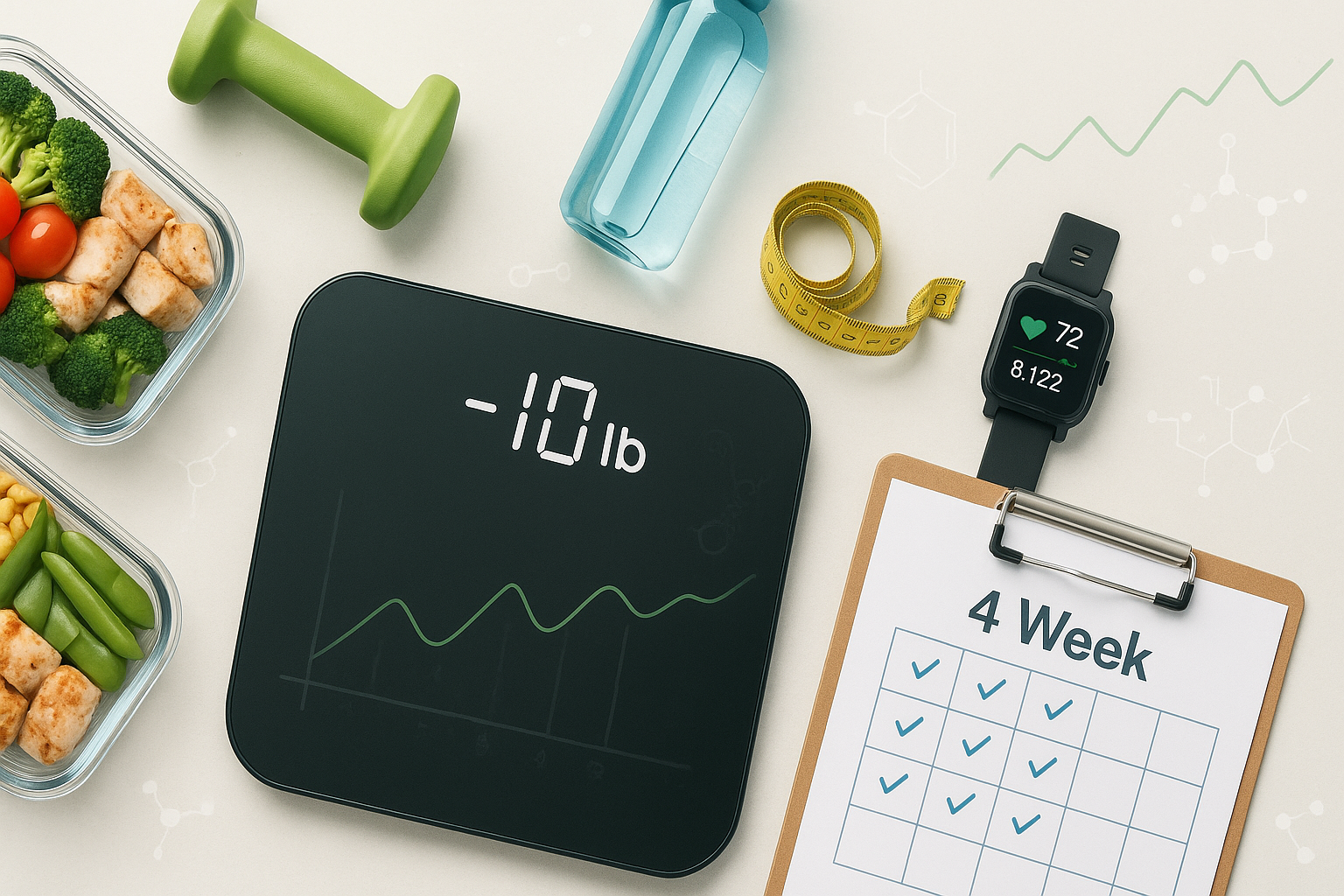
If you’ve ever wondered whether it’s realistic—or even healthy—to lose 10 pounds in a month, you’re not alone. The science behind that goal blends physics (energy balance), physiology (fluid, glycogen, hormones), and behavior (sleep, stress, and daily routines). This guide breaks down how weight changes actually happen, what’s required to drop 10 pounds in four weeks, who should avoid an aggressive timeline, and how to approach it in a safer, more sustainable way. You’ll learn how metabolism works, how to set smart calorie and activity targets, and how to track progress beyond the scale so you know you’re losing body fat—not just water.
Medical disclaimer: This article is educational and not a substitute for personalized medical advice. If you have any medical conditions, take prescription medications, have a history of disordered eating, or are considering very-low-calorie diets or weight-loss medications, consult a qualified healthcare professional before starting.
Key takeaways
- “10 pounds in a month” is an aggressive target for many people. Healthy weight loss typically averages about 1–2 pounds per week for most adults. Larger, early drops often include water and glycogen, not just fat.
- Weight change = energy balance, but the classic “3,500 calories per pound” rule is overly simplistic. Modern models show dynamic (slowing) weight loss over time.
- The most reliable drivers of fat loss: a measured calorie deficit, adequate protein, plenty of fiber and low-energy-density foods, regular physical activity (aerobic + strength), more daily movement (NEAT), and 7+ hours of sleep.
- To pursue a faster month safely: prioritize muscle preservation (protein and resistance training), monitor biofeedback (energy, hunger, performance), and track outcomes beyond weight (waist, strength, clothes fit).
- Very-low-calorie or “soup and shake” protocols can produce rapid loss but require clinical oversight. They’re not general DIY plans.
- Success is more likely when you self-monitor (food, steps, weight), plan meals in advance, and troubleshoot plateaus with data, not guesswork.
What “losing 10 pounds in a month” really means
What it is and why it matters
Ten pounds in four weeks averages ~2.5 lb/week, above the commonly recommended 1–2 lb/week. That doesn’t make it impossible—especially in people with higher starting weights—but it raises two critical points:
- Early losses aren’t all fat. When you cut calories or carbohydrates, your body taps glycogen, the stored form of carbohydrate in muscle and liver. Each gram of glycogen is stored with ~3–4 grams of water, so depleting glycogen sheds water quickly. That’s why week 1 can be dramatic, while later weeks slow.
- Sustainability and safety. Faster loss increases risk of muscle loss, fatigue, and rebound weight if the plan is too extreme to maintain. Preserving lean mass protects metabolic health, strength, and long-term maintenance.
Requirements/prerequisites
- Honest baseline: recent weight trend, medications, health history.
- Time for planning: grocery shopping, meal prep, daily movement, and sleep prioritization.
- Basic tools: food scale or measuring tools, resistance bands/dumbbells (or gym), step counter, body-weight scale, soft tape for waist.
Low-cost alternatives: a free calorie app, body-weight strength moves, brisk walking, and a simple notebook for logs.
Beginner steps (how to implement)
- Set expectations: Understand that week 1 can be mostly water/glycogen; week 2–4 is where body fat loss should lead.
- Pick a conservative deficit first (see “How big a deficit?”) and adjust based on objective trends (scale average, waist, energy, performance).
- Protect muscle: emphasize protein and strength training from day one.
Modifications and progressions
- If your starting weight is lower or your schedule is constrained, target ~1–1.5 lb/week and reassess.
- If you’re larger and active, higher early losses may occur, but still prioritize recovery, protein, and strength.
Recommended metrics & frequency
- Scale weight: daily, same time (use weekly average).
- Waist circumference: 1–2×/week.
- Steps: daily.
- Training log: every workout.
- Subjective ratings: hunger (0–10), energy (0–10), sleep hours.
Safety and common mistakes
- Confusing water loss with fat loss, slashing calories too far, skipping protein/resistance training, overdoing HIIT, sleeping <7 hours, and not tracking.
Mini-plan example (2–3 steps)
- Step 1: Remove 200–300 kcal from two meals/day via lower energy-density swaps (e.g., swap creamy sauce for tomato-based; add veggies to bulk meals).
- Step 2: Add 30–45 min brisk walking most days + 2–3 short strength sessions weekly.
- Step 3: 30 g protein at breakfast and 25–40 g at each main meal.
Energy balance and metabolism: what actually drives weight change
What it is and core purpose
Your total daily energy expenditure (TDEE) has three main components:
- Resting energy expenditure (REE/BMR): the largest chunk for most adults.
- Thermic effect of food (TEF): energy cost of digestion/processing.
- Activity energy: structured exercise + NEAT (non-exercise activity like steps, chores, fidgeting).
Why it matters: To lose weight, average intake must be below average expenditure over time. But your body adapts, so the deficit that works in week 1 may shrink by week 4 as body mass declines and you unconsciously move less.
Requirements/prerequisites
- A ballpark maintenance estimate (from a calculator, wearable data, or a 2-week baseline log).
- Willingness to adjust as real-world data come in.
Step-by-step for beginners
- Estimate maintenance. Use a reputable calculator or observe 10–14 days of stable intake and weight.
- Create a modest initial deficit (see next section).
- Protect TEF and NEAT: eat enough protein/fiber and stay active throughout the day.
Modifications and progressions
- As weight declines, maintenance drops modestly. Re-estimate every 2–4 weeks or when loss stalls.
- If you get unusually hungry, fatigued, or sore, your deficit may be too large or recovery too low.
Metrics (how often)
- Weekly average weight and waist tell you if energy balance is negative.
- Daily steps track NEAT; training performance reflects recovery.
Safety, caveats, mistakes
- Treating the “3,500-calorie rule” as a guarantee; ignoring NEAT drops; assuming HIIT “boosts metabolism” enough to offset overeating; relying on cardio alone without strength training.
Mini-plan example
- Step 1: Set a deficit (e.g., −400 to −600 kcal/day).
- Step 2: Add 8,000–12,000 steps/day average.
- Step 3: Prioritize protein and produce at each meal to support TEF and satiety.
How big a calorie deficit do you actually need?
What it is and core purpose
A deficit is the average gap between calories in and calories out. Traditional back-of-the-napkin math uses ~3,500 kcal per pound of fat. That’s a rough energy content estimate, but real humans don’t lose linearly: water and glycogen shift early, and metabolic responses slow the rate later.
Practical translation
- Target range: For most adults, a ~500–750 kcal/day deficit tends to be effective and more sustainable.
- Chasing 10 lb in 4 weeks often implies >1,000 kcal/day average short-term deficit if it were all fat—a big ask without supervision or high starting weight. A safer compromise for many is 6–8 pounds in a month, with the understanding that week-1 water/glycogen can make totals look larger.
Requirements/prerequisites
- Baseline maintenance estimate, honest food tracking, and flexibility to adjust.
- Awareness of medical exceptions (e.g., very-low-calorie diets <800–900 kcal/day require medical oversight only).
Step-by-step for beginners
- Start with −500 to −600 kcal/day for two weeks.
- Evaluate weekly weight average, waist, energy, training.
- If progress is slow and you’re recovering well, nudge to −700–750 kcal/day by trimming calorie-dense extras and adding steps—not by slashing protein.
Modifications and progressions
- Larger individuals or those supervised clinically may use bigger short-term deficits; smaller or very active individuals often need smaller deficits to preserve performance.
- Consider cycling: 2–3 moderate-deficit days, 1 lighter-deficit day, to manage hunger and social life.
Metrics and frequency
- Weekly loss target: ~0.7–1% of body weight for most; >1.5–2%/week raises muscle-loss risk.
- Adjustments: if two consecutive weeks miss targets, adjust intake/expenditure by ~200–300 kcal/day.
Safety and common mistakes
- Going too low on calories, especially protein; using only cardio; ignoring sleep; relying on “fat-burner” supplements.
Mini-plan example
- Step 1: Remove ~200–300 kcal from dinner (e.g., swap creamy dressing for vinaigrette, add a veggie side).
- Step 2: Remove ~200–300 kcal from snacks/sugary drinks.
- Step 3: Add 30–45 min brisk walking (or cycling) 5–6 days/week.
Nutrition that prioritizes fat loss (and muscle retention)
What it is and benefits
A fat-loss diet isn’t a specific brand; it’s a set of principles that create a deficit while preserving lean mass, hunger control, and performance.
Cornerstones:
- Protein: Aim ~1.2–1.6 g/kg/day (higher end if lean/active). Helps protect muscle and supports satiety and TEF.
- Fiber & low energy density: Build meals around vegetables, fruits, legumes, whole grains, and lean proteins to stay fuller on fewer calories.
- Carb & fat flexibility: You can bias either carbs or fats according to preference and training, as long as protein and total calories are on target.
- TEF edge: Protein digestion is costlier (higher TEF) than carbs or fats—small but helpful over time.
Requirements/prerequisites
- Roughly estimate calories and protein, then build meals out of high-volume, nutrient-dense foods.
- Hydration and sodium awareness: lower-carb weeks can reduce water retention; salty restaurant meals can mask fat loss on the scale.
Step-by-step for beginners
- Set protein first. Multiply body weight (kg) × 1.4 g as a starting midpoint.
- Fill the plate by halves and quarters:
- ½ non-starchy veg
- ¼ lean protein
- ¼ whole-food carbs (or healthy fats if lower-carb suits you)
- Plan fiber: ≥25–38 g/day or ~14 g/1,000 kcal.
- Use energy density tactics: soups, salads, berries, yogurt, legumes, whole grains, and lean proteins; limit oils/dressings/nuts by portion since they’re calorie-dense.
Beginner modifications and progressions
- If appetite is high: raise protein by 0.2 g/kg and add volume foods (veg, broth-based soups).
- If training hard: time carbs around workouts for performance and recovery.
Recommended frequency/metrics
- Protein at each meal: ≥25–40 g.
- Fiber daily: hit your target most days.
- Meal planning: 2–3 times/week.
Safety & common mistakes
- Dropping carbs so low that training and sleep suffer; under-salting after long sweaty workouts; “health halo” overeating (nuts, oils, “clean” desserts).
Mini-plan example
- Step 1: Breakfast with 30 g protein (eggs + Greek yogurt + fruit).
- Step 2: Lunch: lean protein bowl (half plate veg, quarter whole grains, quarter protein).
- Step 3: Dinner: protein + two veg + starch; fruit or skyr for dessert.
Training that accelerates fat loss and protects muscle
What it is and benefits
Exercise isn’t mandatory for weight loss, but it increases energy expenditure, improves health, and—crucially—resistance training preserves lean mass during a deficit. Aerobic exercise has a dose-response relationship with loss of body fat and waist size. Combined programs perform best.
Requirements/prerequisites
- 2–3 resistance sessions/week (full-body or upper/lower splits).
- 150–300 min/week of moderate-intensity aerobic (or 75–150 min vigorous), scaling with time and fitness.
- Daily NEAT: steps, mini-walks, standing breaks.
Low-cost alternatives: Body-weight moves (squats, push-ups, hip hinges, rows, planks), bands, stairs, outdoor walks.
Step-by-step for beginners
- Strength (2–3×/week):
- Squat or hinge, push, pull, lunge, carry/core.
- 2–4 sets × 6–12 reps, 60–90 s rest, progress load/reps weekly.
- Aerobic:
- Start with 30–40 min brisk walking most days; progress by 10% weekly.
- Optionally add 1–2 short HIIT sessions (e.g., 6–10 intervals of 30 s hard/90 s easy) if joints tolerate it.
- NEAT:
- Target 8,000–12,000 steps/day average; break up long sitting.
Modifications and progressions
- If you’re new, keep HIIT brief and infrequent; emphasize easy volume first.
- If short on time, combine circuit-style strength with inter-set brisk walking.
Recommended frequency/metrics
- Strength: 2–3×/week.
- Aerobic: build toward 150–300 min/week.
- NEAT: daily steps.
- Track: sets/reps/loads and resting heart rate trends.
Safety and common mistakes
- Starting HIIT too soon, skipping warm-ups, chasing sweat over progressive overload, ignoring recovery and sleep.
Mini-plan example
- Session A: Goblet squat, push-up (elevated as needed), hip hinge (RDL), 1-arm row, plank (3 sets each).
- Cardio: 35–45 min brisk walk after dinner, 5–6 days/week.
- NEAT: 10-minute walk breaks mid-morning and mid-afternoon.
Sleep and stress: the “silent levers” of hunger and recovery
What it is and benefits
Adults generally function best with 7+ hours of sleep. Short sleep raises hunger, reduces satiety signals, and can shift weight loss away from fat and toward lean tissue. Managing stress similarly helps prevent compensatory overeating.
Requirements/prerequisites
- A consistent sleep window and wind-down routine.
- Caffeine/alcohol timing awareness; dark, cool bedroom.
Step-by-step for beginners
- Set a fixed bedtime 7.5–8.5 hours before wake time.
- Wind-down: lights down, screens off, hot shower, reading.
- Anchor meals and workouts earlier when possible to aid sleep.
Modifications and progressions
- If you can’t extend sleep, protect recovery by dialing back HIIT, keeping strength submaximal, and emphasizing protein and carbs around training.
Metrics/frequency
- Sleep hours/night; subjective energy/hunger next day.
- Training performance as a recovery proxy.
Safety/mistakes
- Cutting sleep to “train more,” late caffeine, scrolling in bed, and relying on alcohol for sedation (it worsens sleep quality).
Mini-plan example
- Step 1: Move caffeine to before noon.
- Step 2: 30-minute wind-down routine nightly.
- Step 3: Keep your bedroom cool, dark, and quiet.
Self-monitoring that actually works
What it is and benefits
People who track (food, weight, steps) tend to lose more weight. Logging builds awareness, and daily weigh-ins—used judiciously—help you see trends despite normal day-to-day noise.
Requirements/prerequisites
- A simple logging method you’ll stick to (app or pen-and-paper).
- Willingness to average data over the week.
Step-by-step for beginners
- Daily weigh-in on waking (after using the restroom), then average weekly.
- Log intake most days; at least record protein and calorie-dense items (oils, desserts, alcohol).
- Track steps with your phone/watch and set a weekly average target.
Modifications and progressions
- If daily weigh-ins negatively affect mood, switch to 3×/week and keep averaging.
- Add a weekly progress photo and waist circ. for context.
Metrics/frequency
- Scale average: weekly.
- Waist: 1–2×/week.
- Food/steps: daily.
Safety & mistakes
- Overreacting to a single day’s spike (often sodium or glycogen), forgetting to average, and letting tracking become perfectionism.
Mini-plan example
- Step 1: Weigh daily, log once weekly (7-day average).
- Step 2: Pre-log dinner before eating.
- Step 3: Add a Sunday check-in: weight average, waist, step average, notes.
Quick-start checklist
- Establish a moderate deficit (−500 to −750 kcal/day).
- Protein: ~1.2–1.6 g/kg/day; fiber: 25–38 g/day (or ~14 g/1,000 kcal).
- Strength 2–3×/week; aerobic building toward 150–300 min/week; steps 8,000–12,000/day.
- Sleep 7–9 hours; wind-down routine nightly.
- Track: daily weight, steps, and intake basics; weekly waist.
- Plan meals and groceries 2×/week; prep protein and produce.
Troubleshooting & common pitfalls
“I lost 5 lbs in week 1, then only 1–2 lbs in week 2–3—did I stall?”
Likely water/glycogen loss first, then slower fat loss. Keep averaging weekly data; look at waist and progress photos.
“The scale bounced up 2 lbs overnight.”
Probably sodium, glycogen, or gut content. Resume normal plan; check your 7-day average.
“I’m exhausted and hungry.”
Deficit likely too large. Add 200–300 kcal/day, especially around training, and ensure 30–40 g protein at meals and better sleep.
“My strength is dropping.”
Reduce HIIT volume, keep strength lower-rep, higher rest, and increase protein. Ensure carbs around lifting.
“No change for 2 weeks.”
Audit tracking accuracy; trim 200 kcal/day or add 2,000–3,000 steps/day. Reassess alcohol and restaurant meals.
“I’m tempted to crash diet.”
Rapid plans can work in clinics but carry risks without supervision. Consider a smaller, sustainable deficit.
How to measure progress (beyond the scale)
- Weekly weight average (7 morning weigh-ins).
- Waist circumference: measure at the level just above the hip bones, after a normal exhale.
- Strength/performance: can you lift a bit more or do more reps?
- Clothes fit and photos: every 1–2 weeks in the same lighting.
- Subjective energy/satiety: aim for “mostly steady.”
A simple 4-week starter roadmap
Week 1 — Foundation & easy wins
- Set a −500 to −600 kcal/day deficit.
- Protein 1.4 g/kg/day, fiber ≥25–38 g/day.
- Walk 30–45 min most days; two full-body strength sessions (2–3 sets each).
- Daily weigh-ins; log dinners and snacks.
- Sleep: fix bedtime/wake time; cut caffeine after noon.
Week 2 — Nudge the levers
- Add one short interval cardio session (e.g., 8×30 s hard/90 s easy) if recovered.
- Increase steps by 1,500/day on average.
- Raise protein by ~0.2 g/kg if hungry; add an extra cup of veg at lunch and dinner.
- Check waist twice; tweak portions if needed.
Week 3 — Progression & plateaus
- If weekly average loss <0.5% body weight, trim ~200 kcal/day (oils, desserts, sugary drinks) or add 15–20 min cardio to 2 sessions.
- Strength: add a set or small load increase on major lifts.
- Prioritize carbs around workouts for performance.
Week 4 — Consolidate & assess
- Maintain the routine; avoid extreme last-minute cuts.
- Re-measure: weight average, waist, photos, strength log.
- Decide next steps: hold, continue modest deficit, or shift to maintenance for 1–2 weeks before another fat-loss block.
FAQs
1) Is losing 10 pounds in a month safe?
For many, that pace is aggressive. Aiming for 1–2 lb/week is generally more sustainable. Early, larger drops often reflect water. If you attempt faster loss, prioritize protein, strength training, sleep, and monitor energy and performance.
2) Do I have to count calories?
Not strictly, but you need some method to ensure a deficit—portion guides, pre-logging key meals, or structured meal plans can work. Counting can be especially helpful short-term to calibrate portions.
3) Which diet is “best” to hit this goal?
The one you can adhere to while meeting protein and fiber targets. Low-carb, low-fat, or Mediterranean can all work if calories and protein are appropriate and the foods suit your taste and routine.
4) How much protein do I need when dieting?
A practical range is ~1.2–1.6 g/kg/day, distributed across meals (25–40 g each), to help preserve muscle and manage hunger.
5) Can I just do cardio?
Cardio helps burn calories and reduces visceral fat, but resistance training is crucial to preserve muscle and keep you strong while dieting. Combine both.
6) Do fat-burner supplements help?
They’re not necessary and often add little beyond caffeine. Your biggest wins come from deficit, protein, fiber, training, movement, and sleep.
7) Why did my weight jump after a salty meal or high-carb day?
Sodium and glycogen pull water into the body. That’s water weight, not fat gain. Resume your plan and watch the weekly average.
8) Should I weigh myself daily?
Daily weigh-ins with weekly averaging can improve awareness and outcomes for many. If it increases stress, use 3×/week or focus on waist and photos.
9) Is HIIT necessary to lose fat faster?
No. HIIT is time-efficient, but beginners should build an aerobic base first and use HIIT sparingly. Overdoing it can impair recovery.
10) How much should I sleep during a cut?
Aim for ≥7 hours. Short sleep increases hunger and can shift weight loss away from fat and toward lean mass.
11) What if I’m stuck after two weeks?
Audit tracking accuracy, trim ~200 kcal/day or add 2,000–3,000 steps/day, and check sleep. If still stuck, reassess your maintenance estimate and training stress.
12) Are “soup and shake” 800-kcal programs a shortcut?
They can produce rapid loss under clinical supervision for specific populations (e.g., some with type 2 diabetes). They’re not general DIY solutions.
Conclusion
Losing 10 pounds in a month sits at the fast end of the spectrum. It’s achievable for some—especially with higher starting weights or tightly structured plans—but the smartest path emphasizes fat loss, not just weight loss. Anchor your month to a moderate, defensible deficit, high-protein, high-fiber, low-energy-density meals, combined strength and aerobic training, daily movement, and 7+ hours of sleep. Track trends, protect muscle, and adjust with data—not hunches.
Ready to start? Pick a modest deficit, schedule two strength sessions this week, and plan tomorrow’s protein-anchored meals—then keep going. You’ve got this.
References
- Losing Weight — Centers for Disease Control and Prevention (CDC). Updated January 17, 2025. https://www.cdc.gov/healthyweight/losing_weight/index.html
- Why Is the 3500-kcal Rule Wrong? — Obesity Reviews (Obesity Action). 2013. https://www.obesityaction.org/resources/why-is-the-3500-kcal-rule-wrong/
- Time to Correctly Predict the Amount of Weight Loss with Caloric Restriction — Obesity Reviews (PMC). 2014. https://pmc.ncbi.nlm.nih.gov/articles/PMC4035446/
- Non-Exercise Activity Thermogenesis (NEAT) in Human Energy Balance — Endotext (NCBI Bookshelf). 2022. https://www.ncbi.nlm.nih.gov/books/NBK279077/
- Factors Affecting Energy Expenditure and Requirements — NCBI Bookshelf. 2023. https://www.ncbi.nlm.nih.gov/books/NBK591031/
- International Society of Sports Nutrition Position Stand: Diets and Body Composition (Table: Components of TDEE) — Journal of the International Society of Sports Nutrition. 2017. https://jissn.biomedcentral.com/articles/10.1186/s12970-017-0174-y/tables/3
- Thermic Effect of a Meal and Appetite in Adults: IPD Meta-analysis — American Journal of Clinical Nutrition (PMC). 2013. https://pmc.ncbi.nlm.nih.gov/articles/PMC3873760/
- The Science of Increasing Dietary Protein for Weight Loss and Metabolic Health — Annual Review of Nutrition (preprint page). 2022. https://arxiv.org/abs/2207.00011 (See also mainstream review: Optimal Diet Strategies for Weight Loss and Weight Loss Maintenance, 2020.)
- Optimal Diet Strategies for Weight Loss and Weight Loss Maintenance — Journal of Obesity & Metabolic Syndrome (PMC). 2020. https://pmc.ncbi.nlm.nih.gov/articles/PMC8017325/
- Increasing Low-Energy-Dense Foods and Decreasing High-Energy-Dense Foods in Weight Loss — International Journal of Behavioral Nutrition and Physical Activity (PMC). 2017. https://pmc.ncbi.nlm.nih.gov/articles/PMC5902316/
- Dietary Energy Density and Successful Weight Loss — Journal of the American Dietetic Association (PMC). 2011. https://pmc.ncbi.nlm.nih.gov/articles/PMC3066438/
- A Year-Long Trial Comparing Two Weight-Loss Diets: Energy Density Effects — American Journal of Clinical Nutrition (PMC). 2007. https://pmc.ncbi.nlm.nih.gov/articles/PMC2018610/
- Postexercise Muscle Glycogen Resynthesis in Humans — Journal of Applied Physiology. 2017. https://journals.physiology.org/doi/10.1152/japplphysiol.00860.2016
- Fundamentals of Glycogen Metabolism for Coaches and Athletes — Sports Medicine (PMC). 2018. https://pmc.ncbi.nlm.nih.gov/articles/PMC6019055/