


























Good neighbors turn a place you live into a place you belong. If you want safer streets, quicker help when it matters, and everyday joy on your block, “Neighborly Support” is the engine that makes it happen. In short, neighborly support is the everyday practice of residents helping one another through trust, shared resources, and quick communication. Building community bonds means creating durable relationships that make a block safer, kinder, and more resilient. Below are 12 practical, low-cost ways to activate that spirit where you live—each one designed to work in urban towers, suburban streets, or rural lanes.
Quick-start in 5 steps: say hello to three neighbors this week; swap numbers with at least two; start (or join) one group chat; host a no-fuss doorstep tea; try one small shared project within 14 days.
1. Launch a Trusted Block Chat (With Clear Norms)
A block chat is the fastest way to coordinate help, share updates, and check in during emergencies. Start with a platform most neighbors already use (often WhatsApp, Signal, or SMS), then set norms so it doesn’t turn into noise. The goal is simple: make it effortless to ask for a spare tool, report a streetlight outage, or find a lost pet within minutes. Begin by inviting immediate neighbors (e.g., the residents on both sides and across the street or everyone on your floor). Keep it private, opt-in, and moderated. A small, well-run chat beats a large, chaotic one.
1.1 Why it matters
- Faster coordination for urgent needs (e.g., rides to a clinic, checking on elders during power cuts).
- Builds familiarity that lowers anxiety and increases trust.
- Creates an easy channel for small wins—“I’ve got extra lemons, anyone want some?”
1.2 How to do it (and keep it sane)
- Name + scope: e.g., “Maple St. 100–150—Neighbors Only.”
- House rules: no spam, politics, or chain forwards; be kind; reply in-thread; @mention for urgent.
- Onboarding: pin a welcome message with norms, emergency numbers, and a short directory.
- Rotating admin: 2–3 volunteers to add/remove members and nudge norms.
- Quiet hours: suggest 10 pm–7 am except emergencies.
Synthesis: A well-moderated chat turns neighbors into first responders for everyday life—without drowning anyone in notifications.
2. Create a Micro-Directory of People, Skills, and Needs
A micro-directory is a shared list of who’s who and who can help with what. Think of it as a living “yellow pages” for your block: basic contact info, preferred help you can offer (e.g., bike repair, legal forms, first-aid), and any needs (e.g., mobility support). It reduces friction—people know whom to call for a ladder, a translator, or a quick check on a pet.
2.1 How to set it up
- Format: start with a simple Google Form/Sheet or a printed sheet slipped under doors.
- Fields to include: name, unit/house, phone/WhatsApp, languages, skills/tools, times available, dietary notes.
- Privacy: make it opt-in; share only within the block chat or as printed copies for participating homes.
- Maintenance: refresh quarterly; archive departures and add new neighbors.
2.2 Mini checklist
- Collect consent before sharing.
- Highlight “availability windows” (e.g., evenings, weekends).
- Mark “urgent contacts” (e.g., trained first-aiders).
- Include accessibility notes (e.g., “bell is hard to hear—please knock.”)
Synthesis: When the directory exists, help becomes a two-minute message instead of an awkward guesswork marathon.
3. Start a Tool Library and Lending Shelf
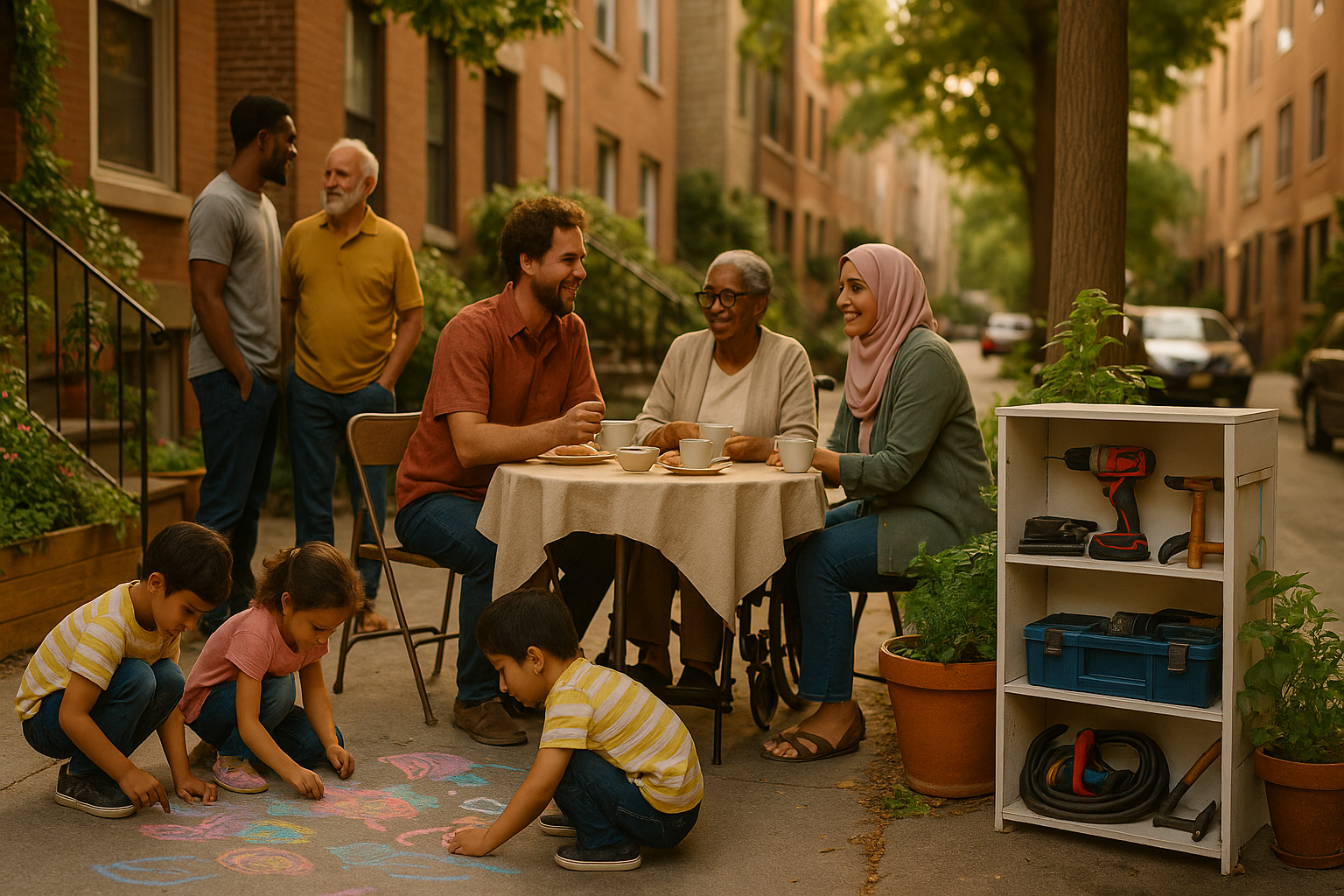
Most households own items used only a few times a year (drills, ladders, party chairs). A micro tool library lets neighbors borrow instead of buy, saving money while sparking conversations that build trust. You can start small with a weatherproof “lending shelf” outside a volunteer’s home or in a lobby, then grow into sign-outs and themed kits (repair kit, party kit, garden kit).
3.1 Numbers & guardrails
- Inventory target: start with 15–30 items; expand to 50+ as demand grows.
- Labeling: item name, owner (if personal), and simple use/safety card.
- Borrowing window: 48–72 hours standard; longer by request.
- Deposits: optional for higher-value tools; keep it friendly, not bureaucratic.
3.2 Common mistakes
- No maintenance plan: assign a quarterly “tool day” to check blades, batteries, and cords.
- Ambiguous responsibility: set a clear “you break it, we fix it together” norm.
- Hidden location: make it visible and well-signed to encourage use.
Synthesis: Sharing objects lowers costs and raises conversation frequency—the two best predictors of stronger neighbor ties.
4. Host Low-Lift, Repeatable Micro-Gatherings
Big events are fun but exhausting. Micro-gatherings—front-yard tea, “stoop hours,” hallway coffee, or Friday evening “chai & chat”—are easier to repeat and more inclusive. Aim for 45–90 minutes, bring simple snacks, and keep it kid-friendly. The goal is not spectacle; it’s rhythm. Regular touchpoints let shy neighbors ease in and help newcomers feel welcome within a week of moving in.
4.1 How to run them
- Cadence: every two weeks or monthly, consistent day/time.
- Setup: chairs, name stickers, marker pens, a sign “All neighbors welcome.”
- Conversation starters: “one skill you can share,” “one small wish for the block.”
- Inclusivity: quiet corner for sensory-sensitive guests; halal/vegetarian options; a space for strollers.
4.2 Mini case
A 24-unit building scheduled “Lobby Lemonade” on the first Sunday monthly. Attendance stabilized around 12–15 people; within three months, a shared child-minding swap and a tool-swap day emerged organically.
Synthesis: Keep gatherings tiny but steady; the compounding effect of repeated hellos turns strangers into allies.
5. Build a Care Ring for Life’s Crunch Moments
A care ring is a small roster that mobilizes when someone faces short-term challenges: new baby, post-surgery recovery, exam season, elder care gaps. It’s the neighbor version of a “meal train” plus practical help. Volunteer roles include food drop-offs, pharmacy runs, pet walks, school pickups, or just a 20-minute check-in.
5.1 How to do it
- Consent-first: the person receiving support sets boundaries (diet, visiting hours, contact preferences).
- Sign-up grid: shared spreadsheet with day-by-day slots and task notes.
- Coordination lead: one neighbor to confirm coverage and avoid duplication.
- Time boxing: usually 2–6 weeks; reassess needs at midpoint.
5.2 Common pitfalls
- Unclear dietary info: use a simple form for restrictions and kitchen access preferences.
- Over-helping: respect “quiet days”; don’t turn care into surveillance.
- Sustainability: rotate volunteers; small, consistent help beats burnout.
Synthesis: Care rings normalize asking and receiving help—transforming private stress into shared relief without overstepping.
6. Get Prepared Together: Safety, First Aid, and Simple Drills
Preparedness is community glue. Map your block’s risks (power cuts, floods, heatwaves), identify who needs check-ins, and run one or two micro-drills a year. Stock basic kits and agree on a meeting point. Even modest prep—phone trees, torch checks, first-aid basics—dramatically reduces panic and strengthens trust.
6.1 Practical steps
- Risk map: note elders, mobility challenges, oxygen users, pets, and single parents.
- Shared supplies: bulk-buy batteries, water containers, and first-aid basics; create two “grab boxes.”
- Drills: 20-minute stairwell evacuation walkthrough, or a “lights-out” evening to test torches and comms.
- Training: at least two neighbors learn CPR and basic first aid; share notes.
6.2 Region notes
- Apartment blocks: prioritize stairwell lighting, backup access to roof/water tanks, and elevator outage plans.
- Suburban/rural: agree on vehicle pooling and generator safety; mark private wells/bores if relevant.
Synthesis: Preparedness converts anxiety into action and makes everyone feel safer—before, during, and after a crisis.
7. Cultivate a Tiny Shared Space: Gardens, Planters, or Pocket Parks
Green space invites lingering and conversation. You don’t need a park-sized plot; start with curb planters, a shared herb bed, or a small community garden box. Shared cultivation provides recurring reasons to meet, swap seedlings, and share harvests—plus visible beauty that signals “people care here.”
7.1 Tools/Examples
- Starter kit: 3–5 planters, soil, hardy herbs (mint, basil), and seasonal flowers.
- Roles: waterers’ rota, compost lead, seedling starts.
- Add-ons: a little free library shelf, bird bath, or bench.
- Care calendar: quick weekly check-in; seasonal tidy-up days.
7.2 Common mistakes
- No watering plan: assign days; post the rota in the chat.
- Monoculture boredom: mix edibles, pollinator plants, and color.
- Ignoring accessibility: keep beds reachable from wheelchairs and strollers.
Synthesis: A tiny patch of green becomes a magnet for slow conversations—the raw material of real bonds.
8. Make Youth and Elders Co-Designers, Not Guests
Strong blocks tap the wisdom of elders and the energy of youth. Instead of programming “for” them, co-design “with” them: teens can map safe routes to school; elders can share local history and craft know-how; everyone can participate in intergenerational walks, storytelling nights, or repair clubs.
8.1 How to include meaningfully
- Roles with purpose: teen photographers for events; elders as garden advisors or reading circle hosts.
- Safety and respect: clear codes of conduct; background checks for adult volunteers where required.
- Scheduling: daylight hours for elders-focused activities; hybrid schedules for exams/holidays.
8.2 Mini-checklist
- Offer stipends or gift cards for teen leads when possible.
- Keep events short (60–90 minutes).
- Provide seating, shade, and water.
- Celebrate contributions publicly (board in the lobby or a monthly shout-out in the chat).
Synthesis: When both ends of the age spectrum have real roles, the middle shows up too—and the block’s memory and future align.
9. Throw Purposeful Micro-Events: Potlucks, Repair Cafés, and Swap Days
Events that combine socializing with practical outcomes build pride and reduce waste. Try a courtyard potluck with “bring a dish from your childhood,” a 2-hour repair café (mending clothes, fixing small appliances), or a seasonal swap day for books, toys, and unused kitchenware. Keep it simple: minimal permits, clear signage, and a post-event cleanup crew.
9.1 How to run them well
- Potlucks: label ingredients; provide vegetarian/halal areas; share recipes in a follow-up doc.
- Repair cafés: set up stations (sewing, electronics, bikes); have safety rules and a “fix at your own risk” sign.
- Swap days: limit items per person (e.g., 10); no money changes hands; donate leftovers.
9.2 Common pitfalls
- Event fatigue: rotate themes and leads; skip a month if energy dips.
- Exclusion by cost: avoid ticketing; if funds are needed, use a transparent donations jar.
- Noise complaints: set hours and give advance notice in the building chat.
Synthesis: Purposeful fun converts strangers into teammates—and clutter into resources.
10. Practice Micro-Advocacy: Solve One Local Issue at a Time
Advocacy sounds big; it doesn’t have to be. Pick one concrete issue—broken streetlight, unsafe crossing, bus stop without seating—and solve it together. Use simple tools: a photo with date/time, a short petition, and polite follow-ups to the relevant department. Success breeds confidence, which becomes a habit of collective problem-solving.
10.1 How to structure a win
- Define the ask: “Repair streetlight #LS-14 at Oak & 5th by next month.”
- Evidence pack: photos, brief incident notes, 10–30 signatures/endorsements.
- Single point of contact: one neighbor liaises with the city/utility.
- Public thanks: acknowledge officials or staff who help—it speeds the next request.
10.2 Tools/Examples
- City 311 apps or email portals; neighborhood association contacts; ward councillor offices; utility fault-report lines.
- Template letter stored in your block’s shared drive for re-use.
- Progress tracker (a simple table in the chat) to keep momentum.
Synthesis: You don’t need to “fix the city”—just fix something near you; the trust dividend is huge.
11. Build Shared Norms and a Simple Conflict Playbook
Bonds don’t eliminate conflict; they help you navigate it. Agree on a few shared norms—quiet hours, respectful language, safety-first—then create a lightweight conflict playbook that favors direct, calm conversation before escalation. Having a script reduces fear and keeps small issues small.
11.1 Playbook components
- Step 1 (direct): calm, private conversation; use “I” statements; seek understanding.
- Step 2 (assist): one neutral neighbor facilitates a short chat.
- Step 3 (document): summarize agreements in the chat or a note; set a check-in date.
- Step 4 (external): only if needed—building management, local mediation services, or community policing liaison.
11.2 Common mistakes
- Public shaming: avoid calling people out in group chats.
- Assumptions: verify facts before reacting to noise, parking, or pet issues.
- Letting it fester: early, respectful conversations are easier than late confrontations.
Synthesis: A simple, fair process preserves dignity and keeps relationships intact—even when people disagree.
12. Measure What Matters (Lightly), Celebrate, and Sustain
What you measure improves—especially when it’s human-centered. Track a few meaningful signals: number of active neighbors, response time to a help request, and completion of two shared projects per quarter. Celebrate publicly: photos in the chat, a small wall of wins, or an annual “gratitude board.” Sustainability comes from rotating leadership and making participation easy at many levels.
12.1 Metrics and cadence
- Participation: aim for 30–50% of households engaged monthly.
- Responsiveness: most help requests answered within 30 minutes in daytime hours.
- Projects: two small wins per quarter (e.g., swap day + planter refresh).
12.2 Keep it rolling
- Rotate roles: 3–6 month terms for admins and project leads.
- Onboard newcomers: a welcome card with the chat QR and norms.
- Mini grants: track small expenses; keep a transparent kitty; publish totals quarterly.
Synthesis: Light measurement plus visible celebration creates momentum—and momentum makes neighborliness stick.
FAQs
1) What exactly is “neighborly support”?
It’s the everyday exchange of help, resources, and attention among people living near each other. Unlike formal services, neighborly support is peer-to-peer, fast, and trust-based: borrowing a drill, sharing a ride to a clinic, or checking on someone during a storm. Its power lies in small, repeatable actions that compound into safety and belonging.
2) How do I start if my neighbors seem indifferent?
Begin tiny and visible: introduce yourself to two neighbors, start a two-household chat, and host a 30-minute doorstep tea. Share one concrete ask (“Anyone have a ladder?”) and one concrete offer (“I can water plants next weekend”). Visible, low-effort wins shift norms more reliably than speeches or big plans.
3) What about privacy and safety in group chats?
Keep groups private and invite-only. Share phone numbers only with consent, avoid posting travel dates publicly, and set quiet hours. Appoint 2–3 admins to remove spam or off-topic content. For sensitive issues, move to direct messages or a short, in-person conversation rather than debating in the group.
4) How can renters participate if the landlord or HOA is unhelpful?
Renters are essential community builders. Focus on actions that don’t require permission: micro-gatherings, chat groups, lending shelves, care rings, and advocacy via public channels (like reporting broken lights). If common areas are restricted, meet on public sidewalks or parks; keep events small and tidy to avoid friction.
5) How do we handle costs for shared projects?
Keep costs minimal—reuse materials, ask for in-kind contributions, and shop secondhand. If money is required, use a transparent kitty with simple records and publish totals quarterly. Consider small local sponsorships (e.g., a bakery donating snacks) and always avoid pay-to-participate barriers that exclude neighbors.
6) Are neighborhood watches a good idea?
Safety programs can help when they emphasize awareness, lighting, and communication—not confrontation. Focus on environmental fixes (working lights, clear sightlines), resource sharing (flashlights, whistles), and respectful reporting through official channels. Avoid profiling; adopt a clear code of conduct and seek local training where available.
7) How can we include different languages and cultures?
Use multilingual signage and chat messages for key updates. Rotate event themes (potlucks, story nights) to honor different holidays and cuisines. Recruit language buddies to help translate announcements, and use visual aids (icons, photos) in flyers so information travels across language barriers.
8) How do we prevent volunteer burnout?
Rotate roles every 3–6 months, keep projects small, and schedule breaks. Pair every lead with a co-lead to share the load. Publish “good enough” standards so people aren’t chasing perfection. Celebrate progress often; gratitude is fuel.
9) What if conflict escalates despite our playbook?
If direct conversation and neighbor facilitation fail, pause. Document facts, avoid public shaming, and seek neutral third-party mediation (community centers, local mediation services). Keep the focus on behaviors and impacts, not personalities. Even partial agreements (quiet hours, cleanup routines) can de-escalate tension.
10) How do we welcome newcomers without overwhelming them?
Deliver a simple welcome card with the chat QR, norms, and the next micro-gathering date. Offer one clear way to contribute (e.g., “Would you like to water planters on Wednesdays?”). Follow up once after a week—then give space. Gentle on-ramps encourage long-term participation.
11) Can neighborly support work in high-rise buildings?
Yes—think in “micro-blocks” (floors or stairwells). Start a floor-specific chat, a hallway coffee once a month, and a door-to-door skill directory. Work with building staff on safety drills (stairwell checks, signage) and shared spaces (lobby shelves, bulletin boards). High-rises often move faster once a few floors model success.
12) How do we know if we’re making progress?
Track simple indicators: active chat participation, average response time to help requests, and two small project wins per quarter. Watch for qualitative signals, too: more spontaneous greetings, quicker problem-solving, and newcomers who feel at home within a month.
Conclusion
Strong communities are not built by rare heroics; they’re built by regular, human-sized actions that lower the barrier to asking and offering help. When you launch a trusted chat, share a few tools, host micro-gatherings, and co-design with youth and elders, you create a flywheel: neighbors meet, swap small favors, succeed together, and show up again. Add simple preparedness, a conflict playbook, and light measurement, and you get a resilient neighborhood that gets safer, more welcoming, and more joyful over time. Start with what you already have—your voice, your doorway, your phone—and invite one or two people to try one small step this week. The bonds you build will outlast the projects you run.
Copy-ready CTA: Pick one idea above, share it in your block chat or on a doorstep note today, and invite two neighbors to co-lead it with you.
References
- “Community Emergency Response Team (CERT).” Federal Emergency Management Agency (FEMA). Accessed 2024. https://www.fema.gov/emergency-managers/individuals-communities/cert
- “How to Start a Tool Library.” Shareable. Updated 2023. https://www.shareable.net/how-to-start-a-tool-library/
- “State of the World’s Volunteerism Report 2022: Building Equal and Inclusive Societies.” United Nations Volunteers, 2022. https://www.unv.org/swvr2022
- “Community Engagement: A Health Promotion Guide for Universal Health Coverage.” World Health Organization, 2020. https://www.who.int/publications/i/item/9789240010529
- “Neighborhood Watch—Start a Watch.” National Neighborhood Watch, Accessed 2024. https://www.nnw.org/get-involved/start-neighborhood-watch
- “Where People Live Affects How They View Their Community.” Pew Research Center, May 22, 2018. https://www.pewresearch.org/social-trends/2018/05/22/where-people-live-affects-how-they-view-their-community/
- “Start a Community Garden.” American Community Gardening Association, Accessed 2024. https://www.communitygarden.org/resources/
- “TimeBanking Basics.” TimeBanks USA, Accessed 2024. https://timebanks.org/
- “CPR & First Aid.” American Heart Association, Accessed 2024. https://cpr.heart.org/
- “Sound the Alarm—Home Fire Campaign.” American Red Cross, Accessed 2024. https://www.redcross.org/sound-the-alarm.html