





















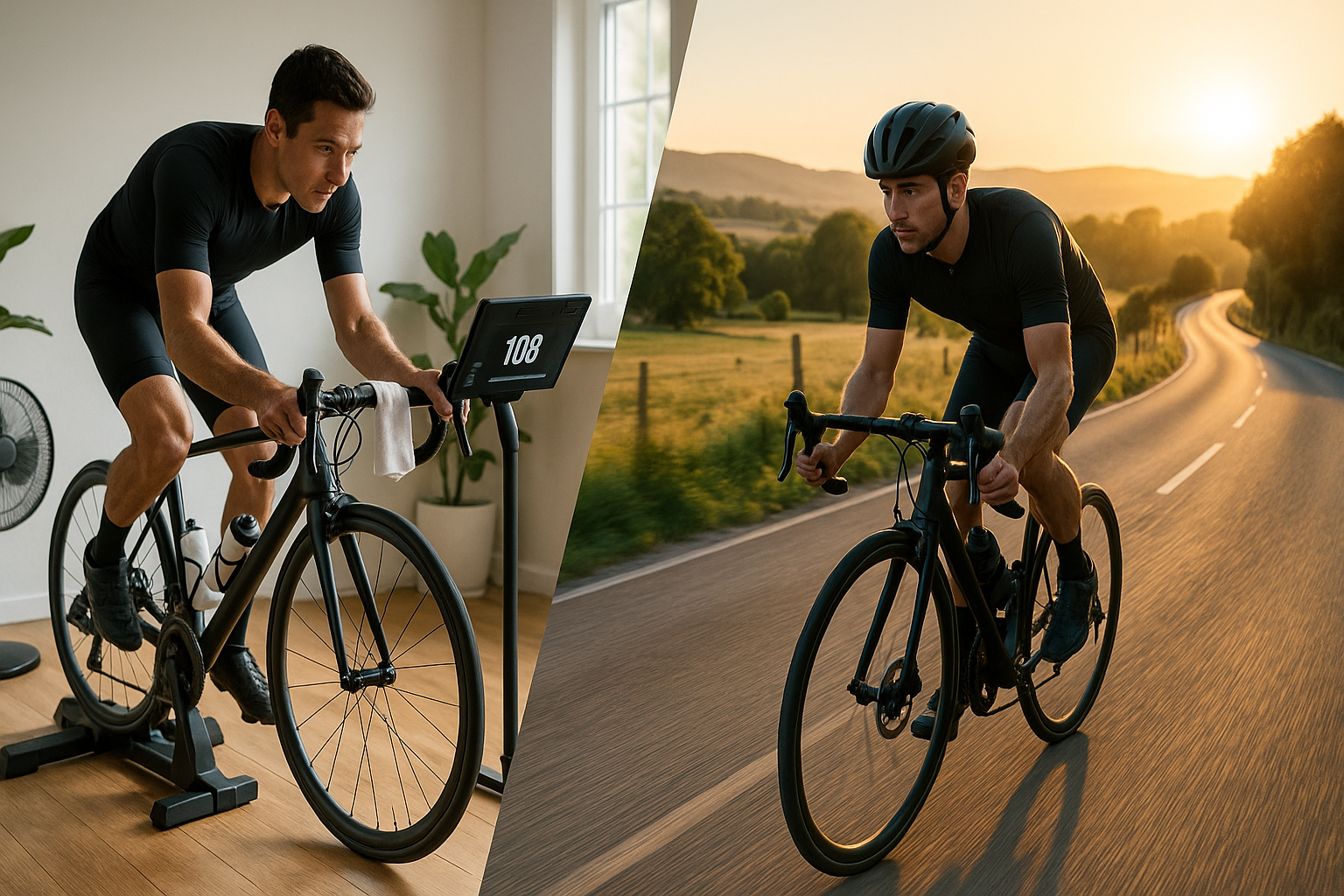
Cyclists love to debate “trainer time” versus riding outside, but the truth is both can be excellent—if you match the format to your goals, constraints, and environment. This guide compares indoor cycling vs outdoor cycling across 12 practical benefits, from fitness and safety to cost and time. It’s written for beginners through experienced riders deciding where each session should live. Quick answer: indoor cycling delivers unmatched control, consistency, and year-round access; outdoor cycling adds real-world skills, terrain variety, and adventure. Use both strategically for the best results. This guide is educational and not a substitute for personal medical advice; adjust for your health status and local conditions.
1. Fitness Gains & Aerobic Adaptations
Both indoor and outdoor cycling build robust aerobic fitness; the better option is the one you’ll do consistently at the right intensities. Indoors, you can hit precise zones and interval targets without coasting or stoplights, which accelerates improvements in lactate threshold and VO₂max for time-crunched riders. Outdoors, longer steady rides, rolling terrain, wind, and subtle surges deliver “endurance noise” that improves durability and real-world pacing. In short: if you need structured intensity and repeatability, go inside; if you need endurance, spontaneity, and mental freshness, go outside. Either way, track progress with objective metrics (e.g., FTP tests, heart-rate zones) and periodize your weeks to balance intensity and recovery.
1.1 Numbers & guardrails
- Target 2–3 quality interval sessions/week inside; anchor 1 longer endurance ride outside where possible (Zone 2 for 60–180 minutes).
- For vigorous efforts, keep perceived exertion honest; heat indoors can raise RPE at the same power.
- Use METs as a rough intensity index: the 2024 Adult Compendium lists ~8.8–9.0 METs for interactive indoor cycling/spin class, comparable to spirited road efforts.
1.2 Mini-checklist
- Calibrate trainer or zero your power meter weekly.
- Replicate outdoor cadences indoors (e.g., 85–95 rpm endurance; 100+ rpm neuromuscular).
- Do a 4–8 week block review using the same field test for apples-to-apples gains.
Bottom line: blend formats—indoor for precision, outdoor for resilience—to amplify aerobic gains, validated by consistent testing and logs.
2. Power Control, Data Quality & Workout Precision
Indoor cycling shines when you need laser-accurate intervals. Smart trainers using ERG mode hold target power even as cadence fluctuates, making workouts like 5×5 minutes at 108–112% FTP both reliable and reproducible. Outdoors, you gain stochastic power exposure: micro-variations from terrain, wind, and drafting teach pacing and surge tolerance, vital for events and group rides. Use platform metrics (e.g., Training Stress Score and Intensity Factor) to compare sessions regardless of venue; they quantify duration × intensity and relative intensity vs threshold. TrainingPeaks
2.1 Tools & examples
- Precision set (indoor): 3×12′ @ 95–100% FTP (IF ≈ 0.95–1.0), 6′ easy between—holds steady in ERG, productive for threshold.
- Pacing set (outdoor): 3×15′ on a gentle climb at your own IF target, practicing even power through corners and grade changes.
2.2 Common mistakes
- Chasing average power outside without checking variability index (VI); too spiky power can inflate TSS with less specific adaptation.
- Indoors without fans—thermal strain skews RPE and reduces output at a given heart rate.
Bottom line: use indoor sessions to “write clean power”; use outdoor rides to translate that power into pacing skill under changing conditions.
3. Time Efficiency, Consistency & Session Density
If your week is busy, indoor cycling removes friction. No traffic lights, stop signs, gear prep, or weather checks; you can turn a 60-minute window into 58 minutes of quality pedaling. Consistency matters more than perfection in endurance training: being able to execute planned sessions, even at odd hours, compounds fitness. Outdoor rides add commute overhead but reward you with scenery, skills, and social motivation—benefits that protect long-term adherence.
3.1 Mini-checklist for efficient sessions
- Park the bike on the trainer ready-to-go; pre-load the workout.
- Two fans + towel + bottle in reach; calibrate device once warmed up.
- Keep warm-ups to ~8–12 minutes for mid-week work; reserve longer warm-ups for race simulations.
3.2 Numbers & guardrails
- Expect 10–20% more “pedaling uptime” per hour indoors versus typical urban road loops.
- For busy riders, 3×45–60 minutes indoors mid-week plus a longer outdoor ride on the weekend is a high-yield pattern.
Bottom line: indoor training multiplies minutes into consistent training load; outside rides keep motivation high—use both to safeguard consistency.
4. Safety Profile: Crashes, Traffic & Controlled Risk
Indoor cycling effectively eliminates collision risk with motor vehicles and most environmental hazards. Outdoor cycling, while immensely rewarding, carries traffic and surface risks that vary by region and route. In the U.S., 1,155 bicyclists were killed in crashes with motor vehicles in 2023, underscoring the importance of route selection, visibility, and skills practice. Indoor sessions also reduce night-riding and inclement-weather exposure while allowing safe high-intensity work.
4.1 Safer-outside checklist
- Choose protected lanes/low-traffic times; run day-bright lights front and rear.
- Widen your safety margin at intersections; scan left/right/behind.
- Helmets always; consider mirrors in urban areas.
4.2 Why it matters
- Reduced crash exposure indoors lets you accumulate intensity without compounding risk. Outdoors, pre-ride route planning is your biggest lever on safety.
Bottom line: indoor = controlled environment; outdoor = real-world exposure that demands extra risk management—plan routes and ride visibly.
5. Air Quality, Ventilation & Inhaled Dose
Outdoors, pollutant concentrations can vary by route and time. Cyclists often inhale a larger dose of pollutants than car passengers because minute ventilation doubles (or more) during riding, even when exposure concentration is similar or lower; this is driven by higher breathing rates and mouth breathing during exercise. On poor-air days, indoor cycling with good ventilation and filtration reduces pollutant intake substantially. Use local AQI guidance: when AQI is “Unhealthy” (≥151) many regions advise reducing or avoiding vigorous outdoor activity; sensitive groups should adjust earlier (≥101).
5.1 Region-smart tactics
- Time rides for off-peak traffic; pick greenway or park loops; avoid bus corridors.
- Indoors, open cross-ventilation and use a HEPA purifier if feasible; position fans to promote evaporation and airflow across head/torso.
5.2 Numbers & guardrails
- Studies report cyclists’ minute ventilation ~2× car/bus passengers during commuting, amplifying inhaled dose for the same concentration. Lippincott Journals
Bottom line: monitor AQI; make outdoor route/time adjustments or move inside with strong airflow and filtration when air quality dips.
6. Heat, Sweat & Hydration Management
Indoors, limited natural airflow increases core and skin temperature, elevating heart rate and perceived effort at the same power. Purposeful airflow and cooling (fans, cool room) reduce physiologic strain; meta-analyses show pre-/per-cooling can improve cycling performance in the heat. Hydration needs vary widely; classic position statements recommend starting euhydrated, limiting body mass loss to <2%, and individualizing fluid/electrolyte intake (often ~0.4–0.8 L/h as a starting range, then adjust by sweat-rate testing). Indoors, expect higher sweat rates without wind; plan towels and corrosion protection for the bike.
6.1 How to do it
- Two high-output fans set ~1–1.5 m away, chest/face level; keep room ≤20–23 °C when possible.
- Pre-ride: ~500 mL fluids in the 2–3 h before; during: sip to thirst guided by body-mass change; after: replace ~125–150% of the deficit with sodium. (Tailor for your health status.)
6.2 Mini example
- If you lose 1.0 kg in a 60-minute session, that’s ~1 L net fluid. Rehydrate ~1.25–1.5 L over the next few hours with some sodium to speed plasma volume restoration.
Bottom line: airflow plus individualized hydration make indoor intensity feel like outdoor effort—cool first, then chase watts.
7. Musculoskeletal Load, Bike Fit & Overuse Risks
On a fixed trainer or spin bike, the bike moves less under you, reducing natural micro-shifts you get outdoors. This can increase localized loading at the contact points (hands/saddle/feet) and around the knees/hips if fit is off. Small asymmetries become repetitive quickly in ERG-held intervals. Outdoor riding varies posture and torque profiles (standing, cornering, micro-bumps), distributing load differently. A careful bike fit—especially saddle height and fore–aft—pays for itself indoors and out; literature shows stationary cycling is widely used in rehab, but poor setup can irritate tissues. SAGE Journals
7.1 Mini-checklist
- Aim for knee angle roughly 25–35° at bottom dead center (general heuristic; let comfort and history guide).
- Add 1–2 standing minutes every 10–15 minutes indoors to vary loading.
- Consider rocker plates or motion-enabled trainers to restore some side-to-side movement.
7.2 Cautionary note
- Rare, but documented: spin-class–associated rhabdomyolysis in new participants after abrupt, maximal efforts. Ramp intensity gradually. Annals Singapore
Bottom line: dial fit and movement variety indoors; outdoors builds handling and postural variability—both protect your tissues.
8. Motivation, Enjoyment & Adherence
The best plan fails if you don’t follow it. Outdoor rides deliver scenery, exploration, group camaraderie, and dopamine from moving through space—powerful adherence drivers. Indoors, modern platforms (structured workouts, virtual worlds, racing, social rides) add gamification and accountability when weather or daylight blocks outdoor sessions. Cooling and entertainment (fans, music, screens) reduce RPE drift indoors; scheduling group rides outdoors can make the long ride happen.
8.1 Tools & tips
- Schedule an indoor group event or workout—structured social sessions improve completion rates.
- Stack habit cues: kit laid out, workout queued, fan remote reachable.
- Rotate stimulus: one “free ride” outside weekly for joy; one “bread-and-butter” threshold set inside for progress.
8.2 Numbers & guardrails
- Expect small performance gains from better thermal management and psychological engagement indoors (e.g., pre-/per-cooling, competition against a ghost file).
Bottom line: harness the psychology of both worlds—novelty and nature outside; structure, social features, and climate control inside.
9. Accessibility, Weather & Inclusivity
Indoor bikes erase barriers: extreme heat/cold, darkness, unsafe roads, and scheduling conflicts. They also support rehab and adaptive cycling when outdoor terrain or traffic isn’t feasible; stationary cycling is a staple in musculoskeletal recovery because you can modulate load and range with precision. Outdoors broadens access to low-cost commuting, fresh air, and green space, but demands route safety and daylight. In regions with monsoons, winter storms, or high AQI seasons, the trainer keeps the habit alive so fitness doesn’t reset every few months.
9.1 Region-specific notes
- During heat waves or poor air days, prioritize indoor intensity and save outdoor spins for cooler mornings or low-AQI windows.
- In winter climates, studs/fenders and layered clothing extend outdoor options—if roads are safe and visible.
9.2 Mini-checklist
- Keep a “bad-weather” plan: backup indoor session, pre-loaded.
- Maintain a small home kit: trainer mat, two fans, towel hook, spare bottles.
Bottom line: indoor riding keeps training equitable and year-round; outdoor riding connects you to community and place—mix for access and joy.
10. Cost of Setup, Subscriptions & Maintenance
Costs differ by path. Outdoor-first riders invest in the bicycle and seasonal gear; maintenance includes tires, chains, and occasional wear from weather and grit. Indoor-first riders may buy a smart trainer or dedicated bike and often pay for a training platform. As of August 2025, Zwift lists $19.99/month or $199.99/year; Peloton All-Access for Peloton hardware shows $44/month in the U.S., while app tiers are lower-cost (regional pricing varies). Outdoor riding has no monthly fee but budget for consumables and, if commuting, locks/lights and occasional service.
10.1 Budgeting tips
- If you already own a road bike, a wheel-off smart trainer often offers the best resistance control; wheel-on is cheaper but may wear tires faster.
- Protect indoor gear from sweat (frame protectors, mats); corrosion is real.
10.2 Mini example
- Annualized: Zwift $199.99 + electricity is predictable; a typical road rider might replace a chain (~$25–$60) and tires ($50–$120/pair) periodically depending on mileage and surfaces.
Bottom line: indoor has predictable subscription costs and lower wear; outdoor has no monthly bill but higher consumables—choose based on usage.
11. Calories, Energy Cost & Weight Management
Both formats can help manage weight via consistent energy expenditure and appetite awareness. At the same external speed outdoors, wind and rolling resistance dominate energy cost; on flat ground near 40 km/h, aerodynamics can account for ~90% of resistance—one reason aero positioning matters outdoors. Indoors, similar power outputs translate directly to caloric burn without stops. Use METs for estimates (e.g., ~8.8–9.0 METs for vigorous indoor cycling); personalize with weight and duration.
11.1 Quick math example
- A 75 kg rider doing a 60-minute vigorous indoor session at ~9 METs expends ≈ 9 × 75 = 675 kcal (plus/minus individual efficiency). Use your meter’s kJ as a tighter proxy (kJ ≈ kcal on the bike over longer rides).
11.2 Guardrails
- Don’t over-correct nutrition after rides; log intake for a week to calibrate.
- Prioritize protein (≥1.6–2.2 g/kg/d) and fiber-rich carbs for satiety on training days.
Bottom line: both modes burn meaningful calories; outside adds aero cost at speed, inside trims downtime—use measured power/METs to guide fueling.
12. Skill Development, Handling & Event Specificity
If you race, commute, or ride in groups, outdoor time is non-negotiable for skill transfer. Cornering, braking, descending, drafting, crosswinds, and surface reading don’t exist indoors. Real roads teach when to coast, when to surge, and how to hold lines in traffic or a peloton. Conversely, if your primary goal is cardio health, weight management, or time-boxed intervals, you can do 80–90% of the necessary work indoors and “top up” with outdoor skills when conditions allow. Even for triathletes and time trialists, blending indoor threshold work with outdoor aero-position practice yields better outcomes than either alone.
12.1 How to progress skills outdoors
- Practice braking and cornering progressively in a quiet lot; eyes level, outside pedal down, light on front, smooth on rear.
- Join a no-drop group ride to learn pack etiquette at manageable speeds.
- Seek steady climbs for aero pacing practice without traffic pressure.
12.2 Indoors that help outdoors
- Cadence pyramids (80→110 rpm) to smooth pedaling.
- Short standing surges (10–20 seconds) to mimic rollers and accelerations.
Bottom line: build fitness anywhere; earn road craft outside—specificity wins when events, commutes, or group rides are your aim.
FAQs
1) Which burns more calories: indoor cycling or outdoor cycling?
At the same average power, energy expenditure is similar. Outdoors you may coast, stop, and face wind/terrain, which can increase total work on some routes; indoors you typically pedal more continuously. A 75 kg rider doing ~9 METs for 60 minutes expends ~675 kcal; your power meter’s kJ is an even better estimate over longer rides.
2) Is indoor cycling “harder” than outdoor?
It often feels harder indoors due to heat build-up and limited airflow, which elevate heart rate and RPE at the same wattage. Strong fans and a cool room reduce the gap; pre-/per-cooling can modestly improve performance in the heat. Outdoors may feel easier at a given power because moving air cools you and the scenery distracts.
3) How should I decide when to train indoors because of air quality?
Check AQI before riding. When AQI exceeds 100 (Unhealthy for Sensitive Groups) many agencies recommend reducing prolonged intense outdoor exercise; at ≥151 (Unhealthy), most people should limit vigorous outdoor activity. If you must train, ride indoors with fans and, ideally, a HEPA purifier.
4) I’m training for a century. Can I do most rides indoors?
Yes—complete your structured intervals and some long rides indoors, but practice outdoor skills (nutrition, pacing on hills, cornering, group etiquette) periodically. Combine 2–3 indoor quality sessions weekly with progressive outdoor long rides to harden contact points and test fueling in real conditions.
5) Are there health benefits unique to riding outside?
The health benefits (cardio, metabolic) come from the activity itself, not the venue. Large cohort studies associate cycling—especially active commuting—with lower all-cause mortality and reduced cardiovascular and cancer risk. Outdoors also provides sunlight and green-space exposure, which some riders find mood-enhancing. Balance these with traffic risk and air quality.
6) What are typical subscription costs for indoor platforms?
As of August 2025, Zwift lists $19.99/month or $199.99/year; Peloton shows $44/month for All-Access on Peloton hardware, with lower-cost app tiers. Prices vary by region and tax; always check the latest pricing.
7) What hydration plan should I follow indoors?
Start euhydrated; for most sessions, sip to thirst and aim to keep body-mass loss under ~2%. Common starting guidance is ~0.4–0.8 L/h, adjusted via weigh-in tests and sweat rate. Include sodium on longer/hot rides. Avoid over-drinking. Individual needs vary with climate, size, and sweat sodium.
8) Can indoor cycling cause injuries?
Overuse can occur with poor fit or abrupt spikes in intensity/volume. Rarely, first-time or deconditioned participants in very intense spin classes have developed exertional rhabdomyolysis. Ramp intensity gradually, mind technique, and seek a fit if discomfort persists.
9) Does aero positioning matter indoors?
Indoors, aero position mainly affects comfort and specificity; outdoors, it dramatically influences required power at speed because aerodynamic drag can be ~90% of total resistance near 40 km/h. Practice aero if your events demand it, but prioritize comfort and cooling indoors. University of Coimbra
10) How do I use TSS/IF to compare rides?
TSS summarizes training load (duration × intensity). IF shows relative intensity vs your threshold. One hour at FTP ≈ 100 TSS by definition. These metrics help compare indoor and outdoor sessions and plan recovery, regardless of route or venue.
11) Is riding to work better than a trainer session?
It depends on goals. Commuter cycling reliably adds daily zone-2 volume and is linked with lower disease and mortality risk, but it may include stop-and-go time that reduces interval quality. If performance is the goal, keep key intervals inside and treat the commute as aerobic base.
12) What’s the ideal weekly mix?
A proven pattern: 2 indoor quality sessions (threshold/VO₂) + 1–2 outdoor endurance rides (skills, group dynamics). Shift more indoors in extreme weather/AQI, more outdoors as events approach. Review every 4–6 weeks and adjust based on fatigue, performance, and life.
Conclusion
You don’t have to pick a side. Indoor cycling offers unmatched control, consistency, and safety for targeted intervals, while outdoor cycling builds the handling, pacing instincts, and joy that keep you riding for life. Use data (power, heart rate, RPE) to unify both worlds, not to argue them apart. On busy weekdays or poor-air days, indoor sessions keep your plan on track and minimize risk; on weekends, long outdoor rides develop endurance, resilience, and road craft. Manage heat and hydration indoors with aggressive airflow and individualized fluid/electrolyte intake; manage risk outside with smart route selection, visibility, and group skills. Costs differ—subscriptions vs consumables—but both paths can be budget-friendly with the right choices. The best program is the one you can sustain joyfully: commit to a weekly blend, evaluate every month, and let your goals determine where you ride each day.
Call to action: Choose one workout you’ll do indoors this week and one you’ll do outdoors—then schedule them now.
References
- Bicyclists — Insurance Institute for Highway Safety (IIHS), 2024 (2023 data). https://www.iihs.org/topics/fatality-statistics/detail/bicyclists c40knowledgehub.org
- Outdoor Activity and Air Quality — AirNow/US EPA, accessed Aug 2025. https://www.airnow.gov/activity-guides/outdoor-activity-guidance/ IIHS
- WHO Global Air Quality Guidelines (2021) — World Health Organization, 2021. https://www.who.int/publications/i/item/9789240034228 CrashStats
- Minute Ventilation of Cyclists vs. Car/Bus Passengers — Zuurbier et al., Epidemiology (2008) & BMC (2009) open-access summary. PMC
- Cyclists’ Inhaled Dose vs. Other Modes — Willberg et al., Int. J. Health Geographics (2023). BioMed Central
- Cooling & Airflow Effects on Cycling Performance — Morrison et al., Sports Med (2014) review (open-access). PMC
- Pre-/Per-Cooling Meta-analyses — van de Kerkhof et al., Sports Med Open (2023); Yu et al., Nutrients (2024). ; PMCMDPI
- Exercise & Fluid Replacement (Position Stand) — American College of Sports Medicine (2007). PubMed
- NATA Fluid Replacement Statement (Update) — McDermott et al., J Athl Train (2017). PubMed
- 2024 Adult Compendium of Physical Activities (Cycling METs) — Herrmann et al., 2024; Activity table PDF. Compendium of Physical Activities
- Aerodynamic Drag ≈ 90% at 40 km/h — Malizia & Blocken reviews (2020–2023). ; SpringerLinkScienceDirect
- Training Stress Score & Intensity Factor (definitions) — TrainingPeaks Help Center (2024–2025). ; https://help.trainingpeaks.com/hc/en-us/articles/204071814-Intensity-Factor-IF help.trainingpeaks.com
- Zwift Pricing (Aug 2025) — Zwift Support. support.zwift.com
- Peloton All-Access Price (US) — Peloton site, accessed Aug 2025. (All-Access $44/mo callouts) ; App vs All-Access support page. PelotonPeloton Support
- Active Commuting & Mortality — Celis-Morales et al., BMJ (2017); Nordengen et al., Br J Sports Med (2019). ; BMJPubMed
- Stationary Cycling in Rehab (overview) — Yum et al., Healthcare (2021). PMC
- Spin-Related Rhabdomyolysis Case Series — Yow et al., Cureus (2021). PMC