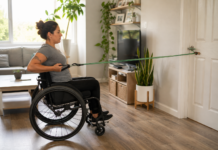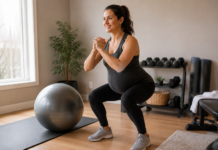


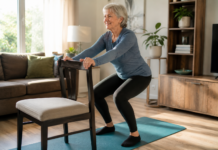























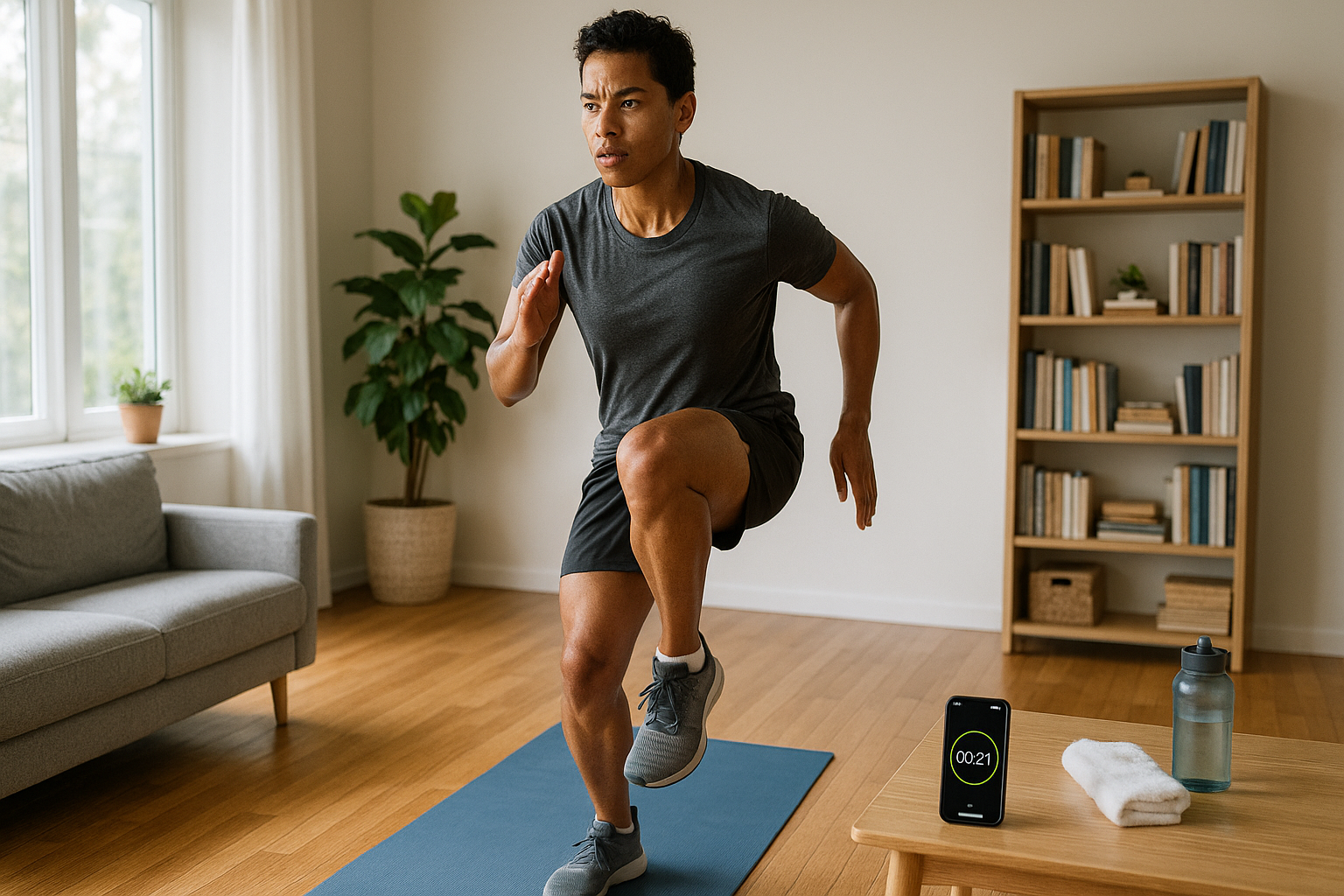
If you want fast, effective training that fits into real life, you’re in the right place. Below are 12 coach-built HIIT workouts you can do at home with zero equipment—each with exact timing, clear cues, and options for any level. High-Intensity Interval Training (HIIT) alternates hard bursts of effort with short recovery periods to deliver big fitness gains in less time. In practice, that means working near your limit (about RPE 8–9/10 or roughly 80–95% of max heart rate) during “work” intervals, then easing off to recover. Do 2–3 HIIT sessions per week with 24–48 hours rest between sessions, and keep moving on other days with low-to-moderate activity.
Quick start (2 steps):
- Warm up for 5 minutes (mobility + light cardio).
- Pick any workout below, set a timer, and go. Stop if you feel pain, dizziness, or chest discomfort. If you’re new to vigorous exercise or managing a health condition, check with a healthcare professional before starting.
1. The 20:10 Tabata (4–12 Minutes Total)
This classic home HIIT session gets you breathless quickly and scales beautifully for beginners or advanced exercisers. The basic template is 20 seconds of all-out effort followed by 10 seconds of rest, repeated eight rounds per block (4 minutes). You’ll rotate through simple bodyweight moves that require minimal space—think squat jumps, mountain climbers, high knees, and burpees. Start with one block (4 minutes) if you’re new; add up to three blocks separated by 2 minutes of easy marching for a solid 14–16 minute training dose. The short work bouts encourage commitment to high intensity, while the very brief rest drives a powerful cardio response.
1.1 How to do it
- Warm-up (5 min): 30s each: marching, arm circles, hip hinges, inchworms, easy high knees.
- Block (4 min): 20s work / 10s rest × 8 rounds. Alternate moves:
- Squat jumps → 2) Mountain climbers → 3) High knees → 4) Burpees → repeat.
- Between blocks (optional): 2 min gentle marching or side steps.
- Cool-down (3–5 min): Slow walk + calves/hips/shoulders stretch.
1.2 Numbers & guardrails
- Intensity: Aim for RPE 8–9/10 on work intervals; RPE 2–3/10 on rests.
- Volume: 1–3 blocks total. Beginners start with 1; experienced trainees may do 2–3.
- Form cues: Soft knee landings, ribs down, neutral spine; keep wrists under shoulders in climbers.
- Safety: If jumping bothers your joints, switch to fast squats and step-back burpees.
Synthesis: Tabata packs a lot into a tiny window, making it ideal when time or motivation is tight—just one focused block still counts.
2. EMOM Power Circuit (10–20 Minutes)
“Every Minute on the Minute” structures intensity by the clock: you complete a small bout of work at the top of each minute and rest with whatever time remains. This is perfect at home because it’s simple, self-paced, and keeps you honest about effort. Choose 3 moves that challenge different patterns (lower body, upper push/pull, cardio). The goal is to finish the prescribed reps in ~30–40 seconds, leaving ~20–30 seconds to recover. Over time, keep the reps the same but move faster or pick slightly tougher variations to maintain intensity.
2.1 Sample EMOM (15 minutes)
- Minute 1: 15 air squats
- Minute 2: 12 push-ups (elevate hands on couch if needed)
- Minute 3: 30 seconds fast mountain climbers (then rest to next minute)
Repeat 5 rounds.
2.2 Tips & progressions
- Pick reps you can complete in ≤40s when fresh.
- If you finish past 45s, cut 2–3 reps next round.
- Advanced: add a fourth station (skater hops 20 total).
- Beginner: reduce to 10 squats, 6–8 push-ups, 20s climbers.
Synthesis: EMOMs deliver HIIT intensity with built-in pacing—a powerful way to build capacity without losing structure.
3. AMRAP Sprint Ladder (12–18 Minutes)
“As Many Rounds As Possible” tests sustained effort while still fitting HIIT’s hard/brief rhythm. This ladder pairs a short sprint-style move with a mini circuit that keeps heart rate high. You’ll climb the rep ladder for one move while holding the others steady, which makes it competitive and fun. Expect heavy breathing and a deep burn.
3.1 The workout
- Set a 12–18 minute timer.
- Moves: High knees (each side), squat-thrusts (no push-up), reverse lunges (each side).
- Ladder: 10/10/10 → 15/10/10 → 20/10/10 → 25/10/10 … continue until time.
- Keep transitions under 10 seconds; shake out arms/legs on the move.
3.2 Common mistakes
- Going out too hot: First 3 minutes should feel “hard but controlled.”
- Messy reps: Quality collapses under fatigue—shorten the ladder jump (add +3 instead of +5).
- Skipping warm-up: Cold hips and knees hate high knees; mobilize first.
Synthesis: AMRAP ladders are simple, spicy, and scalable; the clock keeps you honest while the ladder keeps you engaged.
4. Low-Impact HIIT (Joint-Friendly) (10–20 Minutes)
You don’t have to jump to go hard. Low-impact HIIT swaps plyometrics for fast, full-range moves that are kinder to ankles, knees, and floors. You’ll push intensity via speed, range, and time-under-tension rather than impact. This option is excellent if you’re returning from a break, training in an upstairs apartment, or managing joint sensitivity.
4.1 Template (40:20 × 8–12 rounds)
- Moves (rotate):
- Fast step-outs with arm drives
- Sit-to-stand squats (control down, drive up)
- Standing knee drives (each side)
- Incline push-ups on countertop
- Bear-crawl holds (20–30s)
- Pace: Powerful but smooth; breathe rhythmically.
4.2 Mini-checklist
- Quiet feet (no thudding)
- Knees track over toes
- Tall torso (avoid rounding)
- Use arms to raise intensity
- Stop before form fades
Synthesis: Low-impact HIIT keeps the benefits while reducing noise and wear-and-tear—a smart mainstay for long-term consistency.
5. Shadowboxing Speed Rounds (12–24 Minutes)
Shadowboxing is sneaky-hard: quick footwork, rotational core work, and upper-body conditioning without equipment. It’s a perfect at-home HIIT modality because combinations are short and explosive. You’ll cycle between fast flurries and purposeful resets so intensity spikes and drops cleanly—exactly what HIIT asks for.
5.1 How to structure it
- Rounds: 2–3 minute rounds × 4–6, with 45 seconds easy footwork between rounds.
- Within each round: 15s all-out flurry (1-2-1-2), 15s reset footwork; repeat.
- Add variety: Hooks, uppercuts, slips, and rolls; visualize an opponent; keep guard up.
5.2 Technique cues
- Pivot on the ball of the foot for crosses.
- Chin tucked, elbows in.
- Exhale sharply on punches.
- Don’t lock out elbows; snap and retract.
Synthesis: Short flurries deliver HIIT-worthy spikes while footwork resets prepare you for the next burst—great conditioning with almost zero footprint.
6. 30-20-10 Wave Intervals (15–20 Minutes)
The 30-20-10 method waves intensity within each minute, making it intuitive and extremely effective at home. You’ll spend 30 seconds at easy/moderate pace, 20 seconds hard, and 10 seconds very hard—then repeat. Because the last 10 seconds are maximal, keep moves simple and repeatable.
6.1 Sample block (repeat 4–6×)
- 30s marching with arm swings (RPE 4–5)
- 20s fast jacks or step-jacks (RPE 7–8)
- 10s sprint-in-place or squat thrusts (RPE 9–10)
- Rest 60–90s between blocks as needed.
6.2 Why it works
- The ramp primes your nervous system, helping you hit true high intensity safely.
- The 10-second peaks are short enough to be maximal without wrecking form.
- Beginners can keep all moves low-impact; advanced folks can jump.
Synthesis: Wave intervals teach your body to change gears fast—a hallmark of HIIT that transfers to sports and daily life.
7. Pyramid Power: 15s → 30s → 45s → 60s → 45s → 30s → 15s (16–20 Minutes)
Pyramids pair mental freshness with physiological challenge by varying work duration each set. You’ll climb up, then descend—longer sets teach pacing, shorter sets encourage top-end speed. This is ideal when motivation is high and you want a “main event” session without equipment.
7.1 Moves & flow
- Pair A: Squat jumps ↔ plank shoulder taps
- Pair B: Skater hops ↔ fast step-back lunges
- Timing: Perform Pair A through the pyramid (work = listed time / rest = 15–30s), then Pair B.
7.2 Pacing & guardrails
- Keep breathing audible during long sets.
- Land softly; imagine the floor is hot.
- If form dips at 60s, cap it at 45s and finish strong on the way down.
Synthesis: Pyramids deliver variety without complexity, helping you push hard while staying engaged.
8. Core-Cardio “X” Circuit (12–18 Minutes)
This plan alternates a core brace move with a cardio burst so your trunk stabilizers never fully rest. It’s a smart way to raise heart rate while building resilience for daily tasks (lifting, twisting, carrying). The “X” means you cross-pattern: left/right, upper/lower, front/back.
8.1 Circuit (40:20 × 6–9 rounds)
- Round sequence:
- Dead bug (20 each side)
- Fast high knees (40s)
- Side plank (20–30s/side)
- Switch kicks (40s)
- Hollow hold (30–40s)
- Mountain climbers (40s)
8.2 Technique boosters
- Press low back into the floor during dead bugs/hollows.
- In side planks, stack joints: shoulder over elbow, hips tall.
- Keep climbers light and fast; don’t let hips pike.
Synthesis: The alternating structure lets you push intensity while protecting your spine—perfect for desk-bound bodies.
9. Micro-HIIT: 5×3-Minute “Exercise Snacks” (15 Minutes Total)
When your day is hectic, micro-HIIT accumulates meaningful fitness in tiny bursts. You’ll sprinkle five 3-minute blocks throughout the day, each containing two intense moves and a short reset. This strategy leverages the fact that any movement is better than none and that vigorous minutes add up across the week.
9.1 One 3-minute block
- 40s fast step-ups on a stair (or fast step-outs)
- 20s rest
- 40s push-ups or incline push-ups
- 20s rest
- 40s sprint-in-place
- 20s rest
9.2 How to use it
- Do 5 blocks across the day (e.g., morning, mid-morning, lunch, late afternoon, evening).
- Space them by at least 60 minutes.
- Track with a notes app or smartwatch.
Synthesis: Tiny, ruthless blocks punch above their weight—ideal for busy weeks or heat waves when longer sessions feel daunting.
10. The Apartment-Friendly Sweat (12–20 Minutes, Quiet)
This plan respects neighbors and creaky floors while still delivering HIIT intensity. You’ll rely on tempo, isometrics, and directional changes to spike heart rate without stomping. Think “stealth athlete”: powerful, quiet, controlled.
10.1 Circuit (45:15 × 6–10 rounds)
- Tempo squats (3 seconds down, 1 up)
- Bear crawl forward/back (4–6 “steps” each way)
- Lateral step-shuffle (stay low, quick feet)
- Iso-lunge hold → fast switches (10s hold, 20s switch, 15s hold)
10.2 Neighborhood code
- Train in shoes or on a mat to absorb sound.
- Choose lateral moves over jumps; use step-jacks instead of jumping jacks.
- Ventilate the room—use a fan; hydrate more in hot, humid weather (important for South Asian summers).
- Stop if you feel light-headed; sit, breathe, and sip water.
Synthesis: You’ll finish sweaty, not noisy—perfect for late-night sessions or shared spaces.
11. Cardio-Strength Intervals (18–24 Minutes)
This hybrid alternates a cardio interval with a strength-biased set performed briskly—still HIIT, but with a bit more muscle stimulus. Because you keep equipment-free, you’ll use compound bodyweight moves. The magic is in tempo and range: slow down the lowering phase, then explode up.
11.1 Flow (6 rounds)
- Round A (60s): Stair runs, sprint-in-place, or fast step-outs
- Round B (60s): Push-up to pike (8–12 reps)
- Round C (60s): Alternating reverse lunges (20–24 total)
- Rest: 60–90s; repeat.
11.2 Numbers & guardrails
- Keep B and C brisk but controlled (about 1 rep every 3–4 seconds).
- If you can chat in Round A, go faster; if your form breaks in B or C, slow down and tighten technique.
- As of August 2025, general guidelines suggest pairing vigorous days with easier movement for recovery.
Synthesis: This session hits two birds—engine and muscles—without complicating your setup.
12. 10-Minute Finisher: Burpee-Sprint Blend (One-and-Done)
When you want a single knockout round, this finisher is it. You’ll alternate explosive burpees with sprint-in-place to keep power high and heart rate pegged. Because it’s short and savage, use it on days when you have only a few minutes—or tack it onto a strength session as a conditioning finisher.
12.1 Exact structure (10 minutes)
- Minutes 0–2: 20s burpees / 20s sprint-in-place / 20s rest
- Minutes 2–4: 20s burpees with step-back / 20s sprint-in-place / 20s rest
- Minutes 4–6: 20s burpees / 20s sprint-in-place / 20s rest
- Minutes 6–8: 20s burpees with step-back / 20s sprint-in-place / 20s rest
- Minutes 8–10: 10s max burpees / 20s sprint-in-place / 30s walk
12.2 Safety & scaling
- Step-back burpees for joints; hands elevated on a couch if wrists complain.
- Keep the chest-to-floor portion controlled; no flopping.
- If nausea appears, pause, breathe, and walk—don’t push through.
Synthesis: Ten minutes, major stimulus—proof that “short and sharp” can be enough.
FAQs
1) How many HIIT sessions should I do each week?
For most people, 2–3 sessions weekly with at least 24–48 hours between is plenty. On other days, add walking, mobility, or strength training. This spacing helps you hit true intensity, manage stress, and recover—keys for progress and long-term adherence. Health
2) How long should a HIIT workout be?
Anywhere from 4 to 25 minutes works, depending on your format and fitness. Shorter, harder sessions (like Tabata) can be as brief as 4–8 minutes, while wave intervals or cardio-strength circuits often land in the 15–20 minute range. Quality beats duration—stop when intensity or form fades.
3) What heart rate or effort counts as “high-intensity”?
Aim for roughly 76–96% of max heart rate during work intervals, or an RPE of 8–9/10 if you don’t track heart rate. The “talk test” should feel tough—you can speak a few words, but conversation is broken. Use recovery windows to bring breathing down before the next surge. Lippincott Journals
4) Can HIIT replace steady-state cardio?
Both have value. HIIT can improve cardiorespiratory fitness efficiently, but steady-state builds volume, technique, and recovery capacity. Blend them based on goals—e.g., HIIT 2×/week plus 1–2 easier cardio days. Research shows HIIT boosts VO₂max and health markers, but it isn’t always superior for fat loss versus continuous training.
5) Is HIIT safe for beginners?
Yes—if you scale movements, start with low-impact options, and respect recovery. Keep early sessions short (6–12 minutes of work), learn form, and increase intensity gradually. If you have medical concerns, talk to a clinician first; beginners can use RPE and the talk test to self-monitor well.
6) How does HIIT help health beyond fitness?
HIIT can improve insulin sensitivity, blood pressure, and cardiorespiratory fitness—benefits similar to traditional continuous training when volume is matched. It’s time-efficient, which helps adherence. Combine HIIT with weekly totals that meet public-health activity guidelines for best results.
7) What if I have knee or back issues?
Use the Low-Impact HIIT workout above and avoid deep flexion/jumping early on. Choose step-backs over jumps, elevate push-ups, and shorten work intervals. Focus on posture (neutral spine, ribs down), and stop if pain appears. When in doubt, get a personalized check from a qualified pro.
8) I live in a hot, humid climate. Any tips?
Train earlier or later in the day, ventilate with fans, hydrate well, and reduce the first two intervals to find your rhythm. Heat raises cardiovascular strain; scale intensity sooner and extend rests as needed, especially during heat waves common in South Asia summers.
9) What’s the best timer setup?
Use a free interval-timer app or your phone clock: presets like 20:10 (Tabata), 40:20, or EMOM are ideal. Keep transitions under 10 seconds so your heart rate stays up. If you’re new, set a second timer for a 10–15 minute session cap to prevent overdoing it.
10) Can I do HIIT on consecutive days?
Occasionally, yes—but it’s generally better to alternate hard and easy days. Back-to-back HIIT is more tolerable if one session is low-impact, shorter, or uses different muscle groups (e.g., shadowboxing vs. legs-heavy intervals). Track sleep, soreness, and mood; if they slide, add rest.
11) How does HIIT fit with strength training?
Consider 3–4 total training days: two strength days and two HIIT days, or combine a short finisher (like Workout 12) after a weights session. Keep the heaviest lifting away from the hardest HIIT to protect performance and recovery.
12) Do I still need to meet weekly activity guidelines if I do HIIT?
Yes. Public-health guidelines recommend 150–300 minutes of moderate or 75–150 minutes of vigorous activity weekly, plus muscle-strengthening days. HIIT minutes count as vigorous—use them to reach your goal alongside daily movement and strength work. PMC
Conclusion
HIIT is a powerful, time-smart way to train at home—no equipment, no commute, and no excuses. The key is intensity with intent: brief, high-effort bursts that challenge your system, followed by recoveries that let you do it again with quality. Choose formats that fit your space, joints, and energy—Tabata when time is tight, EMOM when you want structure, waves and pyramids when you’re ready to push, and low-impact options when you need to stay quiet or joint-friendly. Across the week, two to three sessions plus easier movement will deliver impressive gains in cardio, strength endurance, and confidence. Start small, move well, and progress one dial at a time—speed, range, or time—so training stays sustainable. Ready to begin? Pick one workout, set your timer, and go hard for the next 10–20 minutes—your future self will thank you.
CTA: Save this page, choose a plan, and do your first 4-minute block today.
References
- WHO Guidelines on Physical Activity and Sedentary Behaviour, World Health Organization, 2020. World Health Organization
- Bull F. C. et al., World Health Organization 2020 guidelines on physical activity and sedentary behaviour, British Journal of Sports Medicine/PubMed, 2020. PubMed
- Benefits of Physical Activity, Centers for Disease Control and Prevention, April 24, 2024. CDC
- About Physical Activity, Centers for Disease Control and Prevention, August 12, 2025. CDC
- Aerobic Exercise Intensity (Infographic), American College of Sports Medicine, February 2024. ACSM
- Gibala M., Weston M., High-intensity interval training (HIT) for effective and time-efficient exercise, Sports Medicine – Open (review), 2016. PMC
- Kramer A. M. et al., High-intensity interval training is not superior to continuous aerobic training for reducing fat, Scientific Reports, 2023. PMC
- Jagsz S. et al., The Effectiveness of HIIT vs. Moderate-Intensity Continuous Training: Systematic Review, Journal of Clinical Medicine, 2025. MDPI
- High-Intensity Interval Training: For Fitness, for Health or Both?, American College of Sports Medicine, Aug 16, 2019. ACSM
- Yin H. et al., Effectiveness of HIIT in University Students: Systematic Review and Meta-analysis, Frontiers in Physiology, 2025. PMC
- Physical Activity (Fact Sheet), World Health Organization, June 26, 2024. World Health Organization
- High-intensity interval training and cardiorespiratory fitness: systematic reviews summary, Scandinavian Journal of Medicine & Science in Sports, May 17, 2024. Wiley Online Library