



















Self-massage and trigger point release is the at-home practice of applying steady, tolerable pressure and slow strokes to tender “knots” (myofascial trigger points) to reduce pain and improve range of motion. In plain terms: you find a sore spot in the muscle, press into it safely, breathe, and let the sensitivity subside while mobility improves. Trigger points can cause local and referred pain, especially around the neck, shoulders, hips, and calves, and they’re common in both active and desk-bound people.
Before we dive in, a quick safety note: massage is generally low risk, but rare serious effects have been reported (e.g., blood clots), and certain conditions require caution or avoidance (recent injury, suspected DVT, uncontrolled bleeding disorders, active infection, fragile skin/bones, or pregnancy-specific concerns). If in doubt—especially with persistent or worsening pain—talk to a qualified clinician first.
Fast-start sequence (for most body areas):
- Warm up 3–5 minutes (walk, gentle mobility). 2) Palpate to find tender points. 3) Apply pressure 30–90 seconds. 4) Add slow movement through pain-free range. 5) Reassess ROM/pain; repeat up to 2–3 times. 6) Finish with light stretching or easy movement. Evidence suggests these time frames improve short-term range of motion (ROM) and soreness when used sensibly.
1. Screen for Safety and Set Your Pain Guardrails
A good self-massage plan starts by deciding whether you should treat yourself today and how much pressure is appropriate. The principle is simple: stay out of flare-up territory while encouraging the nervous system to “downshift.” Massage therapy is widely used and considered low risk overall, but there are specific red flags and populations that call for extra caution or medical guidance (e.g., suspected blood clots, significant trauma, uncontrolled bleeding disorders, severe osteoporosis, open wounds/skin infection, and pregnancy). In early sessions, aim for “discomfort not distress” (about 4–6/10), ease off if pain sharpens or radiates unusually, and stop if symptoms worsen afterward.
1.1 Why it matters
- Massage can be helpful for several pain conditions, but overdoing pressure or massaging through red flags can backfire. Knowing your limits keeps benefits high and risks low.
1.2 Safety mini-checklist
- Skip today if you have fever, an active infection, or unexplained calf swelling/redness (possible DVT).
- Use light pressure if you bruise easily, have circulatory issues, or are pregnant; when pregnant, consult your clinician first.
- Avoid direct pressure on bony prominences, varicose veins, recent fractures/sprains, or areas with reduced sensation.
- Stop and seek care for new numbness/weakness, chest pain, or sudden severe pain.
A simple “green-light” screen protects you while making every other technique in this guide more effective.
2. Map Your Trigger Points and Referred Pain Patterns
Trigger points are hyper-sensitive spots in taut muscle bands that hurt when pressed and may refer pain elsewhere. Start each session by slowly sweeping your fingertips or a ball across the target region to locate small, tender nodules or “cords.” Mark the most sensitive 1–3 points; these will be your priority. Expect that pressing a point in your upper trapezius can produce ache up the neck or into the head, or a gluteal point may send pain toward the hip—referred patterns are normal and informative.
2.1 How to do it
- Palpate with slow, pea-sized circles across the muscle, not just the skin.
- Note which spots reproduce your familiar pain (local or referred).
- Rate sensitivity (0–10) and range of motion (e.g., neck turn degrees) before/after treatment.
2.2 Common mistakes
- Chasing only the painful spot: Often, adjacent muscles contribute. Scan the whole chain (e.g., calf plus sole of foot; glutes plus hip flexors).
- Pressing too hard too fast: Let the tissue warm up first.
- Ignoring posture and workload: Modify what’s provoking the muscle in daily life.
Finish by selecting the top one or two points—quality beats quantity in each session.
3. Ischemic Compression With a Ball (Lacrosse, Tennis, or Rubber)
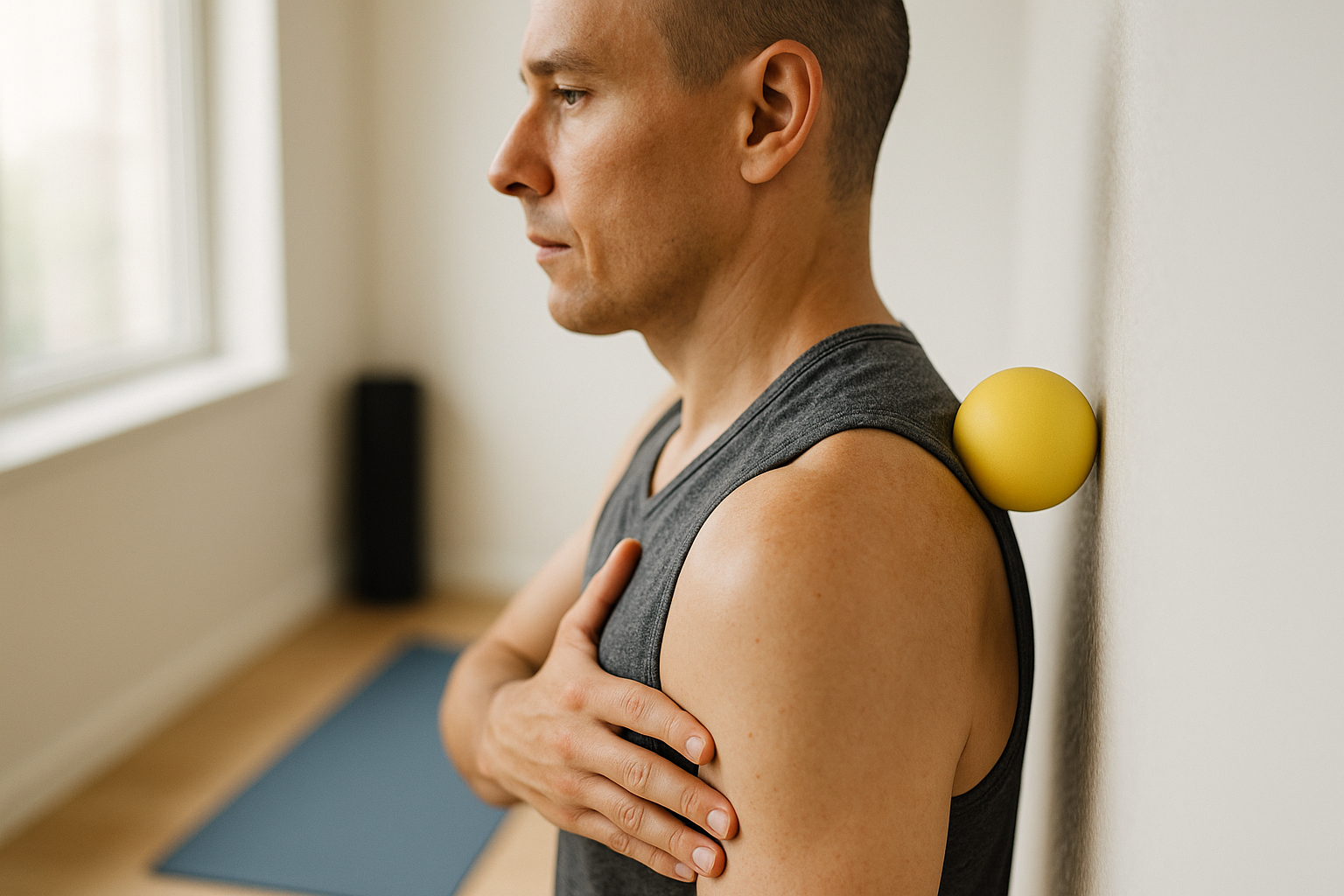
Ischemic compression means applying steady, tolerable pressure to a trigger point until the sensitivity eases. It’s one of the most straightforward, research-supported self-techniques to reduce pain in the short term and increase pressure-pain tolerance. Use a firm ball against a wall or floor for glutes, calves, pecs, lats, or upper traps. Sink into the point, breathe, and wait 30–90 seconds; repeat up to 2–3 times. Meta-analyses show immediate to short-term improvements in pain and pressure thresholds with ischemic compression.SAGE Journals
3.1 Steps
- Position: Place the ball on the tender point; lean until you feel a 4–6/10 pressure.
- Hold: Breathe slowly for 30–90 seconds; let the sensation soften.
- Repeat: 1–3 holds per point, 30–60 seconds rest between.
- Reassess: Move the joint; note any ROM change.
3.2 Numbers & guardrails
- 30–90 seconds per hold; total 1–3 minutes per point per session.
- If pain ramps up or radiates sharply, lighten pressure or stop.
- For neck/upper trap, favor a wall over the floor to better control load.
This “press and wait” method is efficient, portable, and ideal when time is short.e-arm.org
4. Foam Rolling for Broad Tissue Prep and ROM
Foam rolling uses slow, sweeping strokes to warm tissues, reduce soreness, and modestly improve ROM without harming performance. Systematic reviews and meta-analyses report small-to-moderate acute ROM gains and reduced delayed-onset muscle soreness when rolling is dosed sensibly. Use broad passes first (30–120 seconds per muscle), then zoom in on hotspots if needed. Rolling pairs well with dynamic mobility during warm-ups and with easy movement post-training.PMC
4.1 How to do it
- Scan pass: 30–60 seconds, slow (about 3 cm/second).
- Focused passes: 2–3 slow rolls over sensitive bands.
- Finish: 5–8 reps of the joint movement you want to improve (e.g., ankle pumps after calf roll).
4.2 Numbers & guardrails
- Typical research protocols use 30–120 seconds per muscle, 1–3 sets.
- Expect ROM gains to last minutes to an hour; “bank” them with movement or light stretching.
- Rolling shouldn’t feel like punishment; stay at 4–6/10 sensation.
Think of foam rolling as “priming the canvas” so targeted work takes hold.
5. Static Compression on the Roller (Targeting Latent Trigger Points)
Once a hotspot is found on the roller, stop and hold—that static compression can calm latent trigger points and restore function. Research on static compression to latent myofascial trigger points suggests it may improve muscle function acutely. Keep breathing and wait for the sensation to ease before moving on. This hybrid approach (broad sweep + holds) is time-efficient for large muscle groups like quads and glutes.
5.1 Mini-checklist
- Locate the most tender 1–2 spots per muscle.
- Hold 30–60 seconds per spot; repeat up to twice.
- Recheck ROM or movement pattern immediately (e.g., bodyweight squat depth).
5.2 Common mistakes
- Rolling restlessly without pausing on the worst areas.
- Pressing so hard that your body tenses up (defeats the purpose).
- Skipping the re-test, so you miss objective change.
Static holds on the roller give you the best of both worlds—coverage and precision.
6. Cross-Fiber Friction (CFM) to Break Patterned Guarding
Cross-fiber friction involves small, perpendicular strokes across the muscle fibers over a tender point. The goal isn’t to “scrub out” fascia; it’s to provide a novel stimulus that can reduce pain and improve tolerance to pressure. Evidence for friction massage shows within-group improvements in pain, pressure-pain threshold, and ROM; between-group results versus controls are mixed, so treat CFM as a complement rather than a cure-all. Use your fingertips, a thumb, or a small tool and limit sessions to a couple of minutes per site.
6.1 How to do it
- Warm the area (sweeps or a brief hold).
- Apply short, slow, side-to-side strokes over the tender band (30–90 seconds).
- Follow with a pain-free stretch or simple movement to “lock in” change.
6.2 Pitfalls
- Rubbing too fast/hard: stay deliberate; aim for tolerable pressure.
- Working cold tissue: always warm first.
- Overtreating: soreness should fade within 24 hours.
Use CFM when a point is stubborn after compression or when finger control beats tools.
7. Pin-and-Stretch: Move Through the Pressure
Pin-and-stretch combines gentle pressure on a tender spot with active movement of the muscle through a comfortable range. Mechanically, you’re gliding tissue under a fixed contact; neurologically, you’re reassuring the system that movement is safe. While clinical protocols vary and high-quality head-to-head trials are limited, pairing compression with controlled movement is a practical way to reduce guarding and reclaim ROM—especially around the neck, pecs, hip flexors, and calves. Use light-to-moderate pressure and slow, smooth motion.
7.1 Steps
- Pin a trigger point with fingertip/ball.
- Move the joint through a small, comfortable arc (5–10 reps).
- Reposition slightly and repeat through the full pain-free range.
7.2 Mini-case
- Calf/ankle: Pin a soleus hotspot (mid-calf) with a ball against the wall. Perform slow ankle dorsiflexion/plantarflexion 8–10 reps, then re-test squat depth.
Even without flashy claims, this quiet combo often converts tenderness into usable motion.
8. Stripping With a Stick or Roller Massager (Parallel Strokes)
A massage stick or roller massager lets you apply parallel, longitudinal strokes along the muscle belly. This is especially handy for quads, calves, hamstrings, and forearms. Systematic reviews include roller massager techniques among self-myofascial release methods that increase ROM and decrease soreness acutely; dosage ranges mirror foam rolling. Work from mid-belly toward the ends with moderate pressure, then revisit any hotspots with brief holds.
8.1 How to do it
- 30–60 seconds of slow, even strokes per region.
- 2–3 passes, pausing 20–30 seconds on tender bands.
- Follow with the joint action you want to improve (e.g., knee flex/extend).
8.2 Guardrails
- Avoid compressing directly over superficial nerves or bone.
- Keep wrists neutral; don’t strain your hands.
- Start lighter on bony, lean areas like shins/forearms.
Sticks excel when you want precise pressure without getting on the floor.
9. Percussive Massage Guns: Short Bursts, Smart Targets
Massage guns deliver rapid, small-amplitude pulses that can reduce soreness and modestly improve ROM in the short term. Recent reviews suggest benefits for flexibility and recovery-related outcomes, but little to no advantage for strength, balance, or explosive performance—so use them for comfort and mobility, not as a performance hack. Keep sessions brief (30–60 seconds per muscle), start on the lowest setting, and avoid bony areas or recent injuries.
9.1 How to do it
- Glide slowly over the muscle for 30–45 seconds.
- Park for 10–20 seconds on tender spots (don’t jam into bone).
- Reassess ROM; pair with dynamic movement.
9.2 Safety notes
- Skip over varicose veins, active inflammation, or areas with reduced sensation.
- Extra caution if you’re on anticoagulants or have bleeding risks.
- Stop for unusual numbness, tingling, or sharp pain.
Used wisely, guns are a quick comfort tool—not a replacement for movement or strength work.
10. Breath-Led Down-Regulation While You Treat
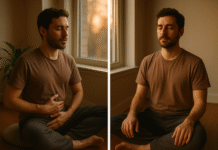
The nervous system heavily influences pain and muscle tone. Simple slow breathing (e.g., 4–6 breaths/min) while you hold pressure often lowers perceived intensity and lets muscles “let go” sooner. Mind–body practices like relaxation breathing and mindfulness are established components of integrative pain care; combining them with mechanical inputs (compression/rolling) is low-risk and pragmatic. Aim for a gentle inhale through the nose, a slightly longer exhale, and soft shoulders/jaw as you hold a point.
10.1 Mini-checklist
- Inhale 4–5 seconds, exhale 6–7 seconds; repeat 6–10 cycles per hold.
- Keep peripheral muscles (face, hands) relaxed.
- If intensity spikes, lessen pressure, slow the breath.
Breath control is free leverage—use it to turn tolerable pressure into lasting relief.
11. Dose and Program Your Sessions (What the Research Uses)
Effective self-myofascial release uses short, focused bouts: 30–120 seconds per muscle or per point, 1–3 sets, several times per week. Meta-analyses of foam rolling and self-myofascial release report ROM improvements and reduced soreness with these durations; at least ~90 seconds per muscle may be optimal for soreness relief. For longer-term ROM gains, pair SMR with stretching and consistent training across weeks.
11.1 Practical template (per region)
- Warm: 30–60 s broad sweeps.
- Target: 1–3 holds of 30–90 s on top points.
- Move: 5–10 reps of the goal motion (e.g., hip hinge).
- Total: 5–8 minutes/region; 3–5 days/week as needed.
11.2 Keep score
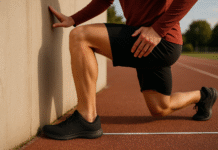
- Track a simple ROM test (e.g., sit-and-reach, ankle dorsiflexion wall test) and a 0–10 pain scale before/after sessions to guide progression.
Dose like a scientist: brief, repeatable inputs and measurable outcomes.
12. Know When to Stop and When to Get Help
Self-massage is a great first line, but not a cure-all. Stop if you notice increasing pain, new neurological symptoms (numbness/weakness), unusual swelling/redness (especially in the calf), or no improvement over 2–3 weeks of consistent, well-dosed work. Seek a clinician’s assessment for persistent or widespread pain, frequent headaches, or if red flags are present. A professional can confirm the diagnosis, rule out other causes, and integrate manual therapy with exercise, education, and—where appropriate—other modalities.Cleveland Clinic
12.1 Next steps
- Book with a physical therapist or sports-medicine clinician if DIY progress stalls.
- Ask for a plan that blends strengthening, mobility, workload changes, and (if needed) clinician-applied techniques.
Knowing your exit criteria keeps you safe and speeds up real recovery.
FAQs
1) What exactly is a trigger point?
A trigger point is a hyper-irritable spot in a taut muscle band that’s painful to touch and can refer pain to other areas (for example, a knot in the upper trapezius that sends pain up the neck). Clinicians diagnose them by palpation; there’s no specific imaging test. They’re common and often linked to overload, posture, or stress.
2) How long should I press on a trigger point?
Most research-based protocols use 30–90 seconds per hold, up to 1–3 minutes total per point per session. If intensity rises or you start tensing up, back off. Holding longer doesn’t necessarily help more—pair pressure with gentle movement and re-tests for better, lasting change.
3) Does foam rolling actually improve flexibility?
Yes—acutely. Meta-analyses show small-to-moderate increases in ROM after brief rolling (30–120 seconds per muscle), without harming performance. Combine rolling with dynamic mobility to “spend” the new range usefully.PMC
4) Are massage guns worth it?
They’re useful for comfort and short-term ROM, not for boosting strength or explosive performance. Keep sessions brief, avoid bones and recent injuries, and start at the lowest setting. Think “feel better, move better,” not “hit a PR.”
5) Can self-massage replace physical therapy?
It’s a strong adjunct, not a replacement. For persistent or complex pain, a clinician can assess mechanics, prescribe exercise, and integrate manual techniques when useful. If DIY work hasn’t helped in 2–3 weeks, get evaluated.
6) What’s the difference between myofascial release and trigger point therapy?
The terms often overlap in practice; many clinics use “myofascial release” to include trigger point methods. The shared aim is to reduce tenderness and improve motion with pressure and stretch, ideally alongside exercise and stress management.Cleveland Clinic
7) How many days per week should I do this?
Aim for 3–5 days/week for tight or symptomatic regions, using short sessions (5–8 minutes/area). Consistency beats marathon sessions. Taper frequency as symptoms settle and you maintain with strength and movement.
8) Is cross-fiber friction safe?
Generally, yes—when done gently on warm tissue for short bouts (30–90 seconds). Evidence shows within-group gains in pain and ROM, though superiority over other methods is mixed. Avoid bony prominences and stop for sharp pain.
9) I’m pregnant—can I self-massage?
Use light pressure, avoid the abdomen and deep pressure on legs, and clear it with your prenatal provider. When in doubt, book a prenatal-trained therapist. Safety takes priority over intensity.
10) What if pressing one spot makes pain appear somewhere else?
That’s typical referred pain from trigger points. It doesn’t mean damage; it’s a recognized pattern. Work the point gently, explore neighboring muscles, and re-test motion. If symptoms are unusual or worsening, stop and seek guidance.
Conclusion
Self-massage and trigger point release work best when they’re targeted, dosed, and paired with movement. Start with a quick safety screen and a simple plan: scan for tender points, apply steady pressure for 30–90 seconds, add slow movement, and retest your motion. Foam rolling offers broad coverage and short-term ROM gains, while focused tools—a lacrosse ball, a massage stick, or a massage gun—let you zero in on stubborn spots. None of these methods replace smart training, ergonomics, sleep, and stress management, but together they can reduce pain, restore motion, and make workouts and daily life feel better. Over two to three consistent weeks, keep score with quick tests (pain 0–10; a simple ROM check). If progress stalls, consult a clinician who can tailor the plan and address root causes like workload, posture, or strength deficits.
Your next step: pick one region, follow the six-step sequence above for 10 minutes, and notice how you move right after—then keep the wins with a few easy reps.
References
- Massage Therapy: What You Need To Know — National Center for Complementary and Integrative Health (NCCIH). Accessed 2025. NCCIH
- Touma J, May T, Isaacson AC. Cervical Myofascial Pain — StatPearls (Last update: July 3, 2023). National Library of Medicine/NCBI Bookshelf. NCBI
- Myofascial Pain Syndrome: What It Is, Symptoms & Treatment — Cleveland Clinic (Last reviewed: June 13, 2023). Cleveland Clinic
- Wilke J, et al. Acute Effects of Foam Rolling on Range of Motion in Healthy Adults: A Systematic Review with Meta-analysis. Int J Sports Phys Ther. 2020. PubMed. PubMed
- Cheatham SW, et al. The Effects of Self-Myofascial Release Using a Foam Roll or Roller Massager on Performance and Recovery: A Systematic Review. J Bodyw Mov Ther. 2015. PMC. PMC
- Hughes GA, Ramer LM. Duration of Myofascial Rolling for Optimal Recovery, Flexibility and Performance: A Systematic Review of the Literature. Int J Sports Phys Ther. 2019. PMC. PMC
- Konrad A, et al. Foam Rolling Training Effects on Range of Motion: A Systematic Review and Meta-analysis. Int J Environ Res Public Health. 2022;19(18):11638. MDPI
- Konrad A, et al. Static Stretch Training vs Foam Rolling Training Effects on Range of Motion: A Systematic Review and Meta-analysis. Sports Medicine. 2024. SpringerLink
- Lu W, et al. Effect of Ischemic Compression on Myofascial Pain Syndrome: A Systematic Review and Meta-analysis. Chiropr Man Therap. 2022. PMC
- Ferreira RM, et al. The Effects of Massage Guns on Performance and Recovery: A Systematic Review. 2023. PMC. PMC
- Sadeghnia M, et al. The Effect of Friction Massage on Pain Intensity, Pressure Pain Threshold, and ROM in Individuals With Myofascial Trigger Points: A Systematic Review. BMC Musculoskelet Disord. 2025. BioMed Central
- Wilke J, et al. Immediate Effects of Self-Myofascial Release on Latent Myofascial Trigger Points. J Sports Sci Med. 2018. PMC. PMC
- Mind and Body Practices — NCCIH. Accessed 2025. NCCIH