



















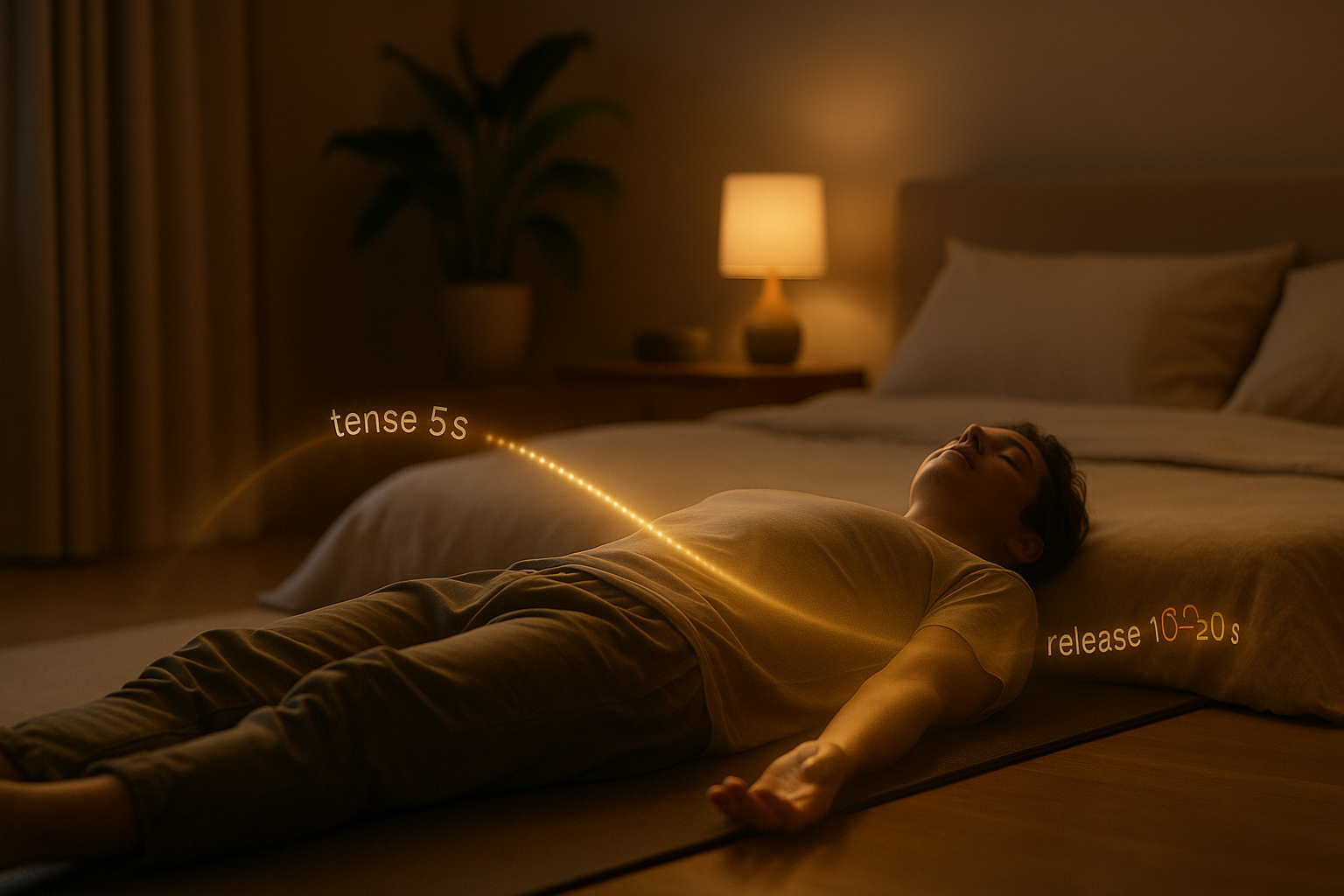
Progressive muscle relaxation with visualization blends a proven muscle-tension/release routine with vivid mental imagery to dial down the body’s stress response. If you’re new, here’s the quick definition: you intentionally tense a muscle group for about 5 seconds and then release for 10–20 seconds while imagining warmth, softness, or tension “flowing out.” Done head-to-toe, this helps quiet the nervous system and reduce anxiety, pain, and insomnia. This guide gives you a practical, safe, step-by-step workflow you can start today. Brief note: this content is educational and not a medical diagnosis or treatment; if you have injuries, acute pain, or medical concerns, adapt or skip steps and consult a clinician.
Quick start (cheat sheet): Sit or lie down → breathe low and slow → for each muscle group: inhale + gently tense ~5 seconds → exhale + release 10–20 seconds → visualize tension melting/draining → notice contrast → move on. Repeat groups 1–2 times.
1. Set Up Your Space, Intention, and Safety Guardrails
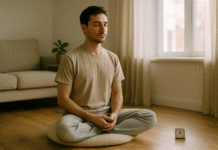
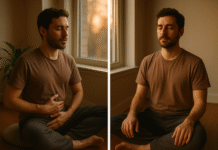
Start by making the practice easy to enter and safe for your body; this step determines how deeply you’ll relax later. Choose a quiet, dim environment where you can remain undisturbed for 10–20 minutes and decide whether you’ll sit supported or lie down on a firm surface. Remove distractions (silence notifications, loosen tight clothing), and set an intention such as “soften my jaw and sleep well” or “reset after work stress.” If you’re dealing with acute injuries, recent surgery, joint instability, or flare-ups of pain, commit now to skip those areas or reduce intensity—PMR should never produce sharp or shooting pain. Think of intensity as a gentle firming (about 30–50% effort), not a maximal squeeze. Finally, remember that release is the point of the exercise; you’ll be learning to feel a contrast between “tense” and “relaxed” so the nervous system can recalibrate.
- Mini-checklist
- Phone on silent; room comfortably cool or warm.
- Support: chair with back, or yoga mat + small pillow under knees.
- Intention stated in one sentence you can repeat.
- Water nearby; any braces or medical supports remain in place.
- Decide on a 10–20 minute window; set a soft chime timer.
1.1 Why it matters
A consistent setup becomes a context cue your brain links to calm. Over days, simply lying on the same mat or hearing the same ambient sound primes relaxation more quickly. Safety guardrails also increase adherence—when you know it won’t hurt, you’ll come back to it.
Synthesis: Clear intention + comfortable setup + safety rules = fewer distractions and a deeper relaxation curve later in the sequence.
2. Prime the System with Diaphragmatic Breathing and an Imagery Anchor
Begin with 2–3 minutes of diaphragmatic breathing to lower baseline arousal and prepare your imagery. Place one hand low on the belly and one on the chest; inhale through the nose so the lower hand rises, exhale through the mouth like fogging a mirror. Keep the rhythm unforced—about 4–5 seconds in and 6–8 seconds out. As you breathe, pick an imagery anchor you’ll reuse during releases: a warm shower washing down your body, sunlight spreading across muscles, or a gentle tide moving out. This anchor creates a consistent “story” your nervous system learns to follow; pairing the same image with each exhale amplifies the relaxation response and helps attention stay put.
- How to do it (60–90 seconds)
- Inhale: feel belly expand; silently say “soften.”
- Exhale longer: imagine warmth spreading; silently say “release.”
- Add a micro-pause (1 second) after exhale before the next inhale.
2.1 Numbers & guardrails
Aim for 5–8 breath cycles per minute while staying comfortable. If you feel lightheaded, reduce depth, not pace. People with respiratory conditions should keep breaths gentle and pain-free.
Synthesis: Slow belly breaths plus a repeating image turn down sympathetic arousal and give you a mental “track” to ride as you move through the muscle groups.
3. Feet and Calves: Build a Ground-Up Relaxation Signal
This step establishes a strong “downward” signal from the periphery, which can be surprisingly effective for anxious restlessness. Point toes toward the face (dorsiflex) to engage the shins, then press toes away (plantarflex) to gently tense the calves. Keep the effort modest—think firm sock, not tourniquet. As you exhale into release, picture tension draining from your soles into the floor or sand. Notice the difference between the mild, tight ache of tensing and the spreading warmth as muscles let go; that contrast is the therapeutic lesson your brain is learning to reproduce spontaneously later.
- Sequence (repeat 1–2 times)
- Inhale + tense: curl toes down for ~5 seconds.
- Exhale + release: 10–20 seconds, imagine warmth radiating through arches.
- Inhale + tense: flex ankles toward you ~5 seconds.
- Exhale + release: 10–20 seconds, picture a tide receding from calves.
3.1 Common mistakes
Over-squeezing (cramps), holding the breath during tension, and rushing the release. If you cramp, ease the next squeeze to ~30% effort or skip that position today.
Synthesis: Starting at the feet sets a rhythm you’ll repeat throughout—short, gentle tension followed by longer, imagery-rich release.
4. Thighs and Hips: Large Muscle Groups, Large Payoff
Your quadriceps, hamstrings, and glutes hold a lot of day-long tension, especially from sitting. Working these bigger groups early yields a palpable drop in overall arousal. With knees slightly bent for comfort, inhale and gently press knees together to engage inner thighs, or push heels into the floor to recruit hamstrings and glutes. Avoid straining the lower back; this is a firm activation, not a max effort. On each exhale, imagine your legs getting pleasantly heavy, like sandbags settling into place, while warmth spreads from hips to knees. The clearer you make that image, the deeper the “let go” signal to your nervous system.
- Mini-routine
- Adductors (inner thighs): Inhale, press knees together 5 seconds → Exhale 15 seconds.
- Hamstrings/glutes: Inhale, gently press heels down 5 seconds → Exhale 15 seconds.
- Quads: Inhale, straighten legs slightly to firm thighs 5 seconds → Exhale 15–20 seconds.
4.1 Numbers & guardrails
For knee or hip issues, keep the joint neutral and skip any position that pinches. If you feel sharp pain, stop—substitute a mental tension only (imagine tensing) and perform only the release with imagery.
Synthesis: Big muscles respond well to small, precise efforts—pair that with slow exhalations and your whole lower body will feel heavier and calmer.
5. Hands and Forearms: From Clench to Release
Hands mirror stress—keyboards, steering wheels, and phone grips leave a low-grade clench. This step trains a noticeable shift from “grip” to “ease.” With arms resting by your sides or on thighs, gently make fists as you inhale, feeling forearms firm. On the exhale, open fingers wide and let palms soften, imagining warm water flowing from wrists to fingertips. Follow with a wrist flex/extend variation: curl wrists toward you on an inhale, release and picture a soft breeze moving through fingers on the exhale. Keep attention sharp; you are studying contrast.
- Checklist
- Fists: 5-second squeeze → 10–20-second release.
- Wrists: flex 5 seconds → release 15 seconds.
- Optional repeat 1–2 times, lighter each round.
5.1 Tools & examples
Pair with a small prop: during release, let a smooth stone rest in each palm and imagine its warmth spreading. If you type all day, this step alone—2 minutes, twice daily—can cut end-of-day forearm tightness.
Synthesis: Training your hands to unclench is a fast way to teach your brain that “not gripping” is safe and available on command.
6. Upper Arms and Shoulders: Unload the Traps
Shoulders and upper arms tend to “creep up” under stress. Here you’ll re-teach them to drop. On an inhale, gently shrug shoulders toward ears or press elbows into the chair/bed to engage biceps/triceps. Keep jaw soft; avoid bracing the neck. On the exhale, feel shoulders melt down and back as if warm sunlight were softening the muscles. Visualize a weighted blanket over the shoulders, transmitting heaviness and safety.
- Step flow
- Shrug: inhale + lift ~5 seconds → exhale + release 15 seconds.
- Press elbows: inhale + press 5 seconds → exhale + release 15 seconds.
- Repeat once, softer.
6.1 Common mistakes
Over-tensing the neck, holding breath, and collapsing posture in release. Keep tension targeted to shoulders/arms; let neck stay long and neutral.
Synthesis: Shoulders respond dramatically to contrast; the clear “up/down” pairing plus warmth imagery builds a reliable drop-the-shoulders reflex.
7. Face and Jaw: Unclench for Headache Relief
Jaw tension and facial bracing feed headaches and fatigue. This step invites a soft, open face. Inhale and gently clench the jaw (teeth together but not grinding) for 3–5 seconds; exhale and allow lips to part, tongue resting on the floor of the mouth. Next, squeeze eyes closed for 3–5 seconds; exhale and soften eyelids and forehead as if warm water were flowing over your brow. Finally, raise eyebrows for 3 seconds, exhale and smooth the forehead with your mind’s hand. Keep each release longer and pair it with a calming image: a lamp dimming, ripples fading on a pond, or a warm towel over the face.
- Mini-checklist
- Jaw: 3–5 s light clench → 10–15 s release.
- Eyes/forehead: 3–5 s squeeze or lift → 10–15 s release.
- Keep intensity gentle; skip if jaw disorders are present.
7.1 Why it matters
Relaxing the jaw and brow can cascade downward—neck, shoulders, and breath often follow. For screen fatigue, add a 30-second eye “palming” during release (cups over eyes, no pressure) to deepen the effect.
Synthesis: A softer face signals “safe” to the nervous system; pairing it with warm, visual cues accelerates full-body calm.
8. Neck and Throat: Soften Without Strain
The neck is vulnerable; here you emphasize micro-tension and big releases. Sit or lie with the head supported. Inhale and gently press the skull into the support for 3–5 seconds to activate deep neck flexors/extensors; exhale and let the head settle heavier. Next, imagine your throat widening as you exhale, like a tunnel opening for breath and sound—this simple image reduces subtle throat guarding many people hold when anxious. Avoid rotating or wrenching the neck; you’re practicing precise, tiny contractions.
- Sequence
- Head press: 3–5 s → release 15–20 s.
- Optional: tiny nod “yes” for 2–3 s → release 10–15 s.
- Picture warm light at the base of the skull during release.
8.1 Common mistakes
Over-rotation, shrugging shoulders, and chasing a stretch sensation. This is PMR, not stretching; keep movements small and pain-free.
Synthesis: Tiny, targeted neck activations followed by long, imagery-rich releases calm an area that often fuels headaches and baseline tension.
9. Chest and Upper Back: Breathe Into Space, Then Soften
Many people brace through the chest and mid-back. Here you’ll create space with breath, then cue release. On an inhale, imagine the ribcage expanding 360°; at the top, gently press shoulder blades together for 3–5 seconds. Exhale and let the back widen and the chest soften, picturing a warm breeze moving through the ribs. Follow with a gentle pec activation by pressing palms together lightly at the sternum for 3–5 seconds, then release and imagine the sternum floating.
- Micro-protocol
- Scapular set: 3–5 s → release 15 s while visualizing widening.
- Palms press: 3–5 s → release 15–20 s with “melting chest” image.
- Keep breath smooth, exhale slightly longer than inhale.
9.1 Numbers & guardrails
If chest breathing feels tight, reduce the inhale depth and focus on exhale-weighted breaths (e.g., 4 seconds in, 6 out). Those with shoulder issues can skip the scapular squeeze and do only breath + imagery.
Synthesis: A spacious chest and wide back reduce the sense of bracing; imagery turns the release into a felt, memorable event.
10. Abdomen and Pelvic Floor: Release the Hidden Braces
Chronic stress often shows up as subtle belly clenching and pelvic floor guarding. This step teaches softening without strain. On an inhale, gently draw the navel toward the spine for 3–5 seconds; exhale and allow the belly to soften, picturing warm sunlight pooling in the abdomen. For the pelvic floor, imagine a gentle elevator: inhale and think “up one floor” (very light lift), exhale and think “down two floors” (soften below baseline). No squeezing or forcing—the visual is the main driver here.
- Mini-checklist
- Belly: 3–5 s light draw-in → 15 s soften with warmth.
- Pelvic floor: mental image only or very light engagement → long release.
- Keep breath smooth; avoid Valsalva (do not hold breath).
10.1 Common mistakes
Over-recruiting (hard bracing), breath-holding, and chasing a flat belly. The goal is ease, not tone. If you’re pregnant, postpartum, or managing pelvic pain, keep this step imagery-only and consult a clinician for individualized guidance.
Synthesis: Teaching the abdomen and pelvic floor to let go unlocks a quieter, more effortless breath and deepens whole-body calm.
11. Full-Body Integration Sweep with Color and Temperature Imagery
Now that you’ve moved through groups, integrate them with a top-to-toe sweep. On an inhale, lightly spread the fingers and toes for 3 seconds; on the exhale, release and visualize a color wash moving down the body (choose a soothing color like warm gold or cool blue). Repeat this sweep two to three times, slowing the exhale each round. Imagine the color carrying comfortable temperature cues—warmth in back/shoulders to soften, coolness on forehead to quiet thoughts. This step stitches isolated releases into a global state your brain can recognize and reproduce later.
- Integration script (try this)
- “Inhale—fingers and toes awake. Exhale—golden light washes from crown to soles.”
- “Inhale—space in ribs. Exhale—color deepens, muscles soften.”
- “Inhale—quiet jaw. Exhale—warmth settles, heavy and safe.”
11.1 Tools/Examples
Use a soft chime every 30–45 seconds to cue sweeps, or set a 3-minute track with ocean sounds to time exhale lengthening. People practicing at bedtime often report this sweep flips the switch to sleep within a few minutes.
Synthesis: The integration sweep consolidates learning—your body now associates exhale + color with a whole-body drop in tension.
12. Ground, Journal a Cue, and Plan Your Practice
Close with grounding so you re-enter the day steady and alert. Wiggle fingers and toes, open eyes, and take one purposeful inhale followed by your longest, softest exhale of the session. Sit up slowly if lying down. Jot a one-line note about what released most (e.g., “jaw softened on exhale + warm towel image”), which becomes your personal cue card for stressful moments. Decide your cadence: daily 10–15 minutes for the first two weeks, then 3–5 days/week for maintenance. Pair PMR with existing routines (after lunch, before bed) to automate it. If you’re training for sleep, keep room dim and roll right into your bedtime.
- Mini-checklist
- Ground: feet on floor, eyes open, look around the room.
- Note one effective image and one muscle group.
- Set a “same time, same place” micro-habit; calendar it.
- Optional: rate tension 0–10 pre/post to track progress.
12.1 Why it matters
Closing the loop (ground → note → plan) moves this from a nice session to a repeatable skill. Brief journaling highlights what works for you, shaping a custom script you’ll refine over weeks.
Synthesis: Grounding and planning translate today’s calm into tomorrow’s habit—your future self will thank you.
FAQs
1) What is progressive muscle relaxation with visualization, in one sentence?
It’s a method where you briefly tense a muscle group and then slowly release it while picturing calming images (warmth, light, waves), training your nervous system to shift from tension to ease on demand. The imagery sharpens attention and deepens the release.
2) How long should a full session take?
Most people do well with 10–20 minutes for a complete head-to-toe pass. If time is tight, a focused 5-minute routine (jaw/shoulders/hands) still helps. For sleep, aim for the longer end so you can linger on releases and let drowsiness arrive naturally.
3) How many seconds do I tense and release?
A practical rule is ~5 seconds of gentle tension followed by 10–20 seconds of release. The exact numbers are less important than keeping release longer than tension and maintaining easy breathing. If you cramp or feel strain, downshift the effort or skip that muscle.
4) Is this safe if I have pain or an injury?
Often, yes—with modifications. Skip painful areas, avoid sharp or shooting sensations, and keep intensity low. You can also perform imagery-only releases (no actual tensing) for sensitive regions. If you have recent surgery, joint instability, or complex pain, consult a clinician for tailored guidance.
5) Can PMR with visualization help anxiety or sleep?
Yes. Relaxation training, including PMR and guided imagery, is associated with reduced state anxiety and better sleep quality in many people. The mechanism involves dampening sympathetic arousal and improving awareness of tension vs. ease, which makes unwinding at bedtime more reliable.
6) How is this different from a body scan or mindfulness meditation?
A body scan observes sensations without changing them; PMR actively creates a contrast (tense → release). Both can be paired with imagery, but PMR’s brief activations give some people a clearer learning signal, especially if they struggle to notice subtle sensations at first.
7) Should I follow toe-to-head or head-to-toe?
Consistency beats direction. Many start at the feet because peripheral releases feel concrete and build momentum, but if facial/jaw tension dominates your day, you can start at the top. Keep your sequence predictable so your brain recognizes the pattern.
8) What imagery works best?
Choose simple, sensory-rich images: warmth (sunlight), flow (water), weight (sand), or color washes. Stick with one anchor for a week so your nervous system links that image to releasing. Avoid overly busy scenes that hijack attention.
9) Can I combine PMR with other techniques?
Absolutely. Pair with diaphragmatic breathing, light stretching after releases, or sleep hygiene (cool, dark room; regular schedule). For daytime stress, a 2-minute hand/shoulder PMR plus one calming image can reset your system between meetings.
10) How often should I practice to see results?
Plan daily sessions for 1–2 weeks, then shift to 3–5 days/week. Many people notice easier “on-demand” relaxing after a few sessions, especially if they reuse the same imagery and timing. Track a simple 0–10 tension rating to see change.
Conclusion
When you combine progressive muscle relaxation with visualization, you give your nervous system both clear data (the physical contrast of tense → release) and a clear instruction (an image that says “soften now”). The 12-step sequence above starts with safety and intention, builds skill group by group, and then integrates everything with a color-and-temperature sweep so that relaxation becomes a full-body experience. With modest, repeatable timing—about five seconds to engage, ten to twenty to release—you’ll develop an increasingly automatic ability to drop shoulders, unclench jaws, and quiet the mind in real time. Commit to a short daily practice for two weeks, keep your imagery consistent, and capture one line after each session about what worked. That’s how you turn a guided routine into a personal regulation skill you can use for stress, pain, or sleep.
Try your first 10-minute session tonight—then save your favorite image as tomorrow’s cue.
References
- Benefits of Progressive Muscle Relaxation — Cleveland Clinic (Nov 10, 2022). https://health.clevelandclinic.org/progressive-muscle-relaxation-pmr
- Progressive Muscle Relaxation for Stress and Insomnia — WebMD (Mar 14, 2024). https://www.webmd.com/sleep-disorders/muscle-relaxation-for-stress-insomnia
- Relaxation Techniques: What You Need to Know — National Center for Complementary and Integrative Health, NIH (Jun 8, 2021). https://www.nccih.nih.gov/health/relaxation-techniques-what-you-need-to-know
- Relaxation Techniques for Mental Wellness — American Psychiatric Association (Mar 14, 2024). https://www.psychiatry.org/news-room/apa-blogs/relaxation-techniques-for-mental-wellness
- Progressive Muscle Relaxation — Whole Health Library — U.S. Department of Veterans Affairs (accessed Aug 2025). https://www.va.gov/WHOLEHEALTHLIBRARY/tools/progressive-muscle-relaxation.asp
- How can meditation help with sleep? (includes Progressive Muscle Relaxation) — NHS Every Mind Matters (accessed Aug 2025). https://www.nhs.uk/every-mind-matters/mental-wellbeing-tips/how-to-fall-asleep-faster-and-sleep-better/how-can-meditation-help-with-sleep/
- Toussaint, L. et al. Effectiveness of Progressive Muscle Relaxation, Deep Breathing, and Guided Imagery on Relaxation — Frontiers in Psychology (2021). https://pmc.ncbi.nlm.nih.gov/articles/PMC8272667/
- Anamagh, M.A. et al. The Effect of Guided Imagery on Perioperative Anxiety: Systematic Review — Perioperative Care and Operating Room Management (2024). https://www.sciencedirect.com/science/article/pii/S2666262024000226
- Progressive Muscle Relaxation Information Sheet — Oxford Health NHS CAMHS (accessed Aug 2025). https://www.oxfordhealth.nhs.uk/camhs/self-care/sleep/relaxation/progressive-muscle-relaxation/
- Progressive Muscle Relaxation PDF (Safety and Steps) — Birmingham & Solihull Mental Health NHS Foundation Trust (accessed Aug 2025). https://www.bsmhft.nhs.uk/wp-content/uploads/2023/08/Progressive-muscle-relaxation.pdf
- Progressive Muscle Relaxation — Healthline (accessed Aug 2025). https://www.healthline.com/health/progressive-muscle-relaxation
- Relaxation Techniques: Mayo Clinic overview — Mayo Clinic (Jan 24, 2024). https://www.mayoclinic.org/healthy-lifestyle/stress-management/in-depth/relaxation-technique/art-20045368