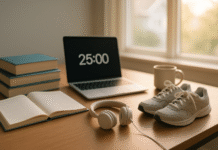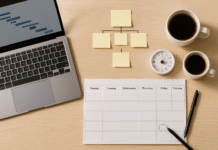




























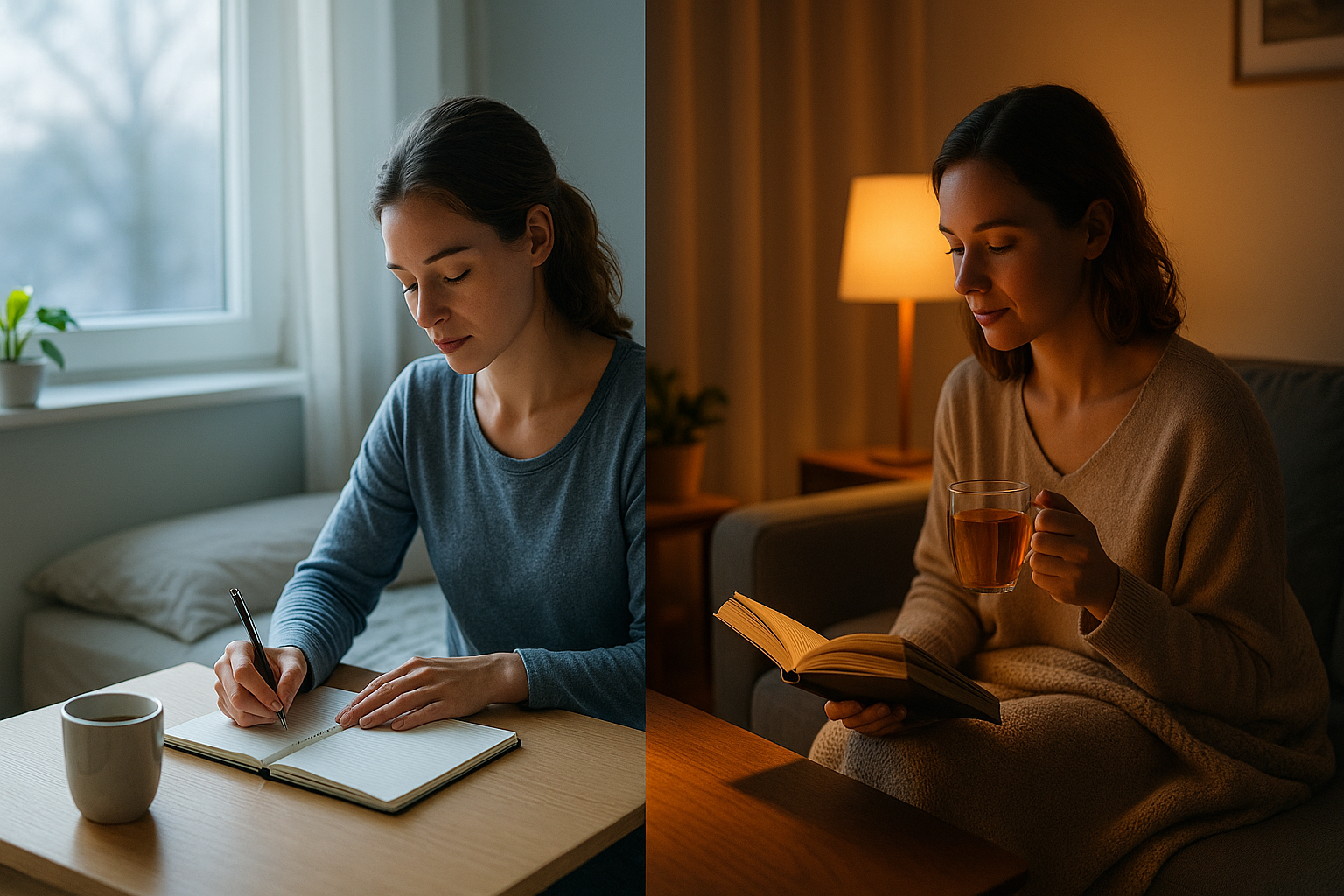
You don’t need a 2-hour checklist to have a great day—you need a simple, repeatable system that treats morning and evening as a matched set. This guide shows you how to tailor your morning routine vs evening routine so they reinforce each other: what you do after waking sets your energy ceiling, and what you do before bed sets tomorrow’s floor. We’ll map light, caffeine, movement, and planning into 9 practical plays you can shape to your life stage, chronotype, and schedule. If you’re time-crunched, focus on the guardrails in each section; they deliver most of the benefit with minimal effort.
In short: a morning routine is a brief sequence that sparks alertness and purposeful action; an evening routine is a brief sequence that cues wind-down and protects sleep for recovery and memory consolidation. Adults generally perform best with 7+ hours of sleep, so your routines exist to make that consistent.
Quick-start steps (5 minutes):
- Pick one AM anchor (sunlight or movement) and one PM anchor (dim lights or device cut-off).
- Set a caffeine cut-off that’s 8–10 hours before your target bedtime.
- Put tomorrow’s top 3 tasks on a sticky note during the evening review.
- Charge devices outside the bedroom; add a paperback or journal instead.
- Track just two metrics this week: time you got outside and time you turned lights down.
Friendly disclaimer: This guide is educational, not medical advice. If you have symptoms like chronic insomnia, suspected sleep apnea, depression, or persistent fatigue, consult a qualified clinician.
1. Set Clear AM/PM Anchors (So Your Habits “Snap” Into Place)
The fastest way to tailor your morning routine vs evening routine is to define one non-negotiable anchor for each. An AM anchor should boost alertness (sunlight, brief movement, hydration, or a planning check-in) while a PM anchor should cue wind-down (dimming lights, screens-off, warm shower, or a brief stretch). Anchors work because they’re easy, cue-based, and consistent—your brain learns to associate them with “start” or “stop,” which reduces decision fatigue. Pair each anchor with a time window rather than an exact minute to accommodate real life (e.g., “within 30 minutes of waking” or “60–90 minutes before bed”). If your schedule varies, anchors ensure you still hit the essentials that protect focus by day and sleep by night.
1.1 Why it matters
- Anchors compress choice; fewer choices mean more follow-through.
- AM anchors raise your alertness baseline without depending solely on caffeine.
- PM anchors reduce arousal (mental and physiological), which improves sleep onset and continuity.
- Consistency beats intensity—small, daily anchors out-perform sporadic, elaborate routines.
1.2 How to do it
- AM anchor ideas: step outside for 3–10 minutes; 5–8 minutes of mobility; skim your top 3 tasks; 300–500 ml water.
- PM anchor ideas: dim household lights; plug phones in a hallway charger; 5–10 minutes of light stretching; warm shower.
- Make it obvious: place sunglasses by the door (for going outside), an analog timer by your lamp (for screens-off), and a journal on your pillow (for nightly review).
Synthesis: Choose one AM and one PM anchor you can keep even on your busiest day; everything else is optional.
2. Use Light Wisely: Bright in the Morning, Dim in the Evening
Treat light like a performance drug: dose it early, taper it late. Bright morning light—ideally outdoors—synchronizes your circadian rhythm, improving daytime alertness and shifting melatonin timing earlier that night. Conversely, dimming light at night, especially in the blue-enriched range, reduces melatonin suppression and helps you fall asleep faster. In practice, this means getting outside for a few minutes after waking (even if it’s cloudy) and turning lights warm and low 60–90 minutes before bed. Your bedroom should be dark enough that you can’t see your hand clearly once lights are off; your evenings should be more “campfire” than “office.” Evidence consistently shows that circadian-effective light during the day supports sleep, and too much light at night degrades it. Sleep Health Journal
2.1 Numbers & guardrails
- AM: Aim for 3–10 minutes of outdoor light within an hour of waking. Through glass is weaker; open air is best.
- Midday boost: If sluggish, take a 5–10 minute outside break rather than a second coffee.
- PM: Dim lights 60–90 minutes before bed; shift to lamps, warm bulbs, or red night-lights in bathrooms/halls.
- Screens: If you must use them at night, lower brightness and enable warm/night modes.
2.2 Tools/Examples
- Free: phone reminder “Lights down” at T-90 to bedtime; lamp with a low-watt bulb.
- Helpful: smart bulbs with warm presets; eye mask; blackout shades.
- Extra: a dawn-simulator alarm if your wake-up is before sunrise in winter.
Synthesis: Bright mornings and dim evenings act as bookends that tell your brain when to be “on” and when to coast toward sleep.
3. Time Caffeine and Nutrition to Help (Not Hurt) Your Sleep
Caffeine is a powerful tool—used thoughtfully, it boosts vigilance; mistimed, it steals sleep. Its half-life averages ~3–7 hours in adults, and controlled studies show that a single dose taken 6 hours before bedtime still reduces total sleep time. That’s why a conservative cut-off 8–10 hours before your target bedtime works well for most people (earlier if you’re sensitive, pregnant, or have anxiety). Pair caffeine with food in the morning to blunt jitters, then rely more on light and movement later. At night, avoid heavy meals within 2–3 hours of bed; if you need a snack, keep it small and balanced (e.g., yogurt and fruit). For overall health and steadier energy, stay near ≤400 mg caffeine/day unless your clinician says otherwise.
3.1 Mini-checklist
- Set a daily caffeine window (e.g., 7:30 a.m.–2:00 p.m.).
- Front-load: most of your caffeine before noon; use light/walking in the afternoon instead.
- Scan labels: energy drinks and pre-workouts can exceed your daily target in one serving.
- Evening fuel: if hungry, choose a light snack; avoid spicy, fatty, or very large meals late.
3.2 Numeric example
- Target bedtime 11:00 p.m. → last caffeine by 1:00–3:00 p.m.
- Typical 8 oz drip coffee ≈ 95–120 mg; 16 oz cold brew can exceed 200 mg; black tea ≈ 40–70 mg.
Synthesis: Caffeine is most effective when you use a hard stop and let light and movement carry the afternoon.
4. Schedule Movement: Activate in the Morning, Unwind in the Evening
Movement is your most reliable energy lever. Morning movement—from a brisk 10-minute walk to a full workout—pairs nicely with daylight to raise alertness and mood. Evening movement should be gentler (mobility, stretching, easy yoga) to lower arousal. Regular physical activity improves sleep quality and reduces time to fall asleep, but vigorous exercise within the last 1–2 hours of bedtime can delay sleep for many people by keeping body temperature and heart rate elevated. If evenings are your only option, finish ≥2–4 hours before lights-out and reduce intensity. For weekly health benefits, aim for 150–300 minutes of moderate activity plus 2+ strength sessions, adjusted to your fitness and doctor’s guidance.
4.1 How to do it
- AM menu (choose one): 10–20 min brisk walk; 5–10 min mobility; 20–40 min strength; commute by foot/bike.
- PM menu: 5–10 min easy stretching; foam rolling; slow yoga; short walk after dinner.
- If nights are for training: schedule hard sessions earlier; cool down longer; shower warm, then finish cool.
4.2 Guardrails
- Finish vigorous work ≥2–4 hours before bed (closer to 4 hours for high-strain sessions).
- Keep high-intensity nights rare on busy weeks that demand top cognitive performance the next morning.
Synthesis: Move early to turn the lights on; move gently late to dim the system and let sleep take over.
5. Plan in the Evening, Launch in the Morning
Your brain loves closure. A 5–10 minute evening review closes the loop on today and tees up tomorrow—write your Top 3 tasks, lay out clothes, and set out essentials (keys, bag, lunch). In the morning, launch with those Top 3 before email or reactive tasks. This PM-to-AM handoff cuts decision friction, reduces the urge to doom-scroll, and aligns your attention with what matters. If your evenings are hectic, keep the review as short as a sticky note on the fridge; if your mornings are rushed, complete one “micro-win” (e.g., a 5-minute admin task) to build momentum before your first meeting or class.
5.1 Mini-checklist
- PM (5–10 min): wins + lessons, Top 3 for tomorrow, calendar glance, pack/lay out items.
- AM (5–15 min): re-confirm Top 3, quick calendar scan, micro-win.
- Blocker radar: Identify one likely derail (e.g., carpool, deadline) and one plan B.
5.2 Tools
- Analog index cards; a single digital note; calendar alerts; a small tray for next-day items.
Synthesis: End each day by deciding; start the next by doing—your routines become a conveyor belt for focus.
6. Draw Digital Boundaries: Make Mornings Intentional and Nights Quiet
Screens are not the enemy; unbounded screens are. In the morning, keep the first 15–30 minutes intentional: skip email and social feeds until after your AM anchor. In the evening, shift from interactive, bright-screen activity to low-arousal options—paper books, audiobooks, crafts, conversation—at least an hour before bed. Research and professional consensus continue to evolve on “blue light” and screens, but major sleep organizations still advise reducing stimulating digital use at night and lowering brightness if you must use devices. The most dependable benefit comes from controlling content (avoid stressful, novel, or interactive inputs) and timing (honor your lights-down window).
6.1 Practical moves
- AM: Put your phone to charge outside the bedroom or in a drawer; use an analog alarm.
- PM: Set a daily screens-off alarm; enable night shift/warm display; download content earlier so you can go airplane mode.
- Bedroom rule: bed is for sleep and sex; keep laptops and TV elsewhere.
6.2 Content ladder (less to more arousing)
- Nature doc → familiar sitcom → competitive video game.
- Shift down the ladder 1–2 hours before bed.
Synthesis: You don’t have to be anti-screen—you just need a fence around when and how you use them.
7. Align With Your Chronotype and Lifestyle (Not Someone Else’s)
“Morning people” and “night owls” exist on a spectrum influenced by genetics, age, and light history. Instead of copying someone else’s 5 a.m. ritual, tailor your morning routine vs evening routine to your chronotype and constraints (work shifts, parenting, study). Teens and young adults skew later; older adults often skew earlier. What matters is consistency and light timing: anchor wake-time and daylight exposure, and adjust bedtime slowly if needed (15–30 minutes earlier or later every few days). If you work nights or rotate shifts, prioritize daytime darkening (blackout curtains) and strategic light exposure before shifts. The biology is clear: your circadian system syncs to light cues, and you’ll feel and sleep better when routines respect that.
7.1 Region-specific notes
- In higher latitudes, winter mornings are dark—consider a bright, broad-spectrum light box after waking (discuss with your clinician if you have eye or mood conditions).
- In hot climates, very early outdoor light + walk may be more practical.
7.2 Mini-checklist
- Pick a regular wake time that fits your life most days.
- Shift bedtime gradually; avoid big weekend swings (“social jet lag”).
- Chase morning light; reduce late-evening light.
Synthesis: Align your routines to your biology and realities; the right schedule is the one you can sustain.
8. Build a Simple Care Stack: Hygiene, Skin, and Environment
Care stacks are tiny sequences that make you feel human—fast. In the morning, think refresh and protect: warm water or a quick shower, brush and floss, an SPF moisturizer, and “reset the room” (open curtains, make the bed). In the evening, think unwind and cue sleep: cleanse face, brush/floss, set out tomorrow’s clothes, dim lights, and cool the bedroom (around 17–19°C / 63–66°F for many). If allergies or dry air are issues, run a HEPA purifier or humidifier per manufacturer guidance. Small environmental tweaks—quiet, cool, dark—support better sleep continuity; many people wake less often and return to sleep faster when the room is darker and cooler.
8.1 Mini-checklist
- AM: curtains open, bed made, SPF, 300–500 ml water.
- PM: face wash, devices docked, lights dimmed, thermostat down or fan on, blackout curtains/eye mask.
8.2 Tools
- Eye mask, earplugs, bedside carafe; warm lamp with low-watt bulb; white-noise machine if needed.
Synthesis: A small, consistent care stack upgrades how your body feels and how your bedroom supports sleep.
9. Review, Measure, and Adapt (In One Page)
Great routines evolve. Review your morning routine vs evening routine weekly on a single page. Track two leading indicators and one outcome: (1) AM outside minutes; (2) PM lights-down time; (3) sleep opportunity (time in bed). If a week feels off, tweak one variable at a time—caffeine cut-off, exercise timing, or device curfew. If your life stage shifted (new job, newborn, caregiving), shrink your routines to their anchors for two weeks; rebuild from there. Older adults, in particular, benefit from steady schedules, daytime light, and avoiding exercise too close to bedtime; adapt anchors to mobility and health needs. If significant issues persist (loud snoring, gasping, frequent awakenings), flag them for a healthcare provider.
9.1 One-page template
- AM anchor: ______ | PM anchor: ______
- Caffeine window: ______
- Movement plan: ______
- Top 3 (set PM): ______
- Sleep opportunity (h:mm): ______
- This week’s tweak: ______
9.2 Common mistakes
- Changing five variables at once; copying an influencer’s schedule; burying routines under 30 steps; ignoring light timing; relying on weekends to “catch up.”
Synthesis: Measure a little, adjust a little, and keep the anchors—you’ll improve steadily without burning out.
FAQs
1) What’s the ideal length for a morning or evening routine?
Short enough that you’ll keep it on bad days. For most people, 5–20 minutes works. Your morning should spark alertness and momentum; your evening should lower stimulation and prepare the room and mind for sleep. If you routinely skip steps, halve the routine. Start with one AM and one PM anchor and layer only what earns its keep over two weeks.
2) I’m not a morning person. Should I force a 5 a.m. wake-up?
No. Chronotypes vary with genetics and age; many teens and young adults naturally wake later, while older adults skew earlier. Instead of forcing an extreme time, set a consistent wake-time that fits your obligations and chase morning daylight to help your clock. Adjust bedtime gradually (15–30 minutes every few days) if you want an earlier schedule.
3) How late can I drink coffee and still sleep well?
Controlled research shows caffeine 6 hours before bed can still reduce total sleep time, and average half-life runs ~3–7 hours (longer for some). Many people do best with an 8–10 hour caffeine cut-off. If sleep is fragile, move your last dose earlier for a week and reassess. Keep total intake near ≤400 mg/day unless your clinician advises otherwise.
4) Does screen time always ruin sleep?
Not always, but unbounded, bright, or stimulating digital use near bedtime commonly delays sleep. Lowering brightness, warming color temperature, and switching to passive content helps. Better yet, set a screens-off window before bed and dim household lights. The balance of guidance from health organizations still supports limiting night-time digital stimulation. AASM
5) What if evenings are my only workout slot?
You can still benefit—just finish ≥2–4 hours before bedtime and avoid very high-intensity sessions near lights-out. Use a longer cool-down and a warm shower followed by a brief cool rinse. On nights when you need deep recovery sleep, keep sessions easy (walk, light mobility) and schedule the hard stuff earlier in the week. Nature
6) I wake up at night—what should I change first?
Start with light and environment: ensure a dark, cool, quiet room; dim lights 60–90 minutes before bed; avoid late large meals and late caffeine. If snoring is loud or you gasp during sleep, talk to a clinician about sleep apnea screening. A small reduction in evening stimulation often helps continuity.
7) How much sleep do adults need, really?
Public-health guidance recommends at least 7 hours for most adults, with many doing well in the 7–9 hour range. Track your daytime alertness and mood: if you’re drowsy, irritable, or reaching for extra caffeine, you likely need a larger sleep opportunity.
8) Should I use a light box in winter?
If mornings are dark, a bright-light device can help shift your clock earlier and lift alertness or mood. Use it soon after waking, at arm’s length, and follow manufacturer/literature guidance. People with eye conditions or bipolar disorder should consult a clinician first. Sleep Foundation
9) What’s a simple evening review that actually works?
Try the 3-3-1: note 3 wins, 3 lessons, and 1 priority for tomorrow. Then lay out what you need for the first task. This gives psychological closure and a clear morning launch point, reducing the urge to scroll at bedtime.
10) How should older adults adapt these routines?
Keep anchors gentle and consistent: morning daylight, a short walk, and a fixed wake-time. Avoid late-day caffeine and plan exercise earlier or easy in the evening. If sleep issues persist beyond a couple of weeks—or if you have new snoring, mood changes, or day-time sleepiness—raise it with your clinician.
Conclusion
When you treat morning and evening as a matched pair, your day gets easier. AM anchors (light, movement, clear priorities) set your ceiling for energy and focus; PM anchors (dimmed lights, digital boundaries, gentle care routines) protect the sleep that restores brain and body. You don’t need a perfect schedule—just a dependable one. Start with two anchors and one guardrail (a caffeine cut-off or a screens-off window). Review weekly on one page, tweaking only one variable at a time. Within a month, your routines will feel automatic, your days will kick off on purpose, and your nights will welcome rest.
Your next step: Pick one AM anchor and one PM anchor, set a caffeine cut-off, and put “lights-down” on your calendar tonight.
References
- About Sleep — Centers for Disease Control and Prevention (CDC), May 15, 2024. https://www.cdc.gov/sleep/about/index.html
- FastStats: Sleep in Adults — CDC, May 15, 2024. https://www.cdc.gov/sleep/data-research/facts-stats/adults-sleep-facts-and-stats.html
- Featured Topic: Circadian Rhythms — National Institute of General Medical Sciences (NIGMS/NIH), May 29, 2025. https://www.nigms.nih.gov/education/Pages/Circadian-Rhythms
- Light & Sleep: Effects on Sleep Quality — Sleep Foundation, Nov 8, 2023. https://www.sleepfoundation.org/bedroom-environment/light-and-sleep
- Blue light has a dark side — Harvard Health Publishing, July 24, 2024. https://www.health.harvard.edu/staying-healthy/blue-light-has-a-dark-side
- Caffeine effects on sleep taken 0, 3, or 6 hours before going to bed — Journal of Clinical Sleep Medicine, Drake et al., 2013. https://pmc.ncbi.nlm.nih.gov/articles/PMC3805807/
- The Safety of Ingested Caffeine: A Comprehensive Review — Temple et al., 2017. https://pmc.ncbi.nlm.nih.gov/articles/PMC5445139/
- Spilling the Beans: How Much Caffeine is Too Much? — U.S. Food & Drug Administration, Aug 28, 2024. https://www.fda.gov/consumers/consumer-updates/spilling-beans-how-much-caffeine-too-much
- How Can Exercise Affect Sleep? — Sleep Foundation, July 29, 2025. https://www.sleepfoundation.org/physical-activity/exercise-and-sleep
- What’s the Best Time of Day to Exercise for Sleep? — Sleep Foundation, July 29, 2025. https://www.sleepfoundation.org/physical-activity/best-time-of-day-to-exercise-for-sleep
- WHO Guidelines on Physical Activity and Sedentary Behaviour — World Health Organization, 2020. https://pmc.ncbi.nlm.nih.gov/articles/PMC7719906/
- Sleep and Older Adults — National Institute on Aging (NIH), Feb 6, 2025. https://www.nia.nih.gov/health/sleep/sleep-and-older-adults