




















Gardening can be more than a hobby—it can be a steady, restorative ritual. Used intentionally, gardening as self-care lowers stress, brings your attention back into your body, and gives you a simple, nourishing routine that grows alongside your plants. This guide is for beginners with a balcony and veterans with backyard beds alike; you’ll get practical, step-by-step ideas that fit busy lives and tight spaces.
In one line: Gardening as self-care means using simple, regular plant-care tasks (watering, pruning, harvesting, observing) as mindful routines that support your mental health, physical activity, and personal growth.
Quick-start today: pick one space (a pot, bed, or shelf), set a 10-minute daily tending time, choose two easy plants (one edible, one ornamental), add mulch, and keep a tiny garden log. That’s enough to begin.
Friendly disclaimer: This article is educational and not a substitute for medical or mental-health advice.
1. Start Small to Build a Calming Habit
Tiny, consistent actions beat occasional bursts. The fastest way to make gardening restorative (not overwhelming) is to shrink the scope until you can show up every day without dread. One big reason people abandon gardens is that the work piles up; the fix is to right-size your first project to a container or two, a single 1×1 m bed, or a sunny windowsill. Keeping scope small does two things for self-care: it creates quick wins (new leaf, first flower, small harvest), and it reduces decision fatigue so your brain can actually relax. Give yourself a ten-minute “green check-in” daily—just water, look closely, and tidy a bit. Over weeks, those micro-sessions add up to a healthier garden and a calmer nervous system.
1.1 How to do it
- Choose one “anchor” spot you see daily (kitchen window, front step, balcony corner).
- Plant 2–3 low-maintenance choices (e.g., pothos + basil; marigold + mint).
- Set a repeating 10-minute time block (morning or sunset works well).
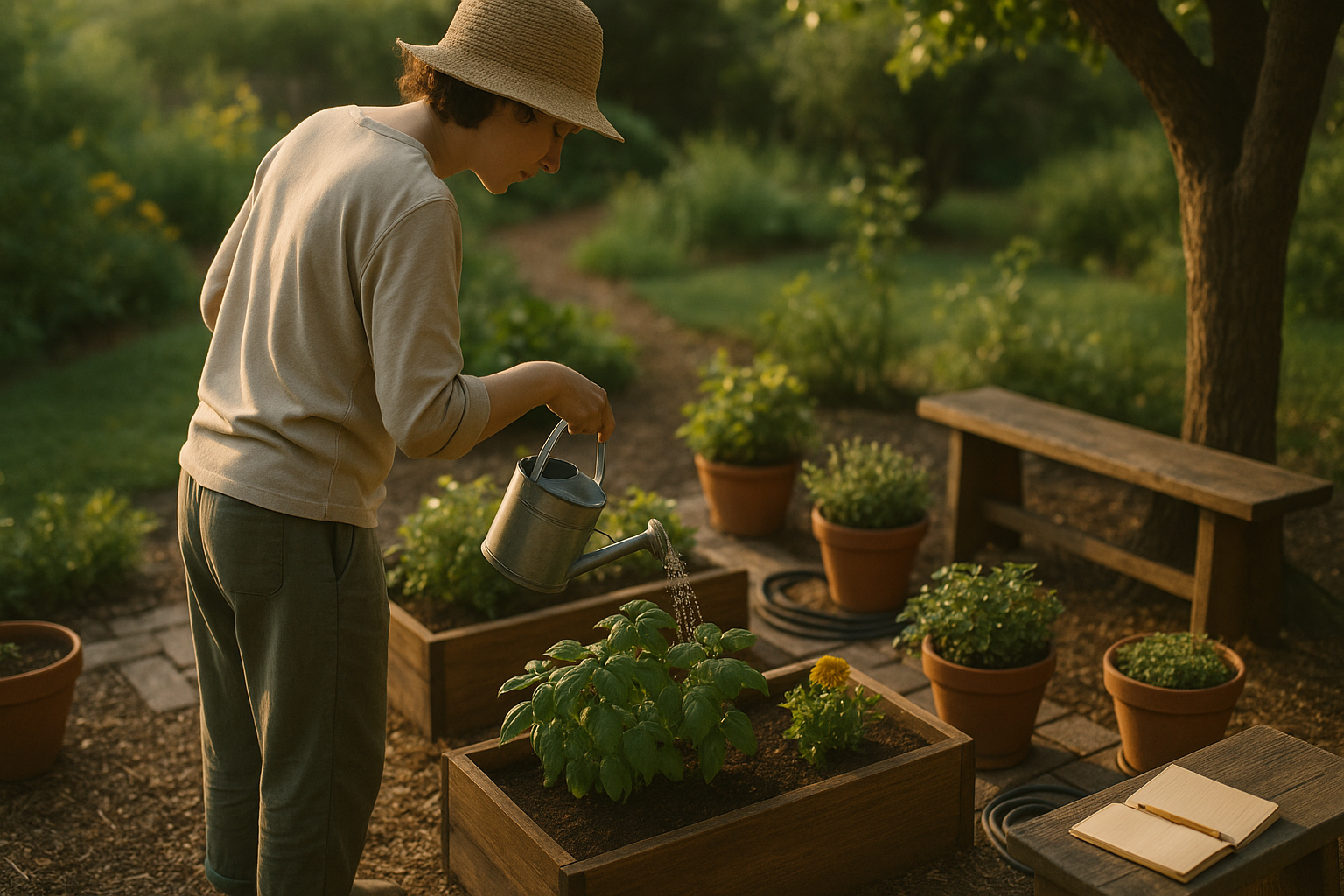
- Keep a small watering can, snips, and gloves in a caddy within reach.
- Track one metric (new growth, mood before/after, or minutes outdoors).
1.2 Numbers & guardrails
- Start with at most 3 containers or 1 m² of bed space.
- Cap daily care at 10–15 minutes; add plants only when care still feels easy.
- If you miss a day, do two minutes today; don’t “make up” hours tomorrow.
Close the loop by celebrating small milestones (first bloom, first salad). Momentum is medicine.
2. Use Sensory Grounding to Turn Chores into Mindfulness
Self-care in the garden isn’t only what you do; it’s how you pay attention. Sensory grounding transforms “tasks” into mini reset rituals that interrupt worry and rumination. Start each session by feeling your feet on the soil or balcony, noticing the air on your skin, and taking five slower breaths. As you prune or water, let your senses lead: the scent of tomato leaves, the grit of soil, the sound of water hitting mulch. Research on nature exposure links time in green spaces with mood improvements and reduced rumination, a mental loop tied to anxiety and low mood. While therapy and medical care are important when needed, simple nature-based practices are a proven complement for everyday stress care.
2.1 Mini-checklist
- 5-4-3-2-1 scan: name 5 sights, 4 sounds, 3 tactile sensations, 2 smells, 1 taste (if safe).
- Match breath to action: inhale to notice, exhale to prune or pinch.
- Single-task: water one plant fully before moving on; no multitasking.
2.2 Common mistakes
- Rushing to finish—set a timer so you can relax into the moment.
- Phone in pocket—leave it inside or on airplane mode.
- Fixating on flaws—name three things going well before troubleshooting.
End each session with a slow look around and one sentence in your log: “Today I noticed…”.
3. Sync With Sunlight: Morning Sessions for Mood and Sleep
Light is the master clock for your body. A short morning garden ritual helps anchor your circadian rhythm—one reason many gardeners report better energy and steadier sleep when they step outside early. Aim to greet your plants soon after sunrise; that gentle natural light cues “daytime” to your brain and pairs nicely with light physical movement. In the evening, keep garden time calmer (observe, harvest, tidy) and dim indoor lights later to avoid pushing your clock later. You don’t need a perfect routine to benefit; think of this as aligning your garden rhythm with your body rhythm.
3.1 How to do it
- Pick a consistent morning window (even 10–20 minutes).
- Combine with hydration and sun protection (hat, SPF).
- Save heavy lifting and mowing for cooler hours; avoid high-heat peaks.
- Keep a headlamp or lantern for safe twilight tasks if needed.
3.2 Guardrails
- Respect heat: hydrate regularly and schedule breaks in shade when temperatures climb (especially in hot or monsoon seasons).
- If sleep is fragile, bias bright-light exposure earlier in the day and dim screens at night.
A steady AM ritual plus calmer PM light hygiene makes your garden a natural sleep ally.
4. Compost and Tend Soil as a Caring Practice
Healthy soil gives you a tangible way to “care for what cares for you.” Making and using compost turns kitchen scraps and yard waste into a living soil amendment that feeds microbes, improves structure, and helps your beds hold moisture. The sensory part—turning a warm pile, smelling that earthy aroma—can be grounding in its own right. Practically, compost reduces landfill waste and boosts plant resilience, which in turn reduces your stress. You don’t need a big yard: a simple bin, tumbler, or worm bin (indoors or out) can work in apartments and small spaces.
4.1 Simple ratios & rules
- Aim for 2–3 parts “browns” (dry leaves, shredded cardboard) to 1 part “greens” (food scraps, fresh prunings) by volume.
- Keep it as damp as a wrung-out sponge; turn every 1–2 weeks to aerate.
- Skip meat, dairy, and greasy foods; bury food scraps to deter pests.
4.2 Mini case
- One family’s 20-litre countertop pail + a covered outdoor bin diverts ~3–5 kg/week of scraps. After 8–12 weeks of active composting (season-dependent), they spread 2–3 cm of finished compost over beds—plants perk up, and watering needs drop.
Treat soil-building as self-building: slow, cyclical, and deeply rewarding.
5. Watering Rituals: Deep, Infrequent, and Efficient
Watering is where many gardens—and good intentions—go sideways. For self-care, you want a ritual that’s simple to execute and hard to overdo. As a rule of thumb, many gardens need around 2.5 cm (1 inch) of water per week, including rainfall, with adjustments for heat, wind, soil type, and plant stage. Water early morning to reduce evaporation. Upgrade to drip or micro-irrigation if you can: it puts water at the roots, reduces disease pressure on leaves, and uses substantially less water than spray sprinklers. Pair with mulch and you’ll stretch every litre.
5.1 Practical steps
- Put a cheap rain gauge (or tuna can) in beds to measure weekly totals.
- Water deeply until moisture reaches 15–20 cm; then let the top few cm dry.
- Mulch (5–8 cm) around plants; keep mulch back from stems.
- Use drip lines or soaker hoses for beds and large containers; hand-water small pots.
5.2 Numbers & notes
- Expect about 2.5 cm/week baseline; sandy soils and containers may need more frequent, smaller doses; clay soils prefer slower, longer soaks.
- Micro-irrigation systems can reduce water use by ~20–50% compared with conventional spray sprinklers, especially when paired with mulch and smart scheduling.
A measured approach replaces guesswork with calm, consistent care.
6. Quick Wins: Microgreens and Windowsill Herbs
Fast feedback is gold for habit-building. Microgreens and kitchen herbs deliver flavor and early success in days to weeks. Most microgreens are ready in 7–21 days from sowing—snip, rinse, and eat. Herbs like basil, mint, or rosemary thrive on a bright windowsill and reward regular pinching with bushier growth. Beyond the harvest, tending a tiny indoor tray or pot gives you a low-stakes, daily reset you can do in any weather.
6.1 How to grow microgreens (mini)
- Shallow tray, sterile seed-starting mix; sow densely and press seeds in.
- Mist, cover to germinate; uncover at sprout and give bright light.
- Bottom-water; harvest at 7–14 days (true leaves emerging).
6.2 Indoor herb guardrails
- Aim for 6–8 hours of direct sun (or use grow lights); rotate pots weekly.
- Water when the top 2–3 cm are dry; ensure drainage holes.
- Pinch stems above a leaf pair to encourage branching; harvest often.
Small, tasty wins train your brain to associate the garden with relief and reward.
7. Reframe “Mistakes” as Experiments: Propagation & Learning
Personal growth in the garden comes from curiosity, not perfection. Try one new thing each season—rooting a cutting, dividing a perennial, or saving seed. When a plant sulks, ask “What is this teaching me about light/soil/water?” rather than “What’s wrong with me?” Propagation is particularly empowering: it’s low-cost, repeatable, and forgiving. Each successful cutting is a visible signal that your care creates life; each failure is a data point you can adjust next time.
7.1 Beginner propagation ideas
- Softwood cuttings: coleus, basil, mint—root in water, pot up later.
- Division: clumping herbs/ornamentals (chives, daylilies).
- Leaf cuttings: snake plant, pothos—root a few at once to learn.
7.2 Mini-checklist
- Label with date and source.
- Change water or misting schedule regularly; keep humidity up for new cuttings.
- Track what took and how long; repeat the winners.
Treat every result as feedback. You’re growing a gardener, not just a garden.
8. Plant for Biodiversity and Pollinators
Caring for more than yourself—bees, butterflies, birds—can deepen meaning and joy. Native and pollinator-friendly plants support local ecosystems and often need less fuss, which eases your workload. Think “succession bloom”: something flowering in spring, summer, and fall. Leave some stems and bare patches for bee nesting and incorporate herbs like thyme, oregano, and lavender, which pollinators love (and you’ll cook with). Skip pesticides whenever possible; healthier soil and plant diversity reduce many pest issues naturally.
8.1 How to design a tiny habitat
- Choose 9+ species across seasons (3 early, 3 mid, 3 late bloomers).
- Cluster flowers in drifts so pollinators can feed efficiently.
- Provide nesting sites: a brush pile, hollow stems, or bare soil patches.
- Offer water (pebble-filled saucer) and avoid night lighting near blooms.
8.2 Region notes
- In hot, dry climates, prioritize drought-tolerant natives; in monsoon regions, ensure good drainage and sturdy staking.
- Check local native-plant lists through your agriculture department or conservation groups.
Supporting pollinators connects your self-care routine to something larger and lasting.
9. Create a “Healing Corner” That Invites You Outside
Spaces shape behavior. A simple sitting nook—bench, stool, or kneeler under a tree or shade sail—invites you to pause rather than power through chores. Good path access matters for safety and serenity; clear, stable routes reduce tripping risk and strain, and they make your garden inclusive for family and friends. A few scent-forward plants (jasmine, basil, mint) near seating cue deep breaths and a calmer nervous system.
9.1 Design moves that help
- Keep a 36 in / 915 mm clear path where you walk most.
- Place a seat within arm’s reach of your favorite bed for mindful observation.
- Add soft morning shade and afternoon dapple if you garden in heat.
- Use mulch or pavers to keep footing even and low-mud.
9.2 Mini-checklist
- Water within reach? Tools in a caddy? A hat and gloves at the door?
- One “wind-down” task for evenings: coil hose, write one line in the log, harvest a sprig.
When the space welcomes you, self-care happens without willpower.
10. Follow the Seasons and Journal What You Notice
Gardening teaches timing—sowing, staking, pruning, resting. A seasonal rhythm makes self-care sustainable: sow hope in late winter, harvest gratitude mid-year, tidy and rest in off-season. A short garden journal (paper or notes app) ties your outer landscape to your inner landscape: weather, what you did, a surprise you noticed, and a one-to-ten mood rating before and after. Over a season you’ll see patterns—“watering before lunch settles me,” “evening weeding overstimulates me,” “heat waves spike my stress.”
10.1 What to track
- Date, weather, task, time spent (even 5–15 minutes).
- Plant notes: first bloom, first fruit, pest sightings.
- Self notes: mood before/after, one thing you’re proud of.
10.2 Use your data
- Adjust watering to reality (heat, wind, rain), not rules.
- Shift self-care sessions to the times that lift you most.
- Plan next season from real observations, not guesswork.
Your journal becomes an owner’s manual for both your garden and your nervous system.
11. Share the Work: Community, Kids, and Kindness
Self-care doesn’t have to be solitary. Community gardens, informal swaps, or volunteering at a school plot bring social connection, motivation, and extra hands. If you care for others—kids, elders, neighbors—simple garden tasks can be co-regulation: slow watering together, pinching herbs, or counting pollinators. Social tending often keeps you showing up when your solo motivation dips, and it multiplies the joy of harvests.
11.1 Easy community steps
- Join a local garden plot or online group for plant swaps and advice.
- Start a tiny “share box” for extra herbs/produce on your block.
- Host a 30-minute “potting hour” with friends—everyone brings one plant.
11.2 Boundaries that protect the vibe
- Choose one shared time per week; keep the rest of your sessions quiet and solo.
- Say yes to help that reduces strain; say no to commitments that add stress.
Tending together reinforces the truth at the heart of gardening: we grow better in community.
12. Protect Your Body: Ergonomics, Hydration, and Pace
Self-care means coming back tomorrow. Treat your joints and back like precious tools: neutral wrists, hinge at hips, and alternate tasks to avoid repetitive strain. Use padded kneelers or a low stool, long-handled tools, and keep blades sharp so cuts take less force. In warm seasons, schedule heavier work for cooler hours, hydrate regularly, and rest in shade. Gardening counts toward weekly movement goals when you’re digging, raking, or wheeling soil—think of it as functional fitness in fresh air.
12.1 Practical guardrails
- Warm-up 5 minutes: shoulder circles, hip hinges, gentle squats.
- Alternate every 20 minutes: prune → water → mulch → rest.
- Hydrate regularly, especially in heat; take shade breaks and reapply sunscreen.
- Keep paths stable and tools stored at waist height to reduce bending.
12.2 Tool tweaks that help
- Long-handled hoe or cultivator for weeding without stooping.
- Ratcheting pruners for thicker stems with less grip strain.
- Lightweight hoses; quick-connects to avoid over-twisting wrists.
Your future self will thank you for gardening like an athlete: steady, smart, and kind to your body.
FAQs
1) What makes “gardening as self-care” different from regular gardening?
It’s the intention and the scale. You’re deliberately using small, repeatable tasks—watering, pruning, observing—as grounding rituals to support mood, focus, and gentle movement. You choose a scope you can sustain in 10–15 minutes a day, track how it feels, and design your space to invite you outside. The plants thrive, and so do you.
2) I only have a windowsill. Can this still work?
Yes. A two-pot herb garden (basil + mint) or a microgreens tray gives you daily tending and weekly harvests. Provide 6–8 hours of light (or a small grow light), water when the top 2–3 cm dries, and pinch herbs regularly to keep them bushy. The point is the ritual, not the square footage.
3) How much should I water, really?
Start with the 2.5 cm (1 inch) per week rule, measured with a rain gauge, then adjust for heat, wind, and soil type. Water early morning and aim for deep soaks less often. Drip or micro-irrigation plus 5–8 cm of mulch conserves water, reduces disease on leaves, and simplifies your routine.
4) Which plants are the easiest “wins” for beginners?
Try microgreens (ready in 7–21 days), basil and mint indoors, and marigolds or nasturtiums outdoors. Pair one edible and one ornamental so you get both flavor and flowers. Choose varieties suited to your light and climate; native plants usually need less fuss.
5) How does gardening help stress?
Green-space exposure and gardening are associated with reduced stress, improved mood, and lower markers like cortisol in experimental and observational studies. You don’t need long sessions; even short, regular contact with plants can support mental well-being when paired with healthy sleep, movement, and, when needed, professional care.
6) What if I’m terrible at keeping plants alive?
You’re not terrible—you’re new. Treat each plant as an experiment: light, water, soil, container. Start small, log what happens, and repeat what works. Propagation (cuttings, divisions) gives you free “practice plants” so the stakes stay low while your skills grow.
7) Are native and pollinator-friendly plants worth it for self-care?
Yes. They reduce maintenance, increase wildlife visits (which boosts joy), and connect your care to local ecosystems. Plant for spring–summer–fall bloom and avoid pesticides whenever possible. Even a balcony can host a few nectar-rich pots and a pebble water dish.
8) How do I make my garden more accessible for my body?
Keep paths clear and stable (target 36 in / 915 mm of clear width where you move most), use raised or elevated beds to reduce bending, store tools at waist height, and choose ergonomic handles. Work in cooler hours, alternate tasks, and hydrate. The goal is gardening you can return to tomorrow.
9) What’s the simplest compost setup for a small space?
A lidded bin or tumbler with a 2–3:1 browns-to-greens mix by volume works almost anywhere; bury food scraps in the pile and keep it as damp as a wrung-out sponge. Turn every week or two. If outdoors isn’t an option, try vermicomposting with worms under the sink—no smell when maintained correctly.
10) How can I fit gardening into a packed schedule?
Shrink the scope and lock a 10-minute slot. Put a small caddy by the door, pick plants that suit your light, and batch tasks (water Mon/Wed/Fri; prune Sat; harvest Sun). Tie the ritual to an existing habit (after coffee, before school drop-off). Consistency beats duration.
11) Is morning sun really better?
For circadian rhythm, earlier light tends to anchor your body clock to an earlier, more stable schedule, which can support daytime energy and night sleep. Pair that with limited bright light late at night (especially from screens), and you’ll often feel the difference within a couple of weeks.
12) How much “exercise” does gardening count for?
Plenty. Many tasks (digging, raking, hauling) are moderate-intensity movement and can contribute to the 150–300 minutes/week guideline for adults. Pace yourself, use good body mechanics, and consider gardening your functional fitness in fresh air.
Conclusion
Self-care thrives on rituals you actually keep. Gardening offers those in spades: short, tactile tasks that meet you where you are, anchor your day in natural light, and reward you with growth you can taste and see. Start with a container or a single bed, a 10-minute window, and two easy plants. Add a rain gauge and a mulched path, and swap a spray sprinkler for drip if you can. Fold in mindful attention—five breaths, five senses—and a one-line log. With time, your garden will hold your habits, and your habits will hold you: steadier mood, kinder sleep, stronger body, more wonder.
Ready to begin? Pick your spot, set tomorrow’s 10-minute “green check-in,” and plant the first seed of a gentler routine.
References
- Soga, M., Gaston, K.J., & Yamaura, Y. (2016). Gardening is beneficial for health: A meta-analysis. Preventive Medicine Reports. National Library of Medicine (PMC). https://pmc.ncbi.nlm.nih.gov/articles/PMC5153451/
- Van den Berg, A.E., & Custers, M.H. (2011). Gardening promotes neuroendocrine and affective restoration from stress. Journal of Health Psychology. SAGE Publications. https://journals.sagepub.com/doi/10.1177/1359105310365577
- Bratman, G.N., Hamilton, J.P., Hahn, K.S., Daily, G.C., & Gross, J.J. (2015). Nature experience reduces rumination and subgenual prefrontal cortex activation. PNAS, 112(28), 8567–8572. https://www.pnas.org/doi/10.1073/pnas.1510459112
- U.S. Department of Health and Human Services. (2018). Physical Activity Guidelines for Americans, 2nd ed. health.gov. https://health.gov/sites/default/files/2019-09/Physical_Activity_Guidelines_2nd_edition.pdf
- U.S. Environmental Protection Agency. (n.d.). Composting at Home. https://www.epa.gov/recycle/composting-home
- Michigan State University Extension. (2025, June 26). Watering strategies to keep a garden productive. https://www.canr.msu.edu/news/watering-strategies-to-keep-a-garden-productive
- U.S. EPA WaterSense. (2018). Saving Water With Microirrigation: A Homeowner Guide. https://www.epa.gov/sites/default/files/2018-05/documents/ws-outdoors-microirrigation-homeownerguide.pdf
- USDA NRCS. (2024). E420A – Establish Pollinator Habitat (FY2024). https://www.nrcs.usda.gov/sites/default/files/2024-03/E420A_FY2024.pdf
- Xerces Society. (n.d.). Bring Back the Pollinators. https://www.xerces.org/bring-back-the-pollinators
- U.S. Access Board. (2010). ADA Standards – Chapter 4: Accessible Routes. https://www.access-board.gov/ada/guides/chapter-4-accessible-routes/
- Penn State Extension. (2023, Mar 14). Growing Microgreens. https://extension.psu.edu/growing-microgreens/
- Penn State Extension. (2024, Nov 1). Growing Herbs Indoors. https://extension.psu.edu/growing-herbs-indoors/