



























A great power nap isn’t guesswork—it’s timing. In this guide, you’ll learn exactly how long to nap (10, 20, 30, 45, 60, 90, or 120 minutes), when to use each option, and how to wake up energized instead of groggy. Whether you’re squeezing in a reset between meetings, preparing for a long study block, or gearing up for a night shift, you’ll get practical timing rules you can apply today. Brief note: this article is educational, not medical advice. If you struggle with chronic insomnia, sleep apnea, or feel excessively sleepy during the day, speak with a clinician; some people should limit naps as part of treatment.
Quick answer: A power nap is a short daytime sleep designed to restore alertness without wrecking your night. The classic power nap is 10–20 minutes to stay in light sleep and avoid sleep inertia; longer options (60–90+ minutes) can help learning or shift-work recovery but require careful timing.
Fast picker for nap length
- Need a rapid reset? Choose 10 minutes.
- Want the safest “classic” power nap? Choose 20 minutes.
- Okay with a little grogginess for a bigger boost later? Choose 30 minutes.
- Practicing skills or training hard? Choose 45 minutes.
- Studying facts or languages? Choose 60 minutes.
- Need fuller recovery after poor sleep? Choose 90 minutes (a full cycle).
- Working a night shift? Add a 120-minute pre-shift anchor nap.
1. 10-Minute Nap: The Fastest, Low-Risk Reset
A 10-minute nap is the quickest route to measurable benefits with almost no downside. In just a few minutes of stage N1–N2 light sleep, you can reduce sleepiness, lift mood, and sharpen attention without drifting into slow-wave sleep (SWS), the stage most associated with heavy sleep inertia on waking. Ten minutes is ideal when you have a packed schedule, need to be “back on” quickly, or want a safe option late morning or early afternoon that won’t sabotage bedtime. In well-controlled experiments, 10-minute naps yielded immediate improvements that lasted 1–2½ hours—perfect for a post-lunch dip or a final push before a workout or meeting.
1.1 Why it works
Ten minutes keeps you squarely in lighter sleep stages, avoiding deep SWS that can cause grogginess. This length exploits the body’s natural early-afternoon increase in sleep propensity (often called the post-lunch dip), when it’s easier to doze for a short period and reap alertness gains. The benefits kick in quickly after waking and—unlike longer naps—rarely demand a long “shake-off” ramp before you’re functional.
1.2 Numbers & guardrails
- Benefit window: typically up to ~155 minutes post-nap.
- Best timing (local): early afternoon (about 1–3 p.m., Asia/Karachi), aligning with natural sleepiness.
- Set two alarms: one for 10 minutes, one 5 minutes later as a buffer to prevent drift into deeper sleep.
- If driving soon after: a 10-minute nap can help, but never rely on napping alone if you’re severely sleep-deprived. For safety stats, drowsy-driving deaths in the U.S. were 633 in 2023; plan proactively.
1.3 How to do it (mini-checklist)
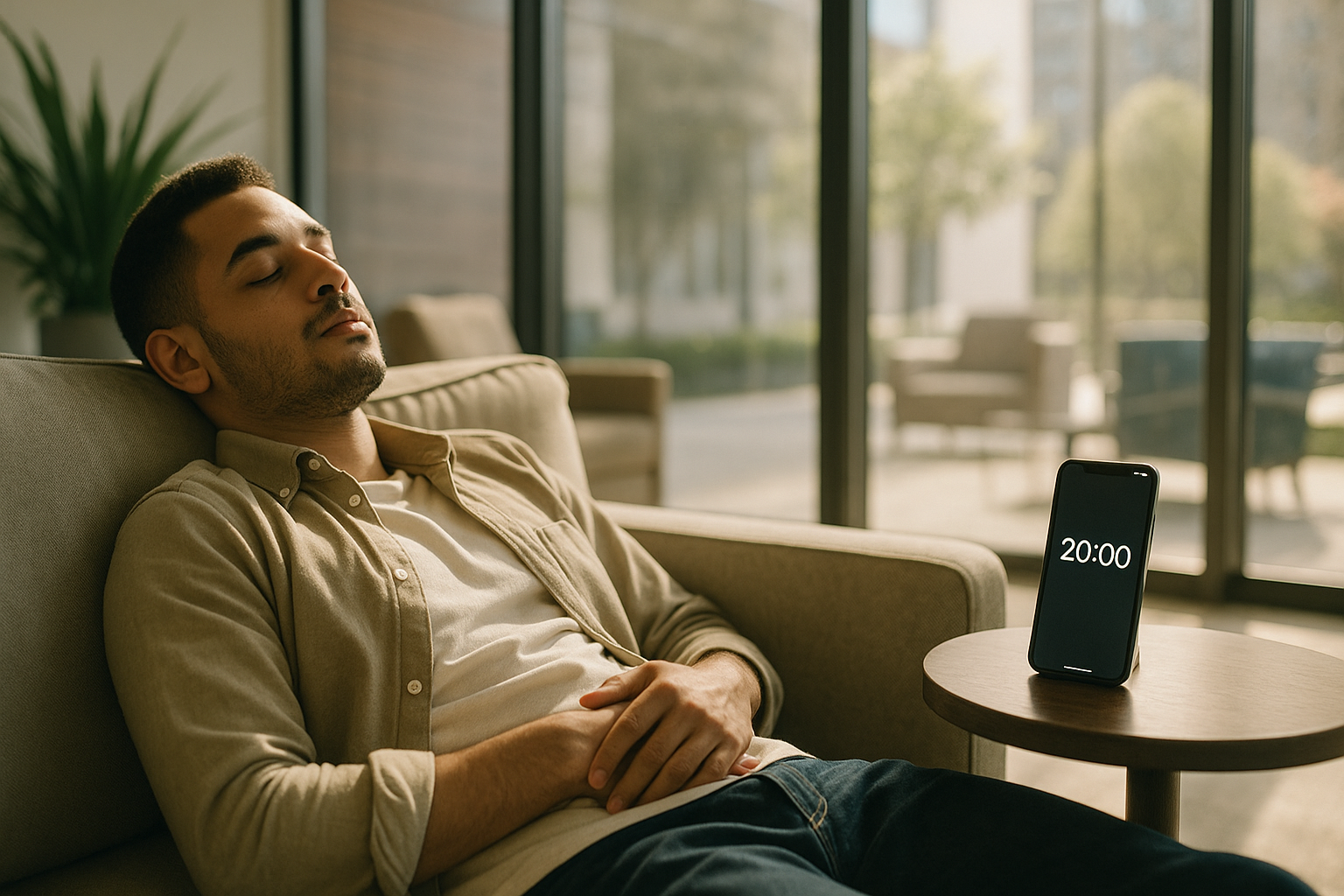
- Darken the room, recline, and start a 10:00 timer.
- Eye mask + earplugs if noisy; cool room helps you drop off.
- Try a “nappuccino”: drink coffee (≈100–200 mg caffeine) and lie down; caffeine kicks in as you wake, amplifying alertness.
Bottom line: choose 10 minutes when you need guaranteed snap-back with minimal inertia and a fast return to peak performance.
2. 20-Minute Nap: The Classic Power Nap
If you want a reliable, easy-to-schedule boost that fits most situations, 20 minutes is the sweet spot. You’ll typically stay in stage N2 (light sleep), which is enough to improve vigilance, reaction time, and mood, but short enough to avoid awakening from deep SWS. Many clinical and educational sources recommend 10–20 minutes as the default power-nap length; even mainstream guidelines emphasize keeping it under 30 minutes to limit grogginess and protect nighttime sleep. A 20-minute nap is especially helpful for knowledge workers, students during dense study days, and parents who need an efficient window while a child naps.
2.1 Why it matters
In about 20 minutes, you reap the alerting benefits of light sleep—and can tack on a 5–10 minute wake-up buffer to smoothly return to work. Many readers associate power naps with NASA’s famous data point showing a 26-minute nap can raise alertness by ~54% and performance by ~34% in pilots; while 26 minutes is slightly longer than the classic 20, the physiology overlaps (light sleep predominance), supporting the broader strategy of short, controlled daytime sleep.
2.2 Tips, tools & timing
- Set 25–30 minutes total (20 minutes sleep + 5–10 to re-orient).
- Nap before 3 p.m. to protect bedtime; later naps increase the risk of delayed sleep.
- Use a phone timer, eye mask, and a white-noise app to fall asleep quickly.
- Try the nappuccino variant if you must be sharp immediately after.
2.3 Mini case
Working through a coding sprint from 9 a.m.–6 p.m.? Drop a 20-minute nap at 1:30 p.m. After a 5-minute ramp-up, you’ll be back online by 2:00 p.m., typically with better reaction time and stabilized mood for the next two hours.
Bottom line: 20 minutes is the most “plug-and-play” power nap—safe, versatile, and consistent across workdays.
3. 30-Minute Nap: Bigger Payoff, Brief Inertia
A 30-minute nap often sits on the edge of deep sleep. That means you may wake up a bit groggy for 10–30 minutes (sleep inertia) but then enjoy a stronger mid-afternoon boost than a shorter nap. This length suits people who can afford a slightly longer ramp-up—say, remote workers, graduate students, or athletes between sessions—and who benefit more from the later performance rise than from instant alertness. It’s not ideal if you need to be crystal-clear the moment you wake, or if late-day napping tends to push your bedtime later.
3.1 Common mistakes
- No buffer: jumping straight into a meeting post-nap.
- Too late: napping after 3–4 p.m. and then struggling to fall asleep at night.
- No movement: failing to re-activate circulation (light walk, face splashes, or bright light exposure).
- Assuming grogginess = failure: much of the benefit arrives after inertia fades.
3.2 Numbers & guardrails
- Inertia window: usually ≤30 minutes in well-rested people; can last longer if severely sleep-deprived.
- Performance curve: benefits can extend 2+ hours after the grogginess phase.
- Countermeasures: bright light, hydration, and a 2–3 minute mobility routine reduce inertia faster; caffeine right before the nap can also help.
3.3 Regional note (timing)
In South Asia (e.g., Pakistan, GMT+5), many offices take lunch between 1–2 p.m. A 30-minute nap ending by 2:30 p.m. typically preserves bedtime while supporting the late-afternoon push.
Bottom line: choose 30 minutes when you can tolerate a brief fog on wake to gain a stronger lift later.
4. 45-Minute Nap: Skill, Training, and Mixed Sleep Stages
Around 45 minutes, naps tend to include more consolidated stage N2 with a sprinkle of SWS and sometimes a touch of REM. This profile makes 45 minutes interesting for motor-skill learning (instrument practice, complex movements, athletic drills) and tasks needing sustained attention later in the day. In a controlled study, ~45-minute afternoon naps (after normal nocturnal sleep) improved procedural motor memory consolidation compared with staying awake—suggesting benefits when you’re practicing skills, not just chasing alertness. Expect moderate inertia on waking; plan a 10–15 minute cool-down.
4.1 How to use a 45-minute nap
- Schedule after training (e.g., post-rehearsal or practice) to lock in motor patterns.
- Buffer wake-up: allow 15 minutes for a light snack, water, and movement.
- Protect bedtime: aim to finish by 3 p.m.
- Environment matters: slightly cooler room and dim light help you reach stable N2 quickly.
4.2 Why it can help learning
Motor learning consolidates during NREM, with sleep spindles (brief bursts of 12–15 Hz activity) in stage 2 linked to certain memory benefits. While the strongest spindle evidence often concerns verbal/declarative memory, the mixed-stage nature of a 45-minute nap and its N2 dominance can still support skills. Don’t expect magic; use it strategically after good practice.
4.3 Mini example
Practicing piano arpeggios for 40 minutes at noon? Nap 45 minutes at 1:30 p.m., then spend 10 minutes waking up gently. Resume at 2:35 p.m. to cement speed and accuracy while staying fresh through late afternoon.
Bottom line: 45 minutes is a training-adjacent nap—useful for motor skills and late-day stamina when a short power nap isn’t quite enough.
5. 60-Minute Nap: SWS-Heavy for Facts and Focus
At ~60 minutes, you’re likely to spend a chunk in slow-wave sleep (SWS), which supports declarative memory—think vocabulary, formulas, case facts, and conceptual frameworks. The trade-off: waking from SWS increases the risk of heavier inertia; measure your calendar accordingly. Several studies show declarative memory benefits from naps containing SWS, with performance tracking the amount of SWS rather than total nap time per se. This makes 60 minutes a strategic length for students cramming dense factual material, analysts reviewing cases, or language learners working on word pairs. ScienceDirect
5.1 Why it helps
SWS appears to facilitate the hippocampus-to-neocortex “offloading” central to consolidating newly learned facts. Reviews in sleep science outline the special role of SWS in declarative memory processing; the gist is that what you encode well during study stands to benefit most from an SWS-rich nap. Plan your nap to finish well before late afternoon to avoid bedtime disruption. Journal of Clinical Sleep Medicine
5.2 Guardrails & timing
- Expect inertia. Schedule a 15–30 minute wake-up buffer.
- Best use case: heavy factual learning; not ideal when you must be sharp the instant you wake.
- Time it: end by 2–3 p.m. to minimize circadian interference with nighttime sleep.
- Insomnia caveat: if you’re in treatment for chronic insomnia, clinicians often limit or avoid naps to consolidate night sleep.
5.3 Mini case
Preparing for a 4 p.m. exam on pharmacology pathways? Study 10–12, nap 60 minutes ending by 1:30, then review. Your decently encoded material benefits most; take 20 minutes post-nap to re-activate before quizzing yourself.
Bottom line: pick 60 minutes when your top goal is locking in facts, and you can tolerate a longer shake-off on waking.
6. 90-Minute Nap: A Full Sleep Cycle for Recovery
About 90 minutes approximates one complete NREM→REM cycle for many adults. Ending after a full cycle often reduces inertia versus waking out of deep SWS, and you gain broader benefits: emotional regulation from REM, SWS-related physical restoration, and overall attentional recovery after a short night. This is the go-to length when you’re running a sizable sleep debt or need to re-center after a demanding morning. It’s more intrusive than a classic power nap, so place it carefully in your day (ideally late morning or early afternoon) and avoid if it will cannibalize your night’s sleep.
6.1 When to choose 90 minutes
- You slept <6 hours last night and must perform later.
- You’re consolidating complex learning that spans facts and creativity/emotion.
- You can allow 15–20 minutes buffer to wake and recalibrate.
6.2 Numbers & nuance
Evidence shows brief naps (10–20 minutes) boost alertness quickly, while longer naps (60–90 minutes) can better assist recovery after restriction and support memory consolidation—provided you schedule them early enough not to push bedtime. Public-facing clinical guidance also notes sub-30-minute naps to avoid sleep inertia—and either ~90 minutes to complete a cycle—when a longer nap is truly needed.
6.3 Practical checklist
- Block ~110 minutes total (5–10 min to fall asleep, 90 min sleep, 10 min wake buffer).
- Keep it earlier: end by 2 p.m. on typical office schedules.
- Re-expose to light and hydrate on waking; move for 3–5 minutes.
Bottom line: 90 minutes is your “recovery plus learning” nap—powerful, but schedule-sensitive.
7. 120-Minute Pre-Shift Anchor Nap: For Night-Shift Survival
If you work nights, longer pre-shift naps (90–180 minutes) can be game-changing: they anchor your alertness before the circadian low and help you maintain performance across a 12–16-hour tour. Occupational safety guidance for nurses and other shift-based roles reports improved alertness during night work when workers took 1.5–3-hour naps pre-shift, compared with no nap. The physiology is straightforward: you partially repay sleep debt, load up SWS, and catch some REM—entering the night less depleted. Expect some inertia on waking; build in 20–30 minutes before you commute.
7.1 How to schedule it
- Aim the anchor: finish 1–2 hours before shift start so inertia fades en route or during your pre-shift routine.
- Protect your main sleep: on days off, keep a consistent sleep window so “yo-yo” schedules don’t sabotage health.
- In-shift micro-naps: where policy allows, 10–20 minute breaks can maintain vigilance in the small hours.
- Safety first: combine naps with bright light, caffeine, and strategic breaks; never drive when drowsy. Peak drowsy-driving risk windows include 2–4 p.m., midnight–2 a.m., and 4–6 a.m.
7.2 Special cautions
- Insomnia history: longer daytime sleep can exacerbate night-onset issues—coordinate with a clinician if you’re in CBT-I.
- Split-sleep strategy: some night workers do core sleep post-shift plus a pre-shift anchor nap; test and log results across 2–3 weeks to dial timing.
Bottom line: 120 minutes is a targeted tool for rotating or permanent night-shift workers who need prolonged, reliable alertness.
FAQs
1) What exactly is a “power nap”?
A power nap is a short daytime sleep designed to restore alertness and performance without entering deep SWS, which risks heavy grogginess. In practice, that usually means 10–20 minutes of light sleep, though special cases (e.g., recovery or shift work) may use longer naps carefully scheduled early in the day. Public guidance generally caps “classic” power naps at ≤30 minutes.
2) Is a 90-minute nap better than a 20-minute nap?
“Better” depends on the goal and your schedule. 20 minutes delivers quick alertness with minimal inertia and little risk to bedtime. 90 minutes is closer to a full cycle and more restorative after short nights—but needs more time and careful timing (ideally ending early afternoon). If you must perform sharply right after waking, choose the shorter option.
3) What is sleep inertia and how long does it last?
Sleep inertia is the groggy, disoriented feeling after waking—especially from SWS. Duration varies with sleep debt, circadian timing, and the task at hand; in typical well-rested scenarios, inertia rarely exceeds ~30 minutes, though extreme cases run longer. Bright light, hydration, movement, and a short post-nap buffer help.
4) When is the best time to nap?
For most adults, the early afternoon aligns with the body’s natural dip in alertness. Finishing by 2–3 p.m. reduces the chance of pushing bedtime later. Night-shift workers benefit from pre-shift anchor naps and brief in-shift micro-naps where allowed. PubMed
5) Are caffeine naps (“nappuccinos”) legit?
Yes—several studies show 200 mg caffeine taken immediately before a short nap (≤15–20 minutes) can reduce sleepiness and improve driving-simulator performance more than either strategy alone. Drink coffee, lie down, and let caffeine kick in as you wake. Don’t try this late day if caffeine disrupts your sleep.
6) Will napping hurt my nighttime sleep?
Short early-afternoon naps (≤20 minutes) usually don’t; later or longer naps increase the risk of delayed sleep. If you’re undergoing CBT-I for chronic insomnia, clinicians often limit or avoid naps to consolidate night sleep. Track your bedtime and sleep quality for two weeks to see personal effects. Mayo Clinic
7) Which nap length is best for studying?
For facts/vocabulary, a 60-minute SWS-rich nap can help consolidate declarative memory—accept the inertia and plan a buffer. For a quick review session, 10–20 minutes stabilizes alertness without deep sleep. Combine napping with spaced-repetition study for best results.
8) I train in the afternoon. Which nap should I choose?
Try 10–20 minutes if you need fast alertness for a workout. If you’re practicing skills (instrument, sport technique), a ~45-minute nap after practice can aid motor memory—just schedule a 15-minute wake buffer before you perform again.
9) How do I avoid grogginess after longer naps?
Finish earlier in the day, build a 15–30 minute wake buffer, get bright light exposure, hydrate, and add 2–3 minutes of light mobility. If inertia routinely feels brutal, cut back to 20 minutes or shift to 90 minutes so you wake at a cycle boundary.
10) Are naps safe for people with high blood pressure or diabetes?
Short, planned naps can be fine for many people, but long or frequent daytime napping has been associated in some studies with higher cardiometabolic risk. If you nap a lot, it may signal poor night sleep or a sleep disorder—check with your clinician. Keep routine naps ≤30 minutes and earlier in the day.
11) Can naps replace a full night’s sleep?
No. Naps are a supplement, not a substitute. Adults still need ~7+ hours nightly on a regular basis for long-term health. Use naps to patch short-term deficits or support learning, but prioritize consistent night sleep. Sleep Education
12) What if I only have five minutes?
A 5-minute nap may provide minimal benefit, but even a very brief eyes-closed rest in a dark, quiet space can help downshift your nervous system. If possible, extend to 10 minutes for reliably measurable gains in alertness and performance.
Conclusion
Power naps work because they respect sleep architecture and circadian biology. Short naps (10–20 minutes) keep you in light sleep, delivering a quick lift with virtually no downside—ideal for most workdays. Thirty to sixty minutes push you toward slow-wave sleep, which can strengthen memory but carries a grogginess tax; use them for targeted study blocks or when you can spare a wake-up buffer. A full 90-minute cycle is a strategic recovery tool after short nights, and 120-minute anchor naps are purpose-built for night-shift survival. Across all options, timing matters: place naps in the early afternoon (or before a night shift), set a clear alarm, and plan a buffer so you don’t sabotage your evening. If you have chronic sleep issues or rely on long daytime sleep to function, treat that as a red flag and talk to a clinician.
Put simply: match the length to your goal, keep it early, and protect your night sleep—that’s how power naps deliver maximum benefit. Set your timer now and try the 10- or 20-minute option today.
References
- A Brief Afternoon Nap Following Nocturnal Sleep Restriction Improves Alertness and Performance, Sleep (Brooks & Lack), 2006. https://academic.oup.com/sleep/article-pdf/29/6/831/13663418/sleep-29-6-831.pdf (also PubMed record updated 2006: https://pubmed.ncbi.nlm.nih.gov/16796222/)
- NASA Nap: How to Power Nap Like an Astronaut, Sleep Foundation, Oct 27, 2023 (summarizing 1995 NASA data). https://www.sleepfoundation.org/sleep-hygiene/nasa-nap
- How Long Should a Nap Be?, Sleep Foundation, Mar 11, 2024. https://www.sleepfoundation.org/napping
- Can a quick snooze help with energy and focus? The science behind power naps, Harvard Health Publishing, Dec 4, 2024. https://www.health.harvard.edu/staying-healthy/can-a-quick-snooze-help-with-energy-and-focus-the-science-behind-power-naps
- Tassi & Muzet, Sleep Inertia, Sleep Medicine Reviews, 2000. https://pubmed.ncbi.nlm.nih.gov/12531174/
- Reyner & Horne, The alerting effects of caffeine and a short nap, Human Psychopharmacology, 1997 (PubMed). https://pubmed.ncbi.nlm.nih.gov/9401427/
- Napping before night shift (Work Hours & Sleep for Nurses), CDC/NIOSH, accessed Aug 2025. https://www.cdc.gov/niosh/work-hour-training-for-nurses/longhours/mod7/06.html
- Naps at Work (continued) (Night-shift naps 2–3 hours), CDC/NIOSH, accessed Aug 2025. https://www.cdc.gov/niosh/work-hour-training-for-nurses/longhours/mod7/08.html
- Driving, Drowsy Driving (peak crash windows & fatigue), CDC/NIOSH, accessed Aug 2025. https://www.cdc.gov/niosh/work-hour-training-for-nurses/longhours/mod11/02.html
- Drowsy Driving, NHTSA (Deaths from drowsy-driving-related crashes in 2023), updated 2024–2025. https://www.nhtsa.gov/risky-driving/drowsy-driving
- Tucker et al., A daytime nap containing solely non-REM sleep enhances declarative but not procedural memory, Neurobiology of Learning and Memory, 2006 (PubMed). https://pubmed.ncbi.nlm.nih.gov/16647282/
- Backhaus et al., Daytime naps improve procedural motor memory, 2006 (University of Lübeck repository summary). https://research.uni-luebeck.de/en/publications/daytime-naps-improve-procedural-motor-memory
- Mednick et al., The Critical Role of Sleep Spindles in Hippocampal-Dependent Memory Consolidation, Frontiers in Human Neuroscience, 2013 (PMC). https://pmc.ncbi.nlm.nih.gov/articles/PMC3744388/
- Insomnia (patient fact sheet), American Academy of Sleep Medicine (CBT-I includes avoiding naps), accessed Aug 2025. https://aasm.org/resources/factsheets/insomnia.pdf