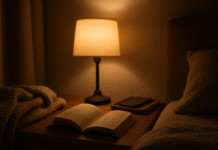


















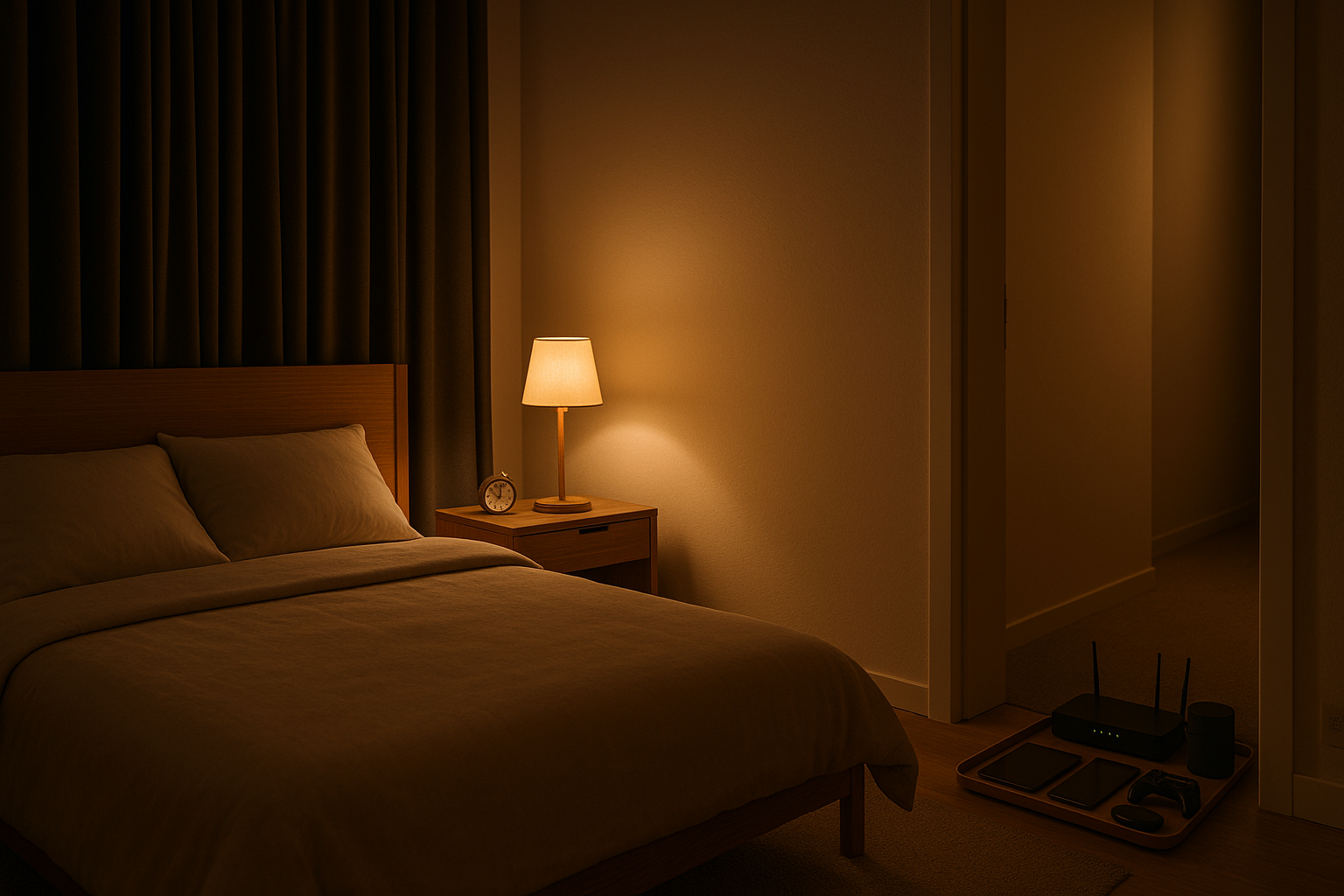
A quieter, darker, tech-light bedroom is one of the fastest ways to sleep better. Put simply: remove devices that add light, noise, notifications, or “work brain,” and your body’s sleep systems can do their job. Below you’ll find 12 high-impact gadgets to keep out of the bedroom, why they sabotage sleep, and exactly what to use instead. In brief: screens suppress melatonin, notifications keep your brain on alert, and bright LEDs and late-evening light nudge your circadian clock later. Do less in the bedroom—and you’ll sleep more.
Before we dive in, a quick health disclaimer: this is general wellness guidance, not medical advice. If you suspect a sleep disorder (e.g., insomnia, sleep apnea), talk to a qualified clinician.
Quick wins (2-minute setup):
• Charge phones outside the bedroom.
• Use a dimmable, analog (non-glowing) alarm clock.
• Cover or remove any blue LEDs; keep lighting warm and low.
• If noise is an issue, use a dedicated sound machine rather than a voice assistant.
• Keep room temperature cool (about 16–19°C / 60–67°F).
1. Smartphones
Keeping your phone in the bedroom is the single biggest sleep saboteur. First, the screen’s evening light suppresses melatonin and delays your body clock, making it harder to fall asleep and shifting your wake time later. Second, even when you’re not looking at the screen, alerts and “just checking” loops keep your brain in problem-solving mode. Experimental studies show that when notifications are on, people experience more inattention and hyperactivity symptoms than when phones are silenced and kept out of sight—exactly the opposite of the calm, low-arousal state you want before bed. Finally, doomscrolling is designed to be sticky; surveys repeatedly link late-night screen use to shorter sleep and poorer next-day alertness. TIME
1.1 Why it matters
- Evening light from phones can phase-delay your circadian rhythm and suppress melatonin.
- Alerts and vibrations create micro-arousals and attention switching.
- Habit loops (news, email, social feeds) increase cognitive and emotional arousal.
- Small-room brightness matters: even modest indoor light levels can affect melatonin and sleep timing.
1.2 How to do it
- Charge elsewhere: Put a charging station in the kitchen or hallway; enable “Allow Calls From Favorites” for emergencies.
- Set boundaries: Schedule “Do Not Disturb” nightly and use app limits after 9–10 p.m.
- Analog alarm: Replace the phone alarm with a simple clock (dim or no light).
- If you must keep it: Airplane mode + face-down + across the room; night mode + lowest brightness.
Bottom line: Out-of-room charging turns off the “always-on” switch in your brain and returns the bedroom to what it’s for—sleep.
2. Televisions
TV in the bedroom keeps you up later and bombards you with bright, dynamic light and unpredictable sound. Surveys find most adults watch TV before bed, and binge-watching is a common reason people delay bedtime. While some newer research notes that passive, familiar content may not affect everyone equally, the combination of light exposure and arousing content still tends to push sleep later and fragment it, especially when you nod off with the TV playing. If you insist on TV, it belongs outside the bedroom with a timer; your sleep space should be dark, quiet, and associated with sleep, not streaming.
2.1 Numbers & guardrails
- Melatonin sensitivity: Humans show strong evening light sensitivity; 50% melatonin suppression can occur at <30 lux—easy to exceed with a TV.
- Noise matters: Nighttime noise is linked to sleep disturbance; sporadic TV audio can be disruptive.
2.2 Mini-checklist
- No TV in the bedroom.
- If watching in another room, set an auto-off timer for the episode length.
- Keep lighting warm and low during evening viewing.
Bottom line: Keep the bedroom a screen-free zone; your brain will learn to power down faster.
3. Tablets & Backlit E-Readers
Backlit tablets and e-readers emit short-wavelength light directly into your eyes, delaying melatonin and your circadian clock. In a controlled crossover study, reading a light-emitting e-reader before bed delayed sleep, reduced evening sleepiness, suppressed melatonin, and impaired next-morning alertness compared to reading a printed book. If you love nighttime reading, use a paper book or a non-backlit e-ink reader with warm front light set very low, or read earlier in the evening with warm lighting. PubMed
3.1 How to do it
- Prefer paper or e-ink with amber/warm front light at the minimum usable level.
- Avoid interactive content (email, apps) while in bed.
- If using a device, enable night shift/night mode and reduce brightness to the lowest comfortable setting.
3.2 Mini case
A week of paper reading vs. tablet: people typically fall asleep faster and wake more refreshed during the paper week—even with the same total time in bed—because melatonin timing and pre-sleep arousal differ. (Result aligns with controlled lab findings.)
Bottom line: Replace glowing screens with low-arousal print or e-ink to protect melatonin and morning alertness.
4. Laptops & Workstations
Working in bed wires your brain to associate the bedroom with meetings, deadlines, and problem-solving. In cognitive behavioral therapy for insomnia (CBT-I), stimulus control explicitly instructs: use the bed/bedroom for sleep and sex only. When the bedroom becomes your office—or even your secondary inbox—sleep pressure competes with conditioned arousal. The fix is both simple and evidence-based: move work out of the bedroom, set a firm digital sunset, and let the bedroom be boring (in the best possible way). AAFP
4.1 How to do it
- Hard boundary: No laptop on the bed. Create a “closing ritual” 60–90 minutes before lights out.
- Staging area: Keep bags, chargers, and notebooks outside the bedroom.
- If space is tight: A small folding desk in another room beats working from bed.
4.2 Region note
In areas with evening power outages or generator use, it’s tempting to “catch up” at odd hours in bed; protect sleep by batching tasks earlier and using offline paper planning at night.
Bottom line: Protect the sleep association—no work tech in your sleep sanctuary.
5. Gaming Consoles & Controllers
Late-evening gaming raises physiological and cognitive arousal, delays bedtime, and can increase sleep-onset latency. Systematic reviews and lab studies find that playing arousing video games close to bedtime is linked to later sleep and reduced sleep efficiency; while results vary by game type and person, the safest move is to keep consoles and controllers out of the bedroom entirely. If you game at night, choose calmer titles, play earlier, and give your brain at least an hour of wind-down without screens. ScienceDirect
5.1 Checklist
- No consoles or controllers in the bedroom.
- Prefer non-competitive or turn-based games after dinner.
- Set a hard stop (alarm or plug timer) 60–90 minutes before bed.
- Dim room lights and use warm settings after sunset.
5.2 Numbers & guardrails
- Expect ~10–30 minutes more to fall asleep after late, arousing sessions; plan buffers accordingly.
- Keep overall evening light low to reduce compounding effects. PMC
Bottom line: Gaming belongs outside the bedroom with a deliberate cut-off; let your nervous system land before lights-out.
6. Smart Speakers & Smart Displays
Smart speakers and displays often mis-activate, playing sound or lighting up at night. Research finds popular models can be accidentally triggered by TV dialogue or similar words up to 1.5–19 times per day; smart displays add a bright screen to the problem. Privacy investigations have also shown that some voice assistant recordings were reviewed by contractors, raising comfort concerns for a room where you sleep. If you like soundscapes, use a dedicated, offline white-noise machine or a simple fan. CBS NewsBloomberg.com
6.1 Mini-checklist
- Keep smart speakers and smart displays out of the bedroom.
- Prefer mechanical sound sources (fan) or a standalone noise machine with no mic.
- If you must use one: disable mic at night, turn the display off, and hard-set a volume cap.
Bottom line: Reduce surprise activations and stray light—choose offline tools for sleep sounds.
7. LED Digital Alarm Clocks (and Clock-Watching)
A bright bedside display keeps your brain in time-tracking mode, fueling worry about “how little sleep I’ll get,” which perpetuates insomnia. Clock-watching increases arousal; bright displays add unwanted light exposure. Use a dimmable analog clock (or a sunrise-style alarm with screen off overnight), face it away from the bed, and avoid checking the time between bedtime and wake time. PMC
7.1 How to do it
- Replace seven-segment LED clocks with dim analog models.
- If you wake at night, don’t check the time—roll over or try a relaxation technique.
- If you need an alarm, place it across the room so you must stand to turn it off.
Bottom line: No glowing digits, no mental math; less anxiety, more sleep.
8. Blue-Rich Overhead Lights & “Too-Bright” Smart Bulbs
Even ordinary indoor light can suppress melatonin. Evening exposure to bright, blue-rich light delays your clock; humans are highly sensitive in the late evening, with notable melatonin suppression at relatively low light levels. Shift your bedroom to warm, low-lux lighting (amber/yellow) and keep brightness minimal at night. Reserve bright, cooler light for morning/daytime. Sleep Foundation
8.1 How to do it
- Use 2700K or lower bulbs for bedside lamps; enable “warm dim” scenes after sunset.
- Add a low-level amber night light for bathroom trips; avoid overheads.
- For smart homes, automate a sunset-to-bedtime scene with warm color and low brightness.
8.2 Numbers & guardrails
- Aim for <30 lux at the pillow after sunset; keep task lights targeted and brief.
- Morning: seek bright light outdoors to strengthen your rhythm for the next night.
Bottom line: Warmer, dimmer evenings protect melatonin; bright mornings anchor your clock.
9. Routers, Modems & Blinking Network Gear
Routers and modems add blinking LEDs and encourage nighttime scrolling. From a health perspective, major international guidelines (ICNIRP 2020 and 2025 updates) find no evidence that radiofrequency EMF exposure below guideline limits causes non-specific symptoms like headaches or sleep disturbances. So the sleep case for moving routers out is mainly practical: reduce stimuli (light, temptation, fan noise) and keep the bedroom visually quiet. Place network gear in another room or cabinet and use stickers or tape to block any stray LEDs in nearby spaces.
9.1 Mini-checklist
- House routers/modems outside the bedroom; disable status LEDs if possible.
- Schedule Wi-Fi off overnight only if it doesn’t trigger morning hassles; a wired connection for fixed devices can also reduce blinking indicators.
Bottom line: This is about behavior and light, not fear—out of sight helps you unplug.
10. Charging Hubs, Power Strips & Notification LEDs
A cluster of chargers adds blue LEDs, cable glow, and the urge to “quick check.” While tiny LEDs are low brightness, eliminating all extra light helps, especially in very dark rooms where your pupils are dilated. Cover or remove LEDs, relocate chargers, and create a single off-bedroom charging zone. If power backup devices beep after outages, disable the beep or move them—sporadic tones fragment sleep.
10.1 Tools/Examples
- Light-dimming stickers for LEDs; cord covers to prevent accidental glow.
- Magnetic/stand chargers set up in a hallway “dock” to break the in-bed check reflex.
Bottom line: One clean charging station outside the bedroom reinforces your digital curfew.
11. Wearables & Sleep Trackers
Wearables can teach you about sleep, but they can also backfire. Clinicians have described orthosomnia—the anxious pursuit of perfect sleep scores—which can worsen insomnia and undermine CBT-I. If you keep a tracker, use night mode, hide the display, avoid checking stats overnight, and review data after breakfast, not in bed. Consider a paper sleep diary for 2–3 weeks if you find yourself chasing scores.
11.1 Mini-checklist
- Night mode (no haptics/light) and airplane mode while sleeping.
- Look for trends weekly, not nightly.
- If anxiety increases, sleep without the device for a month.
Bottom line: Tools should serve you; if data adds stress, ditch it—your sleep will thank you.
12. Heat Tech That Overheats the Room (Space Heaters, Electric Blankets)
Your body needs to cool down to fall and stay asleep; overheated rooms reduce deep and REM sleep. Reviews show that heat exposure increases wakefulness and reduces restorative sleep stages. Aim for a cool bedroom (about 16–19°C / 60–67°F) and use heat tactically: pre-warm the bed, then turn devices off overnight. In hot, humid summers, prioritize airflow and moisture control; in winter, warm your feet briefly to help core cooling while keeping ambient air cool.
12.1 How to do it
- Preheat, then off: Electric blanket to warm sheets for 10–20 minutes; switch off before sleep.
- Keep a cool room and use blankets for personal warmth rather than heating the air.
- In humid climates, a fan + dehumidifier often beats turning the thermostat up.
Bottom line: Cool air, warm feet; avoid all-night heat sources that fight your biology.
FAQs
1) I need my phone as an alarm. What’s a practical workaround?
Use a small analog or sunrise-style alarm and charge your phone in another room with emergency bypass set for key contacts. If separation feels hard, start with airplane mode and move the charger farther away each week until it leaves the room. This reduces late-night checking and micro-arousals from alerts.
2) Is blue light really the main issue—or is it what I do on the device?
Both matter. Blue-rich light in the evening suppresses melatonin and can delay sleep; interactive, emotional content also elevates arousal. Some newer reports suggest passive, familiar content may be less disruptive for some people, but the safest approach remains dim, warm light and low arousal before bed. Wall Street Journal
3) What about reading on an e-ink device?
E-ink (without a strong backlight) is better than phones or tablets. If your reader has a front light, set it amber and very low, and avoid checking notifications or the web. A printed book is still the gold standard for sleep-friendly reading.
4) Are smart speakers safe to use as white noise machines?
They can mis-activate at night (and displays can glow), interrupting sleep. If you love soundscapes, consider a dedicated, offline noise machine or a basic fan. If you keep a smart speaker, disable the mic overnight and turn off the screen.
5) Should I worry about Wi-Fi EMF from routers near my bed?
Current international guidelines indicate no evidence that RF EMF exposure below limits causes sleep disturbances or other non-specific symptoms. For sleep, the practical issues are light, noise, and temptation. Move the gear out of the bedroom to reduce cues to browse, not because of EMF fears.
6) My partner insists on TV in bed. Any compromises?
Best practice is no TV in the bedroom. If that’s a no-go, agree on a single episode, use a sleep timer, lower brightness, enable warm color settings, and use wireless headphones to reduce noise spill. Still, aim to migrate viewing out of the bedroom over time. Sleep Foundation
7) Can a sunrise alarm help if I remove my phone?
Yes. Light-based alarms can reduce sleep inertia by gradually increasing light before wake time. Choose a device that stays dark overnight and doesn’t require a phone on the nightstand. EatingWell
8) I track my sleep. How do I avoid orthosomnia?
Hide the overnight display, review data after breakfast, and focus on trends (weekly/monthly) rather than nightly perfection. If your mood depends on the score, take a tracker holiday and use a paper sleep diary for a couple of weeks. Sleep Foundation
9) Is any screen time okay before bed?
If you do watch or read, keep it brief, passive, warm-toned, and dim, and stop 60–90 minutes before bedtime. The more you reduce evening brightness and arousal, the faster you’ll fall asleep and the better you’ll feel in the morning.
10) What’s the ideal bedroom temperature?
Most adults sleep best around 16–19°C (60–67°F). Use blankets for personal warmth and keep the air cool; avoid all-night heat sources. In hot climates, prioritize airflow and dehumidification.
11) Do white noise apps on my phone count as “tech in the bedroom”?
If they keep the phone in the room, yes. Better to use an offline sound source. At minimum, run the app with airplane mode, screen off, and the phone placed far from the bed—then work toward removing it entirely.
12) I wake to check the clock. How do I stop?
Turn the display away or use a non-illuminated clock. If you wake, avoid time-checking, try a breathing drill, and let your body resettle. Clock-watching sustains insomnia by pairing bed with worry. SciTechDaily
Conclusion
Sleep thrives on consistency and low stimulation. When you remove glowing screens, surprise sounds, and work reminders from your bedroom, you give your brain a clear message: this room is for rest. Start with high-impact changes—move the phone and chargers out, swap the alarm clock, dim the lighting, and cool the room. Then refine: use warm, low-lux lamps in the evening; keep network gear and consoles elsewhere; and choose offline tools for sound or wake-up light. These shifts reinforce healthy conditioning (bed = sleep), protect melatonin timing, and reduce the micro-stressors that fragment rest. Commit to a two-week experiment and notice what improves first—fall-asleep time, fewer night awakenings, or better morning energy. Your next great night of sleep is already waiting on the other side of your bedroom door. Make tonight the night you move the tech out.
References
- Chang A-M, Aeschbach D, Duffy JF, Czeisler CA. Evening use of light-emitting eReaders negatively affects sleep, circadian timing, and next-morning alertness. PNAS. 2015. PNAS
- Phillips AJK et al. High sensitivity and interindividual variability in the response of the human circadian system to evening light. PNAS. 2019. PNAS
- World Health Organization (WHO). Environmental Noise Guidelines for the European Region. 2018. World Health Organization
- Sleep Foundation. Technology in the Bedroom. Updated July 11, 2025. Sleep Foundation
- American Academy of Sleep Medicine. Over three-fourths of Americans lose sleep due to digital distractions; sleep experts urge a change. Dec 4, 2023. AASM
- Edinger JD et al. Behavioral and psychological treatments for chronic insomnia disorder in adults. J Clin Sleep Med. 2021. PMC
- Kushlev K, Proulx J, Dunn EW. “Silence Your Phones”: Smartphone Notifications Increase Inattention and Hyperactivity Symptoms. CHI Proceedings. 2016. Interruptions
- Northeastern University Mon(IoT)r Lab. Smart Speakers Study (preliminary findings). 2020. moniotrlab.khoury.northeastern.edu
- ICNIRP. Guidelines for limiting exposure to electromagnetic fields (100 kHz–300 GHz). 2020; and 2025 update statement. ; https://www.icnirp.org/cms/upload/publications/ICNIRPrfgaps2025.pdf ICNIRP
- Okamoto-Mizuno K, Mizuno K. Effects of thermal environment on sleep and circadian rhythm. J Physiol Anthropol. 2012. BioMed Central
- Sleep Foundation. The Best Temperature for Sleep. Updated July 11, 2025. Sleep Foundation
- Baron KG et al. Are Some Patients Taking the Quantified Self Too Far? J Clin Sleep Med. 2017. PMC