






















Vipassana meditation is the practice of directly observing body and mind to understand their changing nature and respond with balance. In plain terms: Vipassana trains you to notice sensations, thoughts, and feelings as they arise and pass, without clinging or resisting, so clarity replaces reactivity. In early Buddhist sources, this is framed through mindfulness of the body, feelings/vedanā, mind, and mental phenomena—the famous four foundations of mindfulness.
Quick start (2 minutes): Sit comfortably; notice your breath at the nostrils for a minute; then scan attention from head to toe, feeling whatever sensations are present. Name nothing, judge nothing; simply observe sensations changing. If you get lost, return to the breath and continue the sweep.
This educational guide isn’t a substitute for medical or mental-health care. If you have a history of trauma, psychosis, or severe anxiety/depression, consult a qualified professional and consider practicing with an experienced teacher. Research notes that meditation can include unpleasant or adverse effects for some practitioners.
1. Build a Stable Seat and Clear Intention
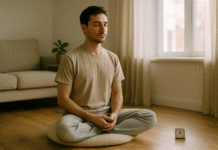
A stable, dignified posture makes Vipassana sustainable by minimizing avoidable discomfort and maximizing attentional steadiness. In the first 1–2 minutes of any session, the most helpful thing you can do is choose stillness, align your spine, and set the intention: “Observe what’s here without reacting.” This simple anchor shapes the nervous system’s expectations—your body learns it won’t be dragged around by every itch or thought, and your mind learns to investigate rather than fix or fight. A clear intention—seeing things as they are—nudges the practice away from daydreaming or self-judgment and toward curiosity, which is the emotional tone most compatible with insight.
1.1 How to do it
- Sit on a cushion or chair; place hands where the shoulders can relax.
- Let the spine lengthen naturally; soften the jaw, brow, and belly.
- Pick a quiet spot; set a timer for 10–20 minutes to start.
- State your intention silently: “Notice sensations, meet them evenly.”
- If pain is sharp or unsafe, adjust posture mindfully, then return.
1.2 Mini-checklist
- Stillness: Can I be 5–10% more still right now?
- Breath: Can I feel the breath without controlling it?
- Attitude: Am I curious rather than striving?
A steady seat and explicit intention form the “container” that supports all other techniques that follow. Think of this as calibrating the instrument before measurement.
2. Sharpen Attention with Breath (Ānāpānasati)
Start by gently placing attention on the natural breath to stabilize the mind; breath mindfulness is the on-ramp to Vipassana in many lineages. You’re not forcing the breath; you’re knowing each in-breath and out-breath as it is—long, short, subtle, coarse—allowing calm and clarity to develop. Classic instructions describe recognizing the length of the breath, feeling the whole body of the breath, and calming bodily fabrication; this builds a poised attention you’ll need for deeper investigation of sensations.
2.1 How to do it
- Feel the touch of breath at the nostrils or upper lip.
- Note the entire duration: beginning, middle, end.
- If distracted, label “thinking” once, then resume feeling.
- Every few minutes, soften effort by 10% to prevent strain.
- After 5–10 minutes, transition to sensation scanning (see Section 3).
2.2 Why it matters
- Breath awareness collects attention without suppression.
- It tunes perception to subtle change—perfect for insight work.
- It offers a reliable “home base” during difficult patches.
Breath practice isn’t the goal but the gateway: when attention is steady and kind, insight practice can proceed without the mind constantly slipping off task.
3. Observe Body Sensations Systematically (Head-to-Toe Scan)
Vipassana often proceeds through a systematic body scan, observing sensations in sequence—from the top of the head down to the toes, then back up—without preference. The key is not the type of sensation but your equanimity toward it. Tingling, warmth, pressure, throbbing, itching, heaviness, or even “no sensation” are all part of the field. The instruction is to observe, not react—no craving for pleasant, no aversion to unpleasant—while recognizing impermanence as sensations arise and pass. This method, taught widely in the Goenka tradition, builds fine-grained interoceptive awareness and stabilizes non-reactivity.
3.1 How to do it
- Divide the body into small zones (scalp, forehead, temples…).
- Spend ~5–20 seconds per zone, noticing actual sensations.
- If an area feels “blank,” rest there calmly for 30–60 seconds.
- Keep attention moving; don’t chase thrills or flee discomfort.
- After one full sweep, reverse direction; repeat 2–4 times.
3.2 Common mistakes
- Hunting for “special” sensations: This feeds craving.
- Fighting pain: Adjust if needed, but observe reactions first.
- Going mechanical: Refresh curiosity every few minutes.
Over time, you’ll discover that sensations are transient and layered. Seeing this directly trains the nervous system to meet life’s ups and downs with evenness.
4. Train Equanimity (Upekkhā) as a Skill
Equanimity is the heart of Vipassana: feeling fully without pushing or pulling. It’s not passivity; it’s balanced responsiveness. By staying with changing sensations—even strong ones—without reflexively tightening or indulging, you weaken the habit loops that generate stress. This capacity grows session by session: as you experience waves of pleasant and unpleasant sensations, you practice “letting them pass through” rather than reflexively grabbing or bracing. In Goenka-style instructions, you’re reminded to observe all sensations objectively, appreciating their impermanence—this reframes discomfort as training material rather than an enemy.
4.1 Tools/Examples
- Name your stance: “Allowing” on the in-breath, “softening” on the out-breath.
- Micro-relaxation: Unclench the jaw, eyes, shoulders when aversion spikes.
- Evening out: When pleasure arises, enjoy it lightly; keep scanning.
- Pain protocol: Pause, observe layers (raw sensation vs. story), then move mindfully if needed.
4.2 Why it matters
- Equanimity underpins emotional regulation; you’re less likely to act from impulse.
- It reduces suffering by disentangling sensation from struggle.
- It generalizes: the same non-reactivity helps in traffic, inboxes, and conflict.
Equanimity doesn’t make you numb; it frees attention to respond wisely rather than react habitually.
5. Understand the Three Characteristics (Anicca, Dukkha, Anattā)
Vipassana aims to reveal impermanence (anicca), unsatisfactoriness (dukkha), and not-self (anattā) in lived experience. You don’t adopt these as beliefs; you validate them by watching sensations arise and pass, noticing how clinging creates tension, and experiencing the absence of a solid controller in the flux. The classic frameworks of mindfulness point to these insights as central to seeing things as they really are; the practice is empirical: see change, see the costs of grasping, see processes where a fixed “me” was assumed.
5.1 Numbers & guardrails
- Expect micro-changes: dozens of distinct sensations in a single sweep.
- Watch clinging/aversion: note the stress cost within 2–5 seconds.
- Track identity talk: “I am anxious” → “Anxiety sensations are present.”
5.2 Mini case
A practitioner notices tightness in the chest during criticism. By observing the pressure and heat without fighting, the intensity drops from “8” to “4,” and the compulsion to defend softens. Insight: the discomfort was transient (anicca), resisting amplified it (dukkha), and no fixed “self” controlled the wave (anattā).
These characteristics aren’t metaphysical claims here; they’re operational lenses that make daily life less sticky.
6. Ground the Practice in Ethics (Sīla): The Five Precepts
Ethics stabilizes the mind. In traditional settings, students undertake five precepts—refraining from killing, stealing, sexual misconduct, false speech, and intoxicants—especially during intensive practice. This ethical baseline reduces agitation and remorse, making concentration and insight more accessible. Even outside retreats, aligning speech and actions with these precepts supports clearer perception; fewer fires to put out means more bandwidth to observe. Vipassana courses explicitly foreground sīla on day one, then build samādhi and paññā on top. Dhamma.org
6.1 How to apply at home
- Choose one precept to emphasize for a week (e.g., truthful speech).
- Journal one concrete choice each day that upheld it.
- Notice how ethical slips affect the next meditation session.
- Reduce stimulants before evening sits to support clarity.
6.2 Why it matters
- Ethics lowers background noise (guilt, rumination).
- It fosters trust—internally and with others—so insight can integrate.
- It echoes the traditional staircase: sīla → samādhi → paññā.
Treat precepts as supports, not perfection tests; progress is cumulative and compassionate. uk.dhamma.org
7. Structure Your Session: A Practical 45-Minute Template
A clear session arc prevents flailing and accelerates learning. Here’s a proven structure: settle posture (5 minutes), breath stabilization (10 minutes), body scan (25 minutes), closing metta or gratitude (5 minutes). This cadence balances collection with investigation, then softens the nervous system at the end. On busier days, compress to 10–20 minutes with the same sequencing. If you practice twice daily, keep the morning sit slightly longer; attention is fresher and sets the tone for the day.
7.1 Step-by-step
- 00:00–05:00: Posture, intention, and a few deeper sighs to relax.
- 05:00–15:00: Breath awareness at the nostrils; steady and soft.
- 15:00–40:00: Head-to-toe and back scanning; even attention.
- 40:00–45:00: Brief loving-kindness or gratitude; note any insights.
7.2 Common pitfalls
- Skipping the settle phase → restlessness lingers.
- Over-efforting → tunnel vision and fatigue.
- Ending abruptly → agitation rebounds.
Consistency beats intensity. A realistic template you actually follow will compound faster than heroic but irregular marathons.
8. Handle Pain and Difficult Emotions Wisely
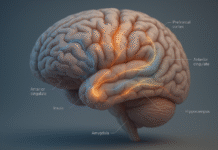
Discomfort is not a sign of failure; it’s training material. In Vipassana you’re learning to distinguish raw sensation from the mental add-ons (stories, catastrophizing, resistance). When pain flares, the first move is curiosity—where is it, what is its shape, does it change? When emotions surge, look for their bodily signatures: tight throat, heat in the face, flutter in the gut. Staying with these without either indulging or suppressing builds capacity that research associates with improved regulation and, in some studies, pain modulation via distinct neural pathways.
8.1 Pain protocol (3 steps)
- Locate & label: Pressure in knee, 3 cm wide, pulsing.
- Deconstruct: Sensation vs. story (“It will never stop!”).
- Decide: Keep watching, or adjust posture slowly and resume.
8.2 Emotional protocol
- Name gently: “Sadness sensations present.”
- Feel directly: Where in the body? Temperature? Movement?
- Offer care: One hand on chest; soften breath; continue observing.
You’re rewiring your default reaction from fight/flight to feel/learn. Over weeks, the nervous system trusts that it can meet intensity without being overwhelmed.
9. Balance Effort and Ease (Right Effort)
Too tight and attention becomes brittle; too loose and it drifts. Vipassana thrives in the middle. Think of effort as precision, not force: you place attention deliberately and renew interest often, but you don’t squeeze. A helpful rhythm is apply → sense → soften → continue. If agitation rises, downshift to larger body areas or reconnect with breath; if dullness creeps in, sit a bit taller, brighten the eyes behind closed lids, and shorten the dwell time per body area. The quality we’re after is alert ease.
9.1 Tools
- Rate of scan: Speed up 10–20% if sleepy; slow down if anxious.
- Breath-reset: 3 slow exhalations to widen attention.
- Micro-goals: “Just this sweep,” then re-commit.
9.2 Numbers & guardrails
- Aim for 70–80% steady presence; perfection isn’t the target.
- If you lose the thread every 15–30 seconds, shrink the zone (e.g., just the hands) until stability returns.
- If agitation lingers beyond 5 minutes, briefly stand or open the eyes.
Effort is a dial you’ll learn to tune. Over time, the system self-calibrates toward steady, sustainable attention.
10. Bring Insight into Daily Life (Off-Cushion Practice)
Insight matures when you practice between sits. The simplest method is micro-noticing: a dozen times per day, feel one breath and one sensation in the body, then continue what you were doing. In conversations, notice the body’s reaction and choose equanimity before replying. During transitions—doors, phone unlocks, kettle boils—treat each as a “bell of mindfulness.” This stitches the insights of impermanence and non-reactivity into email, commuting, parenting, and conflict.
10.1 Mini-checklist for daily life
- Bell: What’s one sensation right now?
- Balance: Can I be 5% less reactive?
- Benefit: What’s the kind thing that’s also true?
10.2 Why it matters
- It dissolves the split between “practice” and “life.”
- It makes retreat insights durable rather than fragile.
- It builds a feedback loop: life challenges → practice material → wiser responses.
When practice is portable, progress accelerates—everything becomes a teacher.
11. Understand Retreats and When to Consider One (10-Day Format)
Residential retreats offer immersion—silence, structure, and teacher guidance—to build momentum. In the Goenka tradition, the standard entry point is a 10-day course: noble silence, five precepts, ~10 hours/day of meditation, nightly discourses, and a daily progression from breath to systematic body scanning. Courses are donation-based, and the code of discipline outlines expectations in detail. For many, this format jump-starts equanimity and concentration by removing everyday friction.
11.1 How to prepare
- Build a consistent daily sit (20–30 minutes) for 4–8 weeks prior.
- Reduce screen time in the evenings a week before.
- Clarify logistics: meds, sleep aids, cushions, and climate.
- Read the code of discipline thoroughly.
11.2 Region-specific note
Access to centers varies by country; check your nearest regional site for availability and local guidelines. If travel is difficult, reinforce home practice and consider shorter day-longs or online teachings from reputable organizations while you build capacity for a residential course.
Retreats aren’t required, but they can compress learning—like language immersion—by surrounding you with conditions that encourage balanced, continuous awareness. ny.us.dhamma.org
12. Stay Evidence-Informed and Safe
While Vipassana is ancient, it’s sensible to align practice with modern evidence and safety guidance. Systematic reviews suggest that mindfulness-based programs can yield small to moderate improvements in anxiety, depression, and some pain outcomes, though results vary and quality of evidence is mixed. Importantly, research also documents unpleasant or adverse effects for a minority of practitioners—ranging from transient distress to longer-lasting difficulties—at rates roughly similar to other psychological treatments. Practicing gradually, with ethics, rest, and (when needed) professional support, helps you benefit while minimizing risk.
12.1 Practical safety tips
- Go gradual: Increase sit length by 5–10 minutes per week.
- Sleep & food: Don’t sacrifice basics; fatigue skews perception.
- Get help: If practice worsens functioning (sleep, work, relationships) for >2 weeks, consult a qualified teacher and clinician.
- Trauma-sensitive: Favor breath and grounding; widen attention if flashbacks occur.
12.2 What the science says (brief)
- Meta-analyses show moderate evidence for emotional symptoms; effects vary by population and program.
- Pain studies indicate meditation can reduce pain via mechanisms distinct from placebo or endogenous opioids.
- Adverse-effect studies emphasize monitoring and context; lasting bad effects are uncommon but real. SAGE Journals
A wise frame is: use the tradition’s clarity and the science’s caution. Practice steadily, track outcomes, and adjust with support as needed. NCCIH
FAQs
1) What does “Vipassana” literally mean?
“Vipassana” is often translated as “insight” or “to see clearly/as things really are.” In practice, it means observing sensations, thoughts, and feelings without clinging or aversion so their changing nature becomes obvious—reducing reactivity and confusion. In Goenka’s presentation, observation of bodily sensations is central because mind and body are deeply interconnected.
2) Is Vipassana the same as mindfulness?
They overlap. “Mindfulness” is the quality of present-moment awareness; “Vipassana” is insight practice that uses mindfulness to investigate phenomena. Many mindfulness programs draw on the same early discourses (e.g., Satipaṭṭhāna and Ānāpānasati), but “Vipassana” in popular use often refers to body-scan–based insight methods.
3) How long should I practice each day?
Start with 10–20 minutes and build toward 45–60 minutes as capacity grows. Twice-daily sits accelerate progress, but consistency matters more than length. If time is tight, keep the breath+scan structure even in a 10-minute sit to preserve the Vipassana arc.
4) Do I have to sit cross-legged on the floor?
No. A chair is fine. Comfort that supports stillness is the aim. Use cushions to adjust pelvis tilt; elevate knees relative to hips if sitting on the floor. If pain becomes sharp or unsafe, change posture mindfully and resume observing.
5) What should I do when I get overwhelmed by emotions?
Widen attention to include the whole body; feel your feet and the contact with the seat. Let the breath lengthen slightly on the exhale. If overwhelm persists, open the eyes, orient to the room, and pause practice until steadier. If difficult symptoms continue or impair functioning, seek guidance from a teacher and a clinician.
6) What happens on a 10-day course?
You’ll observe noble silence, undertake the five precepts, meditate ~10 hours/day, receive daily instructions, and progress from breath training to systematic body scanning, with evening discourses. Courses are donation-based; the code of discipline explains expectations in detail.
7) Is there scientific evidence that Vipassana helps with pain or mood?
There’s moderate evidence that mindfulness-based programs can reduce anxiety and depression for some people; effects are typically small to moderate. Pain research indicates meditation can reduce pain through neural mechanisms distinct from placebo or opioid pathways, though not all studies agree on size or generalizability.
8) Can meditation have side effects?
Yes. Studies document unpleasant or adverse effects in a minority of practitioners—ranging from transient anxiety or agitation to longer-lasting difficulties—at rates similar to other psychological treatments. This underscores the value of gradual training, adequate sleep and nutrition, and professional support when needed.
9) I can’t feel subtle sensations—am I doing it wrong?
Not at all. Start with obvious contact points (seat, feet, hands) and larger zones. Sensitivity grows with regular practice. If an area feels “blank,” rest there with curiosity for 30–60 seconds, then move on and return later.
10) Should I note or label sensations?
In many Vipassana approaches, you feel directly rather than verbalize. If labeling helps you stay present, use very light labels (“warm,” “pressure”) and then return to raw sensation so insight comes from feeling change, not thinking about it.
11) How do ethics affect meditation?
Ethical conduct reduces agitation and remorse, stabilizing attention and reducing conflicts that spill into practice. The five precepts—refraining from killing, stealing, sexual misconduct, false speech, and intoxicants—are a pragmatic way to lower background noise and support insight. Access to Insight
12) What’s the single best next step for beginners?
Pick a time and place you can keep daily, even for 10 minutes. Use the breath+scan sequence, track how you feel before and after, and increase the sit length gradually. If possible, learn from a qualified teacher or consider a structured course when life allows.
Conclusion
Vipassana is a practice of reality-testing: sitting still, you watch sensations, thoughts, and emotions arise and pass, and learn to meet them with equanimity. That simple loop—observe, understand, release—reshapes how you handle pain, conflict, and joy. The twelve practices above are a coherent training progression: stabilize posture and intention, collect attention on the breath, scan sensations, cultivate equanimity, and frame experience through impermanence, unsatisfactoriness, and not-self. Ethics lowers noise; structured sessions build momentum; retreat formats and evidence-informed safety help you deepen wisely. From there, the practice leaves the cushion and infuses your day, one deliberate breath and one sensation at a time. Next step: choose a daily window, set a timer, and follow the breath-and-scan arc for one week—notice, kindly and clearly, what changes.
References
- “Vipassana Meditation.” Dhamma.org (official site of S. N. Goenka’s tradition), accessed Aug 2025. Dhamma.org
- “What is Vipassana?” Vipassana Research Institute (VRI), accessed Aug 2025. Vipassana Research Institute
- Satipaṭṭhāna Sutta (MN 10): “The Foundations/Frames of Mindfulness,” Access to Insight (BCBS edition), 30 Nov–1 Dec 2013. and https://www.accesstoinsight.org/tipitaka/mn/mn.010.nysa.html Access to Insight
- Ānāpānasati Sutta (MN 118): “Mindfulness of Breathing,” Access to Insight (Thanissaro), 30 Nov 2013. Access to Insight
- “Mindfulness of Breathing (MN 118).” Barre Center for Buddhist Studies (article), accessed Aug 2025. Barre Center for Buddhist Studies
- Code of Discipline (five precepts and course guidelines). Dhamma.org, PDF and web pages, accessed Aug 2025. and https://www.dhamma.org/en/docs/core/code-en.pdf Dhamma.org
- “Guidelines for Practicing (Goenka tradition).” Dhamma.org, accessed Aug 2025. Dhamma.org
- “10-Day Courses (overview and scheduling).” Dhamma.org (regional pages), accessed Aug 2025. and Dhamma.orgVipassana Research Institute
- Goyal, M. et al. “Meditation Programs for Psychological Stress and Well-being: A Systematic Review and Meta-analysis.” JAMA Internal Medicine 174(3), 2014. and NIH PMC version JAMA NetworkPMC
- Zeidan, F. et al. “Mindfulness Meditation-Based Pain Relief Employs Distinct Neural Mechanisms.” Journal of Neuroscience 35(46), 2015; and “Not Mediated by Endogenous Opioids.” Journal of Neuroscience 36(11), 2016. and https://www.jneurosci.org/content/36/11/3391 The Journal of Neuroscience
- NCCIH (NIH). “Meditation and Mindfulness: Effectiveness and Safety,” June 3, 2022; plus related research updates (2024). and https://www.nccih.nih.gov/research/research-results/2024 NCCIH
- Britton, W. B., Lindahl, J. R., et al. “Defining and Measuring Meditation-Related Adverse Effects in Mindfulness-Based Programs.” Clinical Psychological Science 9(6), 2021. PMC
- Farias, M. et al. “Adverse Events in Meditation Practices and Meditation-Based Therapies: A Systematic Review.” Acta Psychiatrica Scandinavica 142(5), 2020. PubMed
- SuttaCentral. “MN 10 Mahāsatipaṭṭhāna Sutta,” translation by Bhikkhu Sujato, accessed Aug 2025. SuttaCentral