













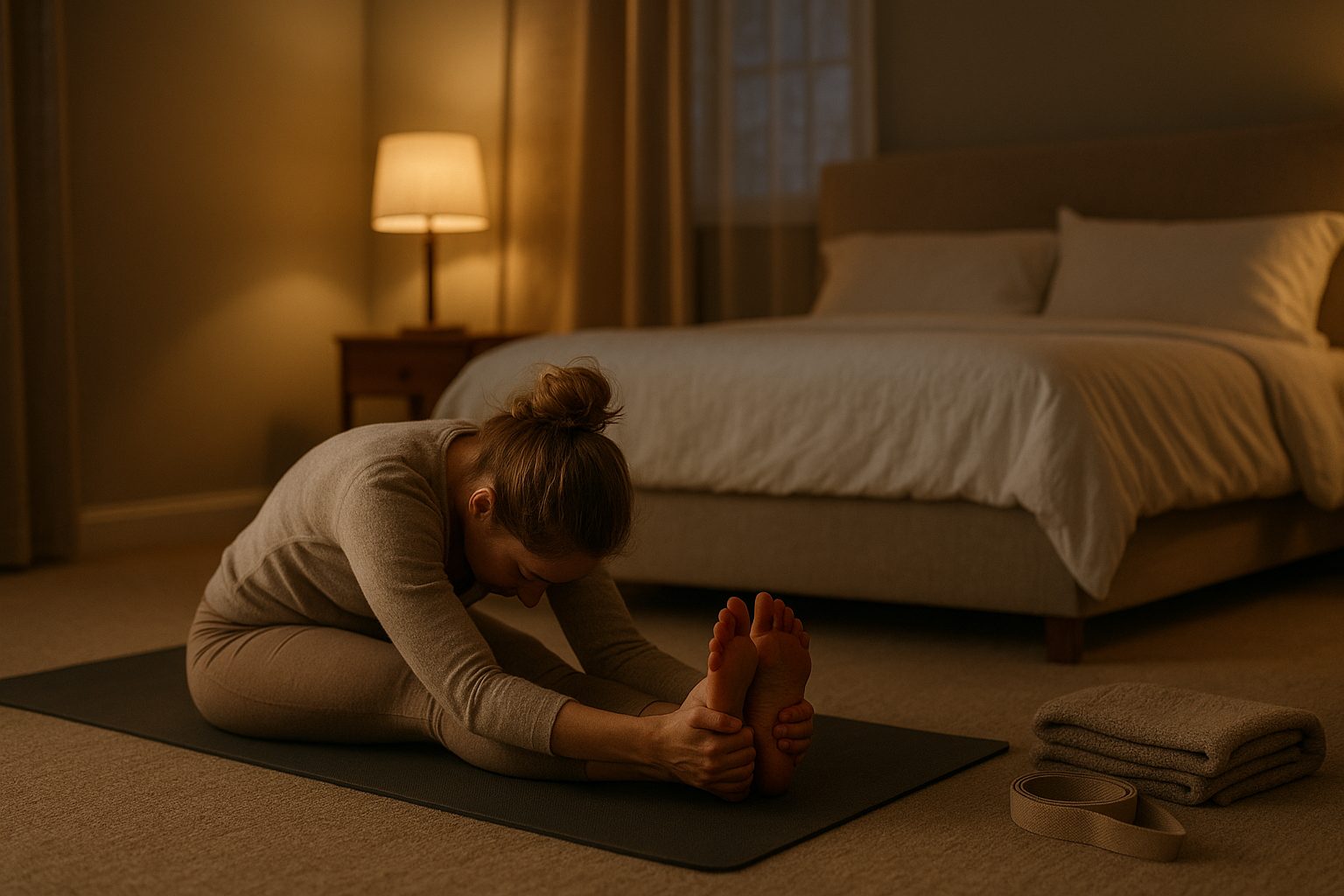
Some nights your body feels wired while your mind wants off the clock. This 9-step evening stretching routine gives you a calm, repeatable way to release your neck, shoulders, back, hips, and legs while downshifting your nervous system for sleep. You’ll learn exactly how long to hold each position, what to do with your breath, and simple substitutions if you’re tight or short on space.
Quick answer: An evening stretching routine is a gentle, 10–20 minute sequence of mostly static stretches paired with slow breathing to relax your muscles and cue your body for sleep. Do each move for 30–60 seconds (total ~60–120 seconds per muscle), keep the breath easy, and avoid painful ranges.
Skimmable sequence (overview):
- Centering breath (diaphragmatic/4-7-8)
- Neck & upper-trap/levator stretch
- Chest opener (doorway or supine)
- Thoracic “open book” twist
- Child’s pose with side reach
- Half-kneeling hip-flexor stretch
- Supine hamstring strap stretch
- Figure-4 glute/piriformis stretch
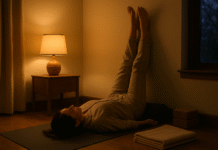
- Legs-up-the-wall (restorative finish)
Friendly reminder: This is general guidance, not medical advice. If you have pain, injuries, or a condition like glaucoma, uncontrolled blood pressure, or nerve symptoms, modify or consult a qualified clinician before trying new stretches.
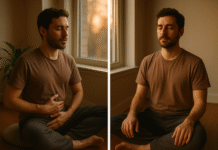
1. Center With Diaphragmatic (4-7-8) Breathing
Your starting point is breath: it’s the fastest, most portable way to flip your body from “go” to “rest.” Diaphragmatic breathing—letting the belly rise on inhale and gently settle on exhale—can lower perceived tension and help regulate heart rate. Begin lying on your back with knees bent and feet on the floor (hook-lying) or seated against your headboard. Place one hand low on your ribs and one on your belly. Inhale through your nose for 4, pause for 7, and exhale through pursed lips for 8, with the belly relaxing on each inhale and the exhale long but unforced. Two to three minutes of this slow cadence signals, “We’re safe; it’s okay to soften.” If 4-7-8 feels too long, shorten to 3-3-6 or simply breathe slowly in and out through your nose.
Why it matters
Slow, nasal, diaphragmatic breathing encourages the diaphragm to descend and the ribs to expand laterally, cueing the parasympathetic (“rest-and-digest”) branch of your autonomic nervous system. Longer, gentle exhales are particularly calming and pair beautifully with static stretching.
How to do it (mini-checklist)
- Lie or sit comfortably; loosen waistbands/bras that restrict the ribcage.
- One hand on belly, one on lower ribs; shoulders stay easy.
- Inhale 4, hold 7, exhale 8 (or a comfortable variant).
- Keep jaw, neck, and glutes relaxed; no straining.
- Aim for 8–10 slow cycles.
Numbers & guardrails
- Duration: 2–3 minutes (or 8–10 breaths).
- Effort: 2–3/10; no lightheadedness.
- If dizzy, shorten the breath or rest between cycles.
Finish with one natural breath and notice your body settle—this is your “entry ramp” into the rest of the routine.
2. Ease Neck & Levator Scapulae Tension
Evening screen time and driving load your neck. Start with a simple upper-trap stretch, then target the levator scapulae (the “turtleneck” muscle that lifts the shoulder blade). From sitting, lengthen tall through the crown of your head. For the upper-trap: tilt your right ear toward your right shoulder until you feel a mild stretch on the left side of your neck; keep your left shoulder heavy. For levator: turn your nose toward your right armpit (about 45°), then nod the chin down slightly; you’ll feel the stretch more toward the back-side of the neck. Use the right hand lightly on your head to guide (not yank) deeper if needed.
How to do it
- Upper-trap: Ear to shoulder, opposite shoulder drops; optional gentle over-pressure with your hand.
- Levator: Turn 45° toward the armpit, chin nods; imagine drawing the back of your head long.
- Gentle breathing; no compression or sharp pain.
Common mistakes
- Shrugging the stretching-side shoulder (reduces the stretch).
- Pulling aggressively on the head (irritates joints).
- Collapsing through the chest (rounds upper back and cheats the neck angle).
Numbers & guardrails
- Hold 30–45 seconds per angle, 1–2 rounds each side.
- Intensity: 3–4/10, not higher.
- If you’re sensitive, do small oscillations (5–10 gentle nods) instead of holds.
Close by slowly rolling the shoulders back 3–5 times. Your jaw and forehead should feel softer—carry that ease forward.
3. Open Your Chest (Doorway or Supine Pec Stretch)
Hours of forward posture leave the chest tight and shoulders rounded. Opening the pectoral muscles gives your neck and upper back room to relax. Use a doorway: stand in a doorway with your right forearm on the frame, elbow at or just below shoulder height (about 70–90°), step the right foot forward slightly, and gently lean until you feel the stretch across the chest/front shoulder. Keep ribs knit (no flaring) and neck long. Prefer the floor? Lie on a rolled towel or foam roller along your spine, arms open in a wide “goalpost” or “T,” palms up.
Tools/Examples
- Doorway single-arm pec stretch: Great in small spaces; easy to modulate.
- Supine on roller/towel: Passive chest opening plus bonus postural reset.
- Hands-behind-back clasp (gentle): For shoulder-friendly days.
Numbers & guardrails
- Doorway: 30–60 seconds each side, 1–2 rounds.
- Supine “T”/goalpost: 1–2 minutes of relaxed breathing.
- Avoid shoulder pinching; lower the elbow if you feel impingement.
- Keep the low ribs heavy to avoid over-arching.
Why it matters
Releasing the chest reduces the tug-of-war on your neck and allows your shoulder blades to rest down and back—an instant antidote to screen posture. A relaxed chest also invites fuller ribcage expansion on each breath.
Finish by shaking out the arms and noticing your collarbones broaden.
4. Restore Thoracic Rotation (Open-Book Twist)
A stiff mid-back can make your neck and low back overwork. The open-book twist restores gentle rotation through your thoracic spine and melts desk-day tension. Lie on your right side, hips and knees stacked at 90°, arms together stretched forward at shoulder height. Inhale, then as you exhale, sweep your top (left) arm up and open it to the left, letting your chest follow while knees stay stacked. Head turns with the arm if comfortable. Only go as far as your ribs can without popping and your knees can stay together—use a pillow between knees if needed.
How to do it
- Set up like a fetal curl with a pillow under your head.
- Breathe in to lengthen; exhale to open the book.
- Pause at your end range for 2–3 breaths, then close and repeat.
Numbers & guardrails
- 5–8 slow repetitions per side, or 30–45 seconds static hold per side.
- Intensity: 3/10 stretch, 0/10 pain.
- If your shoulder protests, keep the elbow bent and the hand sweeping.
Common mistakes
- Letting the top knee float off the bottom knee (loses the thoracic focus).
- Forcing the shoulder to the floor (pinches).
- Holding your breath (beats the purpose).
After both sides, your upper back should feel more elastic and your breath easier. That softness feeds right into the next pose.
5. Lengthen Lats & Low Back (Child’s Pose With Side Reach)
Child’s pose is a universally soothing shape that unweights the spine and lengthens the lats and fascia that wrap your back and ribs. From hands and knees, bring your big toes together and knees comfortably wide, then sink your hips toward your heels. Reach your arms long, forehead to the mat or a folded towel. To target the side body, walk both hands to the right and breathe into your left ribs; repeat to the left. If hips don’t sit back comfortably, place a pillow or folded blanket under your belly or between calves and thighs.
Why it matters
Lengthening the lats (big pulling muscles) and the thoracolumbar fascia reduces tug on your lumbar spine and opens space for the ribs to expand—great for fuller, calmer breathing before bed.
How to do it (mini-checklist)
- Hips toward heels; support with pillows if tight.
- Hands reach forward; forehead supported to relax neck.
- Walk hands right/left for 2–3 breaths each to target the side body.
- Keep shoulders soft and wide; jaw unclenched.
Numbers & guardrails
- 1–2 minutes total, alternating center and side reaches every 2–3 breaths.
- Intensity: gentle lengthening, never knee pain.
- If knees are sensitive, do a seated forward fold over pillows instead.
Come up slowly, stacking the spine, and notice the “weighted blanket” feeling through your back—save that sensation for sleep.
6. Release Hip Flexors (Half-Kneeling Lunge)
Sitting shortens the hip flexors (especially iliopsoas and rectus femoris), which can tug on your low back and make standing posture feel strained. A careful half-kneeling lunge restores length. Kneel with your right knee down (pad under the knee), left foot forward. Tuck the pelvis slightly (posterior tilt—think “zip up your zipper”) to feel the stretch in the front of the right hip without leaning forward yet. Keep ribs stacked over pelvis; then glide your whole torso a few centimeters forward until the stretch deepens but stays comfortable. Optional: reach the right arm up and slightly to the left to target more psoas.
How to do it
- Set a cushion under the back knee.
- Posterior pelvic tilt first; then small forward glide.
- Keep glutes lightly engaged on the kneeling side to protect the lumbar spine.
- Breathe; avoid flaring ribs or over-arching the back.
Numbers & guardrails
- 30–45 seconds each side, 2 rounds.
- Intensity: 3–5/10 stretch, 0/10 pain.
- Knee sensitive? Do a standing lunge with the back foot elevated on a step, or place a thicker pillow.
Common mistakes
- Skipping the pelvic tilt (you’ll feel nothing where you want it).
- Driving the knee far past the toes while collapsing the low back.
- Holding breath or clenching the jaw.
End each side by gently squeezing the glute of the stretching leg for 3–5 seconds; this reinforces a more open hip as you walk to bed.
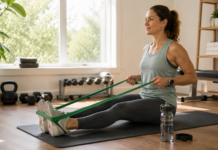
7. Easy Hamstring Reset (Supine Strap Stretch)
Tight hamstrings can pull the pelvis into a posterior tilt and limit comfortable sleep positions. Supine with a strap/towel takes the back out of the equation. Lie on your back, left knee bent and foot on the floor, right leg lifted with a strap around the mid-foot. Straighten the right knee to a comfortable angle while keeping the tailbone heavy and the low back neutral. Avoid yanking the leg toward your face; instead, find the edge, breathe, and let the tissues yield. For a neural “floss,” you can alternate pointing and flexing the ankle.
Why it matters
Gentle, sustained hamstring stretching improves posterior-chain comfort and makes side-sleeping or back-sleeping feel easier. Doing it lying down prevents low-back compensation.
How to do it (mini-checklist)
- Keep the opposite knee bent unless your back is very comfortable.
- Thigh stays relatively vertical; don’t let the tailbone curl up.
- Option: small ankle pumps or micros-bends to modulate intensity.
- Breathe into the back of the leg; shoulders stay relaxed.
Numbers & guardrails
- 30–60 seconds per side, 1–2 rounds.
- Total goal: ~60–120 seconds of time-under-stretch per hamstring.
- If you feel sciatic nerve zing, reduce the stretch and soften the ankle.
Set the leg down slowly and notice your pelvis feel more balanced against the floor—less tug equals more ease.
8. Soothe Glutes & Piriformis (Figure-4 Stretch)
If you sit a lot or enjoy cycling/running, the deep rotators of your hip can feel cranky. The figure-4 targets piriformis and gluteals without stressing the spine. Lie on your back, knees bent. Cross your right ankle over your left thigh just above the knee, forming a “4.” Thread your right hand through the opening to clasp behind your left thigh (or use a strap). Keep your tailbone heavy and gently draw the left thigh toward you until you feel a stretch deep in the right hip. Imagine your right knee moving away from your chest (not collapsing inward).
How to do it
- Neutral pelvis; don’t jam the low back into the floor.
- Right foot flexed (to protect the knee).
- Small rocks side-to-side can help stubborn hips relax.
- Option: Wall-assist—put the left foot on a wall and walk it down for hands-free control.
Numbers & guardrails
- Hold 45–60 seconds per side, 1–2 rounds.
- Intensity: 4/10 deep stretch, no sharp knee pain.
- Knee sensitive? Place a pillow between the crossed legs to shorten the lever.
Common mistakes
- Pulling from the neck/shoulders; use a strap or wall instead.
- Letting the spine twist (keeps the stretch from targeting the hip).
- Forcing the knee down with your hand (can irritate the joint).
Come out slowly and notice the newfound space when you draw your knees into your chest—it should feel smoother and more symmetric.
9. Finish With Legs-Up-the-Wall (Viparita Karani)
Cap the routine with a restorative pose that invites quiet. Sit sideways near a wall, lie back, and swing your legs up so your seat is a hand-width or so from the baseboard. Let your arms fall where comfortable, palms up. If your hamstrings tug, scoot farther from the wall or place a little bend in the knees; a pillow under the hips or a folded blanket under the head can feel luxurious. Eyes soft, jaw relaxed. Breathe naturally or return to a gentle 3-3-6 cadence.
Why it matters
Elevating the legs while supported encourages the back line of the body to release, reduces the sense of heaviness in tired legs, and many people find it calms pre-sleep fidgetiness. It’s not about deep stretch—it’s about letting the body be held so the mind can idle down.
How to do it (mini-checklist)
- Scoot distance to comfort; slight knee bend is fine.
- Support head/low back as needed; keep the throat soft.
- Dim lights; optional eye pillow or an extra blanket over the shins.
- Stay with easy nasal breathing.
Numbers & guardrails
- 2–5 minutes (or as little as 60–90 seconds on busy nights).
- If you feel tingling or numbness, come out, bend the knees, and rest.
- Not ideal for some eye or blood-pressure conditions—skip if advised by your clinician.
Roll to your side, pause for a breath, then stand slowly. Your body should feel heavy-calm and ready for lights out.
FAQs
1) How long should an evening stretching routine take?
Most people do well with 10–20 minutes total. If you’re rushed, hit items 1, 5, and 9 (breath, child’s pose, legs-up-the-wall) for a 5–8 minute “minimum dose.” For deeper work, spend 30–60 seconds per stretch and shoot for ~60–120 seconds total per muscle group across 1–3 rounds.
2) Is it okay to stretch every night?
Yes—gentle, non-painful static stretching is safe nightly for healthy adults. Alternate emphasis (upper body one night, hips/legs the next) if you feel sore. If you’re hypermobile or recovering from injury, reduce intensity and prioritize control work and breath.
3) Should evening stretches be static or dynamic?
Evenings favor slow, static holds and breath work to calm the nervous system. Save faster dynamics for warm-ups. Small, gentle mobility (like open-books) is fine—just keep rhythm slow and avoid high-effort end-range bouncing before bed.
4) Can this replace a workout?
Stretching supports recovery and comfort but doesn’t replace strength or cardio. Think of it as a nightly hygiene habit like brushing your teeth—complementary to training, not a stand-in.
5) Will stretching actually improve my sleep?
For many people, yes. Sleep quality is influenced by many factors, but low-intensity movement plus slow breathing can reduce pre-sleep arousal and muscle tension. The effect is modest but meaningful for comfort and wind-down.
6) What if I have low-back pain?
Keep ranges pain-free, emphasize child’s pose, hamstring strap stretches, and hip flexor mobility, and skip anything that causes symptoms. Use pillows liberally. If pain persists or includes numbness/tingling, consult a clinician for a tailored plan.
7) I’m very tight—where should I start?
Shorten holds to 20–30 seconds, use props (strap, pillows), and reduce lever arms (bend knees, move farther from the wall). Consistency beats intensity; 5–10 minutes nightly for two weeks usually builds momentum.
8) Best time to do this relative to bedtime?
Anywhere from 30 minutes to immediately before lights out works. If you tend to doze off on the floor (it happens!), finish with legs-up-the-wall for 2–3 minutes, then head straight to bed.
9) Can I do this after a late workout?
Yes—cool down first, hydrate, then do a lighter pass: 30 seconds each for neck, chest, hips, and a short legs-up-the-wall. Skip deep end-ranges if you trained intensely.
10) What props help most?
A yoga strap or towel, a folded blanket/pillow, and optional foam roller cover 99% of needs. For sensitive knees, a garden-knee pad or double-folded mat is a game-changer.
11) How hard should these stretches feel?
Aim for 3–5/10 stretch sensation—clear but comfortable. Tingling, sharp pain, or joint pinching means back off or modify the angle. The goal is a downshift, not a grind.
12) What if I fall asleep in the last pose?
That’s a win. If your legs tingle, bend your knees and roll to your side first. Over time you’ll learn how long you can stay without numbness—often 2–5 minutes is perfect.
Conclusion
An effective wind-down routine is less about heroic flexibility and more about consistency, breath, and comfort. By pairing gentle holds with slow nasal breathing, you give your neck and shoulders space, un-tether your spine, and open hips that sat all day. These nine moves are intentionally simple so you’ll actually do them—no equipment required, minimal floor space, and easy modifications for tight days. Start with two or three favorites and build to the full sequence; most people feel a tangible difference in one week of nightly practice. Dim the lights, move slowly, let the breath be your metronome, and let the day dissolve out of your muscles.
Ready to try it tonight? Roll out a mat, set a 15-minute timer, and start with Step 1.
References
- Stretching: Focus on flexibility. Mayo Clinic. Updated 2023. https://www.mayoclinic.org/healthy-lifestyle/fitness/in-depth/stretching/art-20047931
- Diaphragmatic Breathing: Benefits & How To. Cleveland Clinic. Reviewed 2024. https://my.clevelandclinic.org/health/articles/9445-diaphragmatic-breathing
- Best Stretches to Do Before Bed. Sleep Foundation (National Sleep Foundation). Updated 2024. https://www.sleepfoundation.org/sleep-hygiene/best-stretches-before-bed
- The right way to stretch. Harvard Health Publishing. 2019. https://www.health.harvard.edu/staying-healthy/the-right-way-to-stretch
- Sleep Hygiene: Healthy Sleep Tips. Centers for Disease Control and Prevention. Reviewed 2024. https://www.cdc.gov/sleep/about_sleep/sleep_hygiene.html
- Kredlow, M. A., et al. The effects of physical activity on sleep: a meta-analytic review. Sleep Medicine Reviews. 2015;22:23-36. https://doi.org/10.1016/j.smrv.2014.10.007
- Low Back Pain: Exercises. National Health Service (NHS). Updated 2023. https://www.nhs.uk/conditions/back-pain/back-pain-and-stretches/
- Flexibility Training Recommendations. American College of Sports Medicine (ACSM). Accessed 2025. https://www.acsm.org/education-resources/trending-topics-resources/flexibility-training
- Yoga: In Depth. National Center for Complementary and Integrative Health (NCCIH). Reviewed 2024. https://www.nccih.nih.gov/health/yoga-in-depth
- Viparita Karani (Legs-Up-the-Wall Pose). Kripalu Center. Accessed 2025. https://kripalu.org/resources/viparita-karani-legs-wall-pose