



























Skincare can be more than cleansing and moisturizing—it can be a grounding daily ritual that steadies your mood and supports mental wellbeing. Done thoughtfully, “skincare as self-care” ties simple skin-health habits to proven techniques that calm the stress response and add structure to your day. This guide shows you exactly how to build a sustainable ritual that protects your skin barrier, reduces friction through smart habit design, and weaves in micro-moments of mindfulness.
In short: skincare as self-care is a consistent, sensory-aware routine that supports both your skin and your state of mind by combining evidence-based dermatology basics with small, repeatable mental health practices.
Quick glance—your 9-step ritual:
- Set an anchor and intention; 2) Cleanse gently; 3) Hydrate and repair; 4) Protect with SPF by day; 5) Introduce one targeted “treat” step; 6) Add a mindful minute; 7) Create a 5-minute evening wind-down; 8) Track light metrics (skin + mood); 9) Adapt for climate, water, and season.
This article is educational and not medical advice. If you have persistent rashes, acne, eczema, or low mood, consult a dermatologist or mental health professional.
1. Set Your Anchor and Intention (So the Routine Actually Happens)
A skincare ritual helps only if you can repeat it with minimal friction. Start by anchoring it to a moment that already happens every day—after you brush your teeth or when the kettle boils. Then write a one-line “implementation intention”: “After I set down my toothbrush at 7:15 a.m., I will spend five minutes on cleanse-hydrate-SPF.” This marries “habit stacking” (attaching a new action to an existing cue) with a proven “if-then” plan that increases follow-through. Open your session with a tiny intention like, “Gentle care, not perfection.” Small phrases act as cognitive cues and reduce self-criticism, which is crucial for rituals meant to regulate stress rather than fuel it.
- Mini-checklist to lock the habit
- Choose one anchor (after coffee, after prayer, after teeth).
- Write a one-sentence if-then plan and tape it near the mirror.
- Keep your products in a tray so the environment nudges the routine.
- Start tiny (2–5 minutes) to build success momentum.
- Add a micro-reward (sip of tea, favorite song) to reinforce it.
1.1 Why this works
Implementation intentions show medium-to-large effects on goal attainment across 90+ tests, and habit stacking uses the power of existing cues to reduce the effort needed to start. The point isn’t discipline; it’s designing a situation where the next step is obvious. James Clear
Synthesis: A one-line plan + a reliable cue transforms skincare from “something I should do” into an automatic ritual that starts itself.
2. Cleanse Gently to Protect Your Skin Barrier
The goal of cleansing is to remove excess oil, sweat, and pollutants without stripping lipids and proteins that make up your skin’s protective barrier. Use lukewarm (not hot) water, skip harsh scrubs, and limit face washing to once or twice daily based on your skin type. A soft, fragrance-free cleanser reduces irritation risk and preserves barrier function, which directly affects comfort and mood—itch, sting, or tightness can amplify stress and rumination you’re trying to reduce with this ritual.
- Steps that work
- Wet face with lukewarm water; avoid hot water.
- Massage a gentle, fragrance-free cleanser for 20–30 seconds.
- Rinse thoroughly; pat (don’t rub) dry.
- Immediately move to your hydration step to lock in water.
2.1 Numbers & guardrails
Dermatology guidance recommends warm (not hot) short showers, gentle cleansers, pat-drying, and moisturizing right after to support barrier function. Over-cleansing and high-temperature water increase dryness and can worsen symptoms in sensitive skin.
Synthesis: Gentle cleansing is a comfort win today and a barrier-health investment for tomorrow—keep it warm, brief, and fragrance-free.
3. Hydrate and Repair: Moisturizer as a Mood-Support Tool
Apply a moisturizer within 3 minutes of cleansing to trap water and reinforce your barrier. Look for ceramides, glycerin, and hyaluronic acid; these support the skin’s lipid matrix and humectant balance. Beyond comfort, there’s a psychological dividend: when dryness, sting, and visible irritation decline, people report better quality of life—an effect you’ll feel as fewer “skin distractions” through the day. Stress elevations can also impair the barrier; consistent hydration helps buffer that loop.
- What to use
- Normal to oily: lightweight lotion/gel-cream with humectants.
- Dry/sensitive: thicker cream or ointment; fragrance-free.
- Very dry climates: layer a humectant serum under your cream.
3.1 Why it matters
Dermatology sources note moisturizing soon after bathing helps restore barrier integrity; research links psychological stress with increased cortisol and deterioration of skin-barrier function. Regular use of a skincare regimen has been associated with objective skin improvements and improved self-reported quality of life. American Academy of Dermatology
Synthesis: Moisturizer is not vanity—it’s barrier therapy that reduces irritation “noise,” freeing up attention and boosting day-to-day wellbeing.
4. Protect With Sunscreen by Day (SPF 30+, Broad-Spectrum, Reapply)
Daily UV protection is a cornerstone of skin health and makes your routine feel complete: cleanse → hydrate → protect. Choose a broad-spectrum SPF 30+ you like enough to apply generously. For the face and neck, many dermatologists teach the “two-finger” estimate (two finger-lengths of SPF) or about ¼ teaspoon; for body, a pragmatic guide is about 1 ounce (30 mL)—roughly a shot glass—and reapplication every 2 hours outdoors or after swimming/sweating. In high-UV regions, this step is non-negotiable.
- SPF checklist
- Broad-spectrum SPF 30+ (UVA + UVB).
- Apply enough (¼ tsp face/neck; ~1 oz body).
- Reapply every 2 hours outdoors; sooner if swimming/sweating.
- Don’t forget ears, lips, eyelids, and hands.
4.1 Numbers & region notes
Dermatology and public-health guidance consistently recommend broad-spectrum SPF 30+ and regular reapplication; WHO offers quantity guidance (3–4 tablespoons for full adult body), and the FDA reiterates reapplying at least every 2 hours. Karachi and many South Asian cities see very high to extreme UV Index (10–12) in late spring and summer—your ritual should emphasize year-round protection and strict reapplication in those months.
Synthesis: A “find-and-refill” SPF you love is mental ease in a bottle—protection you’ll actually use is the best protection.
5. Introduce One Targeted “Treat” Step (Patch-Test First)
To keep your ritual sustainable, add only one active at a time based on your goal: niacinamide (calm redness, oil balance), azelaic acid (tone, bumps), retinoid (texture, fine lines), or vitamin C (brightening, antioxidant). Patch-test new products before full-face use: apply to a quarter-sized area on the inner arm or elbow twice daily for 7–10 days. If you tolerate it, start 2–3 nights/week and increase slowly. This “one-change-at-a-time” rule protects your barrier and avoids the kind of irritation spiral that can dent your mood.
- Patch-test steps (at-home)
- Choose a quarter-size spot (inner forearm or elbow bend).
- Apply the normal thickness and leave on as directed.
- Repeat twice daily for 7–10 days; stop if redness/itching occurs.
5.1 Why it matters
The American Academy of Dermatology outlines practical, home patch-testing steps to reduce allergic or irritant reactions; dermatology clinics also offer formal patch testing for suspected contact dermatitis. A slow-build approach preserves your barrier and prevents setbacks that can erode confidence in the ritual itself.
Synthesis: Add power, not chaos—one carefully introduced active gives results while keeping your self-care ritual calm and predictable.
6. Add a Mindful Minute: Breath, Touch, and Sensory Grounding
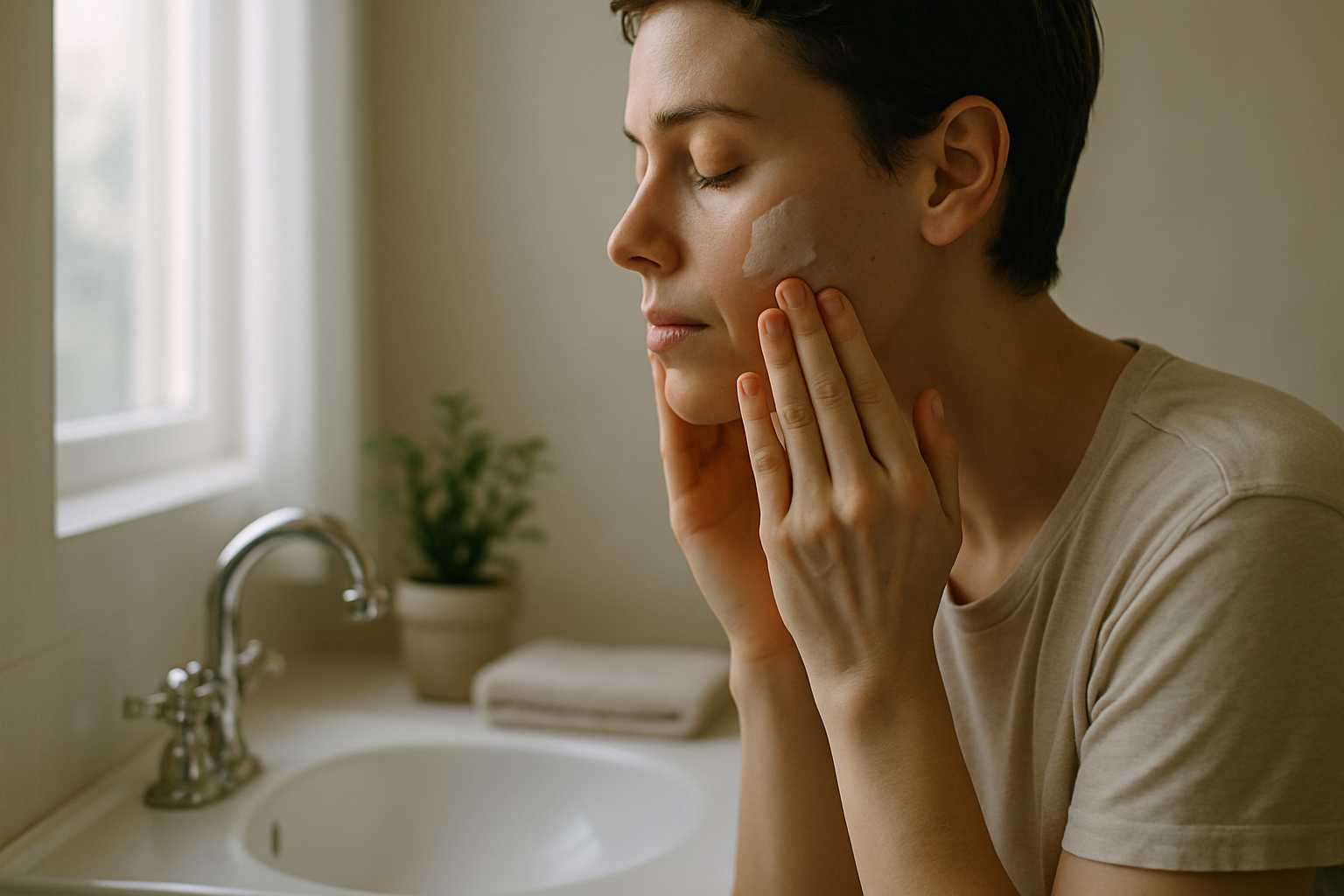
Layer a 60–120 second mindfulness moment into your routine: 6 slow breaths during cleanser massage, or a brief “body scan” as you apply moisturizer. Gentle, intentional self-touch (like slow, light cheek strokes or a palm rest over the chest) is more than soothing; randomized data show self-soothing touch and being hugged can reduce cortisol under stress. Mindfulness-based stress reduction (MBSR) programs have shown medium effects for reducing anxiety and depression across populations. These micro-practices pair beautifully with skincare because the tactile steps are already there—you’re simply bringing awareness to them.
- Two plug-and-play options
- Box breathing 4-4-4-4 while cleansing.
- 3-part touch while moisturizing: cheeks → temples → chest.
6.1 Evidence snapshot
Meta-analytic and clinical evidence supports MBSR for mental-health outcomes; lab work indicates that slow, supportive touch can blunt cortisol responses during stressful tasks. The aim in a bathroom ritual isn’t therapy but consistent, small nervous-system nudges that accumulate.
Synthesis: A mindful minute turns a to-do into a reset—tiny, repeatable, and surprisingly potent.
7. Create a 5-Minute Evening Wind-Down (Screens Off, Skin On)
Evening is the perfect time for a calming “bookend” ritual: cleanse to remove sunscreen/pollution, re-hydrate, and, if using a night-only active (e.g., retinoid), apply it now. Keep lights low and screens off to reduce arousal—let your skincare become the cue that daytime is over. Behaviorally, this is a mini version of behavioral activation: a simple, meaningful activity you do consistently to support mood regulation and sleep-readiness. You’re building a “closing ceremony” that your brain can trust.
- The 5-minute flow
- Cleanse (lukewarm water).
- Treat (only if your patch-tested active is on the schedule).
- Moisturize (cream/ointment if your skin runs dry).
- Lights down + 2 slow breaths with hands on chest.
7.1 Why evenings help
Behavioral activation emphasizes small, routine activities that increase contact with positive reinforcement; evening wind-downs are a reliable, low-effort dose of that principle with benefits for sleep and next-day mood. Equivalence with CBT in many trials suggests BA-style routines are legitimate tools for everyday mental health support. PubMedPMC
Synthesis: Let your night ritual close the loop—less decision-making, more automatic calm.
8. Track Light Metrics: Two Lines a Day (Skin + Mood)
Keep tracking frictionless. On a sticky note or notes app, log two numbers nightly: Skin Comfort (0–10) and Mood Steadiness (0–10). Optional: note one variable (new active? poor sleep? extra sun?). Over 2–4 weeks you’ll see patterns—maybe SPF reapplication correlates with less redness, or mindfulness minutes correlate with steadier afternoons. This is not a biohacking spreadsheet; it’s a feedback loop so you can adjust without guesswork, and it deters all-or-nothing thinking.
- Mini-checklist
- Cap tracking at 30 seconds per day.
- Review weekly, not daily, to avoid noise.
- Adjust one variable at a time (e.g., cleanser, not five things).
- Celebrate process wins (days you showed up).
8.1 Why it matters
Simple self-monitoring paired with implementation intentions strengthens adherence and reduces cognitive load. You’re harnessing the same mechanisms that make health behavior change sticky—clear cues, small steps, and consistent feedback—without turning your bathroom into a lab.
Synthesis: What gets measured (lightly) gets managed—two numbers are enough to learn and adjust.
9. Adapt for Climate, Water Hardness, and Season
Your skin doesn’t live in a vacuum; UV index, humidity, and water hardness all matter. In South Asia and similar latitudes, UV can reach Extreme (10–12) from spring through summer; double down on SPF reapplication and shade at midday. If your tap water is hard (high minerals), surfactants can leave more residue and increase transepidermal water loss and irritation—mitigate with gentler cleansers, shorter contact time, and barrier-focused moisturizers; in some cases, water-softening can help. Cold, dry air can also heighten reactivity; use thicker creams/ointments and humidify rooms to reduce flare-prone dryness.
- Region-ready tweaks
- High UV months: reapply SPF every 2 hours; hat + sunglasses.
- Hard water: gentler cleansers; consider micellar water rinse; moisturize immediately.
- Dry season: upgrade to cream/ointment; add a room humidifier.
- Pollution days: prioritize evening cleanse and antioxidant serum (if tolerated).
9.1 Numbers & sources
Karachi’s UV Index often peaks at 12 (Extreme) in late spring/summer; WHO, AAD, and FDA guidance agree on SPF 30+ with regular reapplication. Studies link hard water to increased surfactant residue and barrier compromise, particularly in atopic-prone skin. Cold, dry conditions also impair barrier function and raise irritant sensitivity. PMC
Synthesis: Calibrate to your environment and your ritual stays effective year-round—same steps, smarter guardrails.
FAQs
1) What does “skincare as self-care” actually mean?
It’s a repeatable daily routine that supports skin health and mental wellbeing by pairing barrier-friendly steps (cleanse, hydrate, protect) with brief, evidence-backed practices (mindful breathing, soothing touch, intention setting). The ritual reduces decisions and adds predictability, which helps downshift stress and frees up attention. Psychodermatology research underscores the mind-skin loop, while mindfulness-based programs show benefits for anxiety and mood across contexts.
2) How much sunscreen should I use and how often should I reapply?
For the body, a practical guide is ~1 ounce (30 mL) for full coverage; for the face/neck, about ¼ teaspoon or the widely used two-finger estimate can help, but focus on even, visible coverage. Reapply every 2 hours outdoors, and sooner after swimming/sweating. Choose broad-spectrum SPF 30+ and cover missed spots (ears, lips, eyelids, hands).
3) Should I double-cleanse?
Only if you wear heavy sunscreen/makeup or work in high-pollution settings. Start with a gentle oil or balm to dissolve buildup, then use your regular cleanser. If your skin feels tight or stingy afterward, scale back to a single, gentle cleanse. The priority is barrier preservation—over-cleansing can undermine comfort and mood benefits.
4) I have sensitive skin. What’s the safest way to try a new active?
Patch-test first: apply to a quarter-sized area on the inner arm/bend of elbow twice daily for 7–10 days. If no reaction, start 2–3 nights/week on the face and increase slowly. If redness, itching, or burning occurs, stop and revert to a simple cleanse-moisturize routine while your skin settles; consider professional patch testing if reactions persist.
5) Can mindfulness really fit into a two-minute bathroom routine?
Yes. Try 6 slow breaths during cleansing or a 30-second body scan while moisturizing. MBSR research shows meaningful reductions in anxiety/depression; studies on supportive touch show cortisol buffering during stress. Tiny, reliable practices repeated daily often beat sporadic, longer sessions.
6) What order should I apply products?
Simple rule: thin → thick, and SPF last in the morning. Typical morning: cleanse → (optional serum) → moisturizer → SPF. Evening: cleanse → treat (if using) → moisturizer. Order affects performance—occlusive products can block lighter, water-based ones if applied first. American Academy of Dermatology
7) Does a consistent skincare routine really improve quality of life?
Beyond aesthetics, routine care reduces sensations like itch/tightness and visible irritation that can sap attention and mood. Clinical work has found objective skin improvements with regular regimens and better self-reported quality of life—which aligns with what people notice: more comfort, fewer flare triggers, and a small daily win that builds self-efficacy.
8) I live where summers are extremely sunny. What changes should I make?
Keep SPF 30+ daily, reapply every 2 hours, and favor shade and hats at midday. In places like Karachi, UV Index can hit Extreme (10–12) from spring through summer, so strict reapplication and physical sun-protective clothing meaningfully reduce exposure. Carry a travel-size SPF and reapply after outdoor commutes.
9) My tap water is very hard. Can that affect my skin?
Yes—hard water can leave more surfactant residue on skin, increasing transepidermal water loss and irritation. Mitigate by using gentle cleansers, rinsing well, keeping contact time short, and moisturizing immediately; some benefit from water-softening solutions. If eczema or irritation persists, a dermatologist can tailor options.
10) How do I know if my ritual is “working” for mental wellness?
Track two quick numbers nightly: Skin Comfort 0–10 and Mood Steadiness 0–10. If the averages trend up (or stay steady during stressful weeks), your ritual is functioning as a stabilizer. If both slide after a product change, roll back and simplify. Pairing this with an if-then plan keeps the habit robust under pressure. PMC
Conclusion
A skincare ritual becomes powerful self-care when it’s consistent, gentle, and mindful—not elaborate. Anchoring the routine to an existing cue makes it feel automatic; cleansing with warm water and a mild formula protects your barrier; moisturizing immediately adds comfort and resilience; daytime SPF is your long-term insurance; and a single targeted active, introduced slowly, brings progress without chaos. Layering a mindful minute turns routine into a reset; a short evening wind-down closes the day with intention; and light tracking gives you just enough feedback to adapt without obsession. Finally, tuning your steps to your climate and water keeps results steady across seasons.
Start small: write your if-then plan, assemble your tray, and show up for five minutes tomorrow. You’ll be caring for your skin—and teaching your nervous system—at the same time. Ready to begin? Set your cue, breathe once, and start with step one.
References
- How to select a sunscreen — American Academy of Dermatology (AAD). Accessed Apr 2025. American Academy of Dermatology
- Sunscreen FAQs & SPF guidance — American Academy of Dermatology (AAD). Accessed Aug 2025. American Academy of Dermatology
- Sunscreen: How to Help Protect Your Skin from the Sun — U.S. FDA, Aug 16, 2024. U.S. Food and Drug Administration
- Radiation: Protecting against skin cancer (UV & sunscreen amounts) — World Health Organization, Jul 16, 2024. World Health Organization
- How to test skin care products (home patch-testing steps) — American Academy of Dermatology (AAD), Aug 10, 2021. American Academy of Dermatology
- Psychological Stress Deteriorates Skin Barrier Function by Inducing Cortisol — Frontiers in Medicine, 2018. PMC
- Psychodermatology: The present standing and a path forward — Indian J Psychiatry, 2022. PMC
- The Skin–Brain Axis: From UV and Pigmentation to Behaviour Modulation — Int J Mol Sci, 2024. PMC
- Adult skin acute stress responses to short-term environmental stressors — Exp Dermatol, 2021. PMC
- A consistent skin care regimen leads to objective and self-perceived improvements — J Cosmet Dermatol, 2021. PMC
- Implementation Intentions and Goal Achievement: A Meta-analysis — Advances in Experimental Social Psychology, 2006. NYU Scholars
- The effectiveness of mindfulness-based stress reduction: meta-analytic evidence — BMC Psychiatry/PMC review summary, 2024. PMC
- Dermatologists’ top tips for relieving dry skin — American Academy of Dermatology (AAD), May 16, 2024. American Academy of Dermatology
- Effect of Water Hardness on Surfactant Deposition and TEWL — J Invest Dermatol, 2018. PubMed
- UV Index in Karachi (seasonal peaks) — Weather-Atlas, accessed Aug 2025. Weather Atlas
- Simple dosage guide for suncreams (2 mg/cm²; “two-finger” origin) — BMJ, 2002. PMC