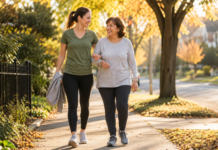





















Walking meditation is the simple practice of bringing full, kind awareness to each step. You use breath, posture, and the sensations of moving to anchor attention, turning ordinary walking into a steady, calming meditation. This guide shows you how to practice safely, adapt the pace to your body and setting, and make mindful walking a reliable, everyday stress reset (this is general education—not medical advice; if you have balance concerns or a health condition, consult a clinician first).
Quick start (skim list):
- Choose a safe route. 2) Stand tall and soften the jaw. 3) Match steps to natural breathing. 4) Feel the whole foot—heel, arch, toes. 5) Walk slower than usual. 6) Use a simple mental note (“step, step”). 7) Welcome sounds and sights without chasing them. 8) When distracted, kindly return to feet and breath. 9) Try silent walking without headphones. 10) Practice indoors or outside. 11) Add short post-meal walks (10–15 min). 12) Track minutes and mood.
Why now? As of June 2024, nearly one-third of adults worldwide are physically inactive; pairing mindfulness with walking helps you meet movement guidelines while caring for your mind.
1. Set Your Intention, Route, and Safety
Start every session by deciding what you’re doing and why: “For the next 10 minutes, I’ll walk to feel my feet and breathe with ease.” That one line sets a gentle boundary for attention and helps you notice when the mind drifts into planning or rumination. Next, decide where and how you’ll walk. A flat, low-traffic path (indoor hallway, quiet sidewalk, park loop) reduces cognitive load so you can feel the mechanics of each step. Safety comes first: check the surface, lighting, and weather; wear shoes with adequate grip; and in hotter regions or seasons, time your walk for cooler hours and shade. If you’re new to meditation, treat this as “moving basics”—you’re not trying to “empty the mind,” just to walk with friendly attention. Expect moments of calm and moments of distraction; both are part of the practice.
1.1 How to do it
- Choose a simple out-and-back route (e.g., 15–30 paces one way, then turn).
- Silence notifications; pockets clear of jangling items.
- Tell yourself the intention once, silently: “Arrive with each step.”
1.2 Region notes
- Hot/humid climates (e.g., South Asia): walk pre-9 a.m. or after sunset; carry water; choose shaded routes; watch for uneven paving.
- Urban areas: pick wider sidewalks; use crossings; avoid noise spikes like construction zones.
Finish with one sentence: “I set my intention to arrive with each step.” That line becomes the mental “doorway” into practice.
2. Build a Balanced Posture
The fastest way to calmer walking is alignment you can feel in seconds. Stand tall as if a thread lifts the crown of your head; let the chin level, shoulders broad and easy, arms swinging naturally. Unlock the knees and lengthen through the back of the neck. This posture frees the diaphragm so breath can move without strain, and it distributes load evenly through hips, knees, and ankles—easing common aches. A balanced stance also clarifies sensations in the feet, which become your primary anchor. If posture slumps, attention follows; if posture is tall and kind, attention steadies. Don’t force a military stance; think “alert and relaxed.”
2.1 Mini-checklist
- Head over shoulders, shoulders over hips.
- Soften jaw and brow; tongue rests on the palate.
- Arms free; hands unclenched; elbows close, not rigid.
- Pelvis neutral—not tucked, not flared.
- Knees unlocked; strides shorter than usual.
2.2 Why it matters
A neutral alignment reduces unnecessary muscular effort and creates a stable base for awareness. The less your body fights gravity, the more attention you can give to breath and step. End each minute with a quiet scan—“Head? Shoulders? Jaw?”—then return to the feet.
3. Breathe with Your Steps
Synchronizing breath and steps gives wandering attention a simple rhythm to follow. Begin by noticing the natural breath without changing it. Then softly pair steps with breathing—for example, three steps on an in-breath and four on an out-breath. If the terrain changes or you speed up, the ratio will change too; follow your lungs, not the clock. This gentle matching helps you avoid breath-holding, reduces over-breathing, and encourages a longer, relaxing exhale. If counting becomes tight or fussy, drop it and just feel the rise and fall. The goal is comfort, not performance.
3.1 How to do it
- Try 2-in / 3-out steps at a slow pace; adjust by feel.
- Use a phrase on the breath: “In—calm; out—ease.”
- On hills or heat, shorten the count and pace; keep exhale smooth.
3.2 Note from tradition
Teachers in the Zen/Plum Village lineage often suggest adapting steps per breath—e.g., three on the inhale, four on the exhale—letting comfort, not rules, lead your rhythm.
Close the loop by asking, “Is my breath easy?” If yes, keep going; if not, slow down until it is.
4. Feel the Whole Foot (Gait Mechanics You Can Sense)
Your feet are the dashboard of walking meditation. Aim to feel the sequence heel → midfoot → toes → lift, along with ground texture, temperature, and pressure. This tactile detail grounds awareness quickly and reduces the tendency to drift into thought spirals. Shorter steps help you land under your center of mass (not out in front), which protects knees and hips and keeps balance subtle rather than effortful. If you’re on varied terrain, welcome the extra information—crunch of gravel, softness of grass, smoothness of tile—as training for real-life conditions.
4.1 Mini-checklist
- Land softly with the heel, roll through the arch, press out the big toe.
- Keep steps short; avoid overstriding.
- Let the ankle be springy, not stiff.
4.2 Small experiment
Walk 10 paces with your usual stride and notice knee sensation. Then walk 10 paces with 5–10% shorter steps and a softer landing. Most people feel immediate ease in the knees and a clearer foot sequence. Name it: “Softer is steadier.”
5. Choose Your Pace: Slow, Natural, Brisk
The best pace is the one that lets you stay curious without strain. Slow walking magnifies sensation and is ideal for beginners and indoor routes. Natural pace (your normal speed, slightly softened) works well outdoors and in daily life. Brisk mindful walking pairs fitness benefits with awareness—great for lunch breaks or commute segments. Rotate among paces depending on goals, time of day, and energy. Mindfulness doesn’t require slowness; it requires remembering to notice. Brisk sessions count toward weekly activity targets while still training attention—an efficient pairing for busy weeks.
5.1 How to choose today
- Overwhelmed/tired? Go slow for 5–10 minutes.
- Clear mind, limited time? Natural pace for 10–20 minutes.
- Want fitness + focus? Brisk, conversational pace for 20+ minutes.
5.2 Numbers & guardrails
Use the “talk test”: you can speak in phrases at a brisk pace but not sing. If breathing gets choppy, downshift. If attention frays at high speed, insert 30–60 seconds of slow steps every 5 minutes. End with three slow, deliberate steps to “seal” the session.
6. Pick Anchors: What to Notice Besides Feet
Anchors are simple, repeatable cues you return to whenever attention wanders. The feet are primary, but adding one or two more can make practice robust. Common anchors include breath at the nostrils, the swing of the arms, ambient sounds (birdsong, distant traffic), and peripheral vision (light and shadow rather than reading signs). Rotate anchors to stay fresh; too many at once can scatter attention. The rule is “simple and kind”: choose an anchor that invites curiosity, not effort.
6.1 Tools/Examples
- Somatic: sole of the big toe; calf muscles as they contract/release.
- Breath: coolness at the nostrils; length of the exhale.
- Senses: soundscape bubble; light-and-shade patterns.
- Phrase: “Arrive—this step.”
6.2 Mini-checklist
- Set 1–2 anchors at the start.
- When distracted, touch the anchor and begin again.
- If an anchor goes dull, gently swap to another for 1–2 minutes.
Close with one clear sentence: “My anchors keep the practice simple.”
7. Use Gentle Mental Notes (“Labeling”)
Mental noting is a lightweight way to keep attention honest without tightening up. Silently label simple, present-moment facts: “stepping,” “touching,” “lifting,” “in,” “out,” “hearing.” If a strong thought or emotion arises, label it once—“planning,” “worry,” “irritation”—and return to the body. The note is not commentary; it’s a tiny cue to remember where you are. Over-labeling can get chattery, so aim for one note every few seconds, then periods of quiet sensing. Noting helps many people avoid getting lost in stories because it gives the mind a dignified job to do.
7.1 How to do it
- Start with “step… step… step…” in sync with footfalls.
- Add breath notes—“in… out…”—during steady sections.
- Use emotion notes only as needed; don’t analyze.
7.2 Common mistakes
- Turning noting into a mantra to block out experience.
- Labeling too quickly to feel anything.
- Using harsh or sarcastic tone inside. Keep it friendly.
Synthesis: a few well-timed notes make wandering obvious and recovery quick.
8. Meet Distractions with Skill
Distractions are the curriculum, not the enemy. The car horn, the to-do list, the memory from last week—each one is a chance to practice noticing and returning. When something pulls you off track, acknowledge it without blame (“thinking…”) and guide attention back to feet and breath. If the mind is especially sticky, pause for three still breaths, then resume. For social interruptions or street crossings, drop the practice and handle safety; you’re not failing, you’re being appropriate. Over time, you’ll discover that recovery—how you return—is more important than uninterrupted concentration.
8.1 Mini protocol (R.A.I.N. for walkers)
- Recognize the distraction.
- Allow it briefly (“this is here”).
- Investigate one body cue (tight jaw? clenched hands?).
- Nurture by returning kindly to the next step.
8.2 Example
You notice irritation after a text preview. Label “irritation,” unclench hands, exhale a beat longer, and feel the next heel touch. That single skill is the heart-muscle of walking meditation.
9. Silent Walking, Guided Audio, and Helpful Apps
Silence is the gold standard because it highlights raw sensory detail. But guided audios and timers can jump-start habit formation and provide structure. Many traditions offer simple phrases and breath cues you can carry into silent practice. Use scaffolding at first; wean toward silence as confidence grows. Avoid music or podcasts during walking meditation—they split attention and turn practice into content consumption. Save entertainment for non-practice walks. If you do use audio, keep one ear free and volume low for situational awareness.
9.1 Tools/Examples
- Short guided pieces from established teachers can teach pacing, breath, and posture; over time, shift to unguided practice. Plum Village Mobile App
- Timers with interval bells (e.g., every 2–3 minutes) remind you to check posture and anchors.
9.2 Mini-checklist
- Start guided; move to silence in week 2–3.
- Keep volume low; one ear open outdoors.
- End with 30–60 seconds of no audio to “feel the residue.”
Wrap-up: tools are supports, not crutches—use them wisely.
10. Choose Your Environment: Indoors vs. Nature, Urban vs. Quiet
Environment shapes attention. Indoors offers controlled surfaces and privacy; it’s excellent for slow practice and for people who prefer fewer variables. Outdoors adds light, air, and contact with nature—often uplifting and easier for mood regulation. Urban walking provides real-world practice handling stimuli and pausing for safety, while parks and gardens are ideal for deep sensory anchoring. Weather matters: rain can enrich sound and smell; heat requires slower pace and shorter sessions. There’s no single “right” place—pick the setting that supports, rather than competes with, your intention.
10.1 How to choose today
- Need steadiness? Indoor hallway, bare feet or socks.
- Need uplift? Green spaces; look for dappled shade.
- Need realism? Urban routes with safe crossings and predictable flows.
10.2 Nature + mindfulness (evidence note)
Outdoor mindful walking programs in research settings have improved mood and reduced stress in students and adults, suggesting the pairing of movement and nature can be especially restorative. PMC
Bottom line: match place to purpose; change the setting when attention flags.
11. Integrate into Daily Life (Including After-Meal Walks)
The most sustainable practice is the one you’ll do. Insert 5–10 mindful minutes into transitions you already have: after you wake, between meetings, before dinner, or on your commute. One high-leverage slot is after meals—walking for 10–15 minutes within an hour of eating can aid digestion and help the body regulate post-meal blood sugar, benefiting energy and mood. Turn this into a family ritual or a solo reset—no phone, just steps and breath. If all you have is a small indoor space, use a 10–15 step lane and turn slowly; simplicity is an advantage, not a flaw.
11.1 Habit design
- Attach to a cue: “After lunch, I walk.”
- Keep shoes and a light cap by the door.
- Use a 2-minute “entry” routine: stand, settle posture, set anchors.
11.2 Numbers & guardrails
Begin with 5 minutes daily for week 1, 10 minutes for week 2, then choose 10–20 minutes most days. If you track activity minutes for health goals, mindful brisk walking contributes to the weekly aerobic target.
12. Track Progress, Not Perfection
Mindfulness grows where you place steady, kind attention—not where you hit streaks. Track simple markers: minutes walked, the mood before/after (−2 to +2), and one sentence about what you noticed. Every few weeks, look for patterns: times of day that feel best, routes you enjoy, distractions that recur. If you like numbers, count total mindful minutes toward your movement goals; if you’re qualitative, note three words after each session (“light, steady, present”). Progress shows up as gentler reactivity and easier returns from distraction, not as unbroken calm. When breaks happen, simply begin again; the road is always under your feet.
12.1 Mini-dashboard (paper or app)
- Minutes today / this week
- Before mood / after mood
- Anchor used (feet, breath, sound)
- One insight (“shorter steps felt kinder”)
12.2 Evidence snapshot
Randomized and controlled studies have linked mindful walking with reduced stress and improved psychological well-being in distressed adults; broader mindfulness research also finds benefits for pain modulation and mood. Use these as encouragement, not pressure to “perform.”
FAQs
1) What is walking meditation, exactly?
Walking meditation is the practice of bringing non-judgmental awareness to the sensations of walking—posture, breath, and footfalls—moment by moment. Instead of trying to stop thoughts, you notice what’s present and gently return attention to an anchor like the feet or breath. It can be done indoors or outdoors, slowly or at a natural pace, and it complements, rather than replaces, seated meditation.
2) How long should a session be for beginners?
Start with 5 minutes so you can finish strong and want to repeat it. In week two, move to 10 minutes, and then to 10–20 minutes on most days. If you already walk regularly, sprinkle 1–2 minutes of mindful attention into your existing routes. The key is consistency—small daily sessions beat occasional long ones.
3) Is walking meditation better slow or brisk?
Both work; they train different skills. Slow magnifies tactile detail and steadies attention for beginners. Natural or brisk helps integrate mindfulness into real life and contributes to fitness goals when you can still talk in short phrases. Switch based on your energy and intention; if breath becomes choppy, slow down to keep awareness clear.
4) Can I listen to music or podcasts while practicing?
For walking meditation, skip music and podcasts—they fragment attention. If you’re transitioning from entertainment-walking, try one short guided track from a reputable teacher to learn pacing, then leave your ears free. You can bring music back on non-practice walks to enjoy movement without the mindfulness goal.
5) Does walking meditation “count” toward exercise goals?
Yes—if you’re walking at a moderate, conversational pace, it contributes to weekly aerobic activity targets recommended for adults (e.g., 150–300 minutes per week). Slow, indoor practice is valuable for attention but may not raise heart rate enough to “count” for fitness minutes, so include brisk mindful segments when appropriate.
6) What about post-meal walks for blood sugar and digestion?
A short 10–15 minute walk within an hour after eating can help with digestion and post-meal glucose handling. Make it gentle and mindful—feel your feet, keep posture tall, and breathe easily. People managing diabetes should follow their clinician’s guidance; mindful walking can complement, not replace, medical care.
7) How do I handle busy streets and safety?
Prioritize safety over mindfulness every time. Drop the practice at crossings, obey signals, give wide berths around others, and avoid noise spikes or poorly lit areas. In hot weather, schedule early or late walks, carry water, and slow your pace. Indoors or parks are excellent for uninterrupted practice when safety outdoors is uncertain.
8) Can walking meditation help with stress or mood?
Yes. Studies show mindful walking programs can reduce stress symptoms and improve quality of life, and broader mindfulness research suggests benefits for mood and pain coping. Expect gradual changes—less reactivity, faster recovery after distractions—not a sudden disappearance of stress. Keep sessions short, frequent, and kind.
9) I get bored quickly. Any tips?
Rotate anchors (feet, breath, sound) and vary routes. Try “interval mindfulness”: one minute slow + two minutes natural pace, repeating. Change environments—quiet hallway one day, shaded park the next. End each session by noting one concrete sensation you enjoyed (“cool breeze on face”), which trains the mind to notice rewarding details.
10) Is there a traditional phrasing or mantra I can use?
Many practitioners like simple lines from the Plum Village tradition, such as “Breathing in, I calm body; breathing out, I smile,” or matching a few steps to each in- and out-breath. Use such phrases lightly so they point you back to the living sensations of walking rather than becoming rote repetition.
11) Will mindful walking help with pain?
Mindfulness practices can change how we relate to discomfort and, in research, have shown distinct neural mechanisms for pain reduction beyond placebo. Apply gently: shorten steps, keep posture tall, and stop if pain increases. Always follow clinical advice for persistent or worsening symptoms. NCCIH
12) How do I know I’m “doing it right”?
If you’re placing kind attention on the present step—feeling your feet, sensing breath, and repeatedly returning after distractions—you’re doing it right. Results show up off the path: a softer reaction during daily stress, a steadier mood, and easier returns from worry. “Begin again” is success, not failure.
Conclusion
Walking meditation turns the world itself into a practice room. With a clear intention, balanced posture, breath that matches your pace, and a few simple anchors, every step becomes a chance to steady attention and ease the nervous system. The 12 steps above help you start small, fit practice into real life, and flex across environments—from a quiet hallway to a shady park loop. Evidence suggests that mindful movement supports stress regulation, mood, and even pain coping; when paired with brisk segments, it also helps you meet weekly activity targets. The practice works not because you finally control thoughts, but because you kindly return—to feet, to breath, to this step—again and again. Begin with five minutes today, try a short post-meal walk this week, and watch tiny, repeatable moments of presence add up to a calmer, steadier day.
CTA: Lace up, choose a safe 10-minute route, and take your first mindful steps now.
References
- Physical activity – Fact sheet. World Health Organization, June 26, 2024. https://www.who.int/news-room/fact-sheets/detail/physical-activity
- WHO Guidelines on Physical Activity and Sedentary Behaviour. World Health Organization, 2020 (open-access summary via PMC). https://pmc.ncbi.nlm.nih.gov/articles/PMC7719906/
- Walking Meditation—Thich Nhat Hanh. Lion’s Roar, (accessed Aug 2025). https://www.lionsroar.com/walking-meditation-thich-nhat-hanh/
- Mindful walking in psychologically distressed individuals: A randomized controlled trial. Evidence-Based Complementary and Alternative Medicine, 2013. https://pmc.ncbi.nlm.nih.gov/articles/PMC3747483/
- Effects of Buddhist walking meditation on glycemic control and anthropometric measures in patients with type 2 diabetes. Diabetes & Metabolic Syndrome: Clinical Research & Reviews, 2016. https://www.sciencedirect.com/science/article/abs/pii/S0965229916300346
- How to reduce stress and anxiety through movement and mindfulness. Harvard Health Publishing, Aug 11, 2025. https://www.health.harvard.edu/mind-and-mood/how-to-reduce-stress-and-anxiety-through-movement-and-mindfulness
- Meditation and Mindfulness: Effectiveness and Safety. National Center for Complementary and Integrative Health, June 3, 2022. https://www.nccih.nih.gov/health/meditation-and-mindfulness-effectiveness-and-safety
- Mindfulness meditation and placebo modulate different brain patterns to reduce pain. NCCIH Research Results, Aug 28, 2024. https://www.nccih.nih.gov/research/research-results/mindfulness-meditation-and-placebo-modulate-different-brain-patterns-to-reduce-pain
- The Case for Taking a Walk After You Eat. TIME, Oct 24, 2018. https://time.com/5405778/walking-after-eating-good-for-you/