




















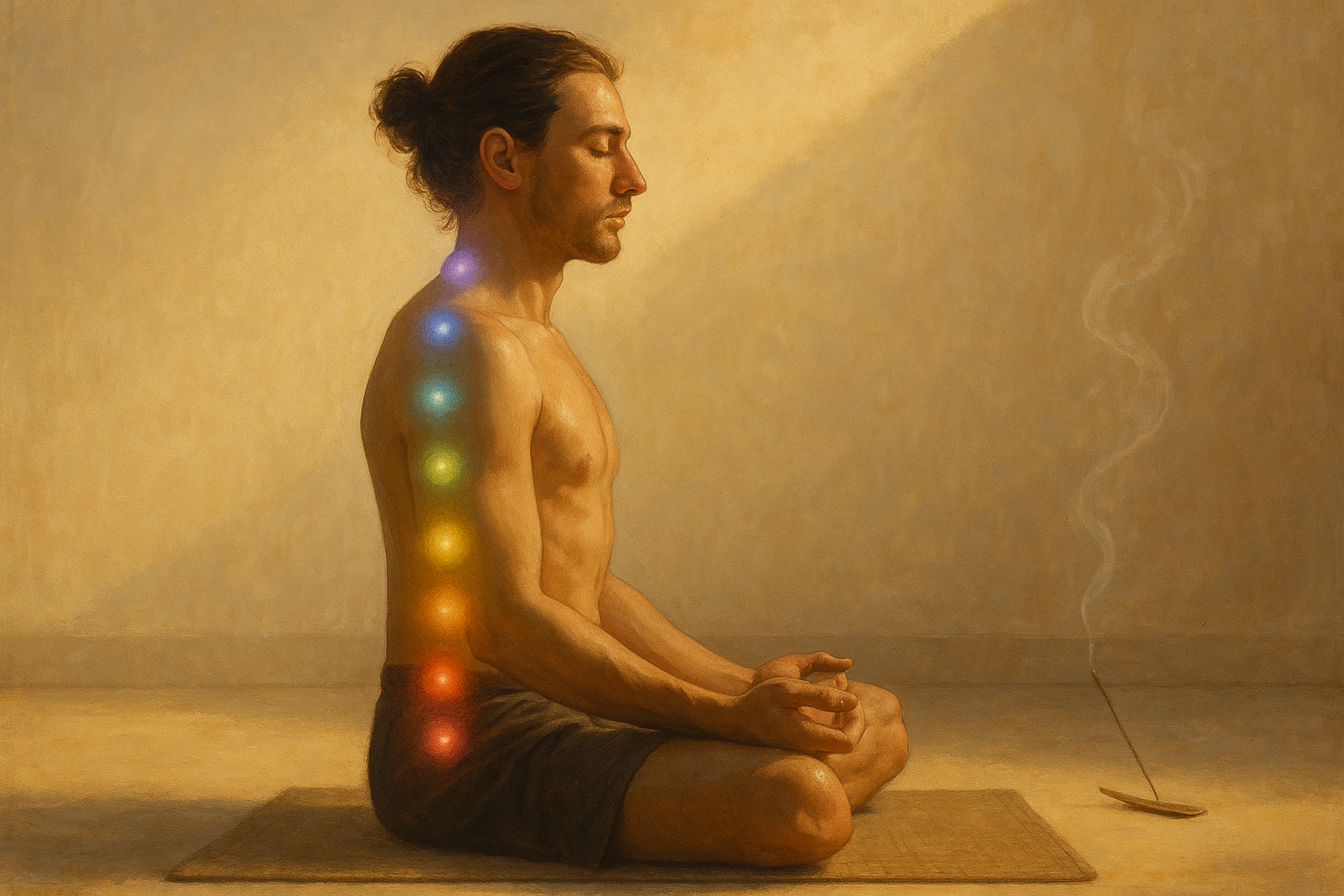
Chakra meditation is a structured way to focus attention on seven symbolic “energy centers” along the spine using breath, visualization, sound, and mindful body awareness. In this guide, you’ll learn exactly how to practice—step by step—for each chakra, with realistic time ranges, common pitfalls, and mini-checklists that make the work practical. If you’re new to meditation, you’ll also find plain-language explanations and options whether you prefer silent focus, mantras, or visualization.
Quick definition: Chakra meditation is a contemplative practice from yoga traditions that helps you organize attention and emotion around seven archetypal themes (safety, flow, will, love, voice, insight, and connection). It complements—not replaces—medical or psychological care.
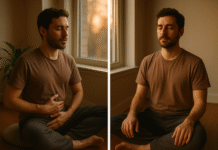
Quick start: Sit comfortably; take 6 slow breaths; move attention from base of spine to crown; at each center: feel the body area, breathe for 1–2 minutes, visualize a color, optionally sound a seed mantra; close with 1 minute of whole-body awareness.
Note: This article offers educational guidance only and is not a substitute for professional medical or mental health advice. If you feel dizzy, panicky, or numb, pause, take a few steady breaths, and resume only when settled.
1. Root (Muladhara): Grounding for Safety and Stability
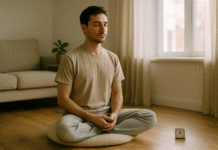
To balance the Root Chakra, practice grounding breath and body awareness that stabilize attention at the base of the spine and legs. This center relates to feeling safe “in your body,” consistent routines, and practical basics such as rest and nourishment. When attention is scattered or anxious, you can’t meaningfully work with higher-level clarity or compassion; starting at the root gives the nervous system a reassuring anchor. Begin by choosing a seat you can maintain for 5–10 minutes, feet planted if you’re on a chair or shins grounded if you’re on a cushion. Breathe low into the belly and pelvic floor—comfortably, not forcefully—and match exhale length to or slightly longer than inhale. Visualize a deep, warm red glow at the base of the spine that steadies with each breath. If you like sound, use the seed syllable LAM softly on the exhale. This isn’t about “feeling energy” in a mystical way; it’s about training awareness to feel contact, weight, and steadiness so the mind has a reliable home base.
1.1 How to do it (5–10 minutes)
- Sit with the pelvis slightly tipped forward; feel sit bones rooted.
- Place attention on feet, legs, and base of spine; note contact points.
- Inhale 4–5 seconds, exhale 5–6 seconds, for 8–12 cycles.
- Visualize a red ember growing steady; quietly tone LAM if helpful.
- On each exhale, imagine excess tension draining into the floor.
1.2 Numbers & guardrails
- Duration: 2–5 minutes focused at the root within a 10–15 minute session.
- Breath pace: 4–6 breaths per minute is a gentle downshift; never strain.
- If you feel agitated, shorten inhale slightly, keep exhale long and relaxed.
1.3 Common mistakes
- Forcing belly breathing until you feel lightheaded.
- Slouching so much that the lower back pinches or the ribs collapse.
- Expecting dramatic sensations instead of simple steadiness.
Mini-checklist: Stable seat, slow exhale, feel weight in legs/feet, red glow, LAM (optional).
Synthesis: Grounding first reduces reactivity; a calm base supports the rest of your practice.
2. Sacral (Svadhisthana): Restoring Flow, Emotion, and Creativity
To balance the Sacral Chakra, invite rhythmic breath and gentle pelvic mobility so emotion and creativity can move without flooding or shutdown. This center is felt around the lower belly and hips and relates to pleasure in small doses, flexible boundaries, and the capacity to feel without being overwhelmed. After rooting, bring attention two finger-widths below the navel. Imagine breath softly “filling” this bowl of the pelvis on inhale and “pouring” out along the hips on exhale. Add micro-movement: a 1–2 cm pelvic rock that you can barely see, coordinated with breath. Visualization can shift from red to a saturated orange tone. The seed syllable VAM pairs well if you enjoy sound. The goal isn’t to chase euphoria; it’s to sense fluidity when you were previously rigid, and gentle containment when you were previously leaky or impulsive.
2.1 How to do it (5–10 minutes)
- Keep the root steady; move attention to lower belly/hips.
- Inhale: feel the bowl of the pelvis widen; exhale: soften the lower back.
- Visualize orange ripples spreading around the hips.
- Optional: hum VAM on exhale to encourage resonance.
- After 2–3 minutes, notice any emotions; name them quietly (“sad,” “soft,” “alive”).
2.2 Tools/Examples
- Use a timer set to 6–8 minutes to prevent overdoing it.
- Pair with a gentle hip figure-eight while seated to embody flow.
- Keep a small notebook; write a two-line “emotion weather report” afterward.
2.3 Common mistakes
- Turning the exercise into a performance or sensuality checklist; keep it simple.
- Collapsing posture, which can kink breath at the solar plexus.
- Ignoring discomfort—adjust seat or move to standing if hips cramp.
Mini-checklist: Lower belly attention, tiny pelvic rock, orange visualization, VAM (optional), name feelings.
Synthesis: A touch of movement plus labeling helps emotions pass through without swallowing you.
3. Solar Plexus (Manipura): Agency, Boundaries, and Consistent Will
To balance the Solar Plexus Chakra, cultivate warm, steady breathing into the upper belly and ribs and practice small acts of self-directed effort during meditation. This center, located around the navel to sternum, involves personal agency, healthy boundaries, and disciplined follow-through. Begin by sensing the ribcage expanding evenly in all directions—front, sides, and back—so effort distributes rather than hardens. Visualize a golden yellow sun at the navel that brightens on inhale and radiates confidence on exhale. If using sound, tone RAM gently, like a warm engine hum rather than a shout. Bring a micro-commitment into the practice: “For the next 8 breaths, I’ll stay with sensation at the solar plexus.” Meeting small commitments builds trust in yourself; it’s the foundation of meaningful boundaries outside the cushion.
3.1 How to do it (5–10 minutes)
- Place one hand over navel, one on lower ribs; feel 360° expansion.
- Inhale 4–5 seconds; exhale 4–5 seconds—balanced, not forceful.
- Visualize a bright yellow sphere; on exhale, imagine it radiating outward.
- Repeat a quiet phrase: “Soft power, steady will.”
- After 2–3 minutes, recall one situation where a clear “yes/no” is needed.
3.2 Numbers & guardrails
- Use sets of 8–12 breaths to practice keeping a promise to yourself.
- If you feel heat rising into the head, slow down, and lengthen exhale by 1–2 seconds.
- Keep shoulders relaxed; let effort be in ribs, not in a clenched jaw.
3.3 Common mistakes
- Confusing control with clarity and over-tightening the abdomen.
- Pushing the breath until it feels like a workout; this is attention training.
- Skipping the micro-commitment; without it, agency won’t “transfer” off-cushion.
Mini-checklist: Even rib expansion, yellow sun visualization, RAM (optional), micro-commitment, relaxed jaw.
Synthesis: Gentle, repeatable effort grows realistic confidence and cleaner boundaries.
4. Heart (Anahata): Compassion, Coherence, and Relational Ease
To balance the Heart Chakra, combine calm breathing with imagery and phrases that evoke warmth and connection—toward yourself first, then outward. This center, perceived around the sternum, speaks to affection, grief integration, and the courage to remain open without collapsing your own needs. Start by sensing the breath widen across the chest and between the shoulder blades; the green visualization can feel like a soft, leaf-colored glow. If you like sound, YAM can be whispered or internally repeated. Add “friendly wishes”—short phrases you actually believe—because forced positivity backfires. Try “May I meet this moment kindly,” then extend to a specific person, “May they be safe,” and finally to a wider circle. Small, believable phrases nurture coherent, sustainable compassion.
4.1 How to do it (6–12 minutes)
- Settle attention at the center of the chest; soften shoulders on every exhale.
- Visualize a green light expanding front/back with breath.
- Repeat 2–3 friendly phrases for yourself; then for one person you know; then for “all beings.”
- If strong emotions arise, reduce scope: return to breath at chest for 1 minute.
- Optionally journal one line: “One kind thing I can do today is ____.”
4.2 Why it matters
- Warmth plus clarity reduces defensive reactivity in conversations.
- Grief and tenderness can coexist; the heart doesn’t need to “fix” feeling.
- Compassion practiced first for yourself avoids martyrdom and burnout.
4.3 Common mistakes
- Using heart work to bypass anger or fear instead of feeling them fully.
- Reciting long scripts that feel fake; keep phrases short and genuine.
- Over-stretching posture; a slightly lifted chest is enough.
Mini-checklist: Chest breath, green glow, YAM (optional), friendly phrases, scale down if flooded.
Synthesis: Honest warmth—starting small—creates durable compassion you can carry into daily life.
5. Throat (Vishuddha): Truth-Telling, Listening, and Expressive Ease
To balance the Throat Chakra, pair gentle breath with attention at the throat and a cadence of speaking and listening that feels clean, timely, and kind. This center concerns voice, timing, and the ability to say both “I mean it” and “I’m listening.” Visualize a sky-blue ring encircling the throat, widening on inhale and clearing on exhale. If sound helps, intone HAM very lightly or hum on a comfortable pitch. Practice a micro-dialogue with yourself during the sit: on inhale, “What is true right now?” on exhale, “How can it be said kindly?” The goal is integrity plus grace, not blurted “honesty” that harms or withholding that corrodes trust.
5.1 How to do it (5–10 minutes)
- Keep jaw unclenched; tip of tongue resting lightly on the palate.
- Breathe with a subtle “ocean” sound (barely audible) to feel airflow in the throat.
- Visualize a blue ring clearing static; softly repeat HAM if you like.
- Rehearse one sentence you need to say today, trimming extra words.
- Commit to one listening action: “I’ll ask one clarifying question before replying.”
5.2 Tools/Examples
- Use a voice memo (30–60 seconds) after practice: say the sentence once, neutrally.
- Pair with a “24-hour rule” for tough messages; sleep before sending.
- Create a two-column note: “What I mean” vs. “How to say it kindly.”
5.3 Common mistakes
- Forcing a loud mantra that strains the voice.
- Equating “truth” with unprocessed emotion; process first, then speak.
- Over-polishing until nothing authentic remains.
Mini-checklist: Relaxed jaw/tongue, blue ring visualization, HAM (optional), one true sentence, one listening action.
Synthesis: A clear throat balances saying and hearing—truth lands when it’s timed and toned well.
6. Third Eye (Ajna): Clarity, Focus, and Wise Interpretation
To balance the Third Eye Chakra, practice single-pointed attention and gentle “zooming out” to test your interpretations against broader context. This center—between the eyebrows—relates to pattern recognition, insight, and the difference between what’s happening and the story you’re telling about it. Start with a soft gaze behind closed eyelids and visualize an indigo point of light at the brow. Breathe naturally. On each exhale, label attention “see/know” to encourage crisp observation. After a minute, add the interpretive step: notice a thought arise; ask, “Is this a fact, an inference, or a worry?” Without judgment, file it accordingly. With repetition, your mind learns to separate data from drama; that separation is the seed of insight.
6.1 How to do it (6–12 minutes)
- Anchor at the brow; let the eyes rest heavy and still.
- Visualize an indigo star or point; keep it the size of a lentil—small and precise.
- Each exhale: silently note “see,” “hear,” or “feel” for raw experience;
- Then add “think” for stories and place them in a mental drawer.
- After 3–4 minutes, invite one question you care about; hold it lightly without forcing an answer.
6.2 Numbers & guardrails
- Keep the focal point small (0.5–1 cm in your mind’s eye) to train precision.
- If you get a headache, relax the brow and widen focus for 30–60 seconds.
- Limit “insight chasing” to the last minute; spend most time perceiving cleanly.
6.3 Common mistakes
- Turning the practice into a debate with yourself.
- Equating vivid imagery with truth; imagery is a tool, not evidence.
- Using “insight” to avoid needed action.
Mini-checklist: Indigo point, raw-experience labels, fact/inference/worry test, relax brow if straining.
Synthesis: Clean perception first; only then interpret—clarity grows when you separate signal from story.
7. Crown (Sahasrara): Quiet Mind, Spacious Awareness, and Connection
To balance the Crown Chakra, soften effort and let awareness rest as if the whole body were breathing—head to toe—while noticing a sense of belonging that needs no proof. The crown sits at the top of the head and, in practice, represents spaciousness, humility, and the ability to let go. Visualize a gentle violet or white radiance above the crown, like a small halo that brightens with the breath. If using sound, you can continue with a soft OM/AUM or simply remain silent. Rather than seek a “peak experience,” let the practice be ordinary: breathing, sensing, and allowing thoughts to pass like birds across a wide sky.
7.1 How to do it (6–12 minutes)
- After completing the brow focus, let attention widen to include the whole body.
- Visualize a violet or white glow just above the crown; keep neck free and long.
- Let breath find its comfortable rhythm; no need to count.
- If a thought grabs you, acknowledge “thinking,” then return to wide awareness.
- Close by feeling your seat, feet, and the room—belonging here, now.
7.2 Why it matters
- Spacious awareness balances the goal-oriented tone of earlier centers.
- Letting go prevents practice from becoming another achievement project.
- A quiet mind can notice subtle “yes/no” signals without drama.
7.3 Common mistakes
- Straining for mystical sensations; ease is the “signal,” not fireworks.
- Losing the body entirely; keep a faint sense of weight and breath.
- Ending abruptly; always ground before standing.
Mini-checklist: Whole-body awareness, violet/white glow, easy breath, label thoughts, re-ground at end.
Synthesis: The crown integrates the journey—spacious but embodied, connected yet practical.
FAQs
What is chakra meditation in simple terms?
Chakra meditation is a step-by-step way of focusing on seven symbolic centers from the base of the spine to the crown using breath, visualization, and sometimes sound. Rather than “fixing” you, it organizes your attention around themes—safety, emotion, will, love, voice, insight, connection—so you can feel steadier and respond more wisely. Many people find it calming and clarifying, especially when paired with compassionate self-talk and realistic time frames.
Is there scientific proof that chakras exist?
Chakras come from yoga and tantra traditions and are best understood as a contemplative framework, not a proven anatomical system. Modern research supports benefits of meditation, breathwork, and compassion practices for stress and attention, but it doesn’t confirm literal energy centers. Practice for felt benefits—calm, clarity, kinder behavior—while keeping medical questions with your clinician.
How long should a beginner spend on each chakra?
A practical range is 2–5 minutes per chakra within a 20–40 minute session. If you only have 10 minutes, choose one or two centers that match your day’s needs (e.g., Root for anxiety, Throat before a hard conversation). Consistency beats marathon sessions: 10–15 minutes most days outperforms one long sit on Sundays.
Do I have to use mantras like LAM, VAM, or OM?
No. Some people love sound; others prefer silence. The seed syllables traditionally associated with the chakras can help you keep a steady rhythm and feel vibration in the body, but they’re optional. If you do use them, keep volume gentle to avoid vocal strain and focus more on relaxation than on hitting a pitch perfectly.
What if I don’t feel anything?
“Noticing nothing” is common and perfectly fine. Treat practice like going to the gym for attention: you show up, do the reps (breaths, visualizations, phrases), and results accrue over weeks. Sensations may be subtle—warmth, weight, or ease. Journal one line after sessions to track small shifts; progress is often clearer on paper than in memory.
Can chakra meditation help with anxiety or sleep?
It can support calmer breathing and a sense of safety, which many people find helpful for anxiety and sleep. However, it is not a medical treatment. If worry spirals or insomnia persist, consult a professional. As a sleep wind-down, try 2 minutes Root (slow exhale), 2 minutes Heart (kind wishes), and 1 minute whole-body awareness while lying on your side.
Is visualization necessary, and what if I’m not “visual”?
Visualization is just one option. You can use touch (placing a hand on the body area), breath counting, or phrases. If colors feel forced, switch to sensing weight, temperature, or movement. The method that helps you stay present is the “right” one; the point is quality of attention, not artistic imagery.
How often should I practice?
Aim for 4–6 days per week, even if some sessions are short. Frequency builds the habit loop, making it easier to settle quickly when life is loud. Many people do well with 15–20 minutes in the morning and a 3–5 minute “top-up” at night. If you miss a day, restart gently—there is nothing to “make up.”
Are there risks or people who shouldn’t do chakra meditation?
If you have unprocessed trauma, strong dissociation, or certain psychiatric conditions, it’s wise to work with a qualified clinician or trauma-informed teacher. The practices here are gentle, but intense breath holds or searching for dramatic experiences can destabilize some folks. Use the guardrails: slow, comfortable breathing; stop if dizzy; keep sessions short at first; ground before standing.
What posture is best—chair or cushion?
Either works. On a chair, sit toward the front with feet flat and a neutral curve in the lower back. On a cushion, elevate hips so knees are lower or level; use blocks under knees if needed. Comfort matters more than “looking meditative.” If pain distracts you, adjust posture or stand for a few breaths before continuing.
How do I know which chakra to focus on today?
Pick the theme that matches your current friction. Need calm? Root. Feeling emotionally stuck or numb? Sacral. Lacking follow-through? Solar Plexus. Needing warmth or forgiveness? Heart. Tough conversation ahead? Throat. Mental fog? Third Eye. Over-controlling or hyper-efforting? Crown’s spaciousness can help you soften.
Can I combine chakra meditation with yoga or prayer?
Yes. Many practitioners pair a short asana sequence or breath practice with a chakra-focused sit, and people of faith sometimes integrate silent prayer or scripture. Keep transitions simple: move, breathe, sit, and close with one concrete action you’ll carry into the day (e.g., “Send the message kindly,” “Take a 5-minute walk at lunch”).
Conclusion
Chakra meditation offers a practical map for attention: ground the body, let emotion move, activate warm agency, open the heart, refine your voice, clear perception, and then rest in spacious awareness. You don’t need special beliefs to benefit; you need a steady, kind routine. Start with 15 minutes: 3 minutes each for Root, Sacral, Solar Plexus, Heart, and Throat; then 2 minutes for Third Eye and Crown. Keep breath comfortable, posture humane, and expectations light. Use the optional mantras if they help you pace and feel vibration, and lean on mini-checklists to prevent overthinking. Above all, treat every session as practice, not a performance. If you miss a day, begin again without drama. Your attention gets stronger, your reactions soften, and your choices get clearer—not by forcing change, but by showing up kindly.
CTA: Choose one chakra that matches your day and sit for five quiet minutes—start now.
References
- “Meditation: In Depth,” National Center for Complementary and Integrative Health (NCCIH), updated October 2022. https://www.nccih.nih.gov/health/meditation-in-depth
- “Relaxation techniques: Breath control helps quell errant stress response,” Harvard Health Publishing, updated April 7, 2020. https://www.health.harvard.edu/mind-and-mood/relaxation-techniques-breath-control-helps-quell-errant-stress-response
- “What Is Mindfulness Meditation?” American Psychological Association, 2019. https://www.apa.org/topics/mindfulness/meditation
- “Chakras: What Are They?” Cleveland Clinic Health Essentials, updated August 23, 2022. https://health.clevelandclinic.org/what-are-chakras
- “Mantra Meditation,” Chopra Foundation (educational overview), 2021. https://chopra.com/articles/mantra-meditation
- “Understanding the Chakras,” Yoga Journal (practice guide), 2021. https://www.yogajournal.com/practice/understanding-the-chakras
- “Slow-Paced Breathing and Cardiac–Vagal Activity,” Frontiers in Human Neuroscience, 2017. https://www.frontiersin.org/articles/10.3389/fnhum.2017.00425/full
- “The Shat-Chakra-Nirupana (Six-Chakra Investigation),” transl. Sir John Woodroffe (Arthur Avalon), public domain edition, n.d. https://www.sacred-texts.com/tantra/sas/sas.htm