




























You can’t just sit back and watch your financial balance quietly grow. To make your money genuinely grow, you need to make long-term goals that are clear, quantifiable, and possible. Now that the economy is uncertain, prices are going up, and markets are changing swiftly, it’s more crucial than ever to set and work toward strategic financial goals. Setting clear financial objectives might help you start your career on the right foot, save money faster, or prepare for a happy retirement.
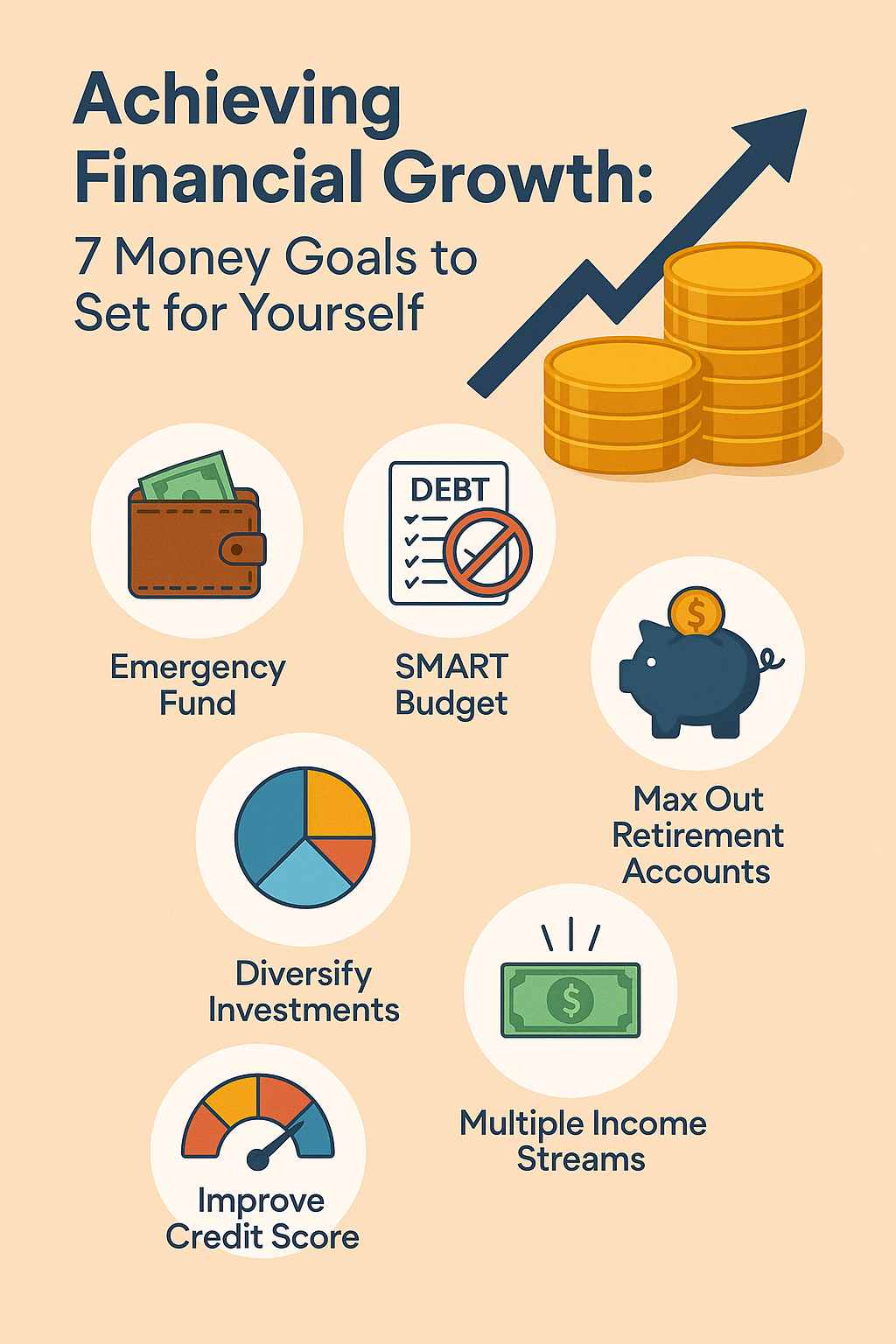
This complete tutorial talks about seven crucial money goals that will help you keep making money over time. You’ll discover practical actions for each goal, see examples from real life, get guidance from experts, and gain tools to help you keep track of how far you’ve come. By the time you finish this essay, you will have a good plan on how to attain your money goals.
Why It’s Crucial to Have Money Objectives
People who know a lot about money suggest that everyone should have money goals, not just rich people. The National Endowment for Financial Education says that those who set down their money objectives are 42% more likely to attain them than persons who don’t. Goals are like signs that help you remain on track, keep yourself accountable, and work toward your greater life goals, like buying a house, paying for your kids’ education, or retiring early.
Setting objectives has several benefits, such as:
- Clarity: It’s simpler to understand enormous goals when you break them down into smaller, more attainable steps.
- Motivation: It offers you actual goals to work for.
- Responsibility: It makes it easy to check items and make changes on a frequent basis.
- Discipline teaches you how to accomplish things like save money and make good investments.
Goal 1: Make an Emergency Fund That Will Last for Three to Six Months.
What It Is and Why It Is Important
You put money in an emergency fund for things like losing your job, paying for medical care, or fixing things around the house that need to be done right soon. All financial gurus agree that you should have enough money saved up to meet your basic living needs for at least three to six months. This buffer protects you from high-interest debt and gives you piece of mind.
How to Do It:
- Figure Out What Your Basic Expenses Are You should total up your rent or mortgage, utilities, groceries, insurance, and loan payments.
- Make a target for how much money you want to save each month. Try to save 10% to 15% of your income each month until you accomplish your goal.
- Set up automatic transfers or direct deposits to a high-yield savings account (HYSA) to make contributions easier.
- Every month, check your balance and alter your transfers if your income or expenses change. This will let you keep track of how far you’ve come.
For example, if you spend $3,500 a month, your goal fund should be between $10,500 to $21,000.
You save $500 a month, which means it will take you around 21 months to attain your objective (3 months’ worth of money).
Goal 2: Pay Off Debt With High Interest Rates
What You Should Know About Debt With High Interest
Payday loans, credit cards, and some personal loans generally have interest rates of 15% to 20% or more. If you don’t pay these off, they could wipe out your investment returns and keep you from accomplishing other goals.
How to Get Rid of It
- The Avalanche Method advises that you should pay off the debts with the highest interest rates first and then only make the minimum payments on the others.
- The Snowball Method recommends to start with the smallest balances so you can win quickly.
- Balance Transfers and Refinancing: Move debt to cards with lower interest rates or refinance loans to pay less interest.
Advice From a Professional
Dr. Sarah Johnson, who has a PhD in Behavioral Economics, adds that “getting rid of high-cost debt is often the best ‘investment’ you can make because it gives you a guaranteed return equal to the interest rate you don’t pay.”
Goal 3: Make a Budget That Is SMART and Stick to It.
Setting SMART Goals
SMART stands for “Specific, Measurable, Achievable, Relevant, and Time-bound.” A SMART goal for budgeting could be:
“Put away 50% of your net income for necessities, 20% for savings or investments, and 30% for fun spending by August 31, 2025.”
Making Your Budget:
- To keep track of your money, use applications like Mint or YNAB to see where your money is going.
- Make Goals for Your Allocations: You can build your own rule or utilize the 50/30/20 rule, which is what works best for you.
- Once a week, go over your spending to see where you may save money and make improvements.
- Reward Milestones: Small prizes, like a great evening out, help people stay on target.
Goal 4: Make the Most of Your Retirement Savings
The Strength of Compound Growth
You may get the most out of compound interest every year by placing as much money as you can into tax-advantaged accounts like a 401(k), IRA, or Roth IRA. The 401(k) cap will be $22,500 in 2025, and if you’re 50 or older, it will be $7,500 more. You can put up to $6,500 in an IRA, additional $1,000 if you’re 50 or older.
- If your workplace offers a plan, sign up for it and put in at least the amount they match. You don’t have to pay this money back.
- Pick a Traditional IRA or a Roth IRA based on how you wish to pay your taxes on your Individual Retirement Accounts.
- Automate contributions: Payroll deductions or monthly transfers make sure they happen every time.
Point of Data
A 25-year-old may have more than $1 million by the time they are 65 if they placed $5,500 a year into a Roth IRA and earned 7% interest on it.
Goal 5: Add Greater Variety to Your Investment Portfolio.
Why Diversification Works
Putting money into diverse types of assets, such stocks, bonds, real estate, and commodities, decreases risk and makes returns more stable. The “60/40 portfolio,” which comprises 60% stocks and 40% bonds, has traditionally been an excellent approach to balance growth and stability.
Making Your Mix
- Learn how much time and risk you can handle. Horizon: Younger investors might want to put more of their money into stocks, while people who are close to retirement would want to put more of their money into bonds and cash.
- You should add index funds and ETFs to your portfolio because they offer cheap fees and help you participate in many different markets.
- You can also distribute your money around by investing in real estate (REITs), commodities, or peer-to-peer lending.
- Rebalance once a year: Go back to your goal allocations to make money and buy dips.
Goal 6: Get Money From More Than One Place
Why You Should Have More Than One Way to Make Money
If you simply rely on a 9-to-5 wage, you could lose your job or the economy could go down. You can make more money by:
- Side jobs include driving people around, freelancing, and tutoring.
- You can earn money without working by earning dividends, renting out property, or getting royalties.
- Affiliate marketing, e-commerce, and digital courses are all examples of internet enterprises that use blogging.
How to Begin
- Find out what you’re good at and what you want to do: Make sure your side jobs match your present skills so you can have the most fun and get the most done.
- Look at the Market: Check out sites like Upwork, Fiverr, or your local classifieds to see if anyone wants what you have to give.
- Put your money to work, pay off debt, or save it.
- Build slowly: Use automation and outsourcing to build your business without decreasing the quality of your labor.
Goal 7: Raise Your Credit Score and Keep It High.
Why It’s Crucial to Have a Good Credit History
If you have a high credit score, you can access loans with reduced interest rates, better credit card deals, and cheaper insurance. Most people think that scores over 750 are extremely good.
How to Improve Your Credit
- Better Payments on Time: Make sure you always pay on time because your payment history makes approximately 35% of your score.
- Be smart with your credit: Your balances should never be more than 30% of your credit limits.
- Account Longevity: Keep old accounts open to indicate that you are stable.
- Credit Mix and New Credit: Don’t open new accounts if you don’t need them. Instead, employ a mix of revolving credit and installment loans.
The End
To attain your financial objectives, you need to be clear about what you want, stay on track, and set the correct goals. Building an emergency fund, paying off high-interest debt, constructing a SMART budget, maximizing retirement contributions, diversifying your investments, creating numerous income streams, and boosting your credit score are all long-term money goals that can help you reach your goals. If you want to be seen as more credible and simpler to locate online, include EEAT principles in all of your financial planning content.
Choose one item you want to do today and do something specific to get there, like setting up automatic savings or writing out how you want to pay off your debt. These small activities pile up over time and help you attain your major ambitions.
Frequently Asked Questions
1. How much money should I put away each month for an emergency fund? Until you have enough money to meet your basic necessities for three to six months, try to save 10% to 15% of your net income. Change when your money coming in or going out changes.
2. Should I pay off my debts before I invest in something? Pay off any debt with a high interest rate (7–8% APR or more) before you invest. This way, you can be guaranteed to obtain back the money you don’t have to pay interest on.
3. What is the greatest way for a 30-year-old investor to spread their money around? A typical formula is to have “110 minus your age” in stocks, which means 80% equities and 20% bonds. Change it to fit your risk level and the time you have.
4. How often should I adjust the mix of my investments? You should rebalance your investments at least once a year or whenever they are more than 5% away from your goals.
5. Is it worth it to work two jobs? Yes, having more than one source of income makes you less dependent on your main employment and helps you attain your goals, like paying off debt and investing, more quickly.
6. What can I do to swiftly raise my credit score? Pay off your credit cards so that you don’t spend more than 30% of your available credit. Pay your bills on time, and don’t open new accounts too rapidly.
7. What instruments can I use to keep an eye on my money? You may try using programs like Mint, You Need a Budget (YNAB), Personal Capital, or spreadsheet templates from well-known financial blogs.
References
- National Endowment for Financial Education, “The Impact of Written Financial Goals,” NEFE, April 2024. https://www.nefe.org/impact-written-goals
- U.S. Securities and Exchange Commission, “Emergency Funds: Why You Need One,” SEC Consumer Bulletin, January 2025. https://www.sec.gov/emergency-funds
- U.S. Department of the Treasury, “50/30/20 Budgeting Rule,” Treasury.gov, March 2025. https://home.treasury.gov/303
- Internal Revenue Service, “Retirement Plan and IRA Contribution Limits for 2025,” IRS.gov, November 2024. https://www.irs.gov/retirement-plans/plan-participant-employee/retirement-topics-contribution-limits
- Morningstar, “The Power of Compounding: A 40-Year Analysis,” Morningstar Research, February 2025. https://www.morningstar.com/compounding-study
- Vanguard, “The Benefits of Diversification,” Vanguard Insights, December 2024. https://investor.vanguard.com/investing/diversification
- FICO, “What’s in Your FICO Score?” FICO.com, June 2025. https://www.fico.com/blogs/what-in-your-fico-score