




























Alternate nostril breathing (Nadi Shodhana) is a classic pranayama that guides air through one nostril at a time in a set pattern to steady the breath and quiet the nervous system. In simple terms, you inhale through one nostril and exhale through the other in a slow, even rhythm. Practiced consistently, it can help you feel calmer, more focused, and more balanced—often within minutes—while remaining gentle and adaptable for beginners. This content is educational and does not replace personalized medical advice; if you have respiratory, cardiovascular, eye-pressure, or pregnancy-related concerns, talk to a clinician before you begin. For general safety on yoga and breathing practices, authoritative health bodies recommend learning gradually and avoiding forceful methods.
Quick start (30–90 seconds):
- Sit tall, relax your jaw and shoulders.
- Make Mrigi/Vishnu mudra (thumb + ring/pinky control nostrils).
- Close right nostril, inhale left; close left, exhale right.
- Inhale right; close right, exhale left (that’s one cycle).
- Repeat 3–6 cycles at a smooth, quiet pace.
1. Set Up Your Seat and Posture for Effortless, Quiet Breathing
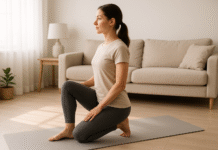
A stable, easy seat is the foundation of effective alternate nostril breathing because it lets the diaphragm move freely and keeps your neck and jaw relaxed. Start by choosing a position you can hold comfortably for 3–10 minutes: cross-legged on a cushion, on a chair with feet grounded, or kneeling on a bolster. Keep your spine tall without stiffness, ribs stacked over pelvis, chin level, and shoulders soft. Rest your non-working hand on your thigh (palm down for grounding or up for alert calm). If your arm tires while using the hand mudra, support the elbow on a cushion so the chest doesn’t collapse. Think “quiet breath, quiet mind”: you’re creating conditions where the breath becomes smooth and silent, not forced or noisy.
1.1 Why it matters
A neutral, lengthened spine gives the diaphragm and intercostals room to expand, making slow nasal breathing easier. A supported elbow prevents shoulder tension that can “choke” the upper ribs. Reducing strain helps you sustain 4–6 breaths per minute without gasping, a range associated with calming autonomic effects in slow-breathing research (while the exact mechanisms vary across studies, slow pranayama—not fast or forceful styles—tends to favor relaxation responses).
1.2 Mini-checklist
- Hips higher than knees (add a cushion if needed).
- Crown lifts gently; jaw and tongue relaxed.
- Elbow supported so the chest stays broad.
- Clothing and room temperature comfortable.
Bottom line: When your seat is steady and comfortable, Nadi Shodhana feels soothing instead of strenuous, letting the breath do the work of calming your system.
2. Learn the Hand Position (Mrigi/Vishnu Mudra) Without Strain
Correct, relaxed hand placement makes switching nostrils clean and gentle. With your right hand, curl the index and middle fingers toward the palm (or rest them lightly between the eyebrows), leaving thumb to seal the right nostril and ring/pinky to seal the left. Your non-working hand rests on your thigh. Left-handed versions are fine; symmetry doesn’t matter as long as seals are gentle and the nose stays midline. Avoid pressing the soft cartilage hard—aim for a light, airtight seal at the nostril rim. If you have shoulder or wrist sensitivity, sit closer to the wall or support your elbow on a cushion to keep the shoulder neutral and the breath unrestricted.
2.1 How to do it
- Thumb softly closes right nostril; inhale through left.
- Ring/pinky softly close left nostril; exhale through right.
- Keep fingers precise but light; avoid pushing the nose sideways.
- Maintain a small smile in the cheeks to relax the jaw and throat.
2.2 Common mistakes
- White-knuckling the seal: compresses tissues and invites tension.
- Elbow floating mid-air: tires the shoulder and lifts the ribs.
- Tilting the head: kinks the airway; keep the nose aligned forward.
Bottom line: A precise but feather-light seal prevents wasted effort and keeps each switch smooth, so the mind can settle on sensation and rhythm.
3. Establish a Calm Baseline: Diaphragmatic Breathing and Pace
Before alternating nostrils, set a relaxed baseline. Breathe through both nostrils with a soft belly expansion on inhale and a gentle return on exhale. Aim for nasal, quiet, diaphragm-led breathing rather than chest lifting. Next, pace your breath. Many beginners settle well around 4–6 breaths per minute (roughly 5–7 seconds inhale and 5–7 seconds exhale), but start where you feel comfortable. The goal is even, unstrained breaths—not chasing numbers. Slow breathing at comfortable rates is the key; overly forceful techniques are not recommended for newcomers and can be counterproductive.
3.1 Numbers & guardrails
- Start with 1:1 inhale:exhale timing (e.g., 5-in/5-out).
- Stay below “air hunger”—you should be able to hold a casual conversation between sets.
- New to breathwork, pregnant, or managing cardiovascular/eye-pressure conditions? Skip breath holds and keep the pace gentle; consult your clinician if unsure.
3.2 Tools you can use
- A metronome or timer app at 60–70 BPM (one count per second).
- Quiet phone vibrations for timed cycles (e.g., 60–120 seconds).
- A simple note in your journal: duration, comfort level, and after-effects.
Bottom line: Settle your breath first; once even, slow, and comfortable, you’re ready to alternate nostrils with confidence.
4. Master the Basic Nadi Shodhana Cycle (No Holds)
The core pattern is simple: inhale left → exhale right → inhale right → exhale left. That complete sequence is one cycle. Keep your breath smooth, silent, and comfortably slow; let the shoulders drop and the chin stay level. As a beginner, practice for 3–5 minutes at a stretch, focusing on quality rather than quantity. If a nostril feels sticky, don’t force it—slightly soften the seal or slow your pace. End by releasing the hand mudra, resting both hands on your thighs, and noticing the after-feel for 30–60 seconds. This foundational version (without holds) is what most reputable yoga resources recommend for new practitioners.
4.1 Step-by-step (1–3 minutes)
- Close right; inhale left (quiet, steady).
- Close left; exhale right (complete but unforced).
- Inhale right; close right.
- Exhale left (that’s one cycle). Repeat 6–12 cycles.
4.2 Common mistakes
- Rushing the switches: pause for a micro-moment as you change nostrils.
- Pulling air through the throat: keep the throat soft; think “nose-to-low-belly.”
- Over-counting: if numbers cause tension, drop the count and feel the flow.
Bottom line: The basic cycle teaches steadiness and presence. Nail this calmly before exploring ratios or more advanced variations.
5. Progress Thoughtfully: Ratios, Extended Exhales, and (Optional) Holds
Once the basic cycle feels effortless for 5–10 minutes, you can introduce gentle pacing strategies to deepen calm. Start with Sama Vritti—equal lengths for inhale and exhale (e.g., 4–4, 5–5, or 6–6). Many people then enjoy the soothing effect of a slightly longer exhale, such as 4–6 or 5–7, which can promote relaxation. Breath holds (kumbhaka) are traditional but optional; if you choose to explore them later, do so cautiously, with very light holds and only if you’re healthy. Evidence on exact mechanisms varies; what’s clearer is that slow, comfortable pranayama tends to support calmer autonomic patterns, while forcing or over-retention can backfire.
5.1 Numbers & guardrails (as of August 2025)
- Build gradually: 3–5 min basic cycles → 6–10 min equal-ratio cycles.
- Try 1:1.2 (e.g., 5-in/6-out) for a gentler downshift.
- If you experiment with holds much later: light and brief (e.g., 4-4-2-4 inhale-hold-exhale-hold), skip if pregnant or if you have cardiovascular or eye-pressure concerns; never strain.
5.2 Mini-checklist
- Smooth breath sounds; zero gasping.
- Chest broad, jaw and tongue soft.
- You can stop any time and feel fine within the next minute.
Bottom line: Ratios are seasoning, not the meal. Keep them gentle and optional, and prioritize an easy, quiet breath over “hitting numbers.”
6. Clear Flow: Nostril Seals, Nasal Care, and What to Do When You’re Congested
Turbulent airflow or blocked nostrils can make the practice frustrating. First, check your seals: they should be light and precise at the nostril rim, not mashing cartilage or deviating the nose. If one side is stuffy, a few minutes of gentle baseline nasal breathing can help; so can a warm shower or a humidifier. Saline rinses (e.g., neti) are traditional in yoga cultures; if you use them, follow sterile-water guidelines, proper device hygiene, and local health recommendations. When pollen or air quality is poor, practice indoors with clean air and moderate temperature; if a nostril refuses to flow comfortably, skip alternation and do simple slow nasal breathing that day. Trusted health sources emphasize avoiding forceful breathing and tailoring practices to your body and context.
6.1 Practical fixes
- Support your elbow so the seal stays steady.
- Tilt the head not at all—keep the nose forward and midline.
- Slightly prolong the exhale if you feel edgy; return to 1:1 if light-headed.
- Practice after rather than during peak allergy exposure.
6.2 Region-aware notes
- In hot climates, avoid overheated rooms; hydrate and keep sessions short.
- In high-pollution days, close windows and use an air purifier, or postpone.
Bottom line: Gentle technique, clean air, and patience make the flow smooth. If conditions aren’t right, choose the kind option and simplify.
7. Add Mindfulness: Attention Cues, Counting, and Mantra (So-Hum)
Breath mechanics are only half the practice; attention completes it. Begin each session by quietly naming your intent (“steady, kind breath”), then place attention on breath sensation at the nostrils. When thoughts wander, escort attention back to the cool inhale/warm exhale feeling. Counting can help—either steady counts (e.g., “in-5, out-5”) or cycle counts (e.g., “left-1, right-1”). If you enjoy mantra, the natural so-hum pairing works well: silent “so” on inhale, “hum” on exhale. Keep your gaze soft (down the nose or eyes closed), jaw relaxed, and tongue resting on the palate. Two minutes of this mindful attention can shift your state, even on a busy day.
7.1 Tools & examples
- Counting example: 8 cycles at 5-in/5-out ≈ 3 min 20 s total.
- So-hum example: 2 breaths per cycle; 12 cycles ≈ 6 minutes of focused practice.
- Timers: set a 2–6 minute chime for focus blocks, then rest for 30–60 seconds.
7.2 Common pitfalls
- Chasing “perfect calm”: notice sensations instead; let calm arrive as a side effect.
- Over-focusing on the hand: keep attention primarily at the nostrils.
- Forgetting to soften: re-drop shoulders and unclench the jaw every minute.
Bottom line: A simple attention anchor—counting or so-hum—turns technique into meditation, making balance and ease more reliable.
8. Track What Changes: Safety Checks, HRV/BP Awareness, and Adaptation
You don’t need lab gear to notice benefits, but gentle self-monitoring helps you practice safely and stay motivated. Check in before and after with one word (e.g., “scattered → steady”), a 0–10 stress rating, or a 60–90 second pulse of breath awareness. If you own a validated home blood pressure monitor, log readings on a calm day before and 10 minutes after practice to understand your personal pattern. Research on alternate nostril breathing (ANB) suggests short-term reductions in blood pressure in some contexts and changes in heart-rate-variability (HRV), though effects can vary with training level, timing, and protocol; a 2024 meta-analysis and earlier controlled studies report modest improvements with slow, non-forceful practice. Use this as context, not a promise.
8.1 A numeric example
- Baseline: 6-in/6-out, 8 cycles (≈3m 12s).
- After 1 week: 5-in/6-out, 12 cycles (≈4m 12s).
- Journal: “Pre 7/10 tension → Post 4/10; slept easier.”
- Optional: check BP weekly at the same time of day; look for trends, not single numbers.
8.2 Personal guardrails
- Stop if dizzy, air-hungry, or anxious; return to normal breathing and rest.
- Skip holds if pregnant or if you manage cardiovascular/eye-pressure conditions.
- Treat alternate nostril breathing as supportive, not a substitute for care plans.
Bottom line: Track how you feel and adjust the recipe. Small, consistent sessions plus kind curiosity beat sporadic intensity.
9. Make It a Habit: Daily Rhythm, Micro-Sessions, and Pairings
Breathwork works best when it’s small and regular. Start with one 3–5 minute session, most days, and choose a cue you already do—after brushing teeth, before opening email, or after prayer/meditation. Sprinkle micro-sessions (2–6 cycles) during transitions: between meetings, after a tough call, or before sleep. Pair Nadi Shodhana with short body resets (neck rolls, shoulder shrugs) or eyes-open stillness if you practice at work. Over time, many people expand to 8–10 minutes comfortably, with longer exhales in the evening and even ratios earlier in the day. If life is hectic, do two minutes; consistency matters more than duration. Respect the basics from reputable health sources—avoid forceful breathing, honor unique health contexts, and keep it kind.
9.1 Habit recipe ideas
- Morning primer (3–4 min): 1:1 ratios, finish with 30 s rest.
- Midday reset (1–2 min): 4–6 cycles; exhale slightly longer.
- Evening wind-down (5–8 min): longer exhale ratios; lights low.
9.2 Mini-checklist
- Keep a small cushion or folded towel where you’ll practice.
- Put a gentle timer on your phone with a soft chime.
- Log two words post-practice; notice patterns over weeks, not days.
Bottom line: Tie the practice to daily anchors, keep sessions humane, and let steady repetition—not willpower—do the heavy lifting.
FAQs
1) What exactly is alternate nostril breathing?
It’s a yogic breathing technique where you inhale through one nostril and exhale through the other in a repeating pattern (left-in, right-out, right-in, left-out). The pacing is slow and comfortable, with gentle nostril seals using the fingers. Beginners usually skip breath holds and focus on smooth, even breaths for 3–5 minutes at a time. It’s simple, portable, and requires no equipment.
2) How long should I practice, and how often?
Most people feel benefits with 3–5 minutes once per day; others prefer two short sessions (morning and evening). Over weeks, you can build gradually to 8–10 minutes if it still feels easy. Think of it like brushing your teeth: regular, short sessions beat occasional marathons. If you’re new or sensitive, keep it shorter and always skip breath holds.
3) Is there evidence it lowers stress or affects blood pressure?
Studies suggest alternate nostril breathing can reduce perceived stress and may modestly influence cardiovascular markers, including blood pressure and HRV, though results vary by protocol and population. A 2024 systematic review found improvements in systolic/diastolic blood pressure across randomized trials, with heterogeneity; controlled experiments also report immediate BP changes after short sessions. Treat this as supportive, not a replacement for medical care.
4) What’s the difference between Nadi Shodhana, Anulom Vilom, and Nadi Shuddhi?
In many contemporary classes, these terms are used interchangeably for the same alternating pattern without or with gentle ratios. Traditional texts and lineages may define nuances (e.g., specific mantra counts or holds). For beginners focused on calm and balance, the non-retentive version described here is appropriate; you can explore lineage-specific methods with a qualified teacher later.
5) Should I start on the left or right nostril?
Most modern instructions start by inhaling through the left and exhaling through the right, then reverse. Some traditions start on the right; both approaches aim at the same balance and calm. What matters is a consistent, gentle pattern that feels sustainable; pick one sequence and use it consistently while you learn.
6) Can I do this before sleep?
Yes—many people find 2–6 minutes with slightly longer exhales helpful in the evening. Keep lights low, sit or lie propped with a pillow, and allow the exhale to taper gently. If you get light-headed, shorten the exhale and slow down; return to normal breathing if needed. Over time, a consistent nighttime ritual can become a reliable “off switch.”
7) Are there situations when I should avoid alternate nostril breathing?
Avoid forceful breathing altogether. If you’re pregnant or manage cardiovascular, respiratory, or eye-pressure conditions, skip holds and keep the pace gentle; check in with your clinician before practicing. If you feel dizzy, anxious, or congested, pause and return to regular nasal breathing. Authoritative health guidance emphasizes modifying yoga practices to individual needs and circumstances.
8) What if one nostril is always more open than the other?
The nasal cycle naturally alternates dominance every few hours, so mild asymmetry is normal. If one side feels very blocked, do a few minutes of easy nasal breathing first, practice in a clean, moderately humid room, and keep seals feather-light. On high-allergen or poor air-quality days, try again later or keep it simple with baseline breathing.
9) Will this improve my focus for work or study?
Many people report clearer, steadier attention after 3–5 minutes, likely because the breath becomes a simple, stable anchor; some controlled studies align slow breathing with calmer autonomic tone. Use a short “transition set” before deep work—8 to 12 cycles with equal ratios, then start your task. Track how you feel after a week to see your personal pattern.
10) Do I need an app, special timer, or teacher?
No equipment is required. A soft timer can help you avoid clock-watching, and a teacher can refine your form if you’re unsure, but the method is inherently simple. Reputable health organizations recommend learning gradually and avoiding intense or forceful practices—wise advice you can follow on your own.
Conclusion
Alternate nostril breathing is a small practice with outsized impact: a few quiet minutes to soften the body, settle the breath, and steady attention. The “secret” is not complexity but consistency—a steady seat, gentle seals, and smooth, comfortable breaths repeated most days. Start with the basic cycle (no holds) for 3–5 minutes; once it feels easy, explore equal ratios or slightly longer exhales, staying well within comfort. Pair the practice with everyday cues, and use simple self-checks to notice changes over weeks, not just days. When in doubt, make it easier, not harder; this is a tool for balance and calm, not a test. Ready to try? Set a soft timer for three minutes, sit tall, and let the breath show you the way.
CTA: Try 3 minutes right now—left-in, right-out, right-in, left-out—and notice one word that describes how you feel.
References
- Blood Pressure and Heart Rate Variability during Yoga-Based Alternate Nostril Breathing Practice and Breath Awareness — Medical Science Monitor Basic Research (PMC), 2014. https://pmc.ncbi.nlm.nih.gov/articles/PMC4247229/
- Assessment of the Effects of Pranayama/Alternate Nostril Breathing on the Parasympathetic Nervous System in Young Adults — National Journal of Physiology, Pharmacy and Pharmacology (PMC), 2013. https://pmc.ncbi.nlm.nih.gov/articles/PMC3681046/
- Influence of Alternate Nostril Breathing on Heart Rate Variability in Non-Practitioners of Yogic Breathing — International Journal of Yoga (PMC), 2012. https://pmc.ncbi.nlm.nih.gov/articles/PMC3276936/
- Exploring the Therapeutic Benefits of Pranayama (Yogic Breathing): A Systematic Review — International Journal of Yoga (PubMed), 2020. https://pubmed.ncbi.nlm.nih.gov/32669763/
- Effects of Various Prāṇāyāma on Cardiovascular and Autonomic Variables — International Journal of Yoga (PMC), 2017. https://pmc.ncbi.nlm.nih.gov/articles/PMC5382821/
- Effect of Fast and Slow Pranayama on Perceived Stress and Cardiovascular Parameters — International Journal of Preventive Medicine (PMC), 2013. https://pmc.ncbi.nlm.nih.gov/articles/PMC3734635/
- Effectiveness of Alternate Nostril Breathing on Blood Pressure: A Systematic Review and Meta-analysis of Randomized Controlled Trials — Complementary Medicine Research (PubMed), 2024. https://pubmed.ncbi.nlm.nih.gov/39008954/
- Channel-Cleaning Breath (Nadi Shodhana Pranayama): How-To and Cautions — Yoga Journal, Jan 20, 2025. https://www.yogajournal.com/practice/energetics/pranayama/channel-cleaning-breath/
- Yoga: Effectiveness and Safety — National Center for Complementary and Integrative Health (NCCIH), page accessed Aug 2025. https://www.nccih.nih.gov/health/yoga-effectiveness-and-safety
- Relaxation Techniques: What You Need to Know — National Center for Complementary and Integrative Health (NCCIH), Jun 8, 2021. https://www.nccih.nih.gov/health/relaxation-techniques-what-you-need-to-know