


























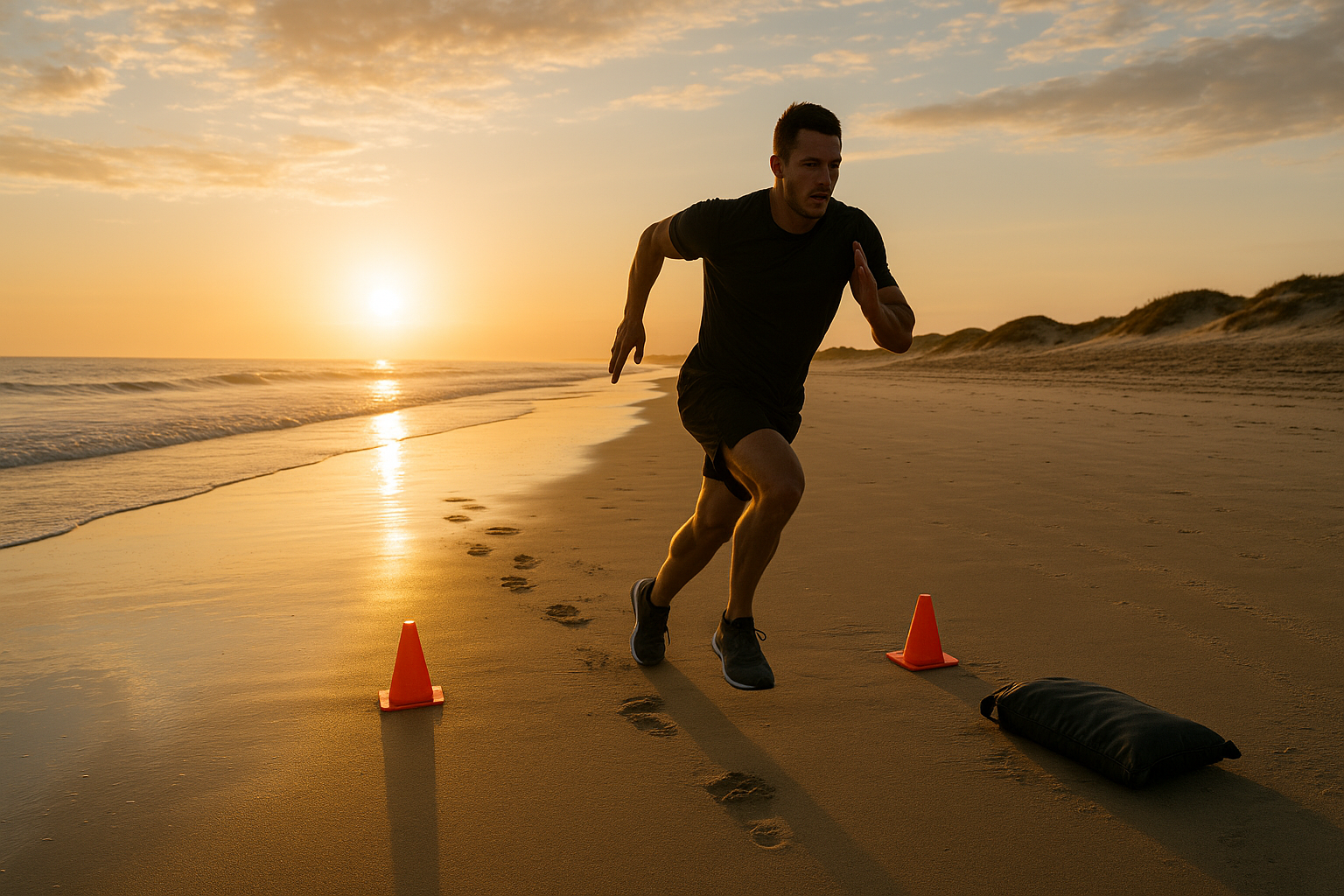
Salt air, shifting sand, and endless horizon—beach training hits muscles and the mind differently. Beach workouts use the beach’s natural “equipment” (sand texture, slope, dunes, and waterline) to build strength, stability, and cardio with lower impact than roads—while demanding more energy per step. In plain terms, you’ll likely move slower while working harder. Beach running in particular increases energy cost versus hard ground, so plan your pace and hydration with intention. Quick answer: beach workouts combine sand-based runs, agility, plyometrics, loaded carries, and mobility to improve strength, stability, and endurance, provided you time sessions around tides, respect beach safety flags, and manage heat and sun exposure. Before you begin, scan the beach for hazards, check tide and rip-current forecasts, and warm up thoroughly.
Medical note: Training in heat or near water increases risk. If you have a health condition or injury, talk with a qualified professional first. Follow local lifeguard guidance and beach flag warnings.
1. Waterline Easy Run (Firm Sand Foundation)
A waterline easy run is the safest, most accessible way to start beach training because the wet, compact sand near the shoreline is firmer and more stable than dry sand. The goal here is steady, conversational effort, not speed. Expect your pace to be slower at the same effort due to the sand’s compliance and energy demands; that’s normal, and it’s part of the benefit. Begin where the sand is firm but above the swash line to avoid unpredictable waves, and keep your route as flat as the beach allows. Because many beaches are slightly cambered, an out-and-back path or alternating directions balances load on hips and knees. A longer warm-up (8–10 minutes) primes ankles and calves, which work harder on sand. Keep an eye on tides; low-to-mid tide windows usually provide the longest sections of firm sand (always verify locally).
1.1 How to do it
- Warm-up: 8–10 minutes brisk walk → jog, plus ankle circles and 10 calf raises.
- Main set: 25–45 minutes at easy effort (RPE 4–5/10), breathing through your nose is a good check.
- Cadence: Aim slightly higher than on roads to shorten stride and reduce braking.
- Direction: Switch directions every 5–10 minutes to offset beach camber.
- Cool-down: 5 minutes easy walk; gentle calf/hip flexor stretches.
1.2 Numbers & guardrails
- Expect heart rate to drift upward as sand fatigues stabilizers; let effort (RPE) govern pace, not your watch.
- Running on sand costs more energy than on hard surfaces; plan shorter distances at first.
Wrap-up: Nail this foundation weekly and everything else on the beach gets safer and more productive.
2. Soft-Sand Power Intervals (Strength-Endurance Boost)
Soft, dry sand amplifies muscular demand and balance challenges, making it ideal for short, controlled intervals that build power and strength-endurance. The aim is quality over distance: short bursts where you keep posture tall, hips stacked, and foot strikes under your center of mass. Because soft sand “steals” push-off energy, you’ll recruit calves, glutes, and deep stabilizers intensely—great for performance but fatiguing fast. Start cautiously; if you’re new to sand, do this only after a few weeks of waterline runs. Pick a flat, debris-free patch; inspect for glass, shells, or driftwood. Keep recoveries generous to preserve form, and stop at the first sign of ankle wobble or calf cramp.
2.1 Session template
- Warm-up: 10 minutes easy waterline jog + 4 × 20-second strides on firm sand.
- Main set (choose 1):
- 10 × 30 seconds hard (RPE 8/10) on soft sand, 60–75 seconds walk-back recovery.
- 6 × 60 seconds strong (RPE 7–8/10), 90 seconds walk-back recovery.
- Technique cues: Short stride, quick cadence, eyes ahead, arms compact.
- Cool-down: 5–8 minutes easy jog/walk on firmer sand.
2.2 Why it works
- Sand’s compliance increases energy cost and reduces impact spikes—tough on muscles, gentler on joints. Progress gradually to avoid calf/achilles overload.
Wrap-up: Use soft-sand power once weekly; it’s the “weight room” for runners without the barbells.
3. Dune Hill Repeats (Uphill Strength Without the Pavement Pounding)
Dunes offer steep, short climbs that build leg strength and aerobic power with less impact than asphalt hills. The catch: dunes are living ecosystems—treat them with care. Only use designated access routes or permitted areas; never trample vegetated dunes or marked nesting zones. Choose a moderate slope you can repeat safely, free of hazards. Because the surface shifts underfoot, you’ll develop foot/ankle stiffness and coordination better than any gym machine. Keep steps short, torso slightly forward, and drive knees without overstriding. Descents are taxing; walk or carefully shuffle down to prevent slips. Schedule this on fresh legs for best form.
3.1 Hill session
- Warm-up: 12 minutes easy + 2 mobility moves (world’s greatest stretch, ankle rocks).
- Main set: 8–12 repeats up a dune path or permitted sandy hill, 20–45 seconds each at RPE 8/10; walk down fully.
- Progression: Add 1–2 reps weekly, or extend work time by 5 seconds.
- Cool-down: 10 minutes easy waterline jog and light calf/quad stretch.
3.2 Eco & safety notes
- Respect posted signs, markers, and seasonal nesting closures; avoid vegetated zones and fill any holes you create. Follow Leave No Trace guidance.
Wrap-up: Dune repeats are your natural stair machine—powerful, joint-friendly, and humbling.
4. Barefoot Stride Drills (Foot Strength Micro-Dose)
Barefoot micro-sessions improve foot intrinsic strength, ankle stiffness, and proprioception—when done slowly and intentionally. The first rule: treat barefoot like a brand-new sport. Your calves, Achilles, and plantar tissues need weeks to adapt. Start on clean, smooth firm sand near the waterline; scan for shells and debris. Keep bouts short with full rest to maintain crisp form: tall posture, quick cadence, gentle landing under your hips. If you feel any sharp plantar discomfort or calf strain, stop. Some athletes will prefer minimalist shoes or socks for protection; that’s fine and often wise.
4.1 15-minute barefoot add-on
- Warm-up (shod): 8 minutes easy jog.
- Barefoot block: 6–8 × 20–30 seconds strides on firm sand, walk back recovery.
- Drills: 2 × 30 meters A-skips and ankling (barefoot or minimalist).
- Re-shod cool-down: 5 minutes easy.
4.2 Transition science & cautions
- Experts stress gradual transition; barefoot uses different muscles and landing patterns. If you’re a lifelong heel striker, build slowly and stop at niggles.
Wrap-up: Keep it micro. Barefoot strides are seasoning, not the whole meal.
5. Sand Plyometrics Circuit (Lower Impact, Big Return)
Plyometrics on sand reduce impact peaks yet challenge power and coordination—great for athletes seeking jump/acceleration gains with less joint stress. On the beach, replace high-drop depth jumps with lower-amplitude hops, bounds, and skips. The unstable surface forces better landing mechanics (quiet feet, knees tracking over toes) and trunk control. Keep contacts moderate (e.g., 80–120 total) and prioritize crisp landings over height or distance. As always, a thorough dynamic warm-up is non-negotiable.
5.1 Circuit (2–3 rounds; 2 minutes rest between)
- A. Skater bounds × 8 each side
- B. Walking lunge to knee drive × 10 each side
- C. In-place pogo hops × 20
- D. Single-leg stick landings × 6 each side
- E. Broad jump → walk back × 6
5.2 Evidence snapshot
- Sand and other soft/aqueous surfaces can reduce muscle damage and still improve jump metrics after several weeks of training. Use progressive volumes and keep technique strict. Frontiers
Wrap-up: Smart, soft-surface plyos let you train explosiveness while sparing your joints.
6. Agility Cones & Shuttle Ladder (Change of Direction on Unstable Ground)
Agility in sand is a different beast: every cut demands extra ankle and hip stability. This session uses cones or an agility ladder placed on firm, flat sand (not in the water). Keep first steps short and think “push the sand back,” not “plant and twist.” Choose patterns that limit extreme pivots early on—e.g., T-drills or 5-10-5 shuttles—before you try lateral bounds or figure-8s. Rest fully between reps to keep footwork precise and reduce fall risk.
6.1 Session menu (pick 2)
- T-Drill: 6–8 reps, 60–75 seconds rest.
- 5-10-5 Shuttle: 8 reps, 60–90 seconds rest.
- Ladder quick-feet (in–in–out–out): 3 × 30 seconds, 60 seconds rest.
- “Z” cuts (5×5 m segments): 6 reps, walk back.
6.2 Why it transfers
- Studies in team sports show sand-based agility/plyo blocks can transfer to improved COD and jumping on firm ground—great when you’re off the field or traveling. Lippincott Journals
Wrap-up: Agility on sand builds foot and hip armor—use it in small, sharp doses.
7. Sandbag Loaded Carries (Strength You Can Feel)
The beach is perfect for loaded carries: sandbags, farmer’s buckets, or a single kettlebell make you stabilize with every step. Carries train grip, trunk stiffness, and gait under load—a potent antidote to slouchy posture and a booster for runners’ late-race form. Choose firm sand to keep steps controlled. Keep spine tall, ribs stacked over pelvis, and walk with shorter strides. Mix unilateral (suitcase carry) and bilateral (farmer’s carry) to challenge anti-lateral flexion and anti-rotation.
7.1 Carry matrix
- Farmer’s carry: 3 × 30–60 meters (moderate load).
- Suitcase carry (one side): 3 × 30–40 meters each.
- Front rack carry: 3 × 20–30 meters (lighter).
- Overhead carry (advanced): 2 × 20 meters each (very light).
7.2 Pro tips
- If sand is sloped, walk out and back to even out asymmetry.
- Keep shoulders down (don’t shrug), squeeze the handle, and breathe quietly through the nose.
Wrap-up: Carries make you sturdy everywhere—from ankles to obliques—especially on shifting sand.
8. Mixed-Modal Beach Circuit (Full-Body, Minimal Gear)
This no-frills circuit hits legs, push, pull (if you have bands), and core in 20–30 minutes. It’s ideal when you want strength + cardio without logging miles. Use an interval timer and set up a small square on firm sand. Keep reps smooth; the sand itself adds resistance and instability, so you’ll feel sets sooner than in a gym. Hydrate between rounds and watch the sun; early morning or late afternoon is typically friendliest.
8.1 30-minute EMOM (Every Minute on the Minute) × 5 rounds
- Min 1: Walking lunges × 12–16
- Min 2: Push-ups × 10–15 (hands on towel if hot)
- Min 3: Mini-band lateral steps × 12 each
- Min 4: Band rows or towel isometric rows × 12–15
- Min 5: Plank shoulder taps × 20 total
- Min 6: Rest (sip fluids)
8.2 Quick checklist
- Sunscreen and hat (reapply as directed), light towel, 1–2 bands, and water/electrolytes.
- Stop if dizziness, nausea, or chills occur—signs heat is winning (see heat notes below).
Wrap-up: A compact, scalable circuit that leverages sand’s instability for free.
9. Fartlek Along the Shore (Play the Terrain & Wind)
Fartlek (“speed play”) turns the beach into your interval track. Pick visual cues—the next lifeguard tower, jetty, or drift log—and surge to them at a strong-but-controlled effort, then jog easily to recover. Use wind and slope: surge with a tailwind on slightly firmer sections; recover into the headwind or over softer patches. This keeps intensity organic while giving you a quality aerobic/anaerobic blend. Because soft patches spike workload, keep surges short at first and prioritize mechanics.
9.1 40-minute template
- Warm-up: 10 minutes easy + 4 × 20-second strides.
- Main set: 12–16 minutes of fartlek surges (e.g., 45–75 seconds on / equal jog), then 8–10 minutes steady.
- Cool-down: 8 minutes easy + calves/hips mobility.
9.2 Pacing truth
- On sand you’ll likely run slower at the same RPE; that’s expected given higher energy cost. Trust effort over pace and sip fluids between blocks in warm weather.
Wrap-up: The most fun you can have with a timer off—productive in any training cycle.
10. Mobility & Foot-Strength Flow (Your Beach Cooldown Workout)
End sessions with targeted mobility and simple foot work while you enjoy the view. The sand is a forgiving surface for ground moves, and the ocean breeze makes cooldowns more pleasant—so you’re more likely to do them. This session improves ankle dorsiflexion, hip extension, thoracic rotation, and intrinsic foot strength, which all matter for running mechanics and injury resistance. You’ll leave fresher for tomorrow.
10.1 12-minute flow
- Calf raises on towel: 2 × 12 slow reps.
- Ankle rocks (knee-to-wall): 2 × 8 each.
- World’s greatest stretch: 2 × 5 each side.
- 90/90 hip switches: 2 × 8.
- Short-foot holds (spread and grip the sand lightly): 3 × 20 seconds.
- Prone swimmer or band pull-apart: 2 × 10.
10.2 Why it matters
- Sand’s compliance encourages gentle ranges at the ankle and foot; use this to “cement” good mechanics after hard work. Keep movements slow and nasal breathe to downshift.
Wrap-up: A little mobility now keeps tomorrow’s session crisp.
11. Heat-Smart Sunrise Session (Tempo + Hydration Plan)
Hot beaches magnify heat stress, so train early and bake hydration into the workout. This is a 40–55-minute tempo-style run on firm sand, scheduled around low to mid-tide and sunrise. The twist: you’ll preload fluids, carry a small soft flask, and cap the tempo with shade recovery. Because cardiac drift rises faster in heat, use RPE 6–7/10 and cap sustained efforts if the breeze stalls. Sun protection is part of the plan: broad-spectrum sunscreen, reapplication timing, lightweight UPF clothing, and sunglasses.
11.1 Session + hydration
- Prehydrate (2–4 h before): ~5–7 mL/kg body mass fluid; include sodium if you’re a salty sweater.
- Warm-up: 10 minutes easy + 4 strides.
- Main set: 2 × 10–12 minutes steady (RPE 6–7/10) with 3–4 minutes easy between.
- On the run: Small sips every 10–20 minutes (~200–300 mL, adjust to sweat rate).
- Cool-down: 8 minutes easy; shade, sip, and snack (salty + carb).
- Reapply sunscreen if you remain outdoors >2 hours or after swimming/sweating.
11.2 Safety cues
- If you feel dizzy, chilled, confused, or stop sweating, stop and seek help—these can be signs of heat illness. Lippincott Journals
Wrap-up: Train the engine without cooking it—plan fluids and sun just like paces.
12. Tide-Timed Long Run (Low-Tide Logistics + Rip-Current Awareness)
Your weekly long run belongs at the beach when low tide gives you miles of firm shoreline. Check tide tables in advance and aim your start just before low tide for the longest firm stretch. Run out and back, switching sides as needed to counter camber. Stick to the dry side of the swash line to avoid surprise waves and slippery spots. If your route passes lifeguard stands, note the flag color; red flags mean hazardous surf/strong currents—do not enter the water. If you or a partner end up in a rip current while wading post-run, don’t fight it; move parallel to shore and signal for help. Plan your fueling/hydration just as carefully as the route.
12.1 Long run plan
- Warm-up: 10–12 minutes easy jog; ankle/calf priming.
- Main set: 60–90 minutes easy (RPE 4–5/10), gel/chews as you normally would.
- Direction: Swap directions every 10–15 minutes to balance load.
- Finish: Walk 5 minutes; cool-down mobility (Section 10).
12.2 Tides, flags & rip safety
- Tide timing prevents getting cut off; check trusted local sources before you go.
- Only swim near lifeguards and learn flag meanings; red = high hazard, double red = water closed, yellow = medium hazard.
Wrap-up: Logistics turn a good long run into a great one—tide timing and flag awareness are your superpowers.
FAQs
1) Is running on sand easier on the joints?
Generally yes on impact spikes, because sand is compliant, but the energy cost is higher so muscles and tendons work harder. Start with firm waterline sand, shorter durations, and rotate directions to reduce asymmetry. Progress load over weeks, especially if you have a history of Achilles or calf issues.
2) Soft sand or firm sand—which is better?
Use firm sand (near the waterline) for longer steady runs and tempos, and soft sand for shorter power intervals and agility. Soft sand develops strength and balance but tires calves and feet quickly; firm sand lets you groove mechanics with fewer slips. Let your goals and experience guide the mix.
3) Should I go barefoot?
Optional. Barefoot micro-sessions can build foot strength and technique, but they require slow progression to avoid overload. Start with short strides on clean, firm sand and stop at the first sign of plantar or calf pain. Minimalist shoes or socks can protect from debris. Cleveland Clinic
4) How do I pace on sand?
Use RPE or heart rate, not usual road paces. Expect slower times at the same effort because running on sand requires more energy. Shorten stride, increase cadence slightly, and run by time, not distance, especially in the heat. PubMed
5) What hydration plan should I follow for hot, sunny beaches?
As a starting point, drink ~5–7 mL/kg of fluid 2–4 hours pre-run; during, sip ~200–300 mL every 10–20 minutes and adjust to your sweat rate. Include sodium if you’re a salty sweater, and replace fluids afterward. Reapply sunscreen at least every two hours and after swimming or heavy sweating. PMC
6) How do tides affect beach workouts?
Low tide typically exposes the widest zone of firm sand. Check tide tables the day before and the morning of your run; plan starts near low tide for long, stable stretches and to avoid being cut off as water rises. Local conditions vary—ask lifeguards if unsure.
7) What are the beach flag colors I should know?
Meanings vary by region, but the common system: yellow = medium hazard, red = high hazard, double red = water closed, and purple = marine pests. Swim only near lifeguards and heed local signage.
8) Are plyometrics safe on sand?
Used wisely, yes. Research shows reduced muscle damage alongside performance gains versus hard surfaces. Keep jumps low, focus on soft, quiet landings, and build contacts gradually (e.g., 80–120 per session).
9) What about rip currents—should I post-run wade to cool down?
Wading can be refreshing, but know the risks. If you’re ever pulled in a rip current, stay calm, swim parallel to shore, and call for help. Better yet, stick to lifeguarded areas and check the day’s surf forecast before entering.
10) How can I protect wildlife and the beach environment when I train?
Stay off vegetated dunes and marked nesting areas, fill in holes after drills, pack out trash, and keep lights low at night on nesting beaches. Follow Leave No Trace principles and local rules.
11) My knees hurt after running on a slanted beach—what gives?
Camber loads one side more than the other and can irritate knees/hips. Counter by running out-and-back, alternating directions frequently, and favoring the flattest line near the waterline. If pain persists, return to firm surfaces and consult a clinician. Marathon Handbook
12) What sunscreen strategy works for longer sessions?
Use a broad-spectrum SPF (≥15 per CDC; many athletes prefer 30+), apply 15–30 minutes before training, and reapply every two hours or after swimming/sweating. Don’t forget ears, lips, and tops of feet; UPF clothing and hats help tremendously.
Conclusion
Beaches turn the world’s simplest training into a masterclass in smart effort: firmer sand for rhythm, soft sand for strength, dunes for power, and the shoreline’s breeze to keep you honest on heat. The 12 workouts above progress from foundational waterline runs to advanced agility, plyometrics, and loaded carries—each tuned to sand’s unique demands. The through-lines are simple: move by effort, progress gradually, and treat tides, flags, and sun as seriously as reps and sets. Keep sessions short at first, rotate directions to defeat camber, and double-down on post-run mobility and hydration. With that, you’ll gain durable feet and ankles, resilient hips and core, and a head that loves the training again.
Ready to start? Pick one foundation run (Section 1), one power/skill session (Sections 2, 5, or 6), and one strength/circuit (Sections 7 or 8) this week—then schedule next week’s sunrise tempo (Section 11) around low tide (Section 12).
CTA: Lace up (or go barefoot for a few strides), check the tide and flag color, and hit the waterline for 25 easy minutes today.
References
- Lejeune TM, Willems PA, Heglund NC. Mechanics and Energetics of Human Locomotion on Sand. Journal of Experimental Biology. 1998. The Company of Biologists Journals
- Zamparo P, Perini R, Orizio C, Sacher M, Ferretti G. The energy cost of walking or running on sand. Eur J Appl Physiol. 1992. PubMed
- Binnie MJ, Dawson B, Pinnington H, Landers G, Peeling P. Sand training: a review of current research and practical applications. J Sports Med. 2014. PubMed
- Arazi H, et al. Type of Ground Surface during Plyometric Training Affects Jumping Performance. Asian J Sports Med. 2016. PMC
- Hammami M, et al. Effect of a sand surface on physical performance following plyometric training. BMC Sports Sci Med Rehabil. 2020. BioMed Central
- de Villarreal ES, et al. Effects of sand surface plyometric and sprint training on beach handball players. Biology (Basel). 2023. PMC
- Sawka MN, et al. ACSM Position Stand: Exercise and Fluid Replacement. Med Sci Sports Exerc. 2007. PubMed
- National Weather Service (NOAA). How to Avoid Getting Caught in a Rip Current. Accessed 2025.
- United States Lifesaving Association (via NOAA). Rip current safety & lifeguarded beaches. Accessed 2025. National Weather Service
- CDC. Sun Safety Facts | Skin Cancer. Updated July 1, 2024. CDC
- U.S. FDA. Sunscreen: How to Help Protect Your Skin from the Sun. Updated Aug 16, 2024. U.S. Food and Drug Administration
- RNLI. Tides—Know the Risks and Beach Safety Tips. Accessed Aug 2025. ; https://rnli.org/safety/beach-safety RNLI
- Alabama Dept. of Public Health. Beach Flag Warning System. July 19, 2024. Alabama Department of Public Health
- Roberts WO, et al. ACSM Expert Consensus Statement on Exertional Heat Illness: Recognition, Management, and Return to Activity. Curr Sports Med Rep. 2021/2023. PubMed
- Harvard Gazette. Different Strokes: Perfect landing (barefoot running insights). Jan 27, 2010. Harvard Gazette
- Leave No Trace (NPS/USFWS). Seven Principles & On/Nearshore Reference. 2022–2023. ; National Park ServiceLeave No Trace
- NSCA (summary referencing ACSM). Hydration and Performance. Accessed 2025. NSCA
- RNLI. Beach Safety PDF: On the Beach Advice. 2024. RNLI
- Jafarnezhadgero AA, et al. Eight Weeks of Exercising on Sand Has Positive Effects… Frontiers in Physiology. 2022. PMC
- Barrett RS, et al. Dynamic loading response of beach sand surfaces (impact). J Sci Med Sport. 1998. ScienceDirect