

























A calm, predictable bedtime routine helps most children fall asleep faster, stay asleep longer, and wake in a better mood. This guide turns research-backed advice into practical steps you can use tonight, whether you’re parenting a toddler, a school-ager, or a teen. In short, bedtime rituals are a consistent, soothing sequence of steps before lights-out that cue the brain for sleep. They work by supporting the body clock (circadian rhythm), lowering arousal, and making evenings more predictable. Quick-start: pick a consistent bedtime and wake time, create a 20–40 minute wind-down (brush, book, bed), dim lights and cut screens an hour before sleep, and keep the bedroom cool, dark, and quiet.
Health note: This article is educational and not a medical diagnosis. If your child snores most nights, has breathing pauses, frequent night terrors, or persistent insomnia, consult a pediatric clinician.
1. Lock the Sleep Schedule (and Guard the Wake Time)
Consistency is the single strongest lever you control. Keeping the same bedtime and wake time—including weekends within about an hour—stabilizes your child’s circadian rhythm and makes it easier to fall asleep. Start by calculating an age-appropriate sleep window, then reverse-engineer bedtime from the needed wake time for school or family routines. Expect a few nights of adjustment; bodies don’t change clocks instantly. If summer or travel threw you off, shift bedtime earlier by 10–15 minutes every few nights until you land on your target. The first two sentences matter most: choose a target wake time, stick to it, and the rest of the routine will align.
1.1 Numbers & guardrails
- Typical sleep ranges (per 24 hours): infants 4–12 months 12–16h, toddlers 1–2y 11–14h, preschool 3–5y 10–13h, school-age 6–12y 9–12h, teens 8–10h. Journal of Clinical Sleep Medicine
- Keep weekday/weekend bedtimes within ~1 hour to avoid “social jetlag.”
- If your child needs to wake at 7:00 a.m. and requires ~10 hours, lights-out should be near 9:00 p.m.
1.2 How to do it
- Set a fixed wake alarm every day; adjust bedtime gradually (10–15 minutes earlier every 2–3 nights).
- Anchor the evening with recurring timestamps: dinner, bath, PJs, brushing, story, lights-out.
- Use an “OK-to-wake” clock for toddlers to reinforce morning timing.
- Track for a week; tweak by 10–15 minutes if sleep latency exceeds 30 minutes.
A steady wake time drives melatonin rhythm predictably, making all other bedtime rituals more effective. Nature
2. Build a 20–40 Minute Wind-Down (Brush, Book, Bed)
A predictable, soothing sequence before lights-out tells a child’s brain, “Sleep is next.” Aim for 20–40 minutes; longer can backfire by adding room for negotiation. Keep the order the same nightly—bath, pajamas, teeth, quiet reading, cuddle, lights-out. This ritual reduces evening chaos, lowers cortisol, and becomes a powerful cue set. The American Academy of Pediatrics’ Brush, Book, Bed framework is a simple, high-yield template many families use successfully.
2.1 Tools & examples
- Template: Bath → Pajamas → Brush → Two books → Lullaby → Lights-out.
- Visual chart: Picture cards for non-readers (bath, PJs, brush, book, bed).
- Timers: A gentle 5-minute sand timer for “one more page” moments.
- Anchor phrase: “After two books, it’s lights-out.”
2.2 Why it works
- Rituals reduce uncertainty and bedtime resistance.
- Pairing reading and cuddles associates bed with calm and connection.
- Repeating the same steps nightly strengthens sleep cues over time.
- The AAP’s Brush, Book, Bed program specifically recommends teeth-brushing, reading together, and a regular bedtime.
Short, consistent, and connection-rich beats long, elaborate, and negotiable—every time.
3. Dim Lights and Cut Screens One Hour Before Bed
The simplest evening biohack: protect the last hour before sleep from bright and blue-enriched light. Children’s melatonin systems are especially sensitive to blue light from LEDs and screens, which can delay sleepiness. Content matters, too—stimulating media keeps the mind “on.” Replace screens with low-key analog activities (drawing, puzzles, audiobooks, quiet play), and transition to dim, warm lighting.
3.1 Mini-checklist
- Tech curfew: Put devices away at least 60 minutes before bedtime.
- Lighting: Use lamps with warm bulbs; dim the house after dinner.
- Bedroom rule: No phones/tablets in the sleep space at night; charge outside.
- Swap-ins: Coloring, gentle stretches, reading, journaling, soft music.
3.2 Research highlights
- AAP and pediatric sleep researchers advise avoiding screens in the hour before bed; replace with calm activities.
- Lab studies show greater melatonin suppression in children with blue-enriched light compared to adults, supporting light hygiene before bedtime.
- Sleep organizations recommend an evening tech curfew and dimmer lights for kids. Sleep Foundation
Darkness is a signal, not a suggestion—protect it, and sleep comes easier.
4. Make the Room Cool, Dark, Quiet (and Safe)
A cool, dark, quiet environment helps bodies wind down. For infants, safety is paramount: a firm flat sleep surface, no pillows or loose blankets, and the baby placed on their back. For all ages, keep the room on the cooler side—many families find ~16–20 °C (61–68 °F) comfortable—use blackout curtains to block early light, and consider steady white noise at safe volumes to mask household sounds.
4.1 Numbers & guardrails
- Temperature: Health authorities commonly recommend ~16–20 °C for babies’ rooms. Use lighter bedding as temps rise.
- White noise: Keep infant sleep machines ≤50 dBA and place them across the room; prolonged noise above ~70 dB can harm hearing.
4.2 Setup basics
- Blackout curtains; a small amber nightlight only if needed for comfort or bathroom trips.
- Declutter floors for safe nighttime navigation.
- Keep pets out if they wake children; use door stoppers to prevent slams.
- For infants: follow AAP safe-sleep recommendations (back-to-sleep, firm surface, no soft bedding). American Academy of Pediatrics
A well-tuned sleep space reduces wake-ups you don’t control—like trucks, dawn light, or clattering dishes.
5. Use Daytime to Win Nighttime: Light, Exercise, and Routine
Sleep pressure and circadian timing are built during the day. Morning daylight and daily physical activity help kids fall asleep faster at night; chaotic daytime schedules often show up as bedtime mayhem. Aim for outdoor time after breakfast and at least 60 minutes of activity for school-age kids. Keep afternoon naps and late-day vigorous exercise timed so they don’t push bedtime later than you want.
5.1 Why it matters
- Morning light advances the body clock, helping earlier sleep onset later. Emerging research emphasizes early-day bright light for kids.
- Consistent daily routines (meals, play, homework) reduce bedtime bargaining and unpredictability.
- Regular exercise improves sleep quality and mood.
5.2 Guardrails & tips
- School-age children benefit from ≥60 minutes/day of moderate-to-vigorous activity; toddlers/preschoolers need active play spread throughout the day. PMCDepartment of Health, Disability and Ageing
- Avoid intense exercise in the last 1–2 hours before bed; substitute gentle stretching or yoga.
- If bedtime is drifting later, add morning outdoor light and cap late naps.
Think of daytime as the on-ramp to sleep—sunlight and movement pave it.
6. Align Naps with Night Sleep
Good naps support good nights—until they don’t. The right number, length, and timing of naps changes with age. For toddlers and preschoolers, too-late or too-long naps can push bedtime past your goal. For infants, overtiredness from missed naps can also wreck bedtime. Use your child’s sleep latency and mood as guides: falling asleep within 15–30 minutes and waking rested suggest you’ve got the balance right.
6.1 How to tune naps
- Protect age-appropriate totals (see Section 1 ranges).
- For 2–3-year-olds, aim to end naps by ~3:00 p.m. if bedtime creep is a problem.
- Trial small changes first: trim a nap by 15 minutes for 3–4 days and watch bedtime.
6.2 Mini example
A 3-year-old sleeps 2 hours from 2:30–4:30 p.m. and fights a 9:00 p.m. bedtime. Shift nap to 1:00–2:15 p.m. for one week and move lights-out to 8:30 p.m.; sleep latency shrinks to 20 minutes.
When bedtime is a battle, the nap clock is often the culprit—tweak there first.
7. Soothe Separation Worries and Bedtime Battles
If your child stalls, pops out of bed, or worries about sleeping alone, blend connection with clear structure. A predictable good-night routine and calm, brief check-ins help many families. For persistent curtain-calls in preschoolers, the Bedtime Pass—one pass valid for a single brief request—can significantly reduce resistance when used consistently.
7.1 Tools & examples
- 5-minute snuggle + two books, then good-night phrase (repeat nightly).
- Check-ins: If called, return briefly at increasing intervals to reassure without re-engaging play.
- Bedtime Pass: Child gets one pass for a quick extra hug/water; second request waits until morning.
- Transitional object: A special stuffed animal “in charge of guard duty.”
7.2 Evidence snapshot
- A randomized clinical trial found the Bedtime Pass reduced bedtime resistance in preschoolers. PubMed
- Behavioral approaches like graduated check-ins or bedtime fading improve infant sleep without long-term harms to attachment or behavior.
Lead with warmth, hold the boundary, and let the routine—not debate—do the work.
8. Time Food and Drink Wisely
What and when children eat can nudge sleep in the right (or wrong) direction. Large, late meals delay sleep; sugary treats and caffeine (including colas, iced tea, and some chocolates) can amp kids up. Instead, offer a light, balanced snack 45–60 minutes before lights-out if they’re hungry—think yogurt with oats, a small cheese-and-cracker plate, or banana with peanut butter. Always finish with tooth-brushing.
8.1 Mini-checklist
- Avoid caffeine after mid-afternoon.
- Skip heavy, spicy, or greasy meals in the last 2–3 hours before bed.
- Pair carbs + protein/fat for a steady release (e.g., toast + nut butter).
- Brush after the snack; align with Brush, Book, Bed.
8.2 Region & routine notes
- Hydration matters, but limit big water bottles late to reduce bathroom trips.
- In hot climates, cool evening showers can double as wind-down while aiding comfort at night.
Even small timing tweaks—lighter dinners, earlier snacks—can shorten sleep latency.
9. Make Reading and Connection the Last Cue
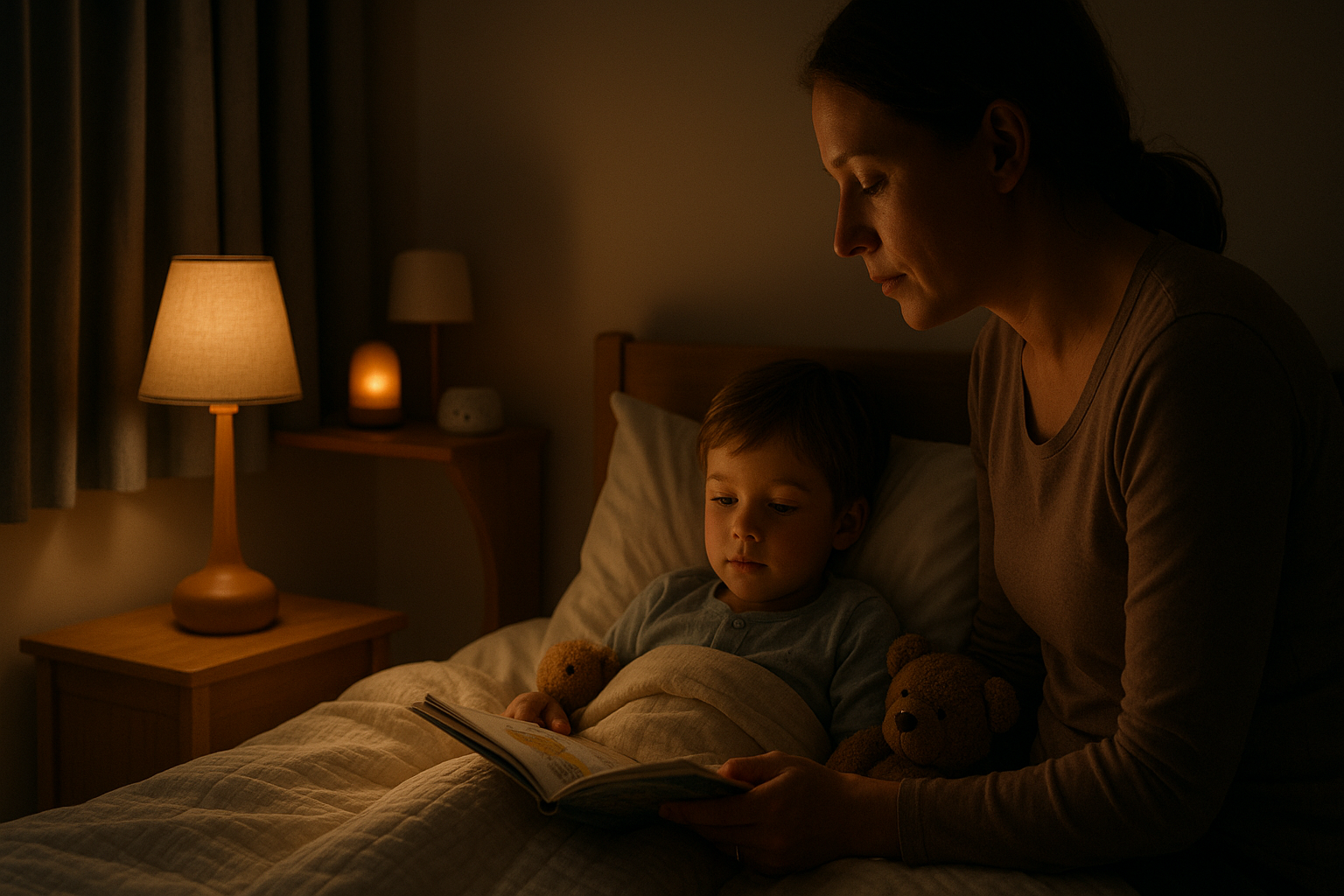
End with something your child loves that also calms—reading aloud, telling a story from your day, or a short back-rub. This final step strengthens the bond between “bed” and “peace,” not “bed” and “battle.” Reading boosts language and attention while lowering arousal; it fits naturally into Brush, Book, Bed and works from toddlerhood through the tween years.
9.1 How to do it
- Two short picture books or one longer chapter section; keep a consistent limit.
- Choose gentle stories and soothing voices; avoid cliffhangers.
- Close with a predictable phrase: “Good night, I love you. See you in the morning.”
9.2 Why it works
- Predictable, affectionate endings lower stress chemicals and ease separation.
- The AAP-endorsed Brush, Book, Bed explicitly builds tooth-brushing and reading into bedtime. American Academy of Pediatrics
When bedtime ends with connection, kids are less likely to chase it after lights-out.
10. Handle Night Wakings Calmly and Briefly
Night wakings are normal; what matters is how you respond. Keep interactions short, boring, and dark so wake-ups don’t become midnight parties. For toddlers and older children, a consistent, low-key resettling routine (whispered reassurance, quick tuck-in, same good-night phrase) teaches self-soothing. For infants, follow safe-sleep guidance and your pediatrician’s feeding plan; over time, space night feeds as age-appropriate.
10.1 Common mistakes
- Turning on bright lights, chatting, or offering snacks—these reward wakefulness.
- Moving to the couch/parent bed “just this once,” which often becomes a new pattern.
- Inconsistent responses between caregivers.
10.2 Research & red flags
- Behavioral strategies (e.g., graduated check-ins, bedtime fading) reduce night wakings without demonstrated long-term harms.
- Call your clinician if your child snores loudly most nights, has breathing pauses, gasps, or struggles with restless sleep—possible sleep-disordered breathing deserves evaluation.
Your middle-of-the-night script should be as predictable as your bedtime routine.
11. Travel, Time Changes, and Seasonal Shifts
Life happens. For travel across time zones, shift toward the destination gradually (15–30 minutes earlier/later each day for 3–5 days), then anchor mornings with bright light and activity. Keep the core sequence (bath/PJs/brush/book) even in hotels or at grandparents’—familiar steps in a new place are surprisingly powerful. Seasonal transitions and school-start changes benefit from the same gradualism.
11.1 Quick planner
- Before travel: Slide bedtime/wake time toward destination time by ~15–30 minutes/day.
- During travel: Keep wind-down steps and a familiar object; block light with travel blackout shades.
- On arrival: Morning sunlight + outdoor time; early dinner; short evening wind-down.
- Back home: Re-establish your usual schedule within a week.
11.2 Bonus tip
If summer slid bedtime late, move earlier in 10–15 minute steps every 2–3 nights; guard the wake time and layer in morning light to lock it.
Predictability beats perfection—keep the core ritual and nudge the clock as needed.
12. Use Supplements Sparingly and Know When to Get Help
When routines are solid but sleep is still hard, talk to your pediatric clinician. Conditions like allergies, eczema, reflux, anxiety, or sleep apnea can fragment sleep. As for melatonin, medical groups advise caution: dosing and product quality vary, and routine use isn’t recommended without professional guidance. For some circadian issues or neurodevelopmental conditions, clinicians may recommend short-term use while you optimize behavioral sleep hygiene.
12.1 Clear guardrails
- Try behavioral steps consistently for 1–2 weeks before considering supplements.
- If you use melatonin under guidance, start low and for short durations; store securely like any medicine.
- Seek care for chronic insomnia, nightly snoring, repeated breathing pauses, or severe daytime sleepiness.
12.2 Evidence cues
- The AASM notes melatonin may help specific pediatric cases but emphasizes clinician oversight; supplement quality and labeling vary.
- Updated reviews highlight that long-term safety data in children remain limited; prioritize non-drug strategies first. PMC
When in doubt, get eyes on the underlying issue—smart routines plus clinical insight beat guesswork.
FAQs
1) What’s the ideal bedtime for my child’s age?
There isn’t a single “right” time—work backward from your needed wake time and the age-based sleep range (e.g., 10–13 hours for preschoolers; 9–12 for school-age). If your 7-year-old must wake at 7:00 a.m. and does best with ~10.5 hours, aim for lights-out around 8:30 p.m. Keep the wake time consistent, even on weekends, to avoid social jetlag.
2) How long should a wind-down last?
Most families do well with 20–40 minutes. Shorter can feel rushed; longer invites bargaining. A simple sequence like bath → PJs → brush → two books → lights-out fits this range and sets expectations. Keep the order the same nightly—predictability is more important than perfection.
3) Do night-lights hurt sleep?
A small, dim amber night-light usually doesn’t disrupt sleep and can help kids feel safe or navigate bathrooms. Avoid bright, blue-white lights that can suppress melatonin. If a night-light seems to delay sleep or cause early wakings, try removing it for a few nights and watch for change. PMC
4) How far from bedtime should we stop screens?
Aim for at least one hour. Use that hour for reading, drawing, or quiet play under dim, warm light. Kids’ melatonin systems are more sensitive to blue-enriched light; even with filters, content can be stimulating. Keep devices out of the bedroom overnight to prevent wake-time temptation. PMC
5) Are white-noise machines safe?
Yes, when used properly. Keep volume ≤50 dBA, place the device across the room, and choose steady, non-pulsing sounds. Prolonged noise above ~70 dB can damage hearing; some products can exceed safe levels if placed close at high volume. Check with a phone dB meter app to be sure. HealthyChildren.org
6) What room temperature is best for sleep?
A cool room (~16–20 °C / 61–68 °F) is comfortable for most children and infants. In warmer weather, use lighter sleepwear and bedding; in colder weather, add layers rather than cranking heat. Avoid overheating—especially for infants—and follow safe-sleep guidance for bedding.
7) How do I handle early morning wakings?
Treat them like night wakings: keep it dark and quiet, and use an OK-to-wake clock for toddlers. If dawn light leaks in, add blackout curtains. Paradoxically, moving bedtime slightly earlier can help if wakings are due to overtiredness; morning outdoor light also strengthens the body clock.
8) Should I wake a sleeping child from a nap?
Sometimes. If a late or long nap is pushing bedtime too late, cap or shift the nap. Trim by 15 minutes over a few days and observe bedtime ease. Preserve total age-appropriate sleep over 24 hours, but protect nighttime first if school schedules require early wake-ups.
9) Can a warm bath help?
For many kids, a warm (not hot) bath 30–60 minutes before bed relaxes muscles and serves as a ritual cue. It’s not required, but if your child enjoys it, include it as a consistent step—then PJs, brushing, and a story. WSH NHS
10) Is melatonin OK for kids who “just can’t sleep”?
Use caution. Medical groups do not recommend routine melatonin for typical bedtime struggles. Dosing and product quality vary, and long-term safety data are limited. Talk to your pediatric clinician first; prioritize routines, light management, and consistent schedules. In some specific cases, short-term clinician-guided use is reasonable.
11) What’s the fastest way to reset after holidays or travel?
Pick a firm wake time, shift bedtime by 10–15 minutes earlier every 2–3 nights, add morning sunlight, and re-establish your wind-down. Expect 3–7 days for most kids to settle; keep weekends within an hour of weekday schedules to lock it in. PMC
12) My child cries when I leave. Does that mean “sleep training” harms attachment?
The best evidence shows that gentle behavioral strategies (like bedtime fading or graduated check-ins) improve sleep without long-term harm to attachment or child behavior. You can choose approaches that fit your family’s values and tolerance; warmth and consistency are the non-negotiables. PubMed
Conclusion
Bedtime gets easier when the evening becomes predictable, soothing, and aligned with biology. Start with the big levers: a stable wake time, a 20–40 minute wind-down built around Brush, Book, Bed, protected darkness, and a cool, quiet room. During the day, stack the deck with morning sunlight and active play, and keep naps aligned with your target bedtime. For common hiccups like curtain calls or early risings, simple tools such as a Bedtime Pass, an OK-to-wake clock, and blackout curtains can turn the tide within a week. If sleep is still difficult, especially with loud snoring or breathing pauses, bring your clinician in early; you don’t have to white-knuckle it, and supplements like melatonin are not the first step.
Tonight’s plan: choose a wake time, sketch a five-step wind-down, dim lights and park devices an hour before bed, and set the room to cool-dark-quiet. Repeat for 7 nights—you’ll feel the difference. Ready to start? Print your routine, pick two easy swaps, and begin this evening.
References
- About Sleep — Centers for Disease Control and Prevention (CDC). Updated May 15, 2024. CDC
- Recommended Amount of Sleep for Pediatric Populations: A Consensus Statement of the American Academy of Sleep Medicine — Paruthi S., et al. J Clin Sleep Med. 2016;12(6):785–786. AASM
- Healthy Sleep Habits: How Many Hours Does Your Child Need? — HealthyChildren.org (AAP). Nov 16, 2020. HealthyChildren.org
- Brush, Book, Bed: How to Structure Your Child’s Nighttime Routine — HealthyChildren.org (AAP). HealthyChildren.org
- Screen Time Affecting Sleep — AAP Center of Excellence on Social Media & Youth Mental Health. Oct 18, 2023. American Academy of Pediatrics
- Melatonin for Kids: What Parents Should Know About This Sleep Aid — HealthyChildren.org (AAP). Apr 27, 2023. HealthyChildren.org
- Health Advisory: Melatonin Use in Children and Adolescents — American Academy of Sleep Medicine. Jul 29, 2024. AASM
- A Nightly Bedtime Routine: Impact on Sleep in Young Children and Maternal Mood — Mindell J.A., et al. Sleep. 2009. PubMed
- Bedtime Routines for Young Children: A Dose-Dependent Association with Sleep Outcomes — Mindell J.A., et al. Sleep Health. 2015. PMC
- Infant Sleep Machines and Hazardous Sound Pressure Levels — Pediatrics (AAP). Apr 2014. AAP Publications
- Reduce the Risk of Sudden Infant Death Syndrome (SIDS) — NHS. Accessed Aug 2025. nhs.uk
- Start for Life: Safer Sleep Advice for Babies — NHS. Accessed Aug 2025. nhs.uk
- Digital Media and Sleep in Childhood and Adolescence — Hale L., et al. Pediatrics (AAP Supplement). Nov 2017. AAP Publications
- How Much Sleep Do Kids Need? — Sleep Foundation. Updated Jul 23, 2025. Sleep Foundation