

















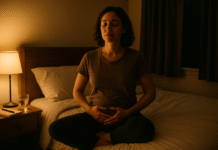




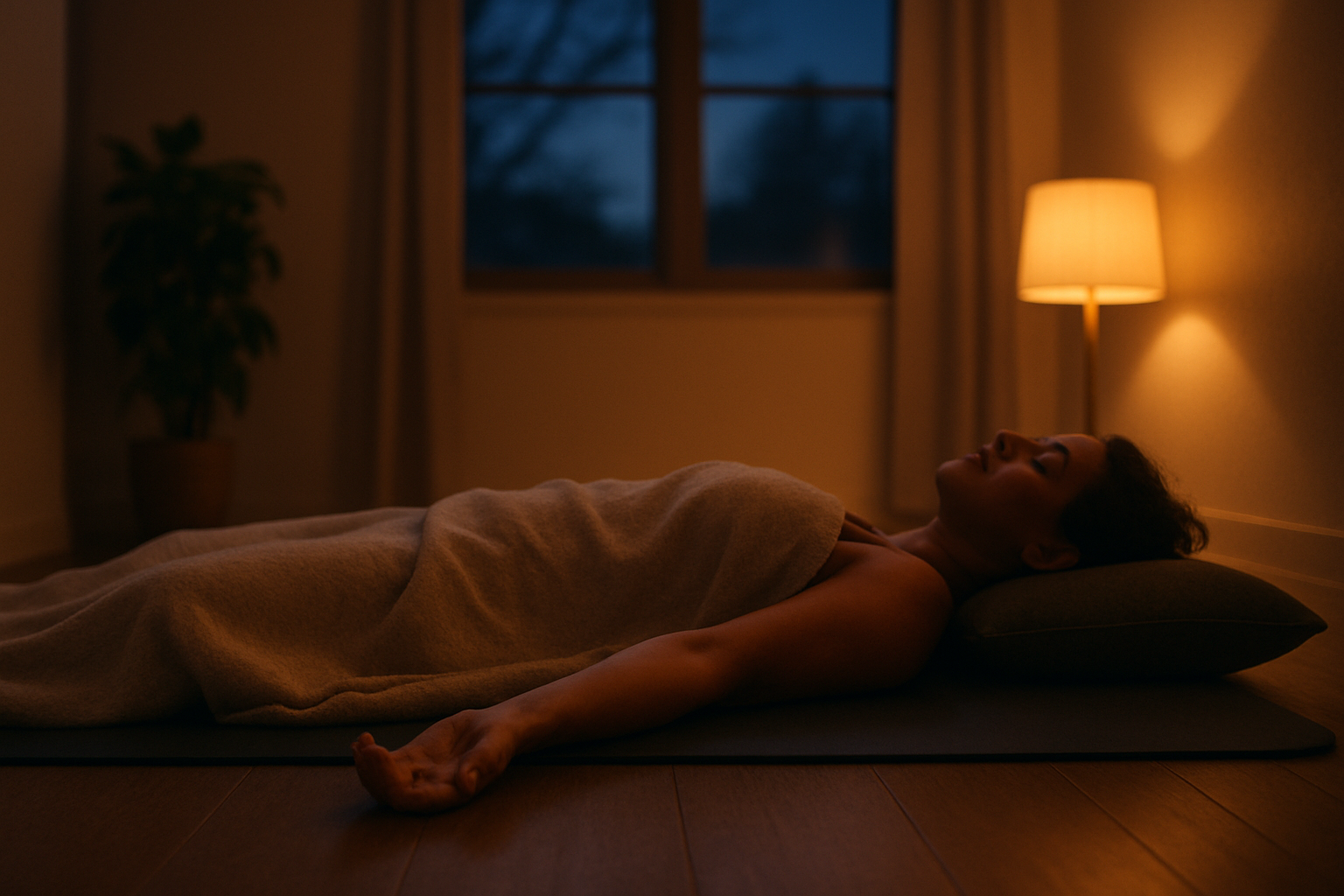
Body scan meditation is a guided mindfulness practice where you move attention through your body—usually from toes to head—observing sensations without judgment. Done well, it releases accumulated tension, downshifts the nervous system, and trains deep interoceptive awareness. Below you’ll learn a practical, evidence-informed way to do it in 10 steps, including timing, posture options, cueing, and real-world troubleshooting. For quick reference, the basic flow is: set up, settle the breath, then scan feet → legs → hips → belly → back/chest/shoulders → hands/arms/neck → face/scalp → whole-body sweep → close.
This guide is educational and not a substitute for medical care. If you live with pain, injury, trauma, or a medical condition, adapt gently and consult a qualified professional.
1. Choose Your Posture and Space
Start by selecting a posture and space that your body can trust for 10–30 minutes; comfort drives consistency. Lying on your back (savasana) is the classic option for deep relaxation, but a supported reclined seat or firm chair also works if your lower back or hips object. Aim for a quiet, dimly lit room with a temperature that won’t pull attention—roughly 20–23°C (68–73°F) for most people. A thin pillow under the head and a rolled towel under the knees reduce lumbar strain when lying down. Silence your phone, set “Do Not Disturb,” and tell others you’re offline for the duration. When the environment feels safe and predictable, your nervous system can fall out of vigilance and into rest-and-digest.
1.1 How to set up quickly
- Surface: Yoga mat or firm bed; avoid very soft beds that bow the spine.
- Supports: Small pillow for head; towel under knees; light blanket if you tend to chill.
- Alignment: Neutral neck; shoulders heavy; feet fall outward.
- Lighting & noise: Low light; white noise or soft ambient if needed.
- Safety: If you’re prone to sleep attacks while supine, use a chair.
Mini-checklist: Can I lie or sit without fidgeting for 15 minutes? Is my lower back neutral? Is my phone silenced? If yes, you’re ready. Close with a breath and a half-smile—tiny cues that tell the body, “You’re safe.”
2. Set a Clear Intention and Timer
Anchor the session with one sentence: “For the next 15 minutes, I’ll explore sensations with curiosity and kindness.” Intention acts like a compass; it keeps the mind from turning the practice into a performance. Then set a timer—10 minutes is a great starting dose, 20 is standard, and 30–45 minutes is common in structured programs. Choose a gentle bell to avoid a jolt at the end. If you’re using an audio guide, download it in advance to dodge streaming hiccups. Remember: the goal isn’t to “feel relaxed right now,” but to build the capacity to notice, include, and soften whatever is here.
2.1 Numbers & guardrails
- Starter dose: 10–12 minutes, 4–5 times/week.
- Standard dose: 20 minutes, 3–5 times/week for 6–8 weeks.
- When stressed: Even 3–5 minutes helps disrupt a tension cascade.
- Pitfall: Chasing a result (“I must relax”) backfires; practice noticing instead.
Synthesis: A concise intention plus a kind, non-alarming timer creates a container where relaxation can unfold rather than be forced.
3. Take Three Settling Breaths and Establish a Baseline
Before scanning, take three slow, unforced breaths. Imagine the inhale widening the ribs and the exhale lengthening the back of the body. On breath four, let the breath “breathe itself” and survey your baseline: Where is tension loudest? What’s neutral? What’s pleasant, even subtly? Labeling the baseline (“jaw tight, hands warm, belly neutral”) gives you a map to revisit later and measure change. Keep the jaw soft, tongue resting on the upper palate, and eyes gently closed or half-closed.
3.1 How to do it
- Breath ratio: Try 4–6 second inhales and 6–8 second exhales for three breaths; then release control.
- Attention cue: “Feel the body breathing” vs. “make the breath deep.”
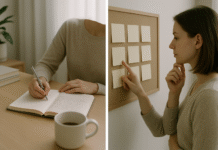
- Baseline notes: Name 1–2 tense zones and 1 easy zone; you can journal them later.
Common mistake: Over-managing the breath. After the three “settling” breaths, switch to observation. Takeaway: A short settle + baseline primes sensitivity without turning into breath-work.
4. Start at the Feet: Map Sensations, Not Stories
Begin with toes and soles. Aim for direct, sensory data: temperature, pressure, tingling, pulsing, stretch, dullness. If you feel “nothing,” that is a sensation—note “neutral” and stay curious. Linger 30–60 seconds per micro-region: toes, balls, arches, heels, tops of feet, ankles. Imagine a slow, warm spotlight traveling through tissue layers. If pain or pins-and-needles appear, widen attention to include the contact with the floor and the breath; pain often eases when it’s not the only thing in awareness.
4.1 Mini-checklist
- Can I distinguish left vs. right toes?
- What’s the most subtle sensation I can notice (micro-tingle, micro-pulse)?
- Where is contact pressure strongest?
4.2 Common pitfalls
- Judging “numb” as failure: Many people start with low interoceptive resolution; it improves.
- Scanning too fast: Rushing turns the scan into a checkbox; slow down until you can feel.
Synthesis: By training “sensation first,” you build the clarity that makes the rest of the scan effective.
5. Sweep Through Ankles, Calves, Knees, and Thighs
Now progress up the lower legs: ankles → calves → shins → knees (front/back) → thighs (quads/hamstrings/adductors). Spend 1–2 minutes per major region. Visualize breath flowing into the tissue on the inhale and softening around it on the exhale. If you notice asymmetry—right calf tight, left easy—let that be data, not a problem to solve. Many people hold “readiness tension” in calves and quads from long sitting or standing; the scan helps convert that background noise into releasable signal.
5.1 How to do it
- Cue: “Feel from the skin inward to the bone.”
- Micro-relax: On exhale, imagine muscles un-gripping by 5–10%.
- If cramps appear: Pause, flex the foot gently, then return to sensing.
5.2 Numbers & guardrails
- Time: 4–6 minutes total for lower legs and thighs in a 20-minute session.
- Pace: If attention blurs, halve the area; smaller zones sharpen clarity.
Synthesis: Consistent, curious attention teaches the legs to downshift from “ready to sprint” to “supported and grounded.”
6. Settle the Pelvis and Hips (Your Center of Gravity)
Bring awareness to sit bones, glutes, hip joints, and pelvic bowl. This region stores hours of chair-time and emotional bracing; moving attention here often yields big drops in background tension. Explore contact with the floor/chair, the angle of the pelvis, and any subtle pulsing around the sacrum. If you meet discomfort, treat it like a guest: name it, widen awareness to include breath and contact, and let it be. The aim is to let the body feel held rather than micromanaged.
6.1 How to do it
- Zones: Sit bones → glutes → hip creases → pelvic floor → sacrum.
- Breath cue: Imagine exhale widening the back of the pelvis.
- Support: A small cushion under the sacrum can flatten tugging in the low back.
6.2 Common mistakes
- Forcing release: Pushing attention at a tight spot tends to tighten it further.
- Skipping the pelvic floor: Many beginners overlook it; include sensations of weight, warmth, or neutrality.
Synthesis: A spacious, non-coercive attention around the hips stabilizes the whole scan; relaxation radiates outward from the center.
7. Belly and Diaphragm: Befriend the Core of the Breath
Shift to the belly, sides of the waist, and the diaphragm under the ribs. Notice movement on inhale and exhale, the stretch under the ribs, and any guarding. Many people unconsciously brace the abdomen; softening here increases perceived safety and deepens relaxation. If anxiety edges up when you focus on the belly (common for some), shrink the window: alternate 10 seconds belly, 10 seconds hands/feet, then return. Pair the belly with a gentle phrase: “Soft belly, kind attention.”
7.1 How to do it
- Hand anchor: Rest one hand on the belly to feel movement directly.
- Breath cue: Let the inhale arrive; ride the exhale down the front body.
- Time: 1–2 minutes belly; 1 minute diaphragm; 30–60 seconds side waist.
7.2 Numbers & guardrails
- If reflux or fullness: Work higher or lower; avoid pressing attention into nausea.
- If emotions surface: Label softly (“sadness,” “worry”), breathe, and widen attention.
Synthesis: The belly is a powerful lever. Gentle attention here teaches the body that softness is safe and available.
8. Back, Chest, and Shoulders: Unhook the Day
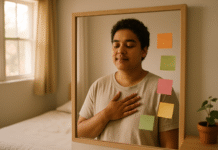
Bring awareness to the lumbar and thoracic spine, shoulder blades, chest, and collarbones. This is where most “day carry” accumulates—posture, typing, driving, social bracing. Track contact points under the shoulder blades and the expansion of the ribs. Include the heart area without forcing any feeling there; you’re noticing motion and tone, not manufacturing emotion. On each exhale, imagine the shoulder blades sliding slightly down and wide; let the chest settle rather than lift.
8.1 Mini-checklist
- Can I feel the shoulder blades’ edges?
- Where does the chest expand first—front, sides, or back ribs?
- Is the upper back holding a subtle “lean forward”?
8.2 Common mistakes
- Shrugging during attention: Notice and let the exhale unhook the trap muscles.
- Chasing big breaths: Over-breathing can cause lightheadedness; keep it natural.
Synthesis: When the back broadens and the chest softens, the whole system registers “off duty,” a prerequisite for deep relaxation.
9. Hands, Arms, Neck: The Action Channels
Arms and hands are “doing” zones; relaxing them signals the end of effort. Start with palms—notice temperature, tingling, and weight. Travel through fingers, palms, wrists, forearms, elbows, biceps/triceps, and into the shoulder heads. Then bring awareness to the neck—front, sides, and back—letting the jaw hang slightly loose. If you detect clenching, place the tongue tip on the ridge behind the front teeth and breathe as if into the throat’s back wall. Keep the micro-movements small; stillness invites depth.
9.1 How to do it
- Palms first: Many find strong sensations here; it’s a reliable anchor.
- Neck cue: Imagine the neck lengthening on exhale, like space between vertebrae.
- Time: 60–90 seconds per major sub-region.
9.2 Pitfalls & fixes
- Fidget feedback loop: If you keep adjusting, notice the urge rather than obeying it for 10 seconds; then adjust once.
- Jaw lock: Insert a soft sigh on exhale (mouth ajar) once or twice, then return to nasal breathing.
Synthesis: Soothing the body’s action channels turns off “doing mode” and makes the next step—head and face—much easier.
10. Face, Scalp, and Whole-Body Integration
Finish with micro-areas: chin, lips, cheeks, nose, eyes/eyelids, brow, temples, ears, and scalp. Faces hold social tension—smiles, frowns, masks of “I’m fine.” Invite the micro-muscles to rest. Then broaden to a whole-body sweep: from crown to toes (or toes to crown) in a single, slow glide of attention, 30–60 seconds per pass, 2–3 passes total. Let pleasantness, neutrality, and discomfort be equally welcome. Close with a gratitude check: name one spot that feels 5–10% softer than when you started.
10.1 Mini-checklist
- Soften eyes behind the eyelids; let them feel heavy.
- Unknit the brow; imagine a warm hand across the forehead.
- Whole-body sweep: 2–3 slow passes, breath synced.
10.2 How to close
- Re-orientation: Deepen breath twice, wiggle fingers and toes, roll to a side if lying.
- Integration: Sit for 30–60 seconds before standing to avoid a head rush.
- Note: Jot one sentence: “Jaw + shoulders softer; feet warm.”
Synthesis: Ending with the face and a whole-body sweep consolidates the session into a felt sense of ease you can carry into the next thing you do.
FAQs
1) What is body scan meditation in one sentence?
It’s a guided practice of moving attention through the body—usually from toes to head—observing sensations exactly as they are, which reduces unconscious bracing and teaches the nervous system to downshift. Over time, you build precision in noticing and the skill of softening without forcing.
2) How long should a body scan take for best results?
Ten minutes is enough to begin, twenty minutes is a common standard, and thirty to forty-five minutes deepen effects found in formal programs. Consistency matters more than any single session; aim for 3–5 practices per week for six to eight weeks, then adjust based on benefits you feel.
3) Should I lie down or sit?
Choose the most sustainable posture for the time you have. Lying down is optimal for deep relaxation and sleep prep, while an upright chair posture builds alertness and transfers well to work breaks. If lying triggers sleep, practice seated and save supine sessions for bedtime rituals.
4) What if I feel pain or strong emotions?
Treat them as signals, not enemies. Label the experience (“sharp,” “tight,” “sad”), widen attention to include breath and contact with the floor, and reduce the intensity by shrinking the area you’re focusing on. If pain spikes or feels unsafe, stop, adjust posture, or seek guidance from a clinician or trauma-informed teacher.
5) Can body scans help with sleep?
Many people find a 10–20 minute scan in bed shortens sleep onset by replacing rumination with sensory attention. Keep the tone gentle, use a soft audio guide, and let yourself drift off—sleep during a bedtime scan is success, not failure. In daytime sessions, sit up if you want to avoid dozing.
6) How is a body scan different from progressive muscle relaxation (PMR)?
PMR alternates intentional tensing and releasing of muscle groups; body scans emphasize noticing and allowing sensations without manipulation. Both reduce arousal, but scans train non-reactive awareness and interoception, which generalize to daily stress and emotion regulation in a distinct way.
7) What should I do if my mind keeps wandering?
Notice “thinking,” label it kindly, and return to the current body region. Expect dozens of re-focus moments—this is not failure; it is the training. If you’re lost repeatedly, choose a strong-sensation anchor (palms, soles) for 30 seconds, then resume the scan with smaller zones.
8) Are apps or audio guides necessary?
Not necessary, but helpful. Quality recordings provide pacing, language, and timing that reduce self-management. Libraries from universities and hospitals offer free, clinically informed guides; commercial apps add structure and reminders. Over time, many people memorize a script and go device-free when convenient.
9) How often should I practice each week?
Three to five sessions per week is a realistic target. Short “micro-scans” (60–120 seconds) sprinkled through the day reinforce the habit—e.g., a quick feet-to-face sweep before meetings, after workouts, or when shifting roles at home.
10) Is it normal to feel nothing in some areas?
Yes. Interoceptive resolution differs across the body and improves with practice. If an area feels blank, note “neutral” and move on; repeated visits, slower pacing, and hand contact (if appropriate) often reveal subtler signals over time.
11) Can I combine the scan with breathing techniques?
Yes, lightly. One or two rounds of extended exhale (e.g., inhale 4, exhale 6) can help you settle. After that, return to natural breathing so the scan remains about sensing, not breath control. If breath-work makes you dizzy, stop controlling and simply observe.
12) Is it safe during pregnancy or with medical conditions?
Generally, yes when adapted—choose comfortable positions, use extra supports, and avoid breath-holding. For high-risk pregnancies, acute pain, trauma history, or complex medical conditions, consult a clinician and consider trauma-sensitive instructions that emphasize choice and titration.
Conclusion
Body scan meditation is a deceptively simple practice that teaches you to listen to your body with precision and kindness. By moving attention step by step—from feet to face—and meeting sensations without judgment, you unwind habitual bracing, reduce reactivity, and cultivate a baseline of ease that follows you into the rest of your day. The 10-step flow in this guide is intentionally practical: it starts with environment and intention, builds through regions in an anatomically sensible order, and closes with integration so the benefits don’t evaporate when the bell rings. Start small with 10 minutes, three to five times a week, and track changes in sleep latency, post-work tension, and mood after eight weeks. Let your practice be process-focused rather than result-obsessed, and the results tend to arrive on their own time.
Ready to begin? Pick a posture, set a kind timer for 10 minutes, and start at your toes. Your body will teach you the rest.
References
- Meditation and Mindfulness: What You Need To Know, National Center for Complementary and Integrative Health (NCCIH), updated 2022, https://www.nccih.nih.gov/health/meditation-and-mindfulness-what-you-need-to-know
- Meditation: A simple, fast way to reduce stress, Mayo Clinic, reviewed 2023, https://www.mayoclinic.org/tests-procedures/meditation/in-depth/meditation/art-20045858
- Meditation Programs for Psychological Stress and Well-being: A Systematic Review and Meta-analysis, JAMA Internal Medicine, 2014, https://doi.org/10.1001/jamainternmed.2013.13018
- Mindfulness meditation may ease anxiety and mental stress, Harvard Health Publishing, 2014, https://www.health.harvard.edu/blog/mindfulness-meditation-may-ease-anxiety-mental-stress-201401086967
- Mindfulness, National Health Service (NHS, UK), reviewed 2022, https://www.nhs.uk/mental-health/self-help/tips-and-support/mindfulness/
- Guided Meditations (including Body Scan), UCLA Mindful Awareness Research Center, accessed 2025, https://www.uclahealth.org/programs/marc/mindful-meditations
- Body Scan Meditation (Practice Guide), Mindful.org, 2018, https://www.mindful.org/body-scan-meditation/
- Full Catastrophe Living (revised edition), Jon Kabat-Zinn, 2013, Penguin Random House, https://www.penguinrandomhouse.com/books/89308/full-catastrophe-living-revised-edition-by-jon-kabat-zinn/