
























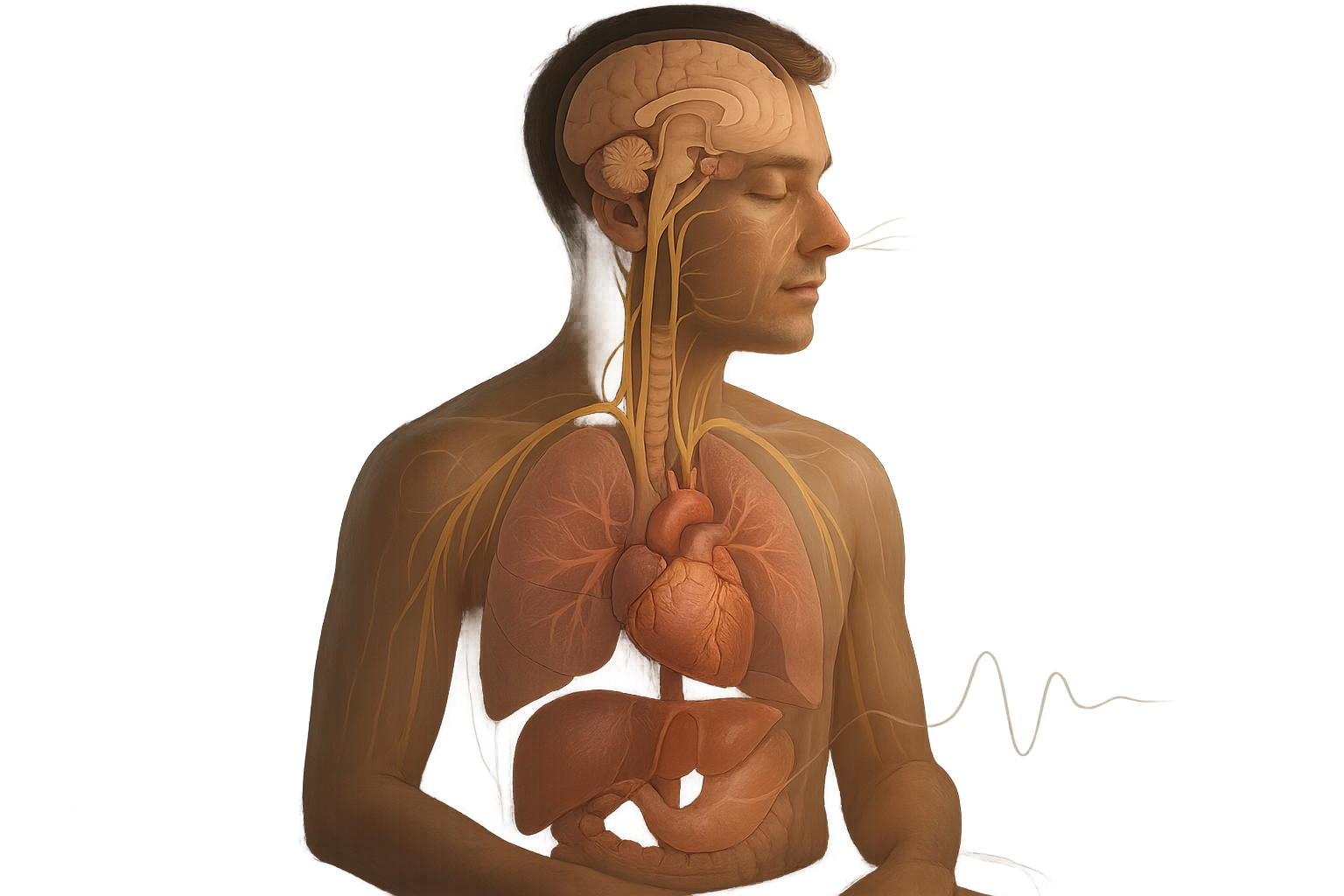
Breathwork uses deliberate changes in rate, depth, and pattern of breathing to influence the nervous system. In simple terms, slower nasal breathing with relaxed, longer exhales tends to tilt the body toward parasympathetic calm, while fast, shallow breathing tends to amplify sympathetic arousal. Practically, that means a handful of well-studied techniques can measurably lower heart rate, increase heart rate variability (HRV), and reduce stress symptoms within minutes.
This guide explains the science behind those shifts—what’s happening in your brain, nerves, and hormones when you change your breath—and how to apply nine evidence-backed mechanisms in daily life. It’s written for curious beginners, coaches, clinicians, and anyone who wants a grounded, practical understanding of breathwork. Safety note: This article is for education, not medical advice. If you have cardiovascular, respiratory, psychiatric, or pregnancy-related conditions, consult a qualified clinician before starting new breathing practices.
Quick definition (for skimmers): Breathwork modulates autonomic and neuroendocrine function by engaging vagal afferents, baroreflex loops, respiratory-coupled brain rhythms, and chemoreflex pathways, with downstream effects on HRV, arousal, and stress hormones.
1. Parasympathetic Up-Shift via the Vagus Nerve
Slow, controlled breathing—especially with slightly longer exhales—activates the parasympathetic branch of the autonomic nervous system through vagal pathways. In practice that looks like a drop in heart rate, a rise in HRV, and a subjective sense of calm within a few minutes. The physiological bridge is respiratory sinus arrhythmia (RSA), the natural beat-to-beat heart rate fluctuation tied to your breath; amplifying RSA is a proxy for stronger vagal tone. Exhale-emphasized patterns, such as “cyclic sighing,” further bias the system toward relaxation and reduced respiratory rate. Across laboratory and field studies, these effects are most robust when people breathe slowly, through the nose, with relaxed belly/diaphragm motion, for at least 5 minutes per session (and ideally daily).
Why it matters
- Vagal activation is linked with better emotion regulation, improved stress recovery, and more stable cardiovascular function.
- Higher HRV is associated with resilience and flexibility under load; while not a diagnostic tool, it’s a helpful training marker.
- Exhale-longer patterns add an extra parasympathetic nudge by prolonging the period of vagal dominance.
Numbers & guardrails
- Aim for 4.5–6.5 breaths/min (roughly 5–7-second inhalations and 5–8-second exhales).
- Keep the exhale ~1–2 seconds longer than the inhale (e.g., in 4–5s, out 6–7s).
- Minimum practice dose for measurable effects: ≥5 minutes/day, though 10–20 minutes builds more reliable change.
Mini-checklist
- Breathe nasally, quietly, and low (belly moves first, shoulders stay soft).
- Let the exhale be unforced; avoid breath strain or breath stacking.
- If lightheaded, slow down and reduce depth; comfort first.
With a few weeks of consistent practice, many people notice calmer baseline arousal and better “on-the-spot” down-shifting under stress.
2. Baroreflex Resonance at ~0.1 Hz (≈6 Breaths/Minute)
One of breathwork’s strongest levers is baroreflex resonance—a cardio-respiratory coupling phenomenon that peaks around 0.1 Hz (about 6 breaths per minute) for many adults. At this rate, oscillations in blood pressure, generated partly by pressure changes from the diaphragm and chest wall, sync up with heart-rate oscillations. The result is a bigger RSA wave, higher HRV amplitude, and enhanced baroreflex sensitivity—the reflex that keeps blood pressure stable beat by beat. This is the core of resonant-frequency breathing and HRV biofeedback protocols used in clinical and performance settings.
2.1 How it works
- Slow breaths create predictable intrathoracic pressure shifts that influence venous return and stroke volume.
- Baroreceptors in the carotid sinus and aortic arch sense these swings and reflexively adjust heart rate via vagal and sympathetic outflow.
- Breathing near your personal resonance synchronizes these loops, maximizing HRV and stabilizing blood pressure variability.
2.2 Finding your frequency (simple version)
- Start at 6 breaths/min (in 5s, out 5s).
- If you feel air hunger or strain, shorten the inhale and lengthen the exhale (e.g., in 4s, out 6s).
- After a week, experiment: try 5.5 and 6.5 breaths/min to see which feels most effortless and yields the calmest, steadiest pulse.
Tips & common mistakes
- Too deep too soon → dizziness or tingling. Keep depth comfortable.
- Mouth breathing → dries airways, reduces nasal nitric oxide (see Mechanism 6).
- Chasing numbers → prioritize ease; resonance is a range, not a single exact point.
Practiced 10–20 minutes most days, resonance breathing reliably raises HRV and can improve autonomic balance in diverse groups—from healthy adults to clinical populations.
3. Chemoreflex Tuning: CO₂, Hyperventilation, and Calm
Your brainstem constantly monitors carbon dioxide (CO₂) and pH via central and peripheral chemoreceptors (notably the carotid bodies). When CO₂ drops too low (from fast, shallow breathing), blood becomes more alkaline (hypocapnia), which can increase nervous system excitability, reduce cerebral blood flow, and amplify anxiety sensations (dizziness, tingling, chest tightness). Conversely, slowing your breath (and, in some practices, brief comfortable breath-holds) can normalize CO₂, easing symptoms and reducing the tendency to over-breathe under stress. In anxiety-sensitive individuals, training to stabilize end-tidal CO₂ has reduced panic symptoms and improved tolerance to interoceptive sensations.
Why it matters
- Hyperventilation is a stress multiplier: The sensations it causes (lightheadedness, paresthesia) are easily misread as danger, escalating panic.
- CO₂ normalization through slow nasal breathing or capnometry-guided training can restore calmer arousal set-points.
- Clinical relevance: Panic-vulnerable individuals show stronger responses to CO₂ challenges; targeted breathing retraining can help.
Practical guardrails
- Use gentle, slow nasal breathing as the first-line antidote to over-breathing.
- If trained and medically appropriate, brief breath holds (e.g., 2–5 seconds after a calm exhale) can reduce the urge to sigh and steady CO₂.
- Avoid extended or forced breath holds if you have cardiovascular, respiratory, or pregnancy-related conditions.
Mini case
A client who “always needed to sigh” during stressful work calls used a 4-in/6-out nasal pattern for 5 minutes before meetings and added a 2-second exhale pause every few breaths. Within two weeks, sigh frequency halved and episodes of lightheadedness resolved—consistent with reduced hypocapnia and calmer interoceptive signaling.
By respecting the chemoreflex—neither chronically flushing CO₂ nor aggressively hoarding it—you help the nervous system read internal signals accurately instead of setting off false alarms.
4. Limbic Entrainment: Nasal Breathing Synchronizes Emotion & Memory Circuits
Breathing isn’t just a gas-exchange pump; in the brain it acts like a metronome. In humans, nasal respiration synchronizes electrical activity in the piriform cortex and limbic areas such as the amygdala and hippocampus, with measurable effects on emotion processing and memory. This respiratory-locked timing matters: tasks tied to emotion recognition and memory encode differently across inhale vs. exhale, and performance can decline during oral (mouth) breathing relative to nasal breathing. Practically, keeping attention with a slow nasal breath can stabilize limbic rhythms and reduce emotional reactivity.
4.1 Why nasal, not mouth?
- Nasal airflow provides rhythmic sensory input to olfactory pathways intimately connected with limbic circuits.
- Mouth breathing bypasses much of this afferent signaling, leading to weaker coupling with limbic oscillations.
4.2 How to apply in moments that matter
- Before a high-stakes conversation, close the mouth, feel cool air at the nostrils, and take four slow nasal cycles (in 4–5s, out 6–7s).
- During emotional surge, lengthen the exhale and soften the eyes—a cue to ride the limbic rhythm rather than fight it.
Quick pitfalls
- Breath holding in conflict can spike sympathetic tone; keep the rhythm smooth.
- Noisy sniffing suggests tension; lighten the touch of inhale.
Nasal-paced awareness recruits the brain’s built-in timing system to align attention, emotion, and memory—an under-appreciated reason breathwork feels like “it changes your headspace.”
5. Arousal Gating: Breathing Circuits Talk to the Locus Coeruleus (LC)
The preBötzinger complex in the brainstem, a key respiratory rhythm generator, projects to the locus coeruleus (LC)—a noradrenergic hub that sets global arousal and vigilance. Experimental work shows specific preBötC neurons promote calm vs. arousal, providing a plausible neural path for why slow, steady breathing settles the mind. More broadly, respiration entrains LC activity and interacts with pupillary dynamics (a window on arousal), suggesting breath rate and phase can modulate alertness in real time. In practice, this means you can steer between focused-calm and sleepy by dialing breath parameters instead of fighting your brain.
5.1 “Dials” for arousal targeting
- Need to calm but stay sharp (meeting, exam): nasal breathing at ~6 bpm with soft but present inhalation; even or slightly longer exhale.
- Need to downshift for sleep: longer exhales, lower tidal volume, and a brief exhale pause; avoid stimulating holds.
- Need to perk up without anxiety: a few controlled “physiological sighs” (two small inhales + one long exhale), then settle at 6 bpm.
5.2 Mini-checklist
- Avoid over-slow breathing that induces air hunger—spikes arousal.
- Watch for brow tension or throat holding—signs of strain.
- If you wear a smartwatch, notice how *pupil size (in mirror) and HR track breath changes; it’s basic arousal biofeedback.
By treating breath as an arousal dial, you leverage direct brainstem-to-LC pathways that signal the rest of the brain to either mobilize or settle—without caffeine or sedation.
6. Nasal Nitric Oxide (NO): A Subtle Neuromodulatory Assist
Your paranasal sinuses produce nitric oxide (NO), a gas with antimicrobial and vaso-modulatory roles. During nasal breathing, especially when humming, NO levels in the nasal cavity increase dramatically—studies report order-of-magnitude rises during humming compared to quiet exhalation. While NO’s primary benefits are airway-level (airflow, antimicrobial defense), nasal NO can support more efficient oxygen exchange and may subtly influence neurovascular coupling. Practically, nasal breathing is the default for calming practices; adding soft humming on the exhale can decongest and reinforce the habit.
How to try it
- Do 3–5 minutes of nasal humming on exhale (“mmm”) at comfortable pitch; keep volume low and throat relaxed.
- If congested, try a few gentle humming cycles before slow breathing to open nasal passages.
Guardrails
- Avoid forceful humming if you have sinus infections, ear issues, or post-surgery status—get medical guidance.
- Don’t overstate NO as a performance shortcut; treat it as a supporting mechanism alongside other levers.
The headline: nasal > mouth for most calming protocols; humming can be a low-effort add-on that supports airflow and comfort.
7. HPA Axis Modulation: Breathing and Cortisol
Stress activates the hypothalamic–pituitary–adrenal (HPA) axis, elevating cortisol and shifting attention and energy toward immediate threats. Several randomized trials and systematic reviews report that diaphragmatic/slow breathing can lower salivary cortisol, improve mood, and reduce perceived stress, especially when delivered in multi-week protocols (e.g., 5–20 minutes daily for 4–8 weeks). The mechanism likely combines parasympathetic up-shift, reduced chemoreflex stress, and top-down interoceptive regulation, rather than a single on/off switch.
Numbers & guardrails
- Expect cortisol changes to be modest but meaningful over weeks (think small-to-moderate effect sizes in meta-analyses).
- Practice near the same time each day (morning or late afternoon) to keep sampling consistent if you track salivary cortisol.
Mini-checklist for consistency
- Pick a repeatable cue (after brushing teeth, during commute, pre-lunch).
- Use a timer for 5–10 minutes; quality > quantity.
- Stack with light movement or sunlight where possible; the nervous system reads context.
Breathing won’t replace trauma therapy or endocrine care, but as a low-risk, teachable tool it can reduce allostatic load and help your HPA axis recover faster from daily stressors.
8. Interoception Training: Insula, ACC, and Emotion Regulation
Directing attention to the breath trains interoception—the brain’s mapping of internal sensations—centered on the anterior insula and anterior cingulate cortex (ACC). Imaging studies show that breath-focused practice strengthens activity and connectivity in these networks, which correlates with better emotion regulation and less reactivity to bodily stress signals. In other words, you’re not just changing the breath; you’re refining the brain’s prediction and interpretation of the breath, reducing the gap between sensation and story.
8.1 How to practice “clean interoception”
- Sit comfortably, mouth closed, and notice the first touch of air at the nostrils and the last trace as it leaves.
- Label with one silent word (“in,” “out”) to anchor attention; if mind wanders, return gently without correction.
- Keep sessions short but frequent (5–10 minutes), then apply during real-life stressors.
8.2 Common mistakes
- Chasing bliss: interoception is about clarity, not constant comfort.
- Over-control: if attention sharpens into strain, return to a soft, natural rhythm for a few minutes.
- Ignoring context: caffeine, poor sleep, and illness all change interoceptive signals; adjust expectations.
As interoceptive maps improve, people often report that early signs of stress become actionable signals instead of alarms—a fundamental nervous-system upgrade.
9. Practice Parameters That Make the Nervous System Change
Across studies, what you do and how you do it determine outcomes as much as the technique label. Interventions that work best typically share four traits: slow pace (not fast-only), sessions ≥5 minutes, multiple sessions over weeks, and some human guidance or structured feedback early on. Short, sporadic, or purely fast-paced routines under-deliver, whereas brief daily practice can reduce respiratory rate, improve HRV, and lift mood in as little as 1–4 weeks.
9.1 Practical template (evidence-informed)
- Daily: 5–10 minutes at ~6 breaths/min, nasal, with longer exhale.
- 2–3×/day micro-doses: 3–5 physiological sighs or 60–120 seconds of 4-in/6-out before stress peaks (meetings, commute, bedtime).
- Weekly: one longer session (15–20 minutes) to deepen familiarity.
- Optional tools: HRV apps/sensors for pacing and biofeedback; capnometry if over-breathing is a pattern.
9.2 Troubleshooting
- Dizziness/tingling: slow down, reduce depth, or take a minute of natural breathing.
- Sleepiness during daytime sessions: shorten exhale slightly or add a gentle 3-second inhale hold to maintain alert calm.
- Can’t nasal-breathe: address congestion with humidification, saline, or medical care; for now, breathe quietly through pursed lips.
9.3 Region-specific notes
- In hot, dusty, or high-pollution environments, indoor practice or filtration reduces airway irritation that can trigger mouth breathing.
- At altitude, expect higher baseline respiratory drive; keep sessions shorter and gentler until acclimatized.
Consistency is the true intervention. With a simple, repeatable structure, the nervous system learns a new default: calm, clear, responsive.
FAQs
1) What’s the fastest breath technique to calm down?
A reliable rapid option is the physiological sigh: take one normal nasal inhale, add a second shorter sip of air on top, then a long, relaxed exhale through the nose (or pursed lips). Repeat 2–5 times. This quickly drops respiratory rate and often reduces tension in under a minute. After that, settle into 4–6 minutes of slow nasal breathing to consolidate the effect.
2) Is 6 breaths per minute right for everyone?
No—0.1 Hz (~6 bpm) is a population average. Your personal resonance might be slightly higher or lower. If 6 bpm feels strained, adjust to 5.5–6.5 bpm and aim for comfort. The goal is smoothness and ease, not a rigid target, because comfort allows the baroreflex and vagal effects to emerge.
3) Does mouth breathing really matter for the brain?
For calm-oriented practices, yes. Nasal breathing sends rhythmic input through olfactory pathways that entrain limbic circuits and support attention/emotion regulation. Mouth breathing can bypass this coupling and may reduce certain benefits. If congestion forces mouth breathing, use pursed lips and work on regaining nasal patency.
4) How long until I notice changes?
Many people feel acute calm within a single 5-minute session. For more stable changes in resting HRV or perceived stress, plan on 2–4 weeks of near-daily practice. Think of it like training a reflex: repetition matters more than marathon sessions.
5) Can breathwork lower blood pressure?
Slow/resonant breathing can improve baroreflex function and reduce sympathetic load, which may help blood pressure in some individuals. But results vary, and breathwork is not a substitute for medical treatment. If you have hypertension, coordinate with your clinician and monitor responses carefully.
6) Is there any risk to breath holds?
Brief, comfortable holds can be useful when guided, but extended or forced holds can trigger dizziness, blood-pressure spikes, or anxiety—especially in cardiovascular, respiratory, or pregnancy contexts. When in doubt, skip holds and prioritize smooth, slow exhalation.
7) Will HRV always go up with slow breathing?
Often, but not always. HRV is influenced by sleep, illness, caffeine, menstrual phase, and training load. Use HRV as one signal. If your HRV doesn’t jump, judge success by subjective calm, resting respiratory rate, and daytime steadiness.
8) Which is better: meditation or breathwork?
They overlap. For immediate state change, exhale-emphasized breathing (e.g., cyclic sighing) often outperforms quiet mindfulness. For trait change (attention, emotion regulation), combining breath pacing with breath-focused attention is a strong, complementary approach.
9) Do wearables help?
They can. A simple respiratory pacer and HRV feedback help you find smooth rhythms and see progress. But don’t chase graphs. The nervous system learns through felt experience—ease, calm, and control under real-world stress.
10) Can breathwork help panic?
It can assist when part of a broader plan. Over-breathing worsens panic by dropping CO₂; training slow nasal breathing and, in some protocols, capnometry-guided retraining can reduce symptoms. For recurrent panic, work with a clinician or therapist; breathwork is helpful but not a standalone cure.
11) What’s an easy daily routine to start?
Morning: 5 minutes of in 4–5s, out 6–7s, nasal. Midday: 60–120 seconds before a known stressor. Evening: 5–10 minutes of the same pattern or physiological sighs followed by slow breathing to ease into sleep. Keep it simple and repeatable.
12) Does humming have nervous-system benefits beyond decongestion?
Humming boosts nasal NO and can make nasal breathing more comfortable. While NO’s direct CNS effects from nasal sources are modest, better nasal airflow supports the other mechanisms—limbic entrainment, baroreflex coupling, and vagal activation—that drive nervous-system change.
Conclusion
Breathwork works because it engages multiple, redundant control systems: vagal afferents that slow the heart and increase HRV; baroreflex loops that stabilize blood pressure; chemoreflex tuning that prevents CO₂-driven anxiety spirals; brain rhythms in limbic and arousal hubs that set the tone for emotion and attention; and neuroendocrine pathways that temper cortisol. The science doesn’t reduce to one magical mechanism; it’s a network effect—and that’s good news. It means you have several dials to turn, and small, consistent adjustments add up.
If you remember one template, make it this: breathe nasally, slowly (~6/min), with a slightly longer exhale, for 5–10 minutes most days, and sprinkle micro-doses before predictable stress. Layer in interoceptive attention to sharpen the brain’s maps. Track what matters to you—calm, sleep quality, readiness—rather than obsessing over a single metric. The payoff is a nervous system that’s quieter when you want calm and sharper when you need focus.
Try it today: two physiological sighs, then four minutes of 4-in/6-out nasal breathing. Notice the shift.
References
- Heart rate variability biofeedback: how and why does it work? Frontiers in Psychology, 2014. https://www.frontiersin.org/articles/10.3389/fpsyg.2014.00756/full
- The physiological effects of slow breathing in the healthy human. Breathe (European Respiratory Society), 2017. https://www.ncbi.nlm.nih.gov/pmc/articles/PMC5709795/
- A Practical Guide to Resonance Frequency Assessment for Heart Rate Variability Biofeedback. Frontiers in Neuroscience, 2020. https://www.frontiersin.org/articles/10.3389/fnins.2020.570400/full
- Brief structured respiration practices enhance mood and physiology compared with mindfulness meditation. Cell Reports Medicine, 2023. https://www.cell.com/cell-reports-medicine/pdf/S2666-3791(22)00474-8.pdf
- Nasal respiration entrains human limbic oscillations and modulates cognitive function. Journal of Neuroscience, 2016. https://www.jneurosci.org/content/36/49/12448
- Breathing control center neurons that promote arousal in mice. Science, 2017. https://www.science.org/doi/10.1126/science.aai7984
- Humming greatly increases nasal nitric oxide. American Journal of Respiratory and Critical Care Medicine, 2002. https://pubmed.ncbi.nlm.nih.gov/12119224/
- Assessment of nasal and sinus nitric oxide output using single-breath humming. Clinical Physiology and Functional Imaging, 2003. https://pubmed.ncbi.nlm.nih.gov/12952268/
- Carotid body chemoreceptors: physiology, pathology, and therapeutic potential. Physiological Reviews, 2021. https://journals.physiology.org/doi/10.1152/physrev.00039.2019
- The Effect of Diaphragmatic Breathing on Attention, Negative Affect and Stress in Healthy Adults. Frontiers in Psychology, 2017. https://www.frontiersin.org/articles/10.3389/fpsyg.2017.00874/full
- Breathing Practices for Stress and Anxiety Reduction: A Systematic Review. Nutrients, 2023. https://www.ncbi.nlm.nih.gov/pmc/articles/PMC10741869/
- How Breath-Control Can Change Your Life: A Systematic Review on Psycho-Physiological Correlates of Slow Breathing. Frontiers in Human Neuroscience, 2018. https://www.frontiersin.org/articles/10.3389/fnhum.2018.00353/full