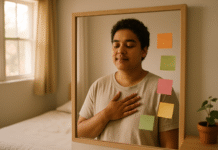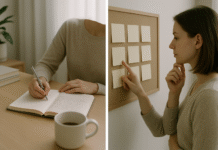

























Bullet journaling for mindfulness is the practice of using the Bullet Journal method to capture tasks, notes, and reflections in a way that calms the mind and deepens self-awareness. In simple terms, it’s a paper-based system that reduces mental clutter (by offloading it) and turns everyday planning into a regular reflection ritual. This guide is for anyone who wants less stress, more clarity, and a simple framework to notice what matters—without elaborate art or complex spreads. Brief note: nothing here is medical advice; if journaling brings up distress or clinical concerns, please speak with a qualified professional.
Quick start (skim-friendly): 1) Set up an Index, Future Log, Monthly Log, and Daily Log. 2) Keep entries short: tasks (•), notes (–), events (○). 3) Add a nightly 3–5 minute reflection line. 4) Track 2–5 habits and your mood trend, not every feeling. 5) End each week with a 10–15 minute review and migrate only what deserves your time.
1. Set Up the Core: Index, Future/Monthly/Daily Logs for Clarity
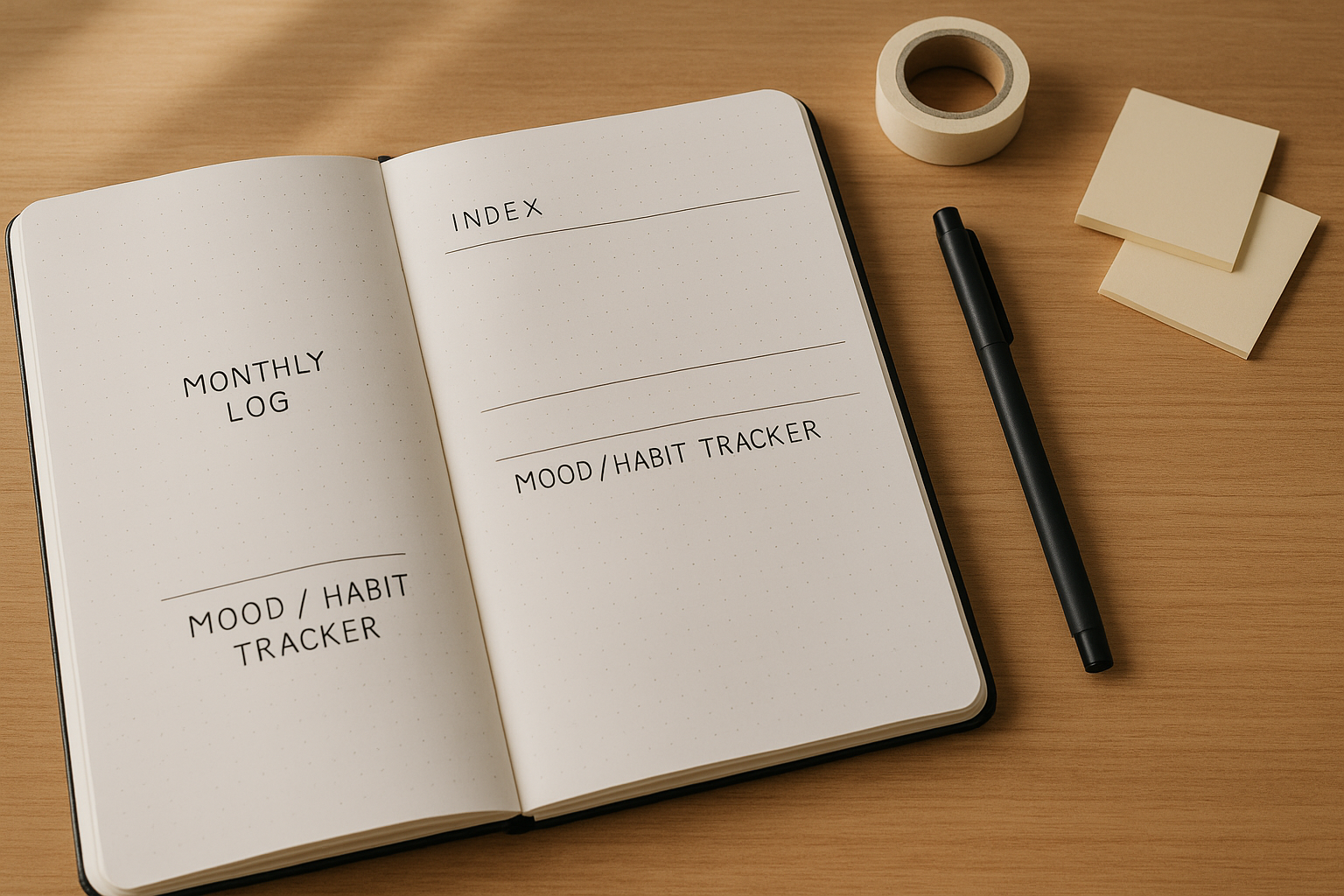
Start with the standard Bullet Journal “skeleton” because it’s the simplest way to organize life and make reflection automatic. The immediate goal is to empty your head—tasks, worries, ideas—into a consistent structure so you can focus on the present instead of spinning mental plates. Create an Index to find things later, a Future Log to park not-now items, a Monthly Log to see the month at a glance, and a Daily Log to capture the day as it unfolds. This setup lowers cognitive load and creates natural checkpoints for mindful review. Once the bones are in place, you can add reflection cues without clutter, which is precisely what keeps the system sustainable.
1.1 Why it matters
- Offloading details to paper frees working memory for thinking instead of remembering; this can improve focus and ease rumination, which supports mindful attention (see “cognitive offloading” in References).
- A consistent Index and logs keep information retrievable, so you don’t chase scraps of paper or apps.
- Structured pages reduce decision fatigue; you always know where the next thought goes.
1.2 How to do it
- Index: Reserve the first 2–4 pages. Log new collections and noteworthy logs with page numbers.
- Future Log: 2–4 pages divided by months/quarters; place long-horizon dates and anchors.
- Monthly Log: One page list of dates + events; facing page lists goals/intentions.
- Daily Log: Each day gets tasks (•), events (○), and notes (–). Keep entries short.
Region note: If dot-grid is hard to find locally (e.g., in parts of South Asia), squared or lined A5 (148×210 mm) works fine; leave 10–12 mm margins for neat indexing. Synthesis: The classic structure turns paper into a calm “external brain,” giving you a stable place to organize and reflect every single day.
2. Make the Daily Log Mindful: Capture, Then Add a One-Line Reflection
Use the Daily Log to capture what’s happening and finish with a 1–2 sentence evening reflection. This approach answers two needs: staying on top of the day and noticing how it felt. By separating lists (doing) from reflection (being), you prevent the task engine from crowding out self-awareness. The first line is logistics; the last line is meaning. Over time, those small notes become a high-signal archive of patterns—energy, triggers, helpful routines—that you’d otherwise forget. It’s a light-weight ritual that takes 3–5 minutes, making it sustainable even on chaotic days.
2.1 Mini-checklist
- Morning: write top 1–3 priorities.
- During day: capture tasks, events, quick notes only.
- Night: add a single line—“What mattered? What I felt? One lesson.”
2.2 Numbers & guardrails
- Keep the reflection to 30–60 words to avoid perfectionism.
- If you miss a day, write “Skipped; I’m still in” and move on—no backlog guilt.
Mini case: After three weeks, you’ll see repeating “good days” patterns (e.g., 10-minute stretch + early lunch), which you can lock in as tiny routines. Synthesis: The one-line reflection stitches meaning into the mechanics, turning a planner into a mindfulness practice.
3. Use AM/PM Prompts to Train Attention (Not Just Productivity)
AM/PM prompts transform the journal from a to-do bin into an attention trainer. In the morning, you orient; at night, you debrief. The prompts should be short, repeatable, and pointed at awareness, not self-critique. Morning questions prime focus and values; evening questions help you process the day and reduce mental residue before sleep. The repetition is deliberate: attention is like a muscle—brief, consistent reps beat occasional heavy lifts.
3.1 Prompts that work
- AM (2–3 mins): What matters today? What could derail me? What one boundary protects my focus?
- PM (3–5 mins): What did I notice? What helped/hurt my mood? What will I not carry into tomorrow?
3.2 Tools/Examples
- Add a small AM/PM box to your Daily Log.
- If you pray or meditate, pair prompts with that practice for “habit stacking.”
Mini case: Many readers find PM prompts lower pre-sleep rumination; writing what to carry forward (or drop) eases letting go. Synthesis: Prompts keep your system human—anchored in awareness instead of just output.
4. Track Mood & Energy as Trends, Not Diagnostics
Mood/energy tracking is for pattern-spotting, not self-diagnosis. The aim is to notice correlations—sleep, caffeine, social time, screen load—so you can make small course corrections. A simple 1–5 scale beside your Daily Log (or a tiny monthly heatmap) is enough. Over weeks, you’ll see real patterns emerge: “3 p.m. slumps after heavy switching,” “better mornings after short walks,” “social dinners lift mood for two days.” This is reflection in action: notice, test, adjust.
4.1 How to do it
- Add a 1–5 Mood and Energy dot to each day.
- At month’s end, circle two drivers (e.g., bedtime before 11 p.m., 20-minute walk).
- Write a one-line hypothesis to test next month.
4.2 Common mistakes
- Over-tracking (15 variables daily) creates friction; track 2–4 drivers max.
- Treating the numbers as verdicts; they’re clues, not grades.
Region note: If you prefer bilingual notes (e.g., English + Urdu), keep numeric scales universal and write drivers in whichever language flows fastest. Synthesis: Trends reveal levers you can actually pull; you learn to adjust life, not judge yourself.
5. Build a Small Habit Tracker to Support Mindful Behaviors
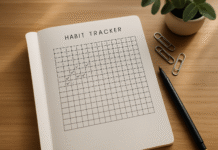
A habit tracker is a visual “receipt” for the behaviors that support calm and clarity—breathwork, movement, screen cut-off, journaling itself. The point isn’t a perfect streak but feedback: “Did I do the things that help my mind today?” Track 2–5 habits, tops. That range is big enough to matter and small enough to maintain. Tie each habit to a cue (after tea, before shower, after prayers), so it becomes automatic over time.
5.1 Numbers & guardrails
- Start with 2–3 habits for 4–6 weeks; add more only if friction stays low.
- A “done-ish” mark (e.g., half box) counts for partial wins to keep momentum.
- Expect ~2 months to feel automatic on average; your mileage will vary.
5.2 Mini-checklist
- Pick habits that are causes of better days (e.g., 10-minute walk) rather than outcomes (“feel calm”).
- Pair habits with if–then cues: “If it’s 10 p.m., then devices go on Do Not Disturb.”
Synthesis: The tracker turns vague intentions into visible behavior, making it easier to keep what helps and drop what drains.
6. Add a Gratitude/Wins Spread to Counter Negativity Bias
Gratitude and “wins” journaling tilts attention toward what’s working, which can buffer stress and support mood. The objective isn’t forced positivity; it’s accurate attention. A weekly spread with three small lines—people, moments, progress—keeps the practice light but consistent. Many people find that gratitude pages become the most re-read section of their journals because they anchor hope and perspective during rough patches.
6.1 How to do it
- Create a Weekly Gratitude & Wins page: three lines per day.
- Be specific (“Bus driver waited 10 seconds,” “Finished 20-minute walk despite rain”).
- End the week with one sentence: “What I want more of next week…”
6.2 Common pitfalls
- Repeating the same generic phrase (“family, health”) without detail; specificity trains attention.
- Skipping weeks after a bad one; that’s actually when this spread helps most.
Mini case: After a month, people often notice more micro-moments during the day because they’re primed to spot them. Synthesis: This spread is a small lever with outsized benefits—more grounded, less reactive days.
7. Do Weekly and Monthly Reviews: Migrate with Intention
Reviews are where mindfulness meets organization. Once a week (10–15 minutes) and once a month (20–30 minutes), scan your logs and migrate tasks that still matter. Strike tasks that no longer deserve time. Write a brief “What I learned” note—two sentences is fine. This is the heart of the Bullet Journal method: you choose, consciously, what earns your attention next. It’s as much about letting go as it is about planning.
7.1 Mini-checklist
- Weekly: What moved the needle? What got in the way? What one change will I try?
- Monthly: What patterns did I see (mood, energy, time sinks)? What do I stop/keep/start?
7.2 Tools/Examples
- Use migration symbols (›) to move tasks forward and (x) to cancel.
- Add a tiny “Not doing” list; it’s liberating and clarifying.
Synthesis: Migration is mindfulness on paper—you notice, decide, and design the next cycle with intention.
8. Prioritize Gently: 1–3 Daily Focus Items + Triage the Rest
Mindful prioritization is choosing a few things you’ll do with full presence and parking the rest where they belong. Each morning, pick 1–3 focus items and mark them with a star. Everything else is secondary or scheduled for later. If a focus item can’t be finished today, define the next visible action to keep momentum. This keeps your day humane and reduces the pressure that fuels avoidance and self-criticism.
8.1 How to do it
- Star 1–3 items; block time where possible.
- For big tasks, write the next 5–15 minute step (call, outline, file, send).
- Triage non-urgent tasks into the Future Log or a weekly “parking lot” collection.
8.2 Common mistakes
- Flooding the day with 10 “priorities” (that’s just a list).
- Forgetting to block time; priorities without time rarely happen.
Mini case: People who move to 1–3 priorities often report fewer half-finished tasks and calmer evenings. Synthesis: A kind, small-number prioritization system is deceptively powerful—it protects attention and preserves energy.
9. Create Mindful Collections: Themes That Help You Think
Collections are themed pages that let you think on paper about a topic—without confusion or clutter. Use them for sleep experiments, triggers and coping plans, therapy homework, book notes, workout progress, or “ideas I’m not acting on yet.” Collections keep related thoughts together, so you can see connections and progress. They’re perfect for mindful work because they encourage curiosity and iteration rather than judgment.
9.1 Tools/Examples
- Trigger → Response playbook: columns for situations, body cues, responses that help.
- Learning log: problem → experiment → result → next tweak.
- Someday/Maybe: ideas you value but won’t pursue this month.
9.2 Mini-checklist
- Title each collection and index it.
- Add a “Next tiny step” line to avoid vague intentions.
- Review monthly: keep, combine, or retire.
Synthesis: Collections are thinking habitats; they tame complexity and foster compassionate problem-solving.
10. Use a Bedtime “To-Do Dump” to Ease Sleep Onset
A short, future-focused to-do list at night helps many people fall asleep faster by clearing mental residue. The mechanism is simple: you write what needs doing tomorrow or soon, and your brain stops rehearsing it in bed. Keep it to 3–5 minutes and aim for specificity (“email Mariam with 2 questions”), not vague categories. Pair it with your PM prompt and you’ll close loops emotionally and practically.
10.1 How to do it
- Set a device-off time (e.g., 45–60 minutes before bed).
- Write tomorrow’s top 3 tasks and any “open loops” in 3–5 minutes.
- Park everything in your Daily Log or a “Tomorrow” box.
10.2 Numbers & guardrails
- Specific tasks work better than general musings.
- If you wake up worried, jot it on a bedside index card and return to bed.
Synthesis: A tiny, future-focused dump is a low-cost way to reduce bedtime rumination and protect restorative sleep.
11. Blend Analog and Digital Wisely (Capture, Then Archive)
You don’t have to choose between paper and apps; use each for what it does best. Paper excels at focus, reflection, and flexible thinking. Digital shines for backups, reminders, and search. The mindful approach: capture and think on paper, then archive key outcomes digitally (photos/scans, brief summaries). For time-specific commitments, set a calendar reminder and note the page number in the event. This hybrid keeps your analog practice peaceful and your logistics reliable.
11.1 Tools/Examples
- Scan pages monthly (phone camera is fine); tag “health,” “work,” “learning.”
- Use your calendar for date/time commitments; include “BuJo p. 86” in the event notes.
- Keep a minimal note app for reference clips; index the collection in your journal.
11.2 Common mistakes
- Duplicating everything both places (double work).
- Letting the archive backlog pile up; schedule a 15-minute first-of-month sweep.
Synthesis: Analog for attention, digital for logistics—a mindful division of labor that scales without chaos.
12. Make It Stick: Design Cues, Lower Friction, Celebrate Small
Consistency beats intensity. To make your mindful journal a stable habit, lower friction (pen lives with journal, simple spreads), anchor it to existing routines (after breakfast/isha), and celebrate small wins (a checkmark, not a parade). Keep the bar low on busy days: one line is a kept promise, and that matters for identity. Over a few months, the practice shifts from “something you do” to “part of how you move through life.”
12.1 Numbers & guardrails
- Keep sessions short: AM 2–3 mins, PM 3–5 mins most days.
- Expect variability; on average, new habits take weeks to months to feel automatic.
- Missed days happen; avoid “catch-up marathons.” Resume today.
12.2 Mini-checklist
- Place the journal where you’ll see it (kitchen table, nightstand).
- Use one pen you enjoy; aesthetics help consistency.
- Review monthly and remove any spread you’re not actually using.
Synthesis: A kind, friction-light design keeps the practice alive—and a living practice is what delivers calm, focus, and honest reflection.
FAQs
1) What exactly is “bullet journaling for mindfulness”?
It’s the Bullet Journal method used deliberately to reduce mental clutter and cultivate awareness. You capture tasks and notes in a clear structure (Index, Future/Monthly/Daily Logs) and weave in short reflection rituals (AM/PM prompts, weekly reviews). The result is a system that helps you notice patterns, make kinder decisions, and act with intention—without turning your day into admin.
2) I’m not artistic—will this still work?
Yes. The mindful approach is deliberately minimalist: short bullets, plain pages, and tiny prompts. Decoration is optional. The key outcomes—less rumination, clearer priorities, better sleep hygiene—come from the structure and consistency, not from elaborate spreads. Keep things simple so the journal serves you, not the other way around.
3) Paper vs. apps: which is better for mindfulness?
Paper is distraction-free and flexible for reflective thinking; apps win at alarms, search, and backups. The best approach is hybrid: think and capture on paper, archive and remind digitally. Research on handwriting vs. typing for learning is mixed; some studies suggest longhand can aid conceptual retention, while replications find smaller or no advantages. Treat paper as a focus tool and use digital for logistics.
4) How long should daily journaling take?
Most people do well with 2–3 minutes in the morning and 3–5 minutes at night. Add a 10–15 minute weekly review and a 20–30 minute monthly review. Longer sessions can be lovely, but the habit sticks when it’s small, frequent, and easy to do even on tough days.
5) What should I track in a habit tracker?
Choose 2–5 habits that predict better days (e.g., 10-minute walk, device cut-off, breathwork, journaling). Track for 4–6 weeks, then adjust. The goal is feedback, not perfection. If a box stays empty for two weeks, ask whether the habit still matters or if the cue needs changing.
6) Can bullet journaling help with anxiety or poor sleep?
It isn’t a treatment, but many people find that offloading tasks and using a short bedtime to-do list lowers rumination and helps them fall asleep faster. A weekly reflection and small gratitude practice can also buffer stress. If anxiety or sleep problems persist or worsen, consult a qualified clinician.
7) How do I avoid perfectionism and blank-page paralysis?
Impose kind constraints: one pen, simple bullets, a daily one-line reflection. Give yourself permission to be messy; content beats aesthetics. If you skip a day, write “Skipped; I’m still in” and move on. You’re building a practice, not an art portfolio.
8) Which notebook and pen should I buy?
Any A5 notebook (dot, grid, or lined) and a smooth pen will do. If dot-grid is scarce in your region, a squared A5 works equally well. Prioritize paper that doesn’t bleed with your favorite pen and pages that lie flat. You can always upgrade later; starting is more important than gear.
9) How do I use collections without creating clutter?
Give each collection a clear purpose and a next step, index it, and review monthly. Retire pages that aren’t helping. Common helpful collections include sleep experiments, triggers→responses, book notes, and a someday/maybe list. Collections are there to help you think—keep them lightweight.
10) What if I miss a whole week?
Resume with today’s date. Don’t fill gaps unless a detail truly matters. Write one line about the last week (“Busy with exams; energy low, evening walks helped”) and keep going. Protecting momentum matters more than backfilling history.
11) How many priorities should I set each day?
Pick 1–3 and star them. Block time where possible and define the next physical action for each. Everything else can wait, be scheduled, or live in the Future Log. Fewer, clearer priorities make presence possible.
12) Can I combine this with meditation or therapy homework?
Absolutely. Pair your AM/PM prompts with meditation, breathwork, or prayer, and keep a therapy homework collection with experiments and notes. The journal becomes the glue between sessions and everyday life.
Conclusion
Mindful bullet journaling works because it’s kinder to your brain and honest about your bandwidth. The simple structure—Index, Future/Monthly/Daily Logs—keeps life organized, while micro-rituals (AM/PM prompts, one-line reflections, weekly reviews) strengthen attention and reduce rumination. You’re not trying to write perfect pages; you’re creating reliable moments of noticing and choosing. Over weeks, you’ll see patterns you can act on: which small habits move the needle, which boundaries protect focus, which evenings set up better mornings. Keep it friction-light, protect the practice with tiny time boxes, and let the pages be a place where logistics and meaning meet.
Start tonight: write tomorrow’s top three, a one-line intention, and one thing you’re grateful for. Keep it simple, keep it kind, keep it going.
References
- What is the Bullet Journal Method? Bullet Journal® (FAQ), Dec 14, 2023. https://bulletjournal.com/blogs/faq/what-is-the-bullet-journal-method
- The Bullet Journal Method. Penguin Random House (Book page), Oct 23, 2018. https://www.penguinrandomhouse.com/books/562034/the-bullet-journal-method-by-ryder-carroll/
- Cognitive Offloading. Risko, E.F., & Gilbert, S.J., Trends in Cognitive Sciences, Sep 2016. https://pubmed.ncbi.nlm.nih.gov/27542527/
- Consequences of Cognitive Offloading: Boosting Performance but Sometimes at a Cost. Risko & colleagues, Psychonomic Bulletin & Review, 2021. https://pmc.ncbi.nlm.nih.gov/articles/PMC8358584/
- The Effects of Bedtime Writing on Difficulty Falling Asleep. Scullin, M.K., & Bliwise, D.L., Journal of Experimental Psychology: General, 2018 (PubMed summary). https://pubmed.ncbi.nlm.nih.gov/29058942/
- Expressive Writing in Psychological Science. Pennebaker, J.W., Perspectives on Psychological Science, 2018. https://cssh.northeastern.edu/pandemic-teaching-initiative/wp-content/uploads/sites/43/2020/10/Pennebaker-Expressive-Writing-in-Psychological-Science.pdf
- Counting Blessings Versus Burdens: An Experimental Investigation of Gratitude and Subjective Well-Being. Emmons, R.A., & McCullough, M.E., Journal of Personality and Social Psychology, Feb 2003. https://pubmed.ncbi.nlm.nih.gov/12585811/
- The Pen Is Mightier Than the Keyboard: Advantages of Longhand Over Laptop Note Taking. Mueller, P.A., & Oppenheimer, D.M., Psychological Science, Jun 2014 (PubMed). https://pubmed.ncbi.nlm.nih.gov/24760141/
- How Much Mightier Is the Pen than the Keyboard for Note-Taking? Replication and Extension. Morehead, K. et al., Educational Psychology Review, 2019. https://link.springer.com/article/10.1007/s10648-019-09468-2
- How long does it take to form a habit? University College London News (summary of Lally et al.), Aug 4, 2009. https://www.ucl.ac.uk/news/2009/aug/how-long-does-it-take-form-habit
- The Effectiveness of Mindfulness-Based Stress Reduction (MBSR) for Health Care Professionals: A Systematic Review. Kriakous, S.A. et al., International Journal of Mental Health and Addiction, 2020. https://pmc.ncbi.nlm.nih.gov/articles/PMC7511255/
- Self-Monitoring in Weight Loss: A Systematic Review of the Literature. Burke, L.E., Wang, J., & Sevick, M.A., Journal of the American Dietetic Association, Jan 2011 (PubMed). https://pubmed.ncbi.nlm.nih.gov/21185970/