


























The fastest way to choose the right mattress and pillow is to match firmness and pillow loft to your sleep position and body weight, then verify temperature, motion isolation, and size before you commit to a trial. This guide breaks those decisions into 11 clear rules, so you can buy once, sleep well, and wake up pain-free.
In short: define your profile, target supportive “medium-firm” unless you need something different, set pillow height for a neutral neck, choose materials for feel and cooling, and protect yourself with generous trials and warranties. If you only remember one thing, it’s this—your spine should feel straight in your usual position, and your pillow should fill the gap between neck and mattress without bending your head up or down.
Quick steps: profile your sleep → pick firmness & loft → choose materials → check cooling & motion → confirm size/base → verify certifications → lock trial & warranty.
1. Profile your sleep: position, body weight, and pain points
Start by deciding as if you were fitting athletic shoes: your sleep position (side, back, stomach, or combination), your body weight, and any pain or medical flags determine the right firmness range and pillow loft. Side sleepers often need more pressure relief at shoulders and hips, while stomach sleepers need a flatter surface that stops hips sinking. Back sleepers generally land in the middle, balancing lumbar support and gentle cradling. Weight matters because heavier bodies compress materials more and typically need a firmer, more supportive core. Finally, list pain points—persistent neck tension, low-back ache, hot sleeping, or a partner who tosses—because each one maps to a specific feature, from cooler fabrics to better motion isolation. Getting this profile right filters out 80% of the wrong options before you ever visit a store or cart page.
- Typical firmness guardrails (1–10 scale):
- Side sleepers: ~4–6 if <90 kg (200 lb); ~6–7 if ≥90 kg
- Back sleepers: ~5–7
- Stomach sleepers: ~6–8
- Pillow loft starting points:
- Side: medium-high (10–13 cm / 4–5 in)
- Back: medium (8–10 cm / 3–4 in)
- Stomach: low (6–8 cm / 2.5–3 in)
- Red flags to note: chronic neck or back pain, snoring/sleep apnea (ask a clinician), broad shoulders (often need higher loft), and very soft or very firm bed bases.
1.1 Why it matters
Firmness and loft are not about preference alone; they control alignment—keeping your head, neck, and spine neutral reduces tissue strain and helps you fall asleep faster. Published buying guides and sleep-testing labs map these associations by position and weight, which is exactly what you’re using here.
Bottom line: profile first, and let your position/weight decide your firmness and pillow short list. This prevents “showroom feel” from leading you astray.
2. Default to medium-firm support unless you have a strong reason not to
If you’re unsure, “medium-firm” is the most evidence-backed starting point for general comfort and spinal support in adults. In a randomized clinical trial of people with chronic low-back pain, participants assigned to medium-firm mattresses reported less pain in bed and on rising, with better disability scores at 90 days than those on very firm beds. While no single firmness suits everyone, medium-firm typically balances pressure relief (so your shoulders/hips aren’t sore) with enough resistance to keep the spine neutral. It also tends to age more gracefully because there’s enough density/support to resist early sagging without feeling like a board.
- How to sense “medium-firm” in store: when lying on your side, your shoulder should sink enough that your neck stays straight; on your back, a hand should slide with mild resistance under your lower back.
- Numbers & guardrails: foams between ~3–5 lb/ft³ (48–80 kg/m³) and coil counts in the 800–1,200 (queen, full-body) range are typical in quality medium-firm builds.
- Mini-case: if you’re a 75 kg back sleeper with occasional morning stiffness, a medium-firm hybrid often resolves both support and pressure complaints in one change.
2.1 Common mistakes
Equating “hard” with “healthy,” or assuming “soft” means poor support. Support is about keeping shape under load, not just feel.
Bottom line: if you don’t know where to start, start at medium-firm, then fine-tune based on your position and pain feedback.
3. Set pillow loft and shape for a neutral neck (not too high, not too low)
Your pillow’s job is to fill the space between your head/neck and the mattress so your nose points straight ahead without a tilt. Too high and your neck bends laterally; too low and it collapses, stressing joints and soft tissue. Research links appropriate pillow height to lower cervical muscle activity and improved comfort, with systematic reviews suggesting that height and contour influence neck pain, waking symptoms, and spinal alignment. For side sleepers, loft must match shoulder breadth and mattress sink—broad shoulders or softer mattresses need higher loft to keep the head level. Back sleepers should aim for a modest loft that maintains the cervical curve without pushing the head forward. Stomach sleeping often benefits from the thinnest pillow—or none—plus a small pillow under the pelvis to reduce lumbar arching.
- Quick fit test: lie in your usual position; have someone snap a side photo. Your forehead, nose, chin should line up roughly horizontal; your ear centered over the shoulder.
- Shapes & fills: contour memory-foam pillows cradle the neck; latex or fiber pillows bounce back and sleep cooler; adjustable shredded foam lets you dial loft by adding/removing fill.
- Numeric example: a side sleeper with a 14 cm shoulder-to-neck gap on a medium mattress often lands on a 11–12 cm loft pillow after sink-in is accounted for.
3.1 Mini-checklist
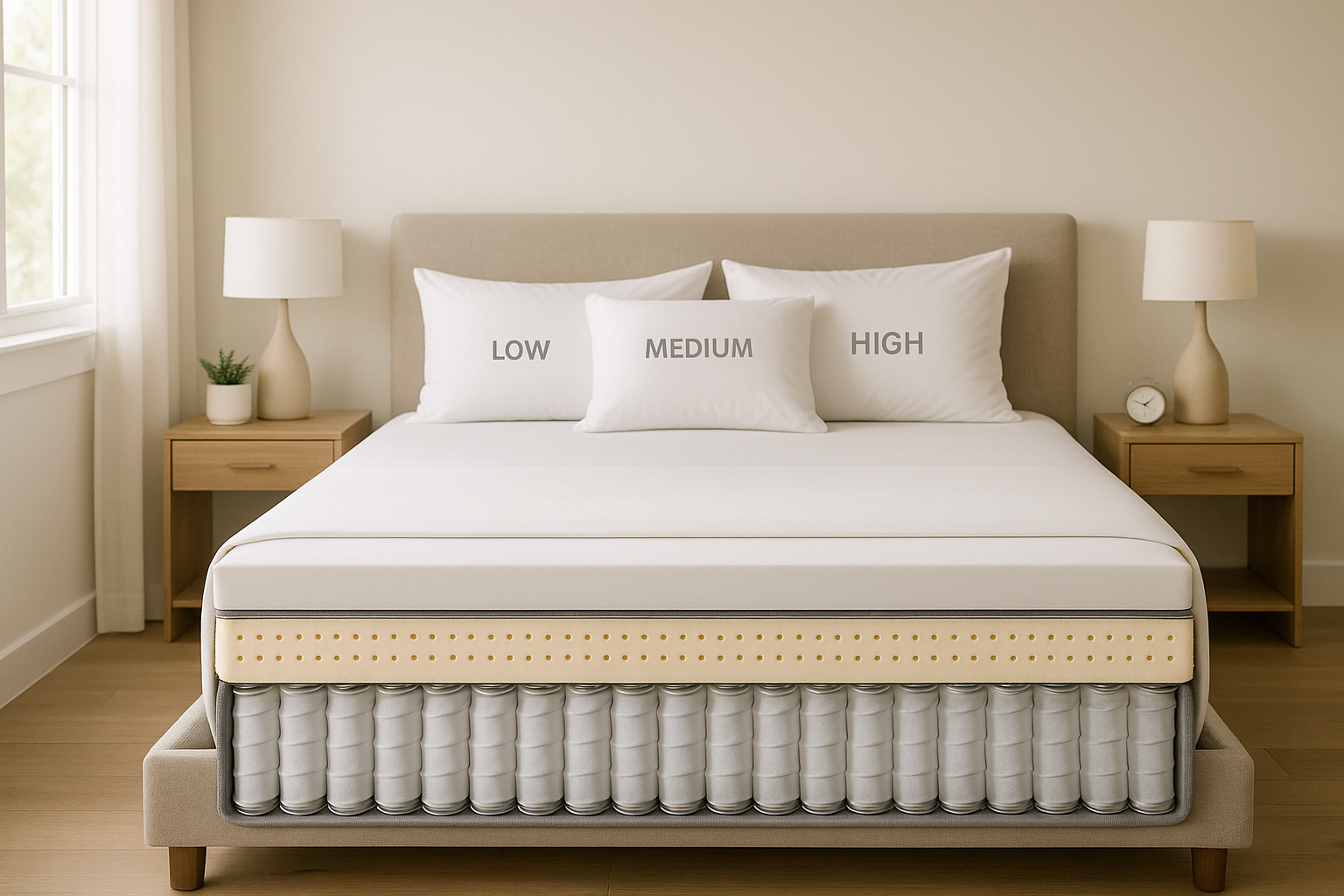
Try three lofts (low/medium/high) for five minutes each in your usual posture; choose the one that makes you forget your neck.
Bottom line: treat pillows like eyewear—fit to your anatomy and posture, and expect measurable comfort changes when the height is right.
4. Choose materials for feel, durability, and allergies (memory foam, latex, hybrid, innerspring)
Materials determine your mattress’s personality—hug vs bounce, silent stillness vs springy mobility, cool airflow vs deep contour. Memory foam excels at pressure relief and motion isolation but can trap heat; it suits side/back sleepers who like a slow, enveloping feel. Latex (especially natural) feels buoyant and responsive with better airflow; it’s great for combo sleepers who move a lot. Hybrids blend foam comfort with coil support, fusing relief and edge strength; most couples thrive here. Traditional innersprings feel bouncy and breathable but often need a plush top for pressure relief. For pillows, memory foam contours deeply; latex and down-alternative sleep cooler; adjustable shredded foam splits the difference and adapts over time.
- Durability clues: higher-density foams (≥4 lb/ft³; 64+ kg/m³) in top layers resist early body impressions; pocketed coils with thicker gauge (13–15) around the perimeter improve edge support.
- Allergy notes: latex allergies are usually contact-related; encased latex cores rarely touch skin, but choose hypoallergenic covers if sensitive.
- Sustainability: look for third-party certifications (see Rule 8) and consider replaceable pillow fills to extend life.
4.1 Tools & examples
If you’re uncertain about feel, order a small sample kit (many brands provide swatches) or test comparable materials in-store, then buy online with a trial.
Bottom line: the “right” material is the one that matches your feel preference and maintenance habits while meeting your support/cooling needs.
5. Plan for temperature regulation (cool covers, airflow, and smart bedding)
Thermal comfort isn’t a luxury—it affects sleep onset and continuity. Cooling the body slightly before bed promotes sleepiness; warmer environments and heat-retentive surfaces can fragment sleep. Materials and construction matter: open-cell foams, perforated latex, and hybrids with breathable coil cores move heat better than dense, closed foams. Covers with phase-change fibers feel cool to the touch but are most effective when paired with airflow. Bedding is your hidden lever: percale cotton or linen sheets breathe better than heavy sateen; light duvets or quilts prevent heat trapping. Keep the room around 18–20 °C (65–68 °F) if possible, and consider a breathable protector rather than plasticized encasements that block airflow.
- Practical upgrades: choose a hybrid or latex if you’re a hot sleeper; use a breathable protector; swap to percale/linen sheets; position a quiet fan to move air across the mattress surface.
- Numeric example: shifting room temperature from 24 °C to 19 °C and switching to percale often reduces night sweats for hot sleepers without changing the mattress.
- Region note: in humid climates, prioritize airflow and moisture-wicking covers; in dry heat, cooling gels/PCMs may feel more noticeable.
5.1 Why it matters
Thermoregulation and sleep are tightly linked in the literature; even small pre-sleep drops in core body temperature correlate with improved autonomic balance overnight.
Bottom line: buy construction that breathes first; treat “cooling yarns” as icing, not cake.
6. If you share a bed, check motion isolation, edge support, and responsiveness
Couples have extra constraints: one partner’s movements should not wake the other, and the edges must feel stable for sitting or sprawling. Motion isolation is where memory foam and many hybrids excel; connected-coil innersprings tend to transmit more vibration. Independent testing labs quantify stability by dropping a standard weight and measuring vibration at set distances, a helpful way to compare apples to apples. Edge support depends on coil design (firmer perimeter rows or foam rails) and top-layer density; it matters if you sit on the edge or sleep right to the border. Responsiveness—how quickly the surface rebounds—affects ease of movement and sex; latex and spring cores are best here.
- Showroom tests for two: lie on the bed while your partner rolls and sits; rate the disturbance from 0–10; then both sit at the edge and note bend.
- Trade-off: ultra-plush foam tops can deaden motion but feel swampy when changing positions; aim for a hybrid if you both want low motion + easy movement.
- Pillow strategy for couples: if your shoulders/loft needs differ, buy adjustable pillows and fine-tune separately.
6.1 Numbers & guardrails
When comparing lab results, look for lower vibration scores and firmer edge ratings; these signal better sleep for light sleepers.
Bottom line: prioritize motion isolation and edge strength if you share a bed; they influence real-world satisfaction more than tiny feel differences.
7. Choose the right size, thickness, and base (and measure your room!)
Size affects comfort and sleep quality as much as feel. Couples are often happiest on a queen at minimum; a king gives space to spread and reduces midnight elbow wars. Thickness (profile) influences both feel and aesthetics; deep comfort stacks (11–14 in / 28–36 cm) allow better pressure relief layering without bottoming out, but only if the core is supportive. Your base matters: slatted frames should have gaps ≤7.5 cm (3 in) to properly support foams/hybrids; platform bases must be flat and dry; adjustable bases can help with snoring and reflux but require compatible, flexible cores. Before you buy, measure doors, hallways, and stair turns; boxed beds simplify delivery, but rigid frames and split foundations may still be necessary in tight spaces.
- Region note: mattress sizing names vary by country and manufacturer (e.g., “King” can differ in dimensions). Always check the exact measurements in centimeters or inches and compare to your existing bed linen and room size.
- Height ergonomics: aim for a bed height (floor to top of mattress) that lets your knees bend at ~90° when sitting—easier on joints.
- Pillow size: match pillow width to bed size for symmetry and support (standard on twin/full; queen pillows on queen; king pillows on king).
7.1 Mini-checklist (sizing)
Confirm mattress measurements, ceiling clearances for lifts, and base compatibility; plan sheet/duvet sizes to prevent corner tension.
Bottom line: a great mattress in the wrong size or on the wrong base is a daily frustration—measure twice, order once.
8. Check certifications, materials safety, and allergy control
Third-party certifications don’t guarantee comfort, but they verify claims about emissions and harmful substances. CertiPUR-US® covers polyurethane foams—it requires low VOC emissions (≤0.5 ppm) and excludes certain chemicals such as formaldehyde, specific phthalates, and heavy metals. OEKO-TEX® STANDARD 100 tests textiles (including covers) for a long list of harmful substances at strict limits; the 2025 standard spells out scope and testing rigor. If you have allergies or asthma, look for tightly woven, washable covers; consider dust-mite-resistant encasements for pillows and, if needed, the mattress. For latex sensitivity, a closed cover and a protector typically limit exposure; when in doubt, consult an allergist and consider synthetic fills.
- Practical checks: verify certification numbers on the issuer’s website; ensure the exact model you’re buying—not just the brand—lists valid certificates.
- Indoor air tips: unbox in a ventilated room; let foam models air out for 24–72 hours.
- Laundry: wash pillow protectors and cases weekly; mattress protectors monthly.
8.1 Tools/Examples
Check the CertiPUR-US directory for the foam vendor and the OEKO-TEX certificate for the fabric lot, especially with third-party marketplace sellers.
Bottom line: use certifications to reduce risk and confirm responsible materials; comfort is step one, safe construction is step two.
9. Read the fine print: trials, returns, and warranties
Mattresses and pillows are use-it-to-know-it products—your body needs 2–4 weeks to adapt and reveal true comfort. That’s why generous sleep trials (often 90–365 nights) matter; they let you test through a full month of routine. Read return terms carefully: who pays pickup, whether you must keep the law tag, and any minimum break-in period before returning. Warranties typically run 10 years for mattresses, with coverage for defects like sagging beyond a threshold (e.g., 2–3 cm / 0.75–1 in). Pillows can have much shorter coverage. Keep receipts and photos of the setup from day one; measure impressions with a ruler if you suspect premature sagging. For online purchases, screenshot the policy page at the time of checkout—the terms you saw should be the terms honored.
- Pro tip: add calendar reminders—trial end date minus 10 days—to reassess comfort.
- Return etiquette: many brands donate returned mattresses; ask how disposal works in your area.
- Hygiene clause: returns usually require a clean, undamaged product; a protector from day one makes this easy.
9.1 Mini-checklist
Record trial length, return fees, warranty years, sagging threshold, and contact channel (email/chat/phone). If terms feel vague, ask for written confirmation.
Bottom line: great policies turn a guess into a risk-managed trial—don’t buy without them.
10. Budget for value: where to spend vs where to save
Think in total cost per night, not sticker price. A $1,000 mattress that lasts eight years costs about $0.34/night—cheap compared to recurring discomfort. Spend on the core (support unit and top comfort layer) and on pillows; save on fancy covers and accessories that don’t change alignment. Expect higher prices for natural latex, thicker coil counts, and premium foams; decide if those deliver benefits you’ll actually feel. Smart timing helps—holiday sales and model refreshes can cut hundreds off list price, but focus on specs and return terms rather than percent-off banners. For pillows, adjustable-fill models stretch your budget by letting you fine-tune loft over time instead of replacing.
- Value signals: clear specs (foam density, coil type), robust edge design, breathable cover, 100-night+ trial.
- False economies: ultra-cheap foam often sags early, increasing long-term cost.
- Accessory triage: prioritize a breathable protector and two good pillows over decorative extras.
10.1 Numeric example
If a hybrid at $1,500 extends your comfortable sleep by just 30 minutes per night vs a $900 option, over 8 years that’s ~1,460 more hours of high-quality rest—well worth the delta.
Bottom line: fund alignment and durability first; let features you won’t feel fall off the list.
11. Test like a pro: showrooms vs online, and a keep/return protocol
Whether you try in-store or go direct-to-consumer, use a structured test. In a showroom, spend 10–15 minutes in your usual position on each finalist; bring your current pillow or choose a similar loft to avoid skewed impressions. Do the roll test—turn from back to side and side to stomach; note effort and any shoulder pinch. For online buys, block out the first two weeks to sleep only on the new setup, keep your routine steady, and journal wake-ups, hot spots, and morning pain. If you share a bed, both partners should rate sleep quality daily. For pillows, adjust fill in 1–2 cm increments until the neck feels neutral for three consecutive mornings.
- Showroom script: 1) side-lying alignment photo, 2) back-lying hand-under-lumbar check, 3) roll-over ease, 4) partner motion test, 5) edge sit test.
- Online protocol: day 1–3 break-in; day 4–14 consistent use; day 15 adjust pillow; day 21 reassess comfort; day 25 decide to keep or return.
- Data to track: wake count, morning stiffness (0–10), hot flashes/night sweats, partner disturbance.
11.1 Region-specific notes
If mattress size labels vary in your market, bring bed-frame measurements to the store and verify exact dimensions on the spec sheet; avoid surprises with sheet fit or headboard spacing.
Bottom line: a simple, timed protocol turns subjective feel into objective keep/return data—so your decision is confident, not lucky.
FAQs
1) How long should a mattress last before I replace it?
Most quality mattresses last 7–10 years, but lifespan depends on materials, body weight, and care. Signs it’s time: visible impressions ≥2–3 cm, new morning stiffness that disappears on other beds, or creaks and edge collapse. Rotate 2–4 times per year, keep a breathable protector on from day one, and ensure slats are ≤3 in apart. Pillows wear out faster—plan on 1–3 years, or sooner if loft collapses.
2) Is memory foam bad for hot sleepers?
Not necessarily, but it’s riskier because dense foams can trap heat. If you run warm, choose open-cell foams, perforated layers, or a hybrid with coils that promote airflow. Pair with breathable sheets (percale or linen) and a light duvet. If you still overheat, a latex hybrid often feels cooler while maintaining pressure relief.
3) What firmness is best for back pain?
Evidence favors medium-firm for many people with nonspecific low-back pain, balancing support and relief. That said, your position and weight still matter: heavier bodies often need a touch firmer; strict side sleepers may prefer slightly softer with strong lumbar support beneath. Always test for two weeks and use return policies if pain persists.
4) How do I know my pillow is the right height?
Take a side photo in your usual sleep position: your forehead, nose, and chin should line up horizontally, and your ear should stack over your shoulder. If your head tilts up, reduce loft; if it dips, add loft. Adjustable shredded-foam pillows make this simple—remove or add handfuls until three consecutive mornings are ache-free.
5) Do certifications like CertiPUR-US and OEKO-TEX really matter?
They don’t predict comfort, but they do validate claims about emissions and harmful substances. CertiPUR-US applies to polyurethane foams (low VOCs, excludes certain chemicals), while OEKO-TEX STANDARD 100 tests textiles like covers. Look up certificate numbers and make sure the exact model you’re buying is covered.
6) What’s better for couples: foam, latex, or hybrid?
For low motion transfer, memory foam excels; for ease of movement and cooler sleep, latex or a hybrid is often better. Many couples compromise with a medium-firm hybrid that uses memory foam over pocketed coils, plus reinforced edges for space and stability. Always perform a partner-roll and edge-sit test.
7) Can a new mattress fix snoring or sleep apnea?
A mattress alone won’t treat sleep apnea. However, pairing the right firmness with an adjustable base (to elevate the head) can reduce positional snoring. If you suspect apnea—loud snoring, gasping, daytime sleepiness—talk to a clinician and consider a sleep study. Comfort helps adherence to any prescribed therapy, but diagnosis and treatment come first.
8) Should stomach sleepers use a pillow?
Often a very thin pillow—or none—works best to avoid neck extension. Many stomach sleepers also benefit from placing a small pillow under the pelvis to reduce low-back arching. If you’re transitioning away from stomach sleeping, a medium loft side-sleeper pillow can train a more neutral posture.
9) Are “cooling covers” worth paying for?
They can feel cool to the touch initially, but airflow is the real workhorse. If you’re deciding between a dense all-foam with a cooling cover and a well-ventilated hybrid without fancy fabric, the hybrid usually sleeps cooler. Prioritize breathable construction; treat specialty covers as a bonus.
10) How firm should an adjustable-fill pillow be?
Start with more fill than you think you need, then remove small amounts until your neck feels neutral and your shoulder pressure eases (side) or your chin isn’t pushed forward (back). Re-check after a week—foam settles—and add a handful if you notice a head-tilt on photos or morning stiffness returns.
11) What sheet fabric helps with night sweats?
Look for percale-weave cotton or linen—they wick and breathe better than heavier sateen. Avoid polyester-heavy blends that trap heat. If you love sateen’s feel, choose a lighter weight and pair with a breathable protector, not a plasticized encasement.
12) How long should I test before returning?
Give it two weeks for your body to adapt, then evaluate trend data (wake-ups, stiffness scores). If pain or overheating persists by day 25, initiate the return while you still have time. Take photos of alignment and impressions to streamline the process.
Conclusion
Mattress and pillow shopping becomes simple—and successful—when you make alignment the hero and let your profile guide the specs. Start by mapping your position, body weight, and pain history. Default to medium-firm unless your needs point elsewhere, and set pillow height to fill the neck-to-mattress gap without tilting your head. Choose materials for the feel and temperature you actually want to live with, and verify the couple-centric features—motion isolation, edge support, and responsiveness—if you share a bed. Size and base compatibility are logistics that make or break daily comfort; measure meticulously. Finally, protect yourself with certifications, robust trials, and clear warranties, and run a straightforward keep/return protocol so your decision is based on data, not guesswork.
Put these 11 rules to work, and you’ll wake up with a calmer neck, a happier back, and the energy you bought the bed for in the first place. Ready to sleep better? Pick one rule to action today and take five minutes to profile your sleep.
References
- Effect of firmness of mattress on chronic non-specific low-back pain — The Lancet (Kovacs et al.), Nov 15, 2003. https://www.thelancet.com/journals/lancet/article/PIIS0140-6736(03)14792-7/fulltext The Lancet
- Mattress Firmness — Sleep Foundation, Updated July 25, 2025. Sleep Foundation
- Choose the Right Mattress for Better Sleep (Buying Guide) — Consumer Reports, Jan 8, 2025. Consumer Reports
- Best Mattresses of 2025 (Testing Methods: Motion Isolation/Edge Support) — Consumer Reports, Apr 23, 2025. Consumer Reports
- Ergonomic Consideration in Pillow Height Determinants and Evaluation — MDPI / Applied Sciences (Open-access review), 2021. PMC
- The effects of pillow designs on neck pain, waking symptoms and spinal alignment: Systematic review and meta-analysis — Journal of Physiotherapy, 2021. PubMed
- The Temperature Dependence of Sleep — Physiology & Behavior review (Harding et al.), 2019. PMC
- Core body temperature changes before sleep are associated with heart rate variability during sleep — Journal of Applied Physiology, 2023. PMC
- What is Certified Foam? (CertiPUR-US® program details) — CertiPUR-US, 2023–2024. CertiPUR-US
- OEKO-TEX® STANDARD 100 — Standard (Edition 03/2025) — OEKO-TEX Service GmbH, Apr 1, 2025. OEKO-TEX