


























Cognitive Behavioral Therapy for Insomnia (CBT-I) is a short, structured program that retrains your brain and body to sleep more efficiently by changing what you do in bed and what you believe about sleep. Major medical bodies recommend CBT-I as the first-line treatment for chronic insomnia because it consistently improves sleep latency, awakenings, and daytime functioning with durable results and without medication side effects. In plain terms: CBT-I uses a handful of precise tools—used together—to shrink time awake in bed, quiet racing thoughts, and rebuild confidence in your ability to sleep. The American Academy of Sleep Medicine (AASM) and the American College of Physicians (ACP) both endorse CBT-I as initial therapy for chronic insomnia. PubMed
Quick answer (for skimmers): CBT-I works by (1) limiting time in bed to your actual sleep time, (2) reserving the bed for sleep and sex only, (3) correcting unhelpful sleep beliefs, (4) practicing relaxation to reduce arousal, and (5) adding targeted tactics like paradoxical intention and scheduled “worry time.” You track progress with a sleep diary and simple metrics such as sleep efficiency and the Insomnia Severity Index (ISI).
Care note: The strategies below are evidence-based, but not a substitute for personal medical advice. If you’re excessively sleepy, have suspected sleep apnea, work safety-sensitive jobs, are pregnant, or have conditions like bipolar disorder or seizure disorders, get clinician guidance before doing sleep restriction or other intensive steps. The latest VA/DoD guideline and AASM patient guide emphasize screening for comorbid sleep and medical disorders.
1. Stimulus Control: Re-pair the Bed With Sleep (Not Worry)
Stimulus control is the fastest way to break the “bed = awake and anxious” link. It teaches your brain that bed cues mean sleep by restricting what happens there and by moving wakefulness out of the bedroom. In practice, you go to bed only when sleepy, get out of bed if you can’t sleep, and use the bed exclusively for sleep and sex. These rules shrink time awake in bed, lower conditioned arousal, and rebuild a clean association between your mattress and drowsiness. The AASM guideline lists stimulus control as an effective component—either within multicomponent CBT-I or as a single-component therapy—and it’s been a cornerstone of CBT-I since Bootzin first described it.
How to do it (classic Bootzin rules)
- Go to bed only when you feel sleepy (not just tired).
- If you can’t fall asleep or return to sleep in ~15–20 minutes, get up and do a quiet, low-light activity elsewhere; return only when sleepy.
- Use the bed for sleep and sex only—no TV, reading, phones, or stress-talk.
- Wake up at the same time every day, regardless of sleep time.
- Avoid daytime naps during the initial retraining phase.
Why it matters
Repeated “awake-in-bed” episodes condition the bedroom to trigger alertness. Stimulus control strips away those pairings and reconditions your brain for rapid sleep onset. The 2021 AASM guideline suggests stimulus control as a stand-alone option and recommends multicomponent CBT-I (which includes it) as first-line.
Synthesis: Follow the rules consistently for 2–3 weeks; the early nights can feel awkward, but adherence is what flips the bedroom from “battlefield” back to “sleep cue.”
2. Sleep Restriction Therapy (SRT): Build Sleep Pressure and Consolidation
Sleep restriction (more accurately, sleep scheduling) aligns your time in bed (TIB) with your actual sleep to boost sleep pressure and consolidate fragmented nights. Initially, you limit TIB to the average total sleep time from a 1–2-week diary (with a protective minimum), fix a strict wake time, and only expand the sleep window when your sleep efficiency rises. This temporarily makes you sleepier in the evening—by design—and helps you fall asleep faster and wake less. Randomized trials show SRT improves sleep outcomes, and it has even matched or outperformed sleep hygiene and other controls in pragmatic studies.
Numbers & guardrails
- Set initial TIB to your 1–2-week average Total Sleep Time; do not go below 5–5.5 hours.
- Fix wake time every day; set bedtime = wake time − TIB.
- Adjust weekly using sleep efficiency (SE = TST/TIB ×100):
- SE > 90% → increase TIB by 15–30 min
- SE 85–90% → hold
- SE < 80–85% → reduce TIB by 15–30 min
- Safety: If you feel dangerously sleepy (e.g., while driving), pause tightening and consult a clinician. Center for Deployment PsychologyNHS Talking Therapies Berkshire
Mini example
If your diary shows TST = 6h and your target wake = 6:30 AM, set bedtime to 12:30 AM. After one week, if SE averages 92%, expand to 6h15–6h30 by moving bedtime earlier. Repeat weekly. Stanford Medicine
Synthesis: Expect a tough first week; consolidation follows. Trials from 2018–2023 support SRT’s clinical utility across primary care and specialty settings.
3. Cognitive Restructuring: Defuse Unhelpful Sleep Beliefs
Cognitive therapy targets thoughts that spike arousal and keep you in “threat mode” at night—beliefs like “If I don’t get 8 hours, tomorrow will be ruined,” or “I must try hard to sleep.” These thoughts amplify performance anxiety, clock-watching, and safety behaviors that prolong insomnia. CBT-I teaches you to identify, question, and replace these beliefs with flexible, testable alternatives (e.g., “I can function adequately with a bit less sleep; effort backfires”). Research shows reductions in insomnia-related worry and dysfunctional beliefs mediate improvements in sleep; guidelines position multicomponent CBT-I (which includes cognitive methods) as the treatment of choice.
How to do it
- Thought record: Capture a hot thought (“I’ll be a wreck”), evidence for/against it, and a balanced reframe.
- Behavioral experiments: Test predictions (e.g., workday ratings) after different sleep amounts.
- Drop safety behaviors: Reduce over-scheduling, extra caffeine, or extended time in bed “just in case.”
- Clock control: Turn clocks away; checking fuels catastrophizing.
Numbers & checkpoints
- Use the Insomnia Severity Index (ISI) weekly (0–28). A 6–8 point drop is clinically meaningful; ≤7 suggests remission. Track sleep latency and wake after sleep onset (WASO) in minutes.
Synthesis: When beliefs soften, arousal drops. Pair restructures with stimulus control and SRT so the mind and schedule send the same “sleep is safe” message.
4. Relaxation Training: Lower Physiologic Arousal on Cue
Insomnia often includes a revved-up nervous system—fast heart rate, tense muscles, shallow breathing. Relaxation training reduces this hyperarousal so you can transition to sleep more quickly. AASM suggests relaxation therapy as a single-component option and includes it within multicomponent CBT-I. Proven methods include progressive muscle relaxation (PMR), diaphragmatic breathing, and guided imagery. Practice during the day first; at night, use your preferred technique for 10–20 minutes if you’re not sleepy or after leaving bed per stimulus control.
Practical menu
- PMR: Tense–release muscle groups from toes to face (5–10 sec tension, 20–30 sec release).
- Breathing: 4-second inhale, 6-second exhale, ~5–10 minutes.
- Body scan or imagery: Scan sensations or imagine a steady, low-stimulation scene.
- Cue-controlled relaxation: Pair a word like “soften” with exhale; condition the cue over a week.
Guardrails
Relaxation is supportive, not curative on its own. Expect incremental gains and combine with stimulus control/SRT for best effect (per AASM).
Synthesis: Use relaxation as a “soft clutch” to downshift arousal—especially after getting out of bed during awakenings.
5. Paradoxical Intention: Stop “Trying” to Sleep
Paradoxical intention has you drop the struggle and gently aim to stay awake in bed with eyes open and low light. The counterintuitive goal reduces sleep performance anxiety, the very pressure that keeps you wired. Modern reviews and meta-analyses indicate paradoxical intention can reduce sleep-onset problems for some people by cutting anticipatory anxiety; it’s often used as an adjunct when “trying to sleep” is the main driver.
How to do it
- At bedtime, if you notice “I have to sleep,” switch the goal: “I’ll rest here and simply stay awake comfortably.”
- Keep lights very dim; avoid stimulating activities.
- If you feel drowsy, allow eyes to close without self-commentary.
- Combine with stimulus control: if wakefulness becomes agitating, get up and reset.
When it helps most
This tactic shines for sleep-onset insomnia dominated by worry and effort. It’s low risk and pairs well with cognitive restructuring around “sleep effort.”
Synthesis: By removing pressure, drowsiness can surface. Think “rest without striving,” not “outsmart my brain.” PMC
6. Targeted Sleep Hygiene (Within CBT-I): Support, Don’t Substitute
“Sleep hygiene” means environmental and routine tweaks—helpful supports, but not a stand-alone treatment for chronic insomnia. The AASM guideline explicitly suggests not using sleep hygiene alone. Within CBT-I, however, a few targeted changes reduce friction: stabilize caffeine/alcohol timing, manage evening light, and make your bedroom quiet, dark, and cool. Keep this lean—focus on the 2–3 friction points that actually show up in your diary, rather than building an exhausting pre-bed ritual.
High-yield tweaks
- Caffeine: None within 6–8 hours of bedtime; watch hidden sources (tea, colas, pre-workouts).
- Alcohol: Avoid within 3–4 hours of bedtime; it fragments the second half of sleep.
- Light: Dim 60–90 minutes before bed; use blackout curtains and keep devices out of arm’s reach.
- Temperature: Aim for a cool room; adjust bedding layers instead of cranking AC.
Region-specific note
If you have early morning commitments (e.g., Fajr prayer in Pakistan), anchor your fixed wake time to that schedule and align your sleep window accordingly; consistent mornings matter more than elaborate pre-bed routines.
Synthesis: Keep hygiene minimal and purposeful; CBT-I’s behavioral and cognitive levers do the heavy lifting.
7. Scheduled “Worry Time” & Problem-Solving: Move Rumination Out of Bed
For many, the mind accelerates at night. “Constructive worry” (scheduled earlier in the evening) gives worries a container so they’re less likely to erupt at lights-out. In a randomized study, adding constructive worry to behavior therapy improved insomnia severity and reduced worry versus behavior therapy alone. The technique externalizes concerns, identifies next actions, and teaches your brain that problem-solving has a time and place—and it isn’t 2 AM.
Mini-protocol (10–15 minutes, 2–3 hours before bed)
- Split a page: Worry / Next Step.
- List top worries quickly; for each, write a single next action (email, list, call, ignore).
- Close the page. If a thought resurfaces later, tell yourself: “Scheduled for tomorrow.”
- Pair with a wind-down (light stretch + diaphragmatic breathing). IAAP Journals
Why it works
Reducing presleep cognitive arousal is a core mediator of insomnia improvements; this method targets that driver directly and dovetails with cognitive restructuring. ScienceDirect
Synthesis: Give worries a desk, not a pillow. You’ll fall asleep faster when your brain trusts that problems will be handled—just not at bedtime. PubMed
8. Sleep Diary, Metrics & Feedback Loops: Make Progress Visible
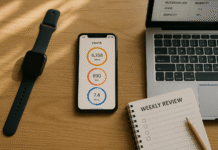
CBT-I is data-driven. A sleep diary (1–2 minutes each morning) tracks time to bed, time to sleep, awakenings, final wake, and naps. From it, you calculate Total Sleep Time, Time in Bed, and Sleep Efficiency; the latter drives SRT adjustments. The Insomnia Severity Index (ISI) is a validated 7-item scale widely used to track clinical change. Watching the numbers move keeps you motivated and prevents reactive schedule changes that backfire.
What to track (daily)
- Bedtime / lights out, estimated sleep onset, awakenings/WASO, final wake, rise time
- Naps (start, length), caffeine/alcohol timing, exercise timing
- Weekly: SE%, ISI total (0–28), and quick notes on adherence to stimulus control/SRT. Sleep Foundation
Interpreting numbers
- SE% targets: <80% = tighten; 85–90% = hold; >90% = expand by 15–30 min.
- ISI bands: 0–7 (no insomnia), 8–14 (subthreshold), 15–21 (moderate), 22–28 (severe). Expect a 6–8-point drop over a CBT-I course if you adhere.
Synthesis: Data beats guesswork. Let the diary—not your 3 AM mood—steer schedule tweaks.
9. Access Paths: In-Person, Group, and Digital CBT-I
Delivery matters. Multicomponent CBT-I works in person, in groups, and via telehealth. When access is limited, digital CBT-I (dCBT-I) programs can help you start immediately; AASM’s Emerging Technology Committee describes when and how dCBT-I fits into care pathways. Evidence suggests therapist-led CBT-I has the strongest effects, with guided digital options next, and unguided programs offering modest benefits. If you begin with dCBT-I, you can still transition to a clinician-guided course for troubleshooting and maintenance planning.
Choosing a path
- Therapist-led CBT-I: Best for complex insomnia (multiple comorbidities, high anxiety).
- Group formats: Cost-effective; leverage peer accountability.
- Digital modules/apps: Start now; look for programs with SRT and SCT, weekly SE% feedback, and relapse-prevention content.
Guideline snapshot
Recent VA/DoD (2025) guidance and AASM resources stress screening for other sleep disorders (e.g., apnea) and using CBT-I first, with meds reserved for short-term adjuncts or when CBT-I access/adherence is limited.
Synthesis: Pick the format you can actually complete. Consistent practice beats the “perfect” program you never start.
FAQs
1) How long does CBT-I take to work?
Most structured courses run 4–8 sessions over 4–8 weeks. Sleep often worsens slightly in week 1–2 of SRT, then improves steadily as efficiency rises. Many people see meaningful gains by week 3–4, with further consolidation over months. Durability is a strength of CBT-I versus medications. PMC
2) Is CBT-I safe if I have sleep apnea, chronic pain, or anxiety?
Yes—with tailoring and clinician oversight. Guidelines recommend screening for obstructive sleep apnea and other disorders first. CBT-I can be paired with CPAP for apnea and with pain/anxiety treatments; components like stimulus control and cognitive work are broadly helpful.
3) Do I need a strict 8-hour goal?
No. Your initial time in bed is set from your actual sleep, not a universal 8-hour target. You expand gradually as sleep efficiency improves. Many adults function well between 6.5–8 hours; the right amount is individualized and guided by daytime functioning and diary metrics. Perelman School of Medicine
4) Can I keep reading in bed?
During retraining, no. Reading—even “relaxing” reading—keeps the bed paired with wakefulness. Read in a chair with dim light; transition to bed only when sleepy. Later, after remission, some people reintroduce brief reading without relapse.
5) What if I wake at 3 AM and feel wired?
Follow stimulus control: get out of bed, keep lights low, do a quiet activity (e.g., body scan), and return when sleepy. Avoid clocks and problem-solving. If early-morning awakenings persist, SRT adjustments can help consolidate the second half of the night.
6) Are there medications I should avoid while doing CBT-I?
The 2025 VA/DoD guideline advises against several agents for chronic insomnia (e.g., antipsychotics, benzodiazepines, diphenhydramine, trazodone) and provides a short list of agents that may be considered if pharmacotherapy is chosen. Discuss with your clinician; many complete CBT-I without meds. Guideline Central
7) Does relaxation alone fix insomnia?
Helpful but typically insufficient. AASM suggests relaxation as a single component, but the strongest recommendation is for multicomponent CBT-I (SRT + SCT + cognitive strategies). Use relaxation to reduce arousal while the behavioral schedule does the heavy lifting.
8) What’s the ISI and why should I use it?
The Insomnia Severity Index is a brief, validated questionnaire (0–28) sensitive to treatment change. It helps you and your clinician quantify progress; a drop of 6–8 points is clinically meaningful. Complete it weekly during CBT-I.
9) Is paradoxical intention safe?
Yes for most, and it’s low effort. It’s not a stand-alone cure but can reduce sleep-effort anxiety. If it increases frustration, switch back to stimulus control and relaxation. Research supports benefit for sleep-onset issues in particular.
10) What if access is limited where I live?
Digital CBT-I programs endorsed by professional bodies can bridge access gaps. Start with dCBT-I to learn SRT/SCT, then add a clinician if possible. AASM’s Emerging Technology Committee outlines when to use digital tools and notes therapist-led CBT-I has the strongest effects.
Conclusion
Insomnia is maintained, not just caused, by a tight loop of conditioned arousal and unhelpful beliefs. CBT-I breaks that loop with a compact toolkit that changes both what you do (stimulus control, SRT) and how you think (cognitive restructuring, paradoxical intention), supported by relaxation, targeted hygiene, and scheduled worry time. Track your nights with a simple diary and ISI, and let sleep efficiency guide changes to your schedule each week. Expect a challenging first fortnight—and durable wins after that. If you have comorbid conditions or safety-sensitive work, involve a clinician and screen for other sleep disorders first. Whether you work with a therapist, a group, or a digital program, the principle is the same: consistent practice rewires your sleep system.
Copy-ready next step: Start a 2-week sleep diary tonight, fix your wake time for the next 14 days, and apply the stimulus control rules—then layer in SRT adjustments weekly.
References
- Behavioral and psychological treatments for chronic insomnia disorder in adults: an AASM clinical practice guideline. American Academy of Sleep Medicine / Journal of Clinical Sleep Medicine. Feb 2021. PMC
- ACP Recommends Cognitive Behavioral Therapy as Initial Treatment for Chronic Insomnia. American College of Physicians / Annals of Internal Medicine news release. May 3, 2016. American College of Physicians
- Management of Chronic Insomnia Disorder in Adults. Qaseem A., et al. Annals of Internal Medicine. 2016. ACP Journals
- Sleep Restriction Therapy vs Sleep Hygiene in Primary Care: Randomized Trials. Kyle S.D., et al. The Lancet. 2023. The Lancet
- How does sleep restriction therapy work? A review. Maurer L.F., et al. PubMed abstract. 2018. PubMed
- Stimulus Control Treatment for Insomnia. Bootzin R.R. (classic protocol). 1972. University of Pennsylvania PDF. Perelman School of Medicine
- A Patient’s Guide to Behavioral and Psychological Treatments for Chronic Insomnia. AASM (Patient Guide). 2021. AASM
- Cognitive Behavioral Therapy for Insomnia (CBT-I): A Primer. Walker J., et al. Frontiers in Sleep / PMC. 2022. PMC
- Insomnia Severity Index: Validation and Psychometrics. Morin C.M., et al. Sleep Medicine. 2011. PMC
- Paradoxical Intention for Insomnia: Systematic Review/Meta-analysis. Jansson-Fröjmark M., et al. Sleep Medicine Reviews. 2022. PubMed
- VA/DoD Clinical Practice Guideline for Chronic Insomnia & OSA (2025). U.S. Dept. of Veterans Affairs/Defense (PDF). Apr 2025. Health Quality VA
- Digital CBT-I: Platforms and Characteristics. AASM Emerging Technology Committee. 2023. AASM