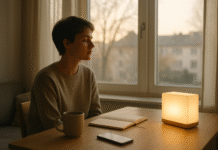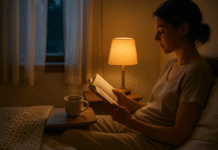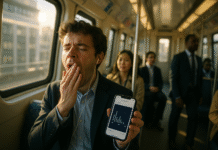












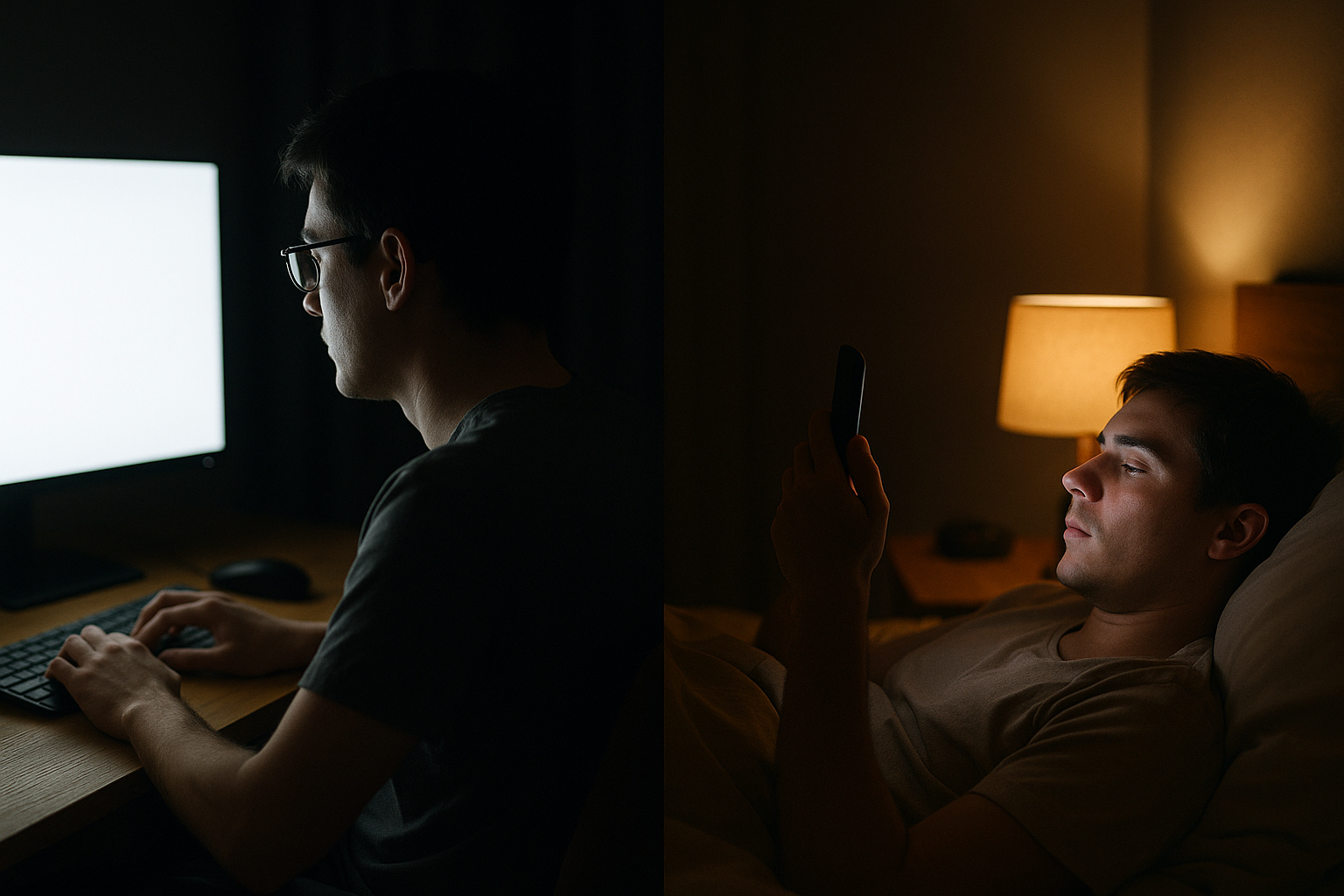
If you’ve ever wondered whether a laptop/monitor or a phone is worse for your sleep, here’s the short answer: neither device is “inherently” worse—the impact depends on how much melanopic light reaches your eyes, when you use the screen, what you’re doing on it, and for how long. In controlled measurements, a bright computer display at desk distance often delivers more melanopically effective light than a dim phone, but phones are typically used closer to bedtime and closer to the face, with notifications and interactive content that keep brains “on.” So in real life, phones often hurt sleep more—unless you tame distance, brightness, timing, and alerts.
Quick takeaway: Keep evening melanopic EDI (melanopic equivalent daylight illuminance) low (ideally ≤10 lux within ~3 hours of bed), dim and warm your screens, increase distance, and silence notifications. As of August 2025, these thresholds reflect expert consensus.
Friendly health note: This article is informational and not a substitute for medical advice. If you suspect a sleep disorder, consult a clinician.
1. Melanopic Light At Your Eyes (Not “Blue Light” in General)
The direct answer is that melanopic dose at your eyes determines sleep impact far more than device category. Our circadian system is most sensitive to short-wavelength light that stimulates intrinsically photosensitive retinal ganglion cells; modern standards bundle this into a practical metric: melanopic EDI (lux). At equal brightness, a display that sends higher melanopic EDI to your eyes is more likely to suppress melatonin and delay sleep. Consensus recommendations suggest keeping evening exposures ≤10 mel EDI lux for ~3 hours before bedtime and minimizing to ~1 mel EDI lux during sleep, while daytime should be ≥250 mel EDI lux to anchor your clock. Practically, that means warmer, dimmer, further, and shorter in the evening—and bright, cool/daylight exposure by day.
1.1 Why it matters
- Melatonin suppression and circadian phase shifts scale with intensity, spectrum, timing, duration, and spatial field at the eye—not with the brand or form factor per se.
- A monitor can bathe a larger portion of your visual field; a phone can deliver a surprisingly high corneal dose if it’s close and bright in a dark room.
- In a lab framework, self-luminous displays used in the evening reliably suppress melatonin and delay circadian timing.
1.2 Numbers & guardrails (as of Aug 2025)
- Evening target: ≤10 mel EDI lux at the eye; during sleep: ~1 mel EDI lux; daytime: ≥250 mel EDI lux.
- Lower melanopic output by dimming, warming color temperature, increasing distance, and reducing field of view (e.g., smaller window, lower full-screen brightness).
- Remember: a dim phone may beat a bright monitor, but a bright phone close to your eyes in bed can exceed targets.
Bottom line: Think “melanopic dose,” not “device vs device.” Hit the evening ≤10 mel EDI lux target, and either screen can be made sleep-safer.
2. Distance, Size, and Brightness: The Geometry That Changes the Game
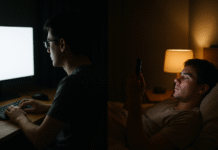
At typical setups, monitors are used at ~50–70 cm, while smartphones often sit around 30 cm (and creep closer as you get tired). Because illuminance at the eye falls with distance and depends on how much of your visual field is filled, a large, bright monitor at 60 cm can deliver more melanopic light than a dim phone at 30 cm—but a small, bright phone very close to the eyes in a dark room can rival or exceed your evening limit. Studies measuring real-world distances find average smartphone viewing around ~29–36 cm in young adults. ResearchGate
2.1 Practical tweaks
- Add distance: Push a laptop/monitor to the back of the desk; hold phones/tablets at ≥30 cm (≥12 in). iPhone/iPad Screen Distance can nudge you if you slip under ~12 inches.
- Dim the source: Drop brightness to the lowest comfortable level; avoid HDR spectacles at night.
- Shrink the field: Use windowed (not full-screen) modes; zoom text instead of moving closer.
2.2 Mini checklist
- Aim for ~60 cm to monitors and ≥30 cm to phones.
- Warm + dim in the evening; bright + cool/daylight by day.
- If your eyes inch closer as you tire, take a break or switch to audio.
Bottom line: Geometry matters. Farther, dimmer, smaller beats closer, brighter, bigger when your goal is sleep.
3. Timing Relative to Bedtime (and Your DLMO)
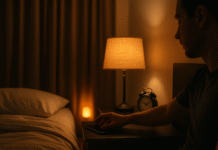
Whether a computer screen or a smartphone “hurts more” depends heavily on timing. Use a bright monitor at 6 pm and you’ll likely be fine; scroll a bright phone in bed at 11:45 pm and you’ll likely extend sleep onset. The circadian system is acutely sensitive in the ~3 hours before habitual bedtime (around the dim-light melatonin onset, DLMO). Expert guidance recommends ≤10 mel EDI lux across this pre-sleep window and as dark as possible during sleep.
3.1 What the evidence shows
- Evening LED displays (tablets/computers) suppress melatonin, delay circadian timing, lengthen sleep latency, and impair next-morning alertness.
- Extended use late at night compounds effects: later bedtimes and reduced REM were observed under tablet conditions versus print.
3.2 Guardrails & examples
- After “lights-out –3 h,” reduce screen melanopic dose aggressively (≤10 mel EDI lux). Warm, dim, distant.
- During sleep, keep ambient mel EDI ~1 lux; if you must glance at a device, use extra-dim, warm, and avert your gaze quickly.
Bottom line: Late timing multiplies the harm. If you must choose, the device you use within the last hour (often the phone) typically “hurts” more for sleep.
4. Content Type & Cognitive Arousal: Interactive Beats Light Alone (In a Bad Way)
Not all screen time is equal. Interactive, emotionally loaded content—doomscrolling, rapid-fire notifications, competitive games—can increase cognitive/physiological arousal independent of light. This is where smartphones often outpace computers: they’re designed for thumb-speed interactions in bed, and the “just one more” loop delays lights-out even if the screen is dim. Experimental and observational work links evening device engagement with later bedtimes, longer sleep latency, and next-day sleepiness—beyond photic effects.
4.1 Tame the arousal, not just the photons
- Switch tasks: Passive long-form reading or a calm video is usually less arousing than social feeds or games.
- Friction tricks: Enable app timers; keep home screens sparse at night; move addictive apps off page one.
- One-app rule: Choose a single calm app after your pre-sleep cutoff.
4.2 Mini case
A user keeps brightness low but doomscrolls social media in bed for 45 minutes. Despite low melanopic output, the prolonged engagement pushes bedtime 20–30 minutes later and fragments wind-down. Switching to a pre-downloaded audio chapter removes visual and interactive load and reduces sleep latency the same week.
Bottom line: The phone’s app ecosystem and ergonomics make arousal control crucial. If you won’t change content, the phone often “wins” at hurting sleep.
5. Duration & Pattern: Short Bursts vs. Long Sessions
Dose = intensity × duration. Long exposures—especially continuous ones—are worse than a few brief checks. Under controlled conditions, hours of tablet or LED-display use reduced melatonin, delayed circadian phase, lengthened time to fall asleep, and reduced next-morning alertness. Short, sporadic checks still matter if they’re very late or very bright.
5.1 Practical pacing (evening)
- Cap total screen minutes in the last 3 hours before bed (e.g., ≤30–45 minutes total).
- Chunk it early: If you must screen, finish the last meaningful use ≥60 minutes before lights-out.
- Swap modalities: Favor audio (music, podcasts, TTS) over visual near bedtime.
5.2 “Pattern pitfalls”
- Creeping exposure: brightness drifts up, distance drifts down, and sessions last longer than planned.
- Binge loops: auto-play, infinite scroll, and notifications turn minutes into an hour.
Bottom line: For otherwise comparable setups, the device that keeps you engaged longer in the last hour is the one that will hurt your sleep more that night.
6. Spectral Tuning & Filters: Helpful… But Not a Free Pass
“Blue-light filters” (Night Shift, warm screens, amber overlays) help some, but brightness dominates. A key study on iPad Night Shift found no significant difference in melatonin suppression across Night Shift conditions when brightness held steady. A large iPhone study similarly found no sleep advantage from Night Shift; the best outcomes came from no phone use before bed. In contrast, display engineering that reduces melanopic output while preserving appearance can lower circadian impact—but that’s under the hood, not a user toggle.
6.1 What to do (ranked)
- First: Dim brightness as much as practical.
- Second: Warm the color (Night Shift/Blue Light Filter) to reduce melanopic contribution.
- Third: Increase distance or shrink the window to reduce corneal dose.
- Always: Combine settings; filters without dimming underperform.
6.2 Mini checklist
- Night Shift/Blue Filter = good; Night Shift + dimming + distance = much better.
- For evening reading, consider e-ink or printed material when feasible.
Bottom line: Filters alone are not sufficient. If you rely only on Night Shift, the phone may still be worse than a dim, distant monitor.
7. Notifications, Alerts & Overnight Awakenings
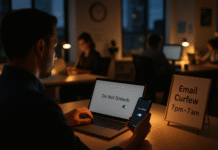
Even if two devices emit similar melanopic light, smartphones typically produce more sleep-breaking alerts—buzzes, banners, pings—that fragment the pre-sleep period and trigger awakenings. Observational and experimental work shows devices can interrupt sleep via nocturnal wake events; adolescents and young adults are particularly at risk. On both Android and iOS, Bedtime/Do Not Disturb modes can silence alerts and darken screens at a schedule.
7.1 Tools & settings
- iOS: Schedule Focus/Do Not Disturb and enable Screen Distance to discourage close-up viewing; both are in Settings (Screen Time & Focus).
- Android: Use Digital Wellbeing → Bedtime mode to keep screen dark and silence alerts automatically.
7.2 Mini checklist
- Hard silence: Schedule DND nightly; whitelist only essential contacts.
- Screen off: Face-down or across the room.
- No glow: Disable ambient-display “always on” near bedtime.
Bottom line: The device that beeps and lights up near bedtime (usually the phone) is the one most likely to derail sleep even if brightness is low.
8. Room Lighting & Context Can Trump Device Differences
Sometimes the room dominates the dose. Modeling work suggests typical home ambient lighting may not strongly suppress melatonin for up to 3 hours—but extended use of self-luminous displays can. Meanwhile, task lamps or overhead LEDs with cool spectra can push total melanopic EDI above evening targets, even if your device is dim. For better sleep, dim the room first, then manage your device.
8.1 Practical environment tweaks
- Fade the room: Low, warm lamps in the last 3 hours; avoid bright overheads.
- Angle matters: Keep bright fixtures out of your direct line of sight.
- Bed mode: Bedroom melanopic EDI during sleep ≈ 1 lux goal; consider blackout curtains and LED-off policies. Preprints
8.2 Mini checklist
- Room first, device second (don’t try to out-dim a bright ceiling light with a filter).
- If you must compute late, consider larger screen further away in a dimmer room rather than a bright phone at 30 cm.
Bottom line: Context rules. An evening-bright room can make either device problematic; a dim room lets either be tamed.
9. Habits & Posture: Where and How You Use the Screen
Finally, typical behavior patterns differ by device. Laptops and monitors are often used at desks, earlier in the evening; phones are used in bed, literally until eyes close. Evening self-luminous displays repeatedly show later bedtimes, suppressed melatonin, delayed circadian timing, and reduced next-morning alertness—effects magnified when devices are used right before lights-out. Phones also invite closer distances as you tire. Simple habit changes—one-hour screen curfew, audio last, charging the phone outside the bedroom—often matter more than hardware choice.
9.1 Habit levers that work
- Set a screen cutoff: 60 minutes before bed; move to audio-only or paper.
- Park the phone: Charge it outside the bedroom or beyond arm’s reach.
- Use tech to fight tech: Bedtime Mode/Focus automation nightly; grayscale to reduce allure.
9.2 Region-agnostic posture tips
- Neck/eye comfort: Prop devices to avoid hunching; discomfort drives you to hold phones closer, increasing dose.
- Text size before distance: Increase font size rather than pulling the screen in.
Bottom line: In real-world behavior, smartphones usually hurt sleep more because they follow you into bed, keep you closer, and ping you—unless you actively counter those defaults.
FAQs
1) Which typically emits more melanopic light at the eye: a monitor or a phone?
At equal screen technology and similar image brightness, a monitor at ~60 cm can deliver more melanopic illuminance than a dim phone because it fills more of your visual field. But a bright phone at ~30 cm—especially in a dark room—can rival or exceed evening targets. Distance, brightness, and field of view decide the winner.
2) Is “blue light” the whole story?
Not really. The modern standard is melanopic EDI, which reflects how effective a light source is for circadian impact after considering spectrum, intensity, and geometry. Manage melanopic dose (≤10 lux in evening, ~1 lux during sleep; ≥250 lux by day), and you’ve managed the “blue light” problem in practice.
3) Does Night Shift (or warm mode) fix the problem?
It helps some, but not enough by itself. Multiple studies show that without dimming, Night Shift hasn’t reliably protected melatonin or sleep outcomes. Combine warmth + dimness + distance for best results; or go screen-free in the last hour.
4) How long before bed should I stop screens?
A conservative, practical buffer is ~60 minutes before lights-out. The formal mel-EDI guidance covers the ~3 hours pre-bed; if you must use a screen, keep melanopic dose as low as possible (≤10 mel EDI lux), favor audio, and avoid interactive content.
5) Is an e-ink reader safer than a tablet?
Generally yes for light exposure, especially if it’s unlit or very dim; it emits little melanopic light compared with backlit LCD/OLED tablets. But content still matters: gripping or interactive material can delay bedtime via arousal even with low light.
6) Do blue-blocking glasses work?
Evidence is mixed. They can reduce short-wavelength exposure, but if overall brightness and distance remain high, melatonin can still be suppressed. Glasses are best as an add-on to dimming, warming, and distancing, not a sole solution.
7) What’s a simple “good enough” setting set for evenings?
On any device: brightness 10–20%, warmest color, no HDR, no full-screen, ≥30 cm distance, and DND/Bedtime mode scheduled nightly. That combination will dramatically lower evening melanopic dose and interruptions.
8) Can PWM/flicker from OLED affect sleep?
Flicker can trigger eyestrain or headaches in sensitive users, which may indirectly affect sleep via discomfort, but the direct circadian driver remains melanopic dose. If flicker bothers you, enable DC dimming/anti-flicker modes where available and keep brightness moderate.
9) I work late on a computer—should I switch to my phone?
Not necessarily. A dim, warm monitor at 60–70 cm in a dim room can be better than a bright phone at 30 cm in bed. If you must work late, optimize the environment and display first; save the phone for brief, dim checks only.
10) How do I estimate melanopic EDI at home?
Consumer apps lack calibrated spectral sensors; use proxies: dim + warm + far in the evening; bright + cool/daylight by day. If you own a calibrated spectrometer or work lighting supports it, aim for ≤10 mel EDI lux in the last 3 hours before bed, and ~1 mel EDI lux during sleep.
Conclusion
Asking “computer screens vs smartphone: which hurts sleep more?” hides the bigger truth: your evening melanopic dose, timing, content, and alerts matter more than the device silhouette. In controlled settings, displays of all types suppress melatonin and delay circadian timing when they’re bright and late. In everyday life, phones usually win at being worse because they’re closer, later, and louder—they follow us under the covers and invite endless engagement. The fix isn’t to ditch one device for the other; it’s to engineer your dose.
Start with the three levers that move the needle most:
- Dim + warm + distance in the last 3 hours (≤10 mel EDI lux target).
- Silence and schedule (Bedtime/DND + Screen Distance nudges).
- Change the content (audio or calm, and stop 60 minutes before lights-out).
Do those, and you’ll neutralize the worst of either device—no heroics required. Pick one lever tonight—lower the melanopic load, tame notifications, or move the screen further—and sleep on it.
References
- Schöllhorn I, et al. Display settings and melanopic irradiance: impact on nocturnal melatonin and sleep. Communications Biology (Nature), 2023. https://www.nature.com/articles/s42003-023-05173-w ScienceDirect
- Brown TM, et al. Recommendations for daytime, evening, and nighttime indoor light exposure to best support physiology, sleep, and wakefulness in healthy adults. PLOS Biology, 2022. PubMed
- PLOS Biology Fig. 2 (Brown et al.). Recommendations for melanopic light exposures… PLOS Biology, 2022. PLOS
- Cajochen C, et al. Evening exposure to a LED-backlit computer screen affects circadian physiology and cognitive performance. Journal of Applied Physiology, 2011. PubMed
- Chang A-M, et al. Evening use of light-emitting eReaders negatively affects sleep, circadian timing, and next-morning alertness. PNAS, 2015. PNAS
- Chinoy ED, Duffy JF, Czeisler CA. Unrestricted evening use of light-emitting tablet computers delays self-selected bedtime and disrupts circadian timing and alertness. Physiological Reports, 2018. PMC
- Nagare R, Plitnick B, Figueiro MG. Does the iPad Night Shift mode reduce melatonin suppression? Lighting Research & Technology, 2019. and PubMedPMC
- Duraccio KM, et al. Does iPhone Night Shift mitigate negative effects of smartphone use on sleep outcomes in emerging adults? Sleep Health, 2021. PubMed
- Long J, et al. Viewing distance and eyestrain symptoms with prolonged smartphone viewing. 2016 study PDF (data widely cited). EyePromise
- Google Support. Set a bedtime schedule (Digital Wellbeing → Bedtime mode). Android Help, current. Google Help
- Apple Support. What is Screen Distance? Apple, current. and iPhone Guide: https://support.apple.com/guide/iphone/protect-vision-health-screen-distance-ipha56b14d75/ios Apple Support
- Rea MS, et al. Predictions of melatonin suppression during early biological night from self-luminous displays vs ambient light. Scientific Reports, 2020. Nature
- 20/20 Magazine. The Right Viewing Distance for Digital Devices (summarizing AOA guidance), 2023. 20/20 Magazine
- Lucas RJ, et al. Measuring and standardizing light for biological action. PLOS Biology, 2024 (consensus view on metrics). PLOS
- “Assessing melanopic EDI in circadian lighting” (overview of thresholds; Lighting Research & Technology), 2025. SAGE Journals