










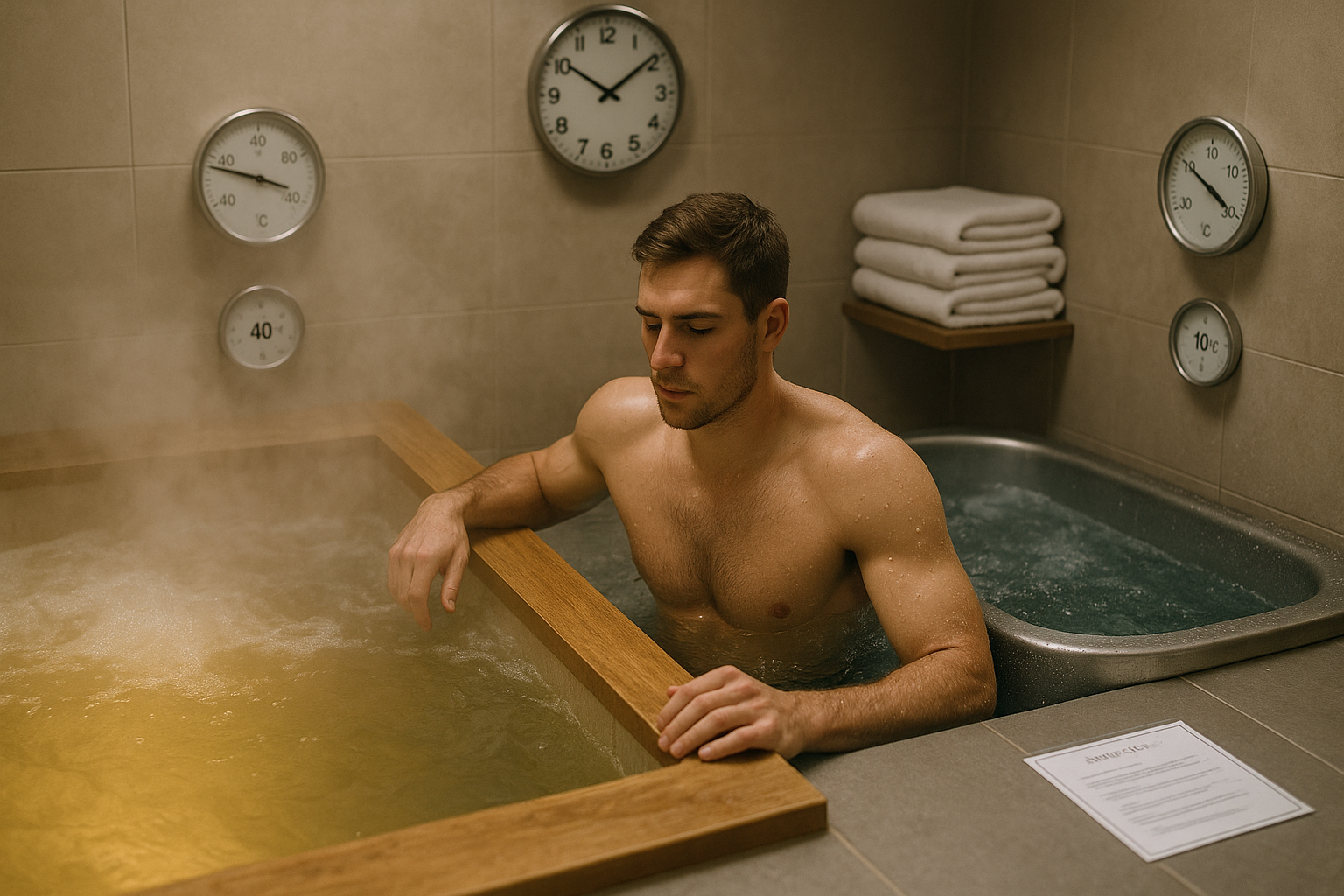
Contrast baths and showers alternate warm/hot and cold water exposures to promote circulation, reduce perceived soreness, and support post-exercise recovery. In simple terms, you spend a few minutes warm (about 38–40°C / 100–104°F), then a short burst cold (about 10–15°C / 50–59°F), and repeat for several cycles. Evidence suggests contrast water therapy can modestly reduce delayed onset muscle soreness (DOMS) compared with passive rest, though effects vary by goal and protocol. As this involves temperature stress, it’s not for everyone; check contraindications below and talk to a clinician if you have cardiovascular, circulatory, or sensory issues.
Quick-start snapshot: For a shower, do 3 minutes hot / 1 minute cold × 3–4 cycles, end cold. For a bath/plunge setup, alternate 3–4 minutes at 38–40°C with 1 minute at 10–15°C for 10–20 minutes total (some limb protocols use an initial 10 minutes warm). Temperatures and ratios appear in research and clinical leaflets cited at the end.
Important: This article is educational and not medical advice. If you have heart disease, uncontrolled hypertension, peripheral vascular disease, neuropathy, Raynaud’s, open wounds, are pregnant, or have any condition affecting temperature sensation or circulation, seek medical guidance first.
1. Decide if Contrast Therapy Matches Your Goal
If your main goal is to feel less sore after moderate training or competition, contrast water therapy (CWT) can help modestly compared with doing nothing. Systematic reviews and meta-analyses report small but meaningful reductions in perceived soreness, with mixed effects on biomarkers and performance. If your primary goal is muscle hypertrophy, regular post-lift cold exposure can blunt anabolic signaling; a contrast routine that features significant cold immediately after heavy resistance training may work against long-term size gains. Start by aligning the method to your intent.
1.1 Why it matters
- DOMS relief: Meta-analyses indicate CWT reduces DOMS versus passive recovery, though differences versus other methods (e.g., massage, compression) are often small.
- Strength & size tradeoffs: Cold water immersion (CWI) right after lifting can attenuate hypertrophy-related signaling and long-term muscle growth; contrast routines heavy on cold could carry similar risks if used chronically post-lift.
- Event periodization: Short-term soreness relief may be valuable during congested competition schedules even if you also pursue hypertrophy elsewhere in the season.
1.2 Guardrails
- Prefer contrast later in the day or after skill/conditioning sessions; avoid immediately post heavy lifting if size is a priority.
- If hypertrophy is the goal, save strong cold exposures for off days or at least 6–8 hours after lifting.
- Track your response (soreness, session RPE, sleep) for 2–3 weeks and adjust.
Mini-checklist: Goal = soreness relief for moderate training? → Yes, proceed. Goal = hypertrophy? → Avoid right after lifting; consider on rest days or far from resistance sessions.
2. Choose the Right Modality: Shower, Limb Baths, or Whole-Body
Use the tool that fits your logistics and needs. Contrast showers are easiest at home and fine for general recovery. Limb contrast baths (e.g., hands/wrists, ankles) can help swelling and stiffness with simple buckets or basins. Whole-body hot/cold (sauna or hot tub plus cold plunge/bath) gives the largest thermal gradient but demands more safety oversight. Clinical protocols for hands often differ from athlete protocols—some hand therapy leaflets recommend ending warm to avoid vasoconstriction, whereas many sports routines end cold.
2.1 How to decide
- Shower: Best for convenience, travel, and quick cycles; typical ratio 3 min hot / 1 min cold × 3–4.
- Limb baths: Good for hand/wrist edema after injury/surgery per specialist guidance; temperatures may be more conservative (e.g., warm ≤37°C; cold ≥22°C in some NHS leaflets).
- Whole-body: Use research ranges (hot ~38–40°C; cold ~8–15°C) with careful monitoring.
2.2 Tools & setup
- Two basins or tubs; pool thermometers; timer/clock; towels and warm clothing for after cold exposures; non-slip mats; and hydration within reach.
- In warm climates where tap “cold” is ~25–30°C, add ice to reach 10–15°C for the cold phase.
Synthesis: Pick the simplest option you’ll actually use—shower for adherence, targeted limb baths for edema, or full immersion when you can control temperatures safely.
3. Nail the Temperatures and Ratios (Without Guesswork)
For the hot phase, most protocols cluster around 38–40°C (100–104°F); for the cold phase, 8–15°C (46–59°F) is typical in sports studies (many home routines use ~10–15°C). Ratios commonly used are 3–4 minutes hot : 1 minute cold, repeated 3–4 times, for 10–20 minutes total. Some clinical limb protocols begin with 10 minutes warm, then alternate.
3.1 Numbers & guardrails
- Hot: 38–40°C (100–104°F). For hand leaflets, “warm” may be ≤37°C (98.6°F).
- Cold: 10–15°C (50–59°F) for general; some performance studies report 8–10°C.
- Ratio: 3–4:1 hot:cold; total session 10–20 min. Limb rehab protocols may last up to 30 min.
- End phase: Athletes often end cold; some hand edema protocols end warm to preserve circulation.
3.2 Practical tips
- Use thermometers—don’t guess.
- If cold is intolerable, start at 14–15°C and progress.
- If hot stings, back off to 37–38°C.
Synthesis: Precision beats bravado. Staying within these temperature bands reduces risk and improves consistency.
4. Time It Right Around Training and Sleep
When you apply contrast influences outcomes. For light to moderate sessions, using contrast within 30–60 minutes can reduce perceived soreness. For heavy resistance training, avoid strong cold exposure for several hours (or skip that day) to protect anabolic signaling. Evening contrast—especially finishing warm in a shower—may relax you before bed; finishing cold can be alerting.
4.1 Scenarios
- Hypertrophy days: Skip post-lift cold; if desired, use a warm-only soak or very gentle contrast far from training.
- Tournament/2-a-day: Use standard contrast to stay fresher across events.
- Pre-sleep: Prefer shower contrast with a warm finish if sleep is the goal.
4.2 Mini case
- A lifter notices slower size gains during a month of nightly cold plunges post-lift. Shifting cold to rest days preserves the mood/alertness benefits while removing the growth penalty observed in research on post-exercise cold exposure.
Synthesis: Contrast helps with short-term freshness; separate strong cold from heavy lifting to protect long-term gains.
5. Master the Contrast Shower (The Easiest At-Home Option)
A contrast shower is accessible, fast, and safer than full plunges. The baseline routine is 3 minutes hot, 1 minute cold, repeated 3–4 cycles (total 12–16 minutes), ending cold if you want an alert finish. If you’re using it to wind down, consider a warm finish. In most homes, “cold” means the coldest the tap allows; if you want closer to research ranges, run a few minutes to purge warm line water and angle spray to torso/limbs first.
5.1 How to do it
- Set a timer for 4-minute blocks.
- Hot: 3 minutes (comfortably hot, not scalding).
- Cold: 1 minute (as cold as the tap allows).
- Repeat 3–4 cycles.
- Option: Finish warm if using for sleep; cold if you want alertness.
5.2 Pro tips
- Keep your head out of cold initially to avoid an exaggerated gasp reflex.
- Breathe slow and steady; exhale through cold switches.
- Use a non-slip mat and keep a towel within reach.
Synthesis: This is the most adherence-friendly protocol—no tubs, minimal gear, solid recovery upside.
6. Run a Safe, Effective Whole-Body Protocol (Bath/Plunge + Hot)
Whole-body contrast creates a larger temperature differential and stronger responses. Use hot tub/sauna around 38–40°C (100–104°F) or sauna (per manufacturer) and cold plunge/bath around 10–15°C (50–59°F). A classic pattern is 3–4 minutes hot, 1 minute cold × 3–4, for 10–20 minutes total. Some research protocols start with 10 minutes warm and then alternate.
6.1 Steps (baseline)
- Set up: Thermometers in both waters; timer; warm clothes for after.
- Cycle: 3–4 min hot → 1 min cold; repeat 3–4×.
- Exit: Dry thoroughly; rewarm naturally (light clothes, movement).
- Hydrate before and after.
6.2 Safety & hygiene
- Hot tubs/whirlpools require good sanitation (risk of waterborne illness).
- Avoid breath-holding or hyperventilation under cold water.
- If you feel dizzy, numb, or chest discomfort, stop immediately.
Synthesis: Whole-body contrast is powerful—treat it with respect, measure temperatures, and keep it short.
7. Use Limb Contrast Baths for Hands/Wrists and Ankles (Edema & Stiffness)
For hand/wrist edema or stiffness after injury or minor surgery (per clinician advice), use two basins. Clinical leaflets often specify conservative temperatures for hands (e.g., warm no hotter than 37°C / 98.6°F, cold no cooler than ~22°C / 72°F), plus gentle movements in water. Many rehab leaflets advise begin warm and end warm to avoid lingering vasoconstriction in small vessels.
7.1 Example hand routine (per NHS-style guidance)
- Warm: 5–10 minutes (≤37°C), gently open/close fist 10 times.
- Cold: ~1 minute (≥22°C), repeat opening/closing.
- Alternate warm/cold 3–5 cycles; end warm.
- Frequency: 1–2× daily as advised.
7.2 When to prefer limb baths
- Local swelling; stiffness after immobilization; post-op per therapist; when full-body contrast is impractical.
Synthesis: For extremities, follow your therapist’s leaflet on temps and ending phase; smaller vessels may do better finishing warm.
8. Progress the Dose Without Overdoing It
You don’t need extreme temperatures to gain benefits. Tolerable, repeatable exposures work best. Increase cold intensity or cycle count gradually across weeks, not days, and keep total sessions 10–20 minutes (limb rehab may run longer under guidance).
8.1 Simple progression model (4–6 weeks)
- Week 1–2: 3× cycles, hot 3 min / cold 45–60 s, moderate temps.
- Week 3–4: 4× cycles, maintain temps; consider one extra cold 15–30 s finisher.
- Week 5–6: Adjust to goals—add a fifth cycle or reduce hot to 2–3 min if time-pressed.
8.2 Red flags to stop
- Numbness that persists, skin color changes that don’t normalize in minutes, dizziness, chest pain, or uncontrolled shivering.
- Any skin breakdown or infection—pause immersion and seek care.
Synthesis: Nudge the dose up slowly; consistency beats intensity.
9. Combine Contrast With Other Low-Risk Recovery Habits
Contrast works best alongside simple fundamentals. Evidence favors sleep, nutrition, and light movement as pillars; massage shows broader benefits for fatigue than CWT alone in some analyses. Use contrast as a complement, not a crutch.
9.1 Practical stack
- After moderate sessions: easy spin or walk 10–20 min → contrast shower.
- Tournament days: nutrition + hydration plan → short contrast → elevate legs.
- Heavy lift days: mobility and protein; skip strong cold right after.
9.2 Tracking
- Keep a recovery log: session type, cycles, temps, next-day soreness (0–10), sleep quality. Adjust based on patterns rather than one-offs.
Synthesis: Put contrast in context—on its own, effects are modest; with basics, benefits add up.
10. Screen for Contraindications and Customize Safely
Not everyone should use temperature extremes. Do not use contrast baths/showers if you have open wounds, active infection, poor circulation, Raynaud’s phenomenon, peripheral vascular disease, cold urticaria/cryoglobulinemia, severe cardiovascular disease, uncontrolled hypertension, or reduced sensation/neuropathy (e.g., in diabetes) without medical clearance. Pregnancy: major bodies advise avoiding hot tubs/saunas due to overheating risks; favor mild warm showers only, and consult your clinician.
10.1 Safety checklist
- Yes: Healthy adults cleared for exercise, minor DOMS, therapist-guided limb edema care.
- Caution: Hypertension on meds, cardiovascular history—seek approval and use gentle temps.
- No: Raynaud’s/PVD, open wounds, sensory loss, cryoglobulinemia, uncontrolled heart disease, pregnancy (avoid heat exposures like hot tubs/saunas).
10.2 Skin & hygiene
- Inspect skin before/after; moisturize after sessions; maintain water hygiene in tubs and avoid communal hot tubs with poor sanitation.
Synthesis: A quick screen prevents most problems; when in doubt, go milder or skip.
11. Adapt for Your Environment (Warm Climates, Small Bathrooms, Travel)
Living somewhere hot or using a small bathroom? You can still create effective contrast by boosting the temperature gap safely. If tap “cold” is warm in summer, add ice to a basin for feet/ankles or use a bucket shower for short cold bursts. For hotels, a shower-only protocol is the simplest option.
11.1 Practical adaptations
- Warm climate: Keep a few ice trays ready; aim for 10–15°C in a small tub or bucket for brief limb immersions.
- No tub: Shower cycles (3:1) with the coldest setting; finish with towel wrap and light movement.
- Gym/club: Check posted hot tub/sauna temps; bring your own thermometer for cold plunge if allowed.
11.2 Mini-checklist
- Target ≥20°C (36°F) difference between hot and cold phases when possible.
- Prioritize safety and traction (mats), and sanitize equipment regularly.
Synthesis: Focus on the differential, not perfection; simple modifications keep you compliant and safe.
12. Troubleshoot, Measure, and Personalize
Response to contrast is individual. Some feel instant relief; others need a couple of weeks. Use structured trials—stick to one protocol for 2–3 weeks, then adjust one variable (cycle count, end phase, or cold temp).
12.1 Common issues & fixes
- Cold intolerable → Start at 14–15°C; shorten to 30–45 s; keep head warm; add breath control.
- No benefit → Add one cycle; ensure accurate temperatures; stack with light active recovery.
- Sleep disrupted → Finish warm at night; move contrast earlier.
- Skin irritation → Reduce hot temp; moisturize; limit chlorine/hot tub time.
12.2 Simple metrics
- Next-day DOMS (0–10), session RPE, and sleep rating.
- Weekly trend beats single sessions; if no improvement after 3 weeks, change approach.
Synthesis: Treat contrast like training—test, learn, and iterate toward what works for your body and schedule.
FAQs
1) Do contrast baths and showers really work for soreness?
Yes—compared with passive rest, contrast water therapy shows small but real reductions in DOMS in meta-analyses. It’s not a magic bullet and may not outperform massage for fatigue, but it can be a practical add-on when done consistently within standard temperature and timing ranges.
2) Is ending cold mandatory?
Not always. Many sports recovery protocols end cold for an alert finish and possible anti-inflammatory effect. However, hand/wrist edema protocols often end warm to prevent prolonged vasoconstriction in small vessels. Choose according to your goal: alertness/“freshness” → cold; distal circulation/edema → warm.
3) What’s the ideal temperature difference?
Aim for hot ~38–40°C and cold ~10–15°C for general recovery. The bigger the safe temperature gap, the more pronounced the vasoconstriction/dilation cycling. For limb rehab, guidelines may use milder ranges (e.g., warm ≤37°C; cold ≥22°C) to protect tissues.
4) How many cycles and how long should a session be?
A practical target is 3–4 cycles of 3–4 minutes hot and 1 minute cold for 10–20 minutes total. Limb protocols in clinic may run up to 30 minutes and sometimes include an initial 10 minutes warm.
5) Can contrast therapy hurt my strength or size gains?
Using strong cold exposure right after heavy lifting can blunt cellular signaling related to hypertrophy and reduce long-term muscle growth in studies. If building size is your priority, avoid strong cold post-lift; use contrast on rest days or many hours later.
6) Is a contrast shower effective, or do I need tubs?
Contrast showers are effective and far easier to implement. Research uses immersions for control and consistency, but shower-based 3:1 cycles still leverage temperature contrast and are often sufficient for perceived recovery.
7) Who should not use contrast baths/showers?
Avoid if you have open wounds, active skin infection, Raynaud’s phenomenon, peripheral vascular disease, cryoglobulinemia, cold urticaria, uncontrolled hypertension, serious heart disease, or reduced sensation/neuropathy—unless cleared by a clinician. Pregnancy: avoid hot tubs/saunas due to overheating risk.
8) Can contrast therapy help ankle or wrist swelling?
It can help stimulate circulation and is commonly used in hand/wrist rehab with gentle movement in water. Follow conservative temperatures and often end warm. Always defer to your therapist’s post-injury or post-op instructions.
9) How often should I do it?
For general recovery, 3–5 times per week is typical during heavy blocks; daily short showers are fine. For limb rehab, frequency (often 1–2× daily) depends on your provider’s plan.
10) What about hygiene and hot tub safety?
Public hot tubs and whirlpools can transmit waterborne germs if poorly maintained. If you use one, ensure proper disinfection and follow posted guidance. At home, clean basins/tubs regularly.
11) Does contrast therapy improve performance the next day?
Evidence is mixed. You may feel fresher (lower soreness/fatigue), but performance effects vary by sport and study. Use it for comfort and readiness, not as a guaranteed performance enhancer.
12) Can I combine contrast with sauna or breathing techniques?
You can alternate sauna → cold using similar time ratios. Keep sessions short, hydrate well, avoid breath-holding, and monitor how you feel. If dizzy or unwell, stop.
Conclusion
Contrast baths and showers create a simple, repeatable cycle of heat and cold that can reduce perceived soreness and help you feel ready for your next session. The strongest results come from measured temperatures (hot ~38–40°C, cold ~10–15°C), manageable ratios (3–4 minutes hot, 1 minute cold), and consistent routines (3–4 cycles, 10–20 minutes total). Align the tool with your priority: use it near moderate sessions or competition windows to stay fresh, and avoid strong cold immediately after heavy lifting if hypertrophy matters. Screen for contraindications, adapt for your environment, and treat contrast like training—test, track, and tweak.
Ready to try? Start with 3× shower cycles of 3 minutes hot / 1 minute cold tonight, log your soreness and sleep tomorrow, and adjust from there.
References
- Contrast Water Therapy and Exercise Induced Muscle Damage: A Systematic Review and Meta-Analysis, PLOS ONE, 2013. https://journals.plos.org/plosone/article
- A Systematic Review With Meta-Analysis: Effect of Recovery Techniques on DOMS and Fatigue, Dupuy et al., Frontiers in Physiology, 2018. https://www.frontiersin.org/journals/physiology/articles/10.3389/fphys.2018.00403/full
- The Effects of Hydrotherapy and Cryotherapy on Recovery from Exercise: A Network Meta-Analysis, Chen et al., BMC Musculoskeletal Disorders, 2024. https://bmcmusculoskeletdisord.biomedcentral.com/articles/10.1186/s12891-024-07315-2
- Contrast Baths, Intramuscular Hemodynamics, and Oxygenation, Shadgan et al., Journal of Athletic Training, 2018. https://pmc.ncbi.nlm.nih.gov/articles/PMC6188085/
- Cold-Water Immersion (Cryotherapy) for Preventing and Treating Muscle Soreness After Exercise, Bleakley et al., Cochrane Review, 2012. https://pmc.ncbi.nlm.nih.gov/articles/PMC6492480/
- Contrast Bath, Ohio State University Wexner Medical Center (resource page), accessed Aug 2025. https://hpc.osu.edu/resources/contrast-bath
- Contrast Bathing for the Hand and Wrist (Patient Information), Cambridge University Hospitals NHS Foundation Trust, accessed Aug 2025. https://www.cuh.nhs.uk/patient-information/contrast-bathing-for-the-hand-and-wrist/
- Oedema Management: Contrast Bathing (Patient Leaflet), St George’s University Hospitals NHS Foundation Trust, May 2025. https://www.stgeorges.nhs.uk/wp-content/uploads/2025/05/HAN_OMCB.pdf
- 6 Cold Shower Benefits to Consider (includes contrast shower tips), UCLA Health, Jan 2023. https://www.uclahealth.org/news/article/6-cold-shower-benefits-consider
- Can I Use a Sauna or Hot Tub Early in Pregnancy?, American College of Obstetricians and Gynecologists, accessed Aug 2025. https://www.acog.org/womens-health/experts-and-stories/ask-acog/can-i-use-a-sauna-or-hot-tub-early-in-pregnancy
- What You Can Do to Stay Healthy in Hot Tubs, Centers for Disease Control and Prevention, May 2025. https://www.cdc.gov/healthy-swimming/safety/what-you-can-do-to-stay-healthy-in-hot-tubs.html
- Post-exercise Cold Water Immersion Attenuates Acute Anabolic Signalling and Long-Term Adaptations in Muscle to Strength Training, Roberts et al., The Journal of Physiology, 2015. https://pmc.ncbi.nlm.nih.gov/articles/PMC4594298/