



























Life rarely sticks to a neat training plan. Work runs late, kids get sick, travel pops up, energy dips—and rigid programs snap under that pressure. Flexible fitness goals solve this by giving you clear priorities plus multiple ways to win each week. In this guide, you’ll learn seven evidence-informed principles that keep you progressing even when life gets messy. The approach is practical, compassionate, and data-aware—useful for beginners through busy professionals. Brief note: this article is educational and not a substitute for personalized medical advice; consult a qualified professional if you have health conditions or concerns.
Quick definition: Flexible fitness goals are objectives designed to bend without breaking: they specify outcomes and guardrails while allowing alternate routes (shorter sessions, swaps, intensity adjustments) to meet the week’s realities.
Fast-start steps:
- Pick one primary outcome (e.g., “3 days of cardio + 2 strength sessions”).
- Set a “floor” you can always hit (e.g., 10 minutes).
- Pre-plan 2–3 swaps (home vs. gym, outdoors vs. indoors).
- Use a simple effort guide (RPE) to adjust intensity.
- Track a few leading indicators (minutes, steps, sleep), not just the scale.
1. Define Floors, Ceilings, and Non-Negotiables So Your Plan Can Bend Without Breaking
Flexible goals start by making success multi-sized: a minimum you can always do, a typical target, and a stretch you’ll hit on good weeks. This structure prevents the all-or-nothing trap that stalls progress when a day goes sideways. A floor (e.g., 10–15 minutes) keeps your streak alive and preserves habit strength; a ceiling (e.g., 45–60 minutes) stops you from overreaching when time opens up and you’re tempted to do too much. Add 1–2 non-negotiables that matter most (like two full-body strength sessions or 150+ minutes of moderate activity across the week), and you’ve built a plan that lives in the real world. With floors and ceilings, “busy” becomes a parameter, not a roadblock, because you have pre-set dials to turn up or down without scrapping the plan.
1.1 Why it matters
- Protects adherence: Tiny wins maintain momentum and identity (“I’m someone who trains”), which predicts longer-term success.
- Prevents boom-bust cycles: Ceilings keep enthusiasm from turning into overuse or fatigue that derails the next week.
- Reduces decision fatigue: You already know the “small,” “standard,” and “stretch” options.
- Matches guidelines: A flexible structure still supports evidence-based targets for weekly activity and resistance training.
1.2 Numbers & guardrails
- Cardio time: Floor 10–15 min/day; standard ~30 min; stretch 45–60 min.
- Strength frequency: Minimum 2 nonconsecutive days/week; standard 2–3; stretch 3–4.
- Weekly activity: Aim to accumulate ~150–300 minutes moderate intensity or ~75–150 minutes vigorous intensity.
- Recovery: At least 1–2 easier days/week.
Mini-checklist
- Decide your floor (shortest session you can do even on travel days).
- Decide your standard (the plan you’ll hit most weeks).
- Decide your ceiling (upper bound to avoid overdoing it).
- Pick 1–2 non-negotiables (e.g., two full-body lifts).
Close with synthesis: By defining floors, ceilings, and non-negotiables, you replace rigid “perfect or nothing” plans with a resilient structure that keeps you consistent through busy, normal, and great weeks.
2. Use Implementation Intentions and Scheduling Windows to Pre-Solve Real-Life Obstacles
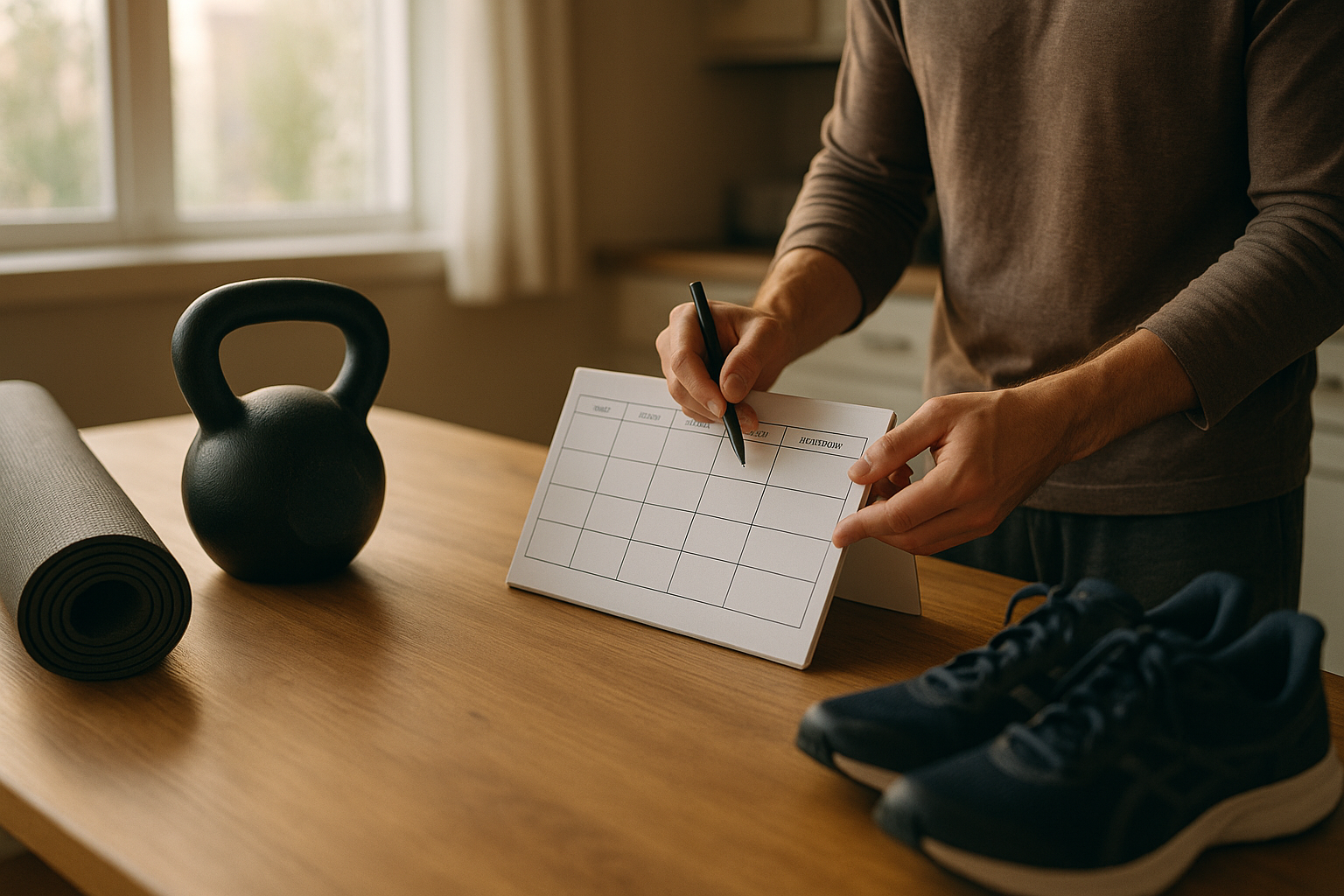
Flexible goals work best when you decide in advance how you’ll adapt. Implementation intentions—“If X happens, then I will do Y”—turn vague intentions into automatic responses, reducing friction when schedules change. Pair them with scheduling windows rather than single, brittle appointment times. Instead of “Run at 6:00 a.m.,” you might set “Run before 9:00 a.m., or do a 20-minute indoor circuit at lunch if morning gets crowded.” This two-layer approach makes your calendar forgiving, your decision-making faster, and your adherence higher under stress. It also improves family/work coordination because the plan communicates options, not ultimatums.
2.1 How to do it
- Write 3–5 “if-then” rules: “If it rains, I will do a bike or rower session.” “If I miss the gym window, I will do a 25-minute dumbbell circuit at home.”
- Use windows, not pins: Block 2–3 possible time slots (e.g., early a.m., lunch, early evening).
- Batch prep: Keep a go-bag (shoes, shorts, bands) in the car/office; store a kettlebell at home.
- Pre-decide travel options: Hotel-room circuit, stair sprints, resistance bands, or walking meetings.
- Communicate rules: Share windows and substitutes with partners, roommates, or teammates to reduce conflicts.
2.2 Numeric example
Week plan: Mon/Wed/Fri strength in a 6–9 a.m. window; if missed, 7–8 p.m. home workout. Tue/Thu cardio in a lunch window; if meetings spill, do 20 minutes after dinner. Sat optional long hike; Sun recovery walk and mobility (15 minutes minimum).
Synthesis: Implementation intentions plus windows eliminate “I’ll do it later” guesswork, ensuring your plan adapts to realities while keeping the week’s priorities intact.
3. Autoregulate Intensity with RPE/RIR to Match Stress, Sleep, and Time
The most flexible plans self-adjust in real time using effort scales like RPE (Rating of Perceived Exertion) and RIR (Reps in Reserve). You start with a target (e.g., “moderate cardio” or “3 sets of 8 squats”), then tune intensity based on how you feel that day. On limited sleep or after hard meetings, you might hold RPE 12–13 (moderate) and use lighter loads; on high-energy days, you can safely nudge intensity up. Autoregulation respects the fact that your body is not a robot and that stress, heat, and recovery quality meaningfully affect performance. It also improves safety by avoiding forced maximal efforts on “bad” days while allowing progress on “good” ones.
3.1 Numbers & guardrails
- Cardio: Moderate = RPE 12–13 on the 6–20 scale (you can talk but not sing); vigorous = RPE 14–17 (talking is difficult).
- Strength (RIR): Leave 1–3 reps in reserve on most working sets; push closer to 0 RIR only on select sets when recovered.
- Progression: Increase weight, reps, or time when the same RPE/RIR feels easier for two sessions in a row.
- Heat/altitude: Drop intensity by 5–20% and/or shorten intervals; re-assess after acclimation.
3.2 Tools/Examples
- Timers & trackers: Basic stopwatch, heart-rate monitor, or a simple log noting RPE/RIR after each set.
- Example adjustment: Planned 4×8 squats @ RIR 2 with 60 kg. Today you feel flat at set 1. You use 55 kg and still hit RIR 2—goal met at an adjusted load.
- Cardio swap: Planned 30-minute tempo run @ RPE 15. Stressed day? Do 25 minutes at RPE 13 or 5×3-minute intervals @ RPE 14 with easy jog recoveries.
Synthesis: By regulating intensity to perceived effort and reserve reps, you keep training quality high across variable life stress—progress without burnout.
4. Build Modular, Swappable Workouts So You Can Train Anywhere
Modular programming breaks sessions into movement families and swappable blocks so you can train effectively with whatever time and tools you have. Instead of a rigid machine-specific plan, you keep a menu for each pattern (squat, hinge, push, pull, carry, core), plus cardio options across environments (outdoor, gym, hotel room). Ten minutes? Do an “express block.” Thirty? Stack two blocks. Forty-five? Run the full session. This structure preserves progressive overload while giving you immediate alternatives when equipment is taken, weather shifts, or travel happens. It also reduces missed sessions because you always have a good-enough Plan B.
4.1 Template library (save these)
- Squat: Goblet squat → front squat → back squat → split squat (DB).
- Hinge: Hip hinge drill → RDL (DB/BB) → trap-bar deadlift → hip thrust.
- Push: Incline push-up → push-up → DB bench → barbell bench.
- Pull: Band row → 1-arm DB row → cable row → pull-up.
- Carry: Suitcase carry → farmer carry → front-rack carry.
- Core: Plank → side plank → dead bug → pallof press.
- Cardio: Brisk walk → jog → bike/rower → intervals.
4.2 Session blocks
- Express (10–15 min): Warm up (2 min), pick one strength pattern (4×6–8 @ RIR 2), finish with 3 min brisk walk or easy jog.
- Standard (25–35 min): Warm up (5 min), pick two patterns (3–4 sets each), optional 6–8 minutes of intervals (e.g., 6×30 sec hard / 60 sec easy).
- Full (45–60 min): Warm up (8–10 min), three patterns (3–5 sets), cardio finisher (8–12 min).
Mini-checklist
- Maintain a pattern menu and block lengths.
- Pre-plan no-equipment and minimal-equipment swaps.
- Log what you did so you can progress the same pattern next time.
Synthesis: Modular, swappable blocks ensure you can always press “play” on a high-quality session—at home, in a gym, or on the road—sustaining progress through chaotic weeks.
5. Plan Deloads and Recovery Triggers So Flexibility Includes Rest
Flexible fitness isn’t only about fitting more work in; it’s about knowing when to do less. Planned deloads and clear recovery triggers prevent the slow creep of fatigue that wrecks consistency. A deload is a lighter week (reduced volume and/or intensity) that lets adaptations consolidate and joints calm down—especially helpful after 4–8 weeks of progressive training or following heavy travel or illness. Triggers like three poor-sleep nights in a row, unusual soreness beyond 48–72 hours, or falling performance signal that dialing back is the flexible—but smart—move. This approach treats recovery as a training variable, not an afterthought.
5.1 Trigger-based rules
- Sleep flag: <6 hours for 3 consecutive nights → reduce the next 2–3 sessions by 30–50% volume.
- Pain flag: Sharp or worsening joint pain → stop the offending movement and replace with a pain-free variant; seek professional advice if it persists.
- Travel flag: >3 time zones crossed or multi-day flights → 1 easy week (shorter sessions, lower RPE).
- Illness flag: Fever or chest symptoms → skip training; resume with a graded return once fully recovered and cleared if needed.
5.2 How to deload (simple)
- Duration: 5–7 days.
- Strength: Keep movement patterns; cut sets by 30–50% and stop 2–3 reps earlier than usual (higher RIR).
- Cardio: Drop interval count by 30–50% or cruise at RPE 11–12 for steady sessions.
- Lifestyle: Emphasize sleep, nutrition, hydration, and easy walking.
Synthesis: By building rest into the plan and responding to recovery triggers, you protect consistency and make progress steadier over months—not just days.
6. Track Leading Indicators (Minutes, Steps, Sessions) to Drive Sustainable Progress
Scale weight and PRs are lagging indicators; useful, but slow to reflect your effort. Flexible goals thrive on leading indicators you can influence today: active minutes, step counts, completed sessions, and simple recovery metrics. These measures tell you whether your flexible adaptations (shorter sessions, swaps, intensity changes) still add up to a training dose that maintains or advances fitness. They also give you easy weekly dashboards so you can course-correct before a slump becomes a slide.
6.1 Practical KPIs
- Weekly minutes: Accumulate ~150–300 minutes of moderate activity (or 75–150 vigorous), including brisk walking and cycling.
- Sessions completed: Aim for 4–6 total sessions across cardio/strength/mobility, with at least 2 strength days.
- Steps: Many adults see meaningful health benefits at ~6,000–8,000 steps/day (older adults) or ~8,000–10,000+ (younger, if time allows).
- Recovery cues: 7–9 hours sleep, energy ratings (1–5 scale), soreness <48 hours, consistent mood.
6.2 Tools & review cadence
- Trackers: Phone pedometer, analog tally, or wearable.
- Logging: Use a notes app or spreadsheet with columns for minutes, sessions, steps, and RPE.
- Weekly review (10 minutes): Check totals, mark obstacles, adjust next week’s floors/ceilings.
- Monthly pulse: Re-test a simple benchmark (e.g., 1-mile easy run time at same RPE; 10-rep squat load at RIR 2).
Synthesis: When you monitor leading indicators, you can keep your weekly dose on target—even as the shape of sessions changes—so progress continues without perfection.
7. Apply Self-Compassion and a 24-Hour Restart Protocol to Beat All-or-Nothing Thinking
Flexible goals are anchored in self-compassion—treating setbacks like a coach, not a critic—plus a clear restart protocol that gets you back on track within 24 hours. Harsh self-talk predicts avoidance and dropout; compassionate, realistic framing supports persistence and problem-solving. A restart protocol turns a missed session into a quick bounce-back: you shrink the next workout to your floor, pick the most approachable pattern, and lower intensity. This preserves your routine, reduces guilt spirals, and keeps you emotionally available to re-engage the plan tomorrow.
7.1 The 24-hour restart (mini-playbook)
- Name it (neutrally): “I missed Tuesday because of a deadline.”
- Pick the floor: 10–15 minutes today—no negotiations.
- Choose easy-win patterns: Walk + push-ups + rows or a mobility flow.
- Lower the bar: RPE 11–12 or RIR 3–4 for strength.
- Reflect once: One sentence on what you’ll change (e.g., use the lunch window tomorrow).
7.2 Why it works
- Protects identity: You’re still “someone who trains,” even on low-capacity days.
- Prevents overcorrection: You don’t punish-make-up with risky volume.
- Builds resilience: Compassion + action tightens the loop between setback and re-engagement.
Synthesis: With a kind mindset and a simple restart protocol, you convert interruptions into brief detours instead of exits—exactly what flexible fitness goals are designed to do.
FAQs
1) What are “flexible fitness goals,” in plain language?
They’re goals that specify what matters (minutes, sessions, key lifts) and set floors/ceilings so you can adapt when life changes. Instead of a single “perfect plan,” you design several acceptable versions (shorter sessions, at-home swaps, easier intensity). This keeps you consistent, which is what actually drives results. The point isn’t to do less; it’s to do something effective every week, regardless of obstacles.
2) How do I make a goal both flexible and measurable?
Define a weekly non-negotiable (e.g., 2 full-body strength sessions), a time goal (e.g., 150–200 minutes of moderate activity), and a floor (e.g., 10 minutes per day). Add 2–3 “if-then” rules for common obstacles and track leading indicators (minutes, steps, sessions). You’ll know you’re succeeding when you hit the weekly totals, not just the exact plan layout.
3) Can this approach still build strength or improve endurance?
Yes. Flexibility doesn’t mean random; it means adjustable. Maintain consistent movement patterns and progression targets, then tune load and volume via RPE/RIR. For endurance, keep at least one quality session (tempo/intervals) on good weeks and swap to steady-easy sessions when life is hectic. Over months, you’ll still accumulate the training needed for adaptations.
4) What if I can only manage 10–15 minutes—does it even count?
Short sessions help maintain habit and can improve fitness, especially if you add intensity when appropriate and stack multiple “micro-bouts” across the day. Ten minutes of brisk walking or a focused strength block preserves momentum and contributes to weekly totals. Think “minimum effective dose for today” rather than “not worth it.”
5) How should I adjust when I’m sick or coming back after illness?
If you have fever, chest symptoms, or doctor’s guidance to rest, pause. When cleared or fully better, use a graded return: start with short, easy sessions (RPE 9–11), then add time before intensity. Expect 1–2 weeks to re-stabilize. Keep your floor tiny (5–10 minutes of mobility/walking) until confidence and energy return.
6) What’s the best way to use RPE/RIR if I’m new to lifting?
Start conservative: finish most sets with 2–3 reps in reserve and focus on technique. If in doubt, stop earlier and add a set rather than forcing reps. Log what you lifted and how it felt. When a weight feels easier at the same reps (same RIR) two sessions in a row, add a small increment next time.
7) How do I handle travel without losing progress?
Set a travel template in advance: carry a mini-band and a jump rope, save a bodyweight circuit on your phone, and define a 10-minute floor for busy days. Walk airports and new neighborhoods to keep steps high; use hotel stairs for intervals. After you return, schedule an easy session first to re-sync sleep and circadian rhythm.
8) I tend to overdo it on good days and then crash—how can flexibility help?
Add ceilings that cap sets, time, or intensity and commit to deloads every 4–8 weeks. Use RPE to avoid turning every workout into a test. Track recovery cues (sleep, soreness, mood) and respond to triggers by trimming volume by 30–50% for a few sessions. Over time, you’ll feel better and make steadier gains.
9) Are step counts a good flexible goal substitute for formal cardio?
They’re a helpful leading indicator—especially on busy weeks. Evidence suggests benefits even from moderate step totals, with higher counts often offering more. Use steps to keep activity up when you can’t do structured cardio, then reintroduce planned sessions when the schedule eases. Aim to mix steps with purposeful workouts across the month.
10) What apps or tools make flexible planning easier?
Any simple combination works: a calendar with time windows, a notes app or spreadsheet for sessions/minutes/steps, and a basic timer. Optional: a wearable for steps/HR. Resist app-hopping; the best tool is the one you’ll actually use. Review weekly in ten minutes, adjust floors/ceilings, and set two fresh “if-then” rules for next week.
Conclusion
Rigid plans shatter under real life; flexible goals bend and keep moving. By setting floors, ceilings, and non-negotiables, you ensure there’s always a version of the plan you can do. Implementation intentions with scheduling windows remove decision bottlenecks, while RPE/RIR lets you tune intensity to stress and recovery. Modular, swappable workouts keep training doable anywhere, and planned deloads with clear recovery triggers make rest a strategic ally. Finally, tracking leading indicators and adopting a self-compassionate 24-hour restart protocol protect the consistency that actually delivers results. Start this week by defining your floor (10–15 minutes), naming two non-negotiables, and writing three “if-then” rules. Then review your week, adjust, and repeat. Ready to build goals that bend, not break? Set your floor and schedule your first window today.
References
- WHO Guidelines on Physical Activity and Sedentary Behaviour, World Health Organization, 2020. https://www.who.int/publications/i/item/9789240015128
- Physical Activity Guidelines for Americans, 2nd Edition (Key Guidelines for Adults), U.S. Department of Health and Human Services/health.gov, updated 2018 (periodically reviewed). https://health.gov/our-work/nutrition-physical-activity/physical-activity-guidelines/current-guidelines
- ACSM’s Guidelines for Exercise Testing and Prescription (11th ed.), American College of Sports Medicine, 2021. https://www.acsm.org/education-resources/books/exercise-testing-and-prescription
- Paluch, A.E., et al., Daily Steps and All-Cause Mortality: A Meta-analysis, JAMA Internal Medicine, 2022. https://jamanetwork.com/journals/jamainternalmedicine/fullarticle/2796133
- Banach, M., et al., Association of Daily Step Counts With All-Cause Mortality, European Journal of Preventive Cardiology, 2023. https://academic.oup.com/eurjpc/article/30/15/1701/7241340
- Borg, G., Borg’s Perceived Exertion and Pain Scales, Human Kinetics, 1998. https://us.humankinetics.com/products/borgs-perceived-exertion-and-pain-scales
- Gollwitzer, P.M., Implementation Intentions: Strong Effects of Simple Plans, American Psychologist, 1999. https://psycnet.apa.org/record/1999-10192-006
- Lally, P., et al., How Are Habits Formed: Modelling Habit Formation in the Real World, European Journal of Social Psychology, 2010. https://onlinelibrary.wiley.com/doi/10.1002/ejsp.674
- How Much Sleep Do I Need?, Centers for Disease Control and Prevention, reviewed 2024. https://www.cdc.gov/sleep/about_sleep/how_much_sleep.html
- Exercise Intensity: Using the Talk Test and RPE, American College of Sports Medicine, accessed 2025. https://www.acsm.org/blog-detail/acsm-certified-blog/2017/11/27/exercise-intensity-using-the-talk-test-and-rpe